
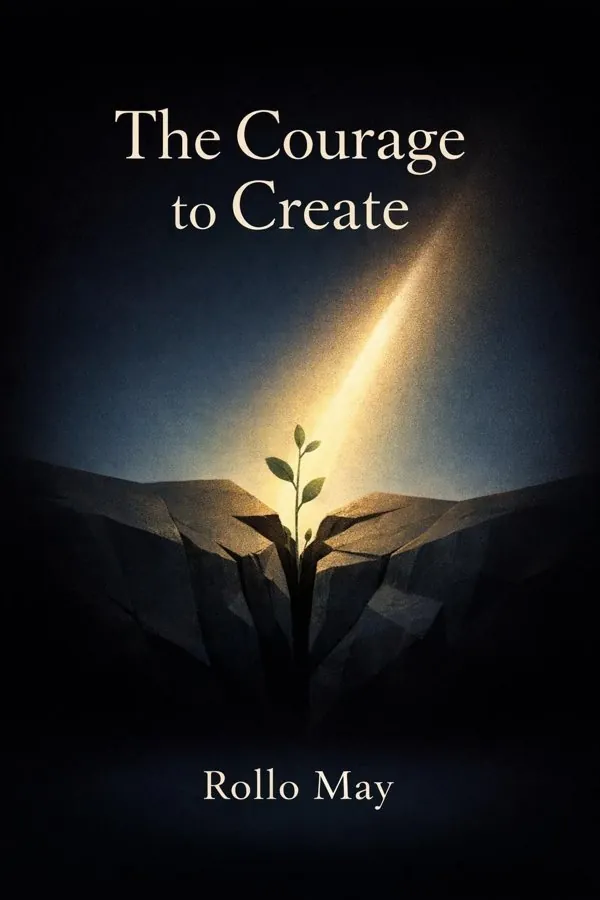
The Courage to Create: Summary & Key Insights
by Rollo May
 10 min8 chaptersAudio available
What Is The Courage to Create About?
The Courage to Create by Rollo May is a psychology book spanning 8 pages. In this influential work, existential psychologist Rollo May explores the nature of creativity and the courage required to bring new ideas into being. He argues that creativity is not limited to artists but is a fundamental expression of human existence, requiring individuals to confront anxiety, uncertainty, and the fear of rejection. Through philosophical reflection and psychological insight, May examines how creative acts emerge from the tension between freedom and limitation, and how they serve as a vital force for personal and cultural renewal.
This FizzRead summary covers all 8 key chapters of The Courage to Create in approximately 10 minutes, distilling the most important ideas, arguments, and takeaways from Rollo May's work. Also available as an audio summary and Key Quotes Podcast.
The Courage to Create
In this influential work, existential psychologist Rollo May explores the nature of creativity and the courage required to bring new ideas into being. He argues that creativity is not limited to artists but is a fundamental expression of human existence, requiring individuals to confront anxiety, uncertainty, and the fear of rejection. Through philosophical reflection and psychological insight, May examines how creative acts emerge from the tension between freedom and limitation, and how they serve as a vital force for personal and cultural renewal.
Who Should Read The Courage to Create?
This book is perfect for anyone interested in psychology and looking to gain actionable insights in a short read. Whether you're a student, professional, or lifelong learner, the key ideas from The Courage to Create by Rollo May will help you think differently.
- ✓Readers who enjoy psychology and want practical takeaways
- ✓Professionals looking to apply new ideas to their work and life
- ✓Anyone who wants the core insights of The Courage to Create in just 10 minutes
Want the full summary?
Get instant access to this book summary and 100K+ more with Fizz Moment.
Get Free SummaryAvailable on App Store • Free to download
Key Chapters
Creativity begins in the mysterious interplay between the conscious and the unconscious. Too often, we think of creativity as either the domain of rational planning or as the result of sudden inspiration. In truth, it arises from the dynamic interaction of both. The unconscious brings forth images, possibilities, and intuitions, while the conscious mind organizes, evaluates, and shapes them into coherent form.
In this sense, creativity is not simply a product but a process—a dialectic between chaos and order. The artist, the scientist, and the philosopher all work within this tension. In my own psychological practice, I have observed that individuals become most creative when they can tolerate ambiguity, when they can allow the unconscious to speak without fear, and yet retain enough awareness to refine and give structure to what emerges.
To create is also to encounter one’s own depths. The unconscious, as Freud described it, is not merely a repository of repressed impulses; it is also the source of vitality, imagination, and meaning. Creativity uses that raw energy, transforming it into new patterns of thought and expression. The act of integrating these levels of the mind is itself an act of courage, because it requires us to confront inner conflict and reawaken feelings that may have long been buried.
Ultimately, creativity is the means by which we participate in the continual evolution of human consciousness. Through it, we align ourselves with what I have called the formative striving of existence—the impulse to bring forth what has not yet been.
Every act of creativity is, at its heart, an encounter between the self and the world. It is not something that occurs solely within the mind. To create is to engage fully with the materials, problems, and relationships around us. The painter confronts the blank canvas, the scientist confronts the phenomenon she seeks to understand, and the individual confronts the conditions of his own existence. Out of that encounter emerges something new.
In this encounter, tension plays a central role. Creativity requires both receptivity and assertiveness: receptivity to what the world presents, and assertiveness to shape that material according to one’s vision. The creative person must be willing to dialogue with reality—to listen as well as to respond. When the creator loses either side of this balance, creativity collapses into either sterile imitation or solipsistic fantasy.
This relationship also has an ethical dimension. Through creativity, we affirm our participation in the world; we recognize that our inner life gains meaning only through engagement with others and with the environment. The creative encounter thus becomes a means of discovering not only what the world is but who we are in relation to it. To create is to enter into a conversation with being itself.
+ 6 more chapters — available in the FizzRead app
All Chapters in The Courage to Create
About the Author
Rollo May (1909–1994) was an American existential psychologist and author known for introducing existential psychology to the United States. His works, including 'Love and Will' and 'The Meaning of Anxiety,' explore the human struggle for meaning, creativity, and authenticity in the face of existential challenges.
Get This Summary in Your Preferred Format
Read or listen to the The Courage to Create summary by Rollo May anytime, anywhere. FizzRead offers multiple formats so you can learn on your terms — all free.
Available formats: App · Audio · PDF · EPUB — All included free with FizzRead
Download The Courage to Create PDF and EPUB Summary
Key Quotes from The Courage to Create
“Creativity begins in the mysterious interplay between the conscious and the unconscious.”
“Every act of creativity is, at its heart, an encounter between the self and the world.”
Frequently Asked Questions about The Courage to Create
The Courage to Create by Rollo May is a psychology book that explores key ideas across 8 chapters. In this influential work, existential psychologist Rollo May explores the nature of creativity and the courage required to bring new ideas into being. He argues that creativity is not limited to artists but is a fundamental expression of human existence, requiring individuals to confront anxiety, uncertainty, and the fear of rejection. Through philosophical reflection and psychological insight, May examines how creative acts emerge from the tension between freedom and limitation, and how they serve as a vital force for personal and cultural renewal.
More by Rollo May
You Might Also Like
The Body Keeps the Score
Bessel van der Kolk
10 min
Surrounded by Idiots
Thomas Erikson
10 min
Emotional Intelligence
Daniel Goleman
10 min
Attached
Amir Levine
10 min
Why Does He Do That
Lundy Bancroft
10 min
Women Who Run with the Wolves
Clarissa Pinkola Estés
10 minBrowse by Category
Ready to read The Courage to Create?
Get the full summary and 100K+ more books with Fizz Moment.