
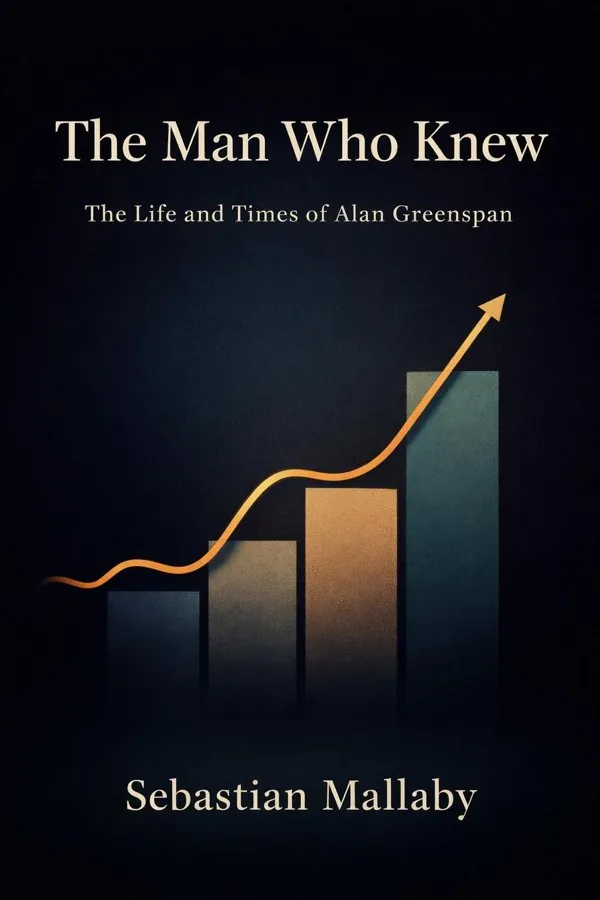
The Man Who Knew: The Life and Times of Alan Greenspan: Summary & Key Insights
 10 min12 chaptersAudio available
What Is The Man Who Knew: The Life and Times of Alan Greenspan About?
The Man Who Knew: The Life and Times of Alan Greenspan by Sebastian Mallaby is a biographies book spanning 12 pages. A comprehensive biography of Alan Greenspan, former chairman of the U.S. Federal Reserve, exploring his intellectual development, economic philosophy, and influence on global financial policy. Drawing on extensive interviews and archival research, Mallaby presents a nuanced portrait of Greenspan’s rise from a young economist to one of the most powerful figures in modern finance, examining both his achievements and the controversies surrounding his tenure.
This FizzRead summary covers all 12 key chapters of The Man Who Knew: The Life and Times of Alan Greenspan in approximately 10 minutes, distilling the most important ideas, arguments, and takeaways from Sebastian Mallaby's work. Also available as an audio summary and Key Quotes Podcast.
The Man Who Knew: The Life and Times of Alan Greenspan
A comprehensive biography of Alan Greenspan, former chairman of the U.S. Federal Reserve, exploring his intellectual development, economic philosophy, and influence on global financial policy. Drawing on extensive interviews and archival research, Mallaby presents a nuanced portrait of Greenspan’s rise from a young economist to one of the most powerful figures in modern finance, examining both his achievements and the controversies surrounding his tenure.
Who Should Read The Man Who Knew: The Life and Times of Alan Greenspan?
This book is perfect for anyone interested in biographies and looking to gain actionable insights in a short read. Whether you're a student, professional, or lifelong learner, the key ideas from The Man Who Knew: The Life and Times of Alan Greenspan by Sebastian Mallaby will help you think differently.
- ✓Readers who enjoy biographies and want practical takeaways
- ✓Professionals looking to apply new ideas to their work and life
- ✓Anyone who wants the core insights of The Man Who Knew: The Life and Times of Alan Greenspan in just 10 minutes
Want the full summary?
Get instant access to this book summary and 100K+ more with Fizz Moment.
Get Free SummaryAvailable on App Store • Free to download
Key Chapters
Alan Greenspan’s journey began in Washington Heights, New York City, during the Depression era—a time when scarcity sharpened intellects and ambition. His mother, Rose, encouraged discipline and study, while his father, Herbert, introduced him to the subtleties of economic reasoning. Young Alan showed a natural aptitude for both numbers and music. His love for the clarinet and jazz revealed not only aesthetic curiosity but an early fascination with patterns and fluidity—the same qualities that later shaped his approach to markets.
At New York University, Greenspan immersed himself in economics with the intensity of someone solving a musical composition. His mentors valued precise measurement and empirical rigor, and he began to combine his quantitative skills with a deep interest in how expectation and sentiment influenced economic dynamics. Columbia University later provided exposure to econometric methods and broader theoretical debates, refining his analytical edge. This early intellectual training cultivated his life-long belief that, behind every apparent disorder, there exists a calculable logic. He pursued that conviction relentlessly, convinced that the movements of prices and productivity followed discernible rhythms—not unlike a symphony composed by invisible hands.
In the 1950s, Greenspan found himself drawn into a circle of thinkers surrounding the novelist-philosopher Ayn Rand. This was the crucible in which his ideological identity was forged. Rand’s doctrine of Objectivism, with its emphasis on rational self-interest and moral defense of capitalism, appealed to Greenspan’s analytical mind. Through long evenings at Rand’s apartment, he debated ethics, economics, and the role of government with a small group of devotees who saw laissez-faire markets as expressions of human freedom.
Rand’s influence was profound but not total. Greenspan admired her capacity for intellectual clarity yet understood the world demanded flexibility. The objectivist ideal of pure rationality met the messy realm of political compromise. As time passed, he translated her moral fervor into pragmatic governance. Still, the philosophical seeds Rand planted never died. His deep-seated trust in markets—the conviction that they are more efficient and moral than bureaucratic interventions—originated here. Yet as later chapters show, his adherence to this creed often collided with the empirical complexity of the global economy.
+ 10 more chapters — available in the FizzRead app
All Chapters in The Man Who Knew: The Life and Times of Alan Greenspan
About the Author
Sebastian Mallaby is a British journalist and author known for his works on economics and finance. A former columnist for The Washington Post and a senior fellow at the Council on Foreign Relations, he has written several acclaimed books analyzing global economic systems and influential financial figures.
Get This Summary in Your Preferred Format
Read or listen to the The Man Who Knew: The Life and Times of Alan Greenspan summary by Sebastian Mallaby anytime, anywhere. FizzRead offers multiple formats so you can learn on your terms — all free.
Available formats: App · Audio · PDF · EPUB — All included free with FizzRead
Download The Man Who Knew: The Life and Times of Alan Greenspan PDF and EPUB Summary
Key Quotes from The Man Who Knew: The Life and Times of Alan Greenspan
“Alan Greenspan’s journey began in Washington Heights, New York City, during the Depression era—a time when scarcity sharpened intellects and ambition.”
“In the 1950s, Greenspan found himself drawn into a circle of thinkers surrounding the novelist-philosopher Ayn Rand.”
Frequently Asked Questions about The Man Who Knew: The Life and Times of Alan Greenspan
The Man Who Knew: The Life and Times of Alan Greenspan by Sebastian Mallaby is a biographies book that explores key ideas across 12 chapters. A comprehensive biography of Alan Greenspan, former chairman of the U.S. Federal Reserve, exploring his intellectual development, economic philosophy, and influence on global financial policy. Drawing on extensive interviews and archival research, Mallaby presents a nuanced portrait of Greenspan’s rise from a young economist to one of the most powerful figures in modern finance, examining both his achievements and the controversies surrounding his tenure.
More by Sebastian Mallaby
You Might Also Like

An American Marriage
Tayari Jones
10 min
Benjamin Franklin: An American Life
Walter Isaacson
10 min
I Know Why The Caged Bird Sings
Maya Angelou
10 min
Long Walk to Freedom
Nelson Mandela
10 min
Persepolis
Marjane Satrapi
10 min
Surely You're Joking, Mr. Feynman!
Richard P. Feynman
10 minBrowse by Category
Ready to read The Man Who Knew: The Life and Times of Alan Greenspan?
Get the full summary and 100K+ more books with Fizz Moment.