
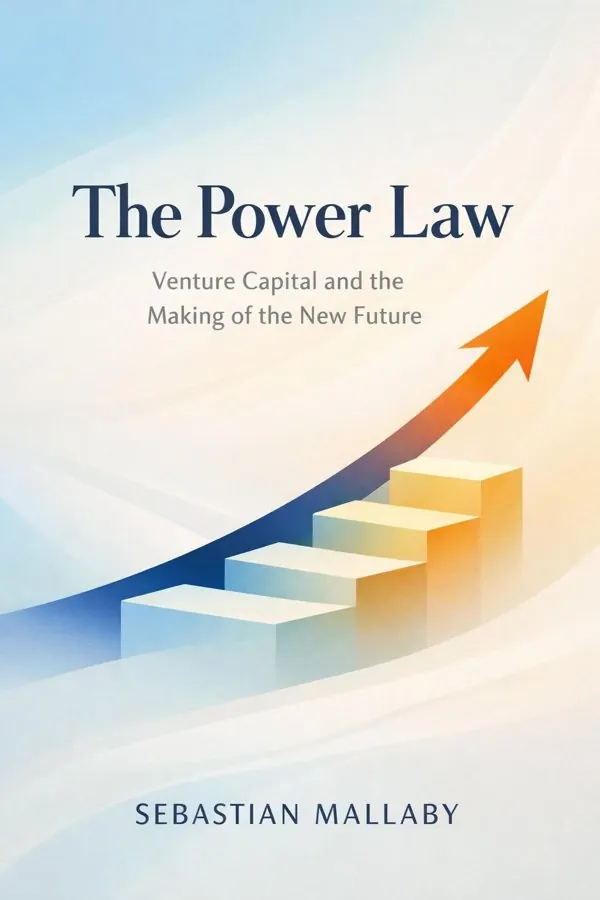
The Power Law: Venture Capital and the Making of the New Future: Summary & Key Insights
 10 min9 chaptersAudio available
Key Takeaways from The Power Law: Venture Capital and the Making of the New Future
Every major financial industry begins with someone willing to look irrational before the world catches up.
Innovation often grows fastest where hierarchy is weakest.
The biggest investing gains rarely come from being slightly more right than everyone else.
Some technological waves create growth.
A portfolio filled with losses can still be a masterpiece if one investment changes the score.
What Is The Power Law: Venture Capital and the Making of the New Future About?
The Power Law: Venture Capital and the Making of the New Future by Sebastian Mallaby is a economics book spanning 8 pages. Why do a tiny number of startups reshape entire industries while thousands of others disappear without a trace? In The Power Law, Sebastian Mallaby answers that question by examining the unusual logic of venture capital, where one spectacular success can outweigh dozens of failures. This is not just a history of investors chasing profit. It is an account of how modern innovation has been funded, accelerated, and sometimes distorted by a financial model built to find extreme outliers. Mallaby traces venture capital from its postwar origins to the rise of Silicon Valley, the internet boom, global expansion, and the moral dilemmas created when private investors gain enormous influence over the future. Along the way, he introduces the bold personalities, controversial decisions, and high-stakes bets that helped produce companies like Intel, Apple, Google, and many others. The book matters because venture capital has become one of the defining forces of the digital economy. It shapes which technologies get built, which founders get support, and which visions of the future become real. Mallaby, an acclaimed journalist and economic historian, brings authority, depth, and narrative skill to a subject that affects business, politics, and everyday life.
This FizzRead summary covers all 9 key chapters of The Power Law: Venture Capital and the Making of the New Future in approximately 10 minutes, distilling the most important ideas, arguments, and takeaways from Sebastian Mallaby's work. Also available as an audio summary and Key Quotes Podcast.
The Power Law: Venture Capital and the Making of the New Future
Why do a tiny number of startups reshape entire industries while thousands of others disappear without a trace? In The Power Law, Sebastian Mallaby answers that question by examining the unusual logic of venture capital, where one spectacular success can outweigh dozens of failures. This is not just a history of investors chasing profit. It is an account of how modern innovation has been funded, accelerated, and sometimes distorted by a financial model built to find extreme outliers.
Mallaby traces venture capital from its postwar origins to the rise of Silicon Valley, the internet boom, global expansion, and the moral dilemmas created when private investors gain enormous influence over the future. Along the way, he introduces the bold personalities, controversial decisions, and high-stakes bets that helped produce companies like Intel, Apple, Google, and many others.
The book matters because venture capital has become one of the defining forces of the digital economy. It shapes which technologies get built, which founders get support, and which visions of the future become real. Mallaby, an acclaimed journalist and economic historian, brings authority, depth, and narrative skill to a subject that affects business, politics, and everyday life.
Who Should Read The Power Law: Venture Capital and the Making of the New Future?
This book is perfect for anyone interested in economics and looking to gain actionable insights in a short read. Whether you're a student, professional, or lifelong learner, the key ideas from The Power Law: Venture Capital and the Making of the New Future by Sebastian Mallaby will help you think differently.
- ✓Readers who enjoy economics and want practical takeaways
- ✓Professionals looking to apply new ideas to their work and life
- ✓Anyone who wants the core insights of The Power Law: Venture Capital and the Making of the New Future in just 10 minutes
Want the full summary?
Get instant access to this book summary and 100K+ more with Fizz Moment.
Get Free SummaryAvailable on App Store • Free to download
Key Chapters
Every major financial industry begins with someone willing to look irrational before the world catches up. For venture capital, that figure was Georges Doriot, the Harvard Business School professor and immigrant entrepreneur who helped create American Research and Development Corporation after World War II. At a time when banks wanted collateral and public markets favored established firms, Doriot argued that young companies built around ideas and talent deserved patient capital.
His approach was revolutionary because it treated innovation as an investable asset. Rather than funding factories with predictable cash flow, he backed founders with technical knowledge and uncertain futures. ARD’s famous investment in Digital Equipment Corporation proved the point. A relatively modest early stake generated extraordinary returns, demonstrating that a single breakthrough company could transform an entire portfolio.
Doriot also contributed more than money. He offered mentorship, strategic pressure, and belief. That combination became a template for the venture capitalist’s role: not passive financier, but active partner in company building. His methods showed that capital works best in uncertain fields when paired with conviction and guidance.
For entrepreneurs, the lesson is that great investors often see possibility before evidence is obvious. For managers and investors, Doriot’s story highlights the importance of backing capability, not just current performance. In uncertain environments, future value rarely looks safe at the beginning.
Actionable takeaway: when evaluating a new idea, ask not only whether it fits existing financial models, but whether it could create an entirely new category if given time, talent, and informed support.
Innovation often grows fastest where hierarchy is weakest. Mallaby shows that while the East Coast helped create venture capital, Silicon Valley turned it into a culture. California’s ecosystem encouraged experimentation, tolerated failure, and rewarded engineers who challenged corporate orthodoxy. The shift was not merely geographic. It reflected a deeper change in how investors thought about talent, ambition, and risk.
In Boston, the early venture model often mirrored traditional finance: polished executives, formal structures, and measured expectations. In California, investors learned that unconventional founders could produce extraordinary outcomes. Engineers left secure jobs, startups spun out of established firms, and informal networks spread knowledge and opportunity. This openness made it easier for ideas, people, and capital to recombine at speed.
The Valley’s culture also normalized a mindset that sounded reckless elsewhere: aim for markets big enough to justify repeated failure. Investors accepted that most bets would not work because one category-defining success could repay everything. This attitude encouraged founders to pursue transformative products rather than incremental improvements.
The practical significance extends beyond technology. Organizations in any sector can borrow from Silicon Valley’s strengths by reducing fear of failure, encouraging cross-functional collaboration, and rewarding initiative over status. The point is not to imitate startup clichés, but to create conditions where unproven ideas can survive long enough to improve.
Actionable takeaway: if you want more breakthrough thinking in your team or business, build an environment where smart people can question assumptions, experiment quickly, and recover from failure without career-ending consequences.
The biggest investing gains rarely come from being slightly more right than everyone else. They come from seeing potential in what most people dismiss as absurd. Mallaby uses firms like Kleiner Perkins and Sequoia Capital to show how elite venture capitalists learned to identify founders and technologies that looked improbable at first but became foundational later.
These firms excelled not because they avoided mistakes, but because they embraced asymmetric thinking. They knew that the best opportunities often looked too early, too technical, too niche, or too ambitious. Backing companies such as Genentech, Apple, Cisco, and later Google required conviction in markets that were not yet obvious and in founders who were often difficult, young, or unconventional.
Their edge came from pattern recognition and judgment. Experienced venture investors asked different questions from traditional financiers. Instead of focusing primarily on current revenue or polished operations, they examined founder intensity, technical differentiation, market expansion potential, and whether a product could become the default choice in a fast-growing category. They also understood timing: a brilliant idea launched too soon can fail, while the same idea backed at the right moment can dominate.
For readers building businesses, this idea is a reminder that important opportunities are often uncomfortable. If everyone already agrees something will succeed, much of the upside is gone. For investors and leaders, it suggests that real edge comes from clear thinking under uncertainty, not consensus.
Actionable takeaway: when assessing a bold opportunity, do not ask only, “What could go wrong?” Also ask, “If this works, how big could it become, and what unique insight makes it plausible now?”
Some technological waves create growth. Others reorder the economy. The internet did both, and venture capital was the financial engine that helped turn scattered digital experiments into global platforms. Mallaby traces how firms backed companies like Netscape, Amazon, Yahoo, PayPal, and Google, often before the broader market understood how online businesses would make money or achieve scale.
The internet era sharpened the logic of the power law. Digital products could spread quickly, scale cheaply, and dominate globally, which meant returns became even more concentrated. A startup no longer had to grow city by city or factory by factory. If it built a superior platform, it could reach millions of users in a short time. That possibility made venture investing more attractive and more intense.
But the period also revealed the importance of informed patience. Plenty of internet companies attracted excitement without durable models. The winners were not merely early; they built defensible advantages through network effects, infrastructure, brand, or superior algorithms. Google, for example, did not win simply because search was promising. It won because its product was significantly better and its model scaled elegantly.
Today, the same lesson applies to fields like artificial intelligence, biotech, climate tech, and fintech. Hype can attract capital, but durable value comes from solving real problems better than alternatives and building mechanisms that compound over time.
Actionable takeaway: in fast-moving sectors, separate surface excitement from deep advantage by asking what makes a product hard to replace, easy to scale, and likely to improve as more users adopt it.
A portfolio filled with losses can still be a masterpiece if one investment changes the score. This is the central mathematics of venture capital, and Mallaby repeatedly shows that misunderstanding it leads to bad judgments. Outsiders often see failed startups and assume investors were careless. But in venture capital, failure is not an exception to the model. It is the cost of pursuing rare, outsized wins.
The dot-com crash made this brutally visible. Many companies collapsed, valuations evaporated, and critics declared the venture model broken. Yet the industry’s best participants adapted rather than retreated. They became more disciplined about business models, customer economics, and timing, while still preserving the willingness to take big bets. In other words, they learned without becoming timid.
This distinction matters. There is a difference between reckless speculation and structured risk-taking. Good venture investors expect losses, but they want intelligent losses: experiments based on meaningful insight, not fantasy. They diversify across ideas, support founders through uncertainty, and remain emotionally prepared for a hit-driven business.
The lesson is useful far beyond finance. In innovation, research, product development, and career growth, demanding certainty before acting usually eliminates the best opportunities. Intelligent systems must be built to absorb failure and keep learning.
Actionable takeaway: redefine failure in your own work. Instead of aiming to avoid all mistakes, create a process where small or contained losses generate information, preserve optionality, and increase the odds of a breakthrough later.
Industries prove their value not during booms, but in what they become after collapse. Mallaby shows that venture capital survived repeated busts because its strongest firms used downturns as periods of selection and reinvention. The crash after the dot-com bubble wiped out weak companies and exposed lazy investing, yet it also clarified what truly mattered: product quality, founder resilience, and sustainable paths to dominance.
In the aftermath, venture capitalists became more rigorous about unit economics, customer retention, and operational discipline. At the same time, they did not abandon ambition. They continued to fund major bets in software, social platforms, semiconductors, and mobile computing. This balance between skepticism and imagination helped set the stage for the next generation of giants.
Mallaby’s larger point is that venture capital is not static. It evolves with technology, market structure, and competition. Firms that once focused narrowly on hardware adapted to software. Investors accustomed to U.S. markets expanded globally. The best players refreshed their networks, sharpened their judgment, and updated their theses without losing the courage to back unconventional founders.
For companies and leaders, this adaptability is the real insight. Strategic resilience does not mean clinging to the same methods through every cycle. It means protecting the core logic of your mission while upgrading how you execute under new conditions.
Actionable takeaway: after any setback, conduct a two-part review: identify what should change in your methods, and separately define what core principle remains worth protecting. Reinvention works best when discipline evolves but ambition survives.
Once an American specialty, venture capital became a global operating system for innovation. Mallaby tracks how the model spread to places like China, India, and other emerging technology ecosystems, where local conditions changed the rules but not the underlying ambition. Entrepreneurs everywhere wanted what venture capital promised: money for rapid growth, strategic guidance, and a chance to build category-defining companies.
Yet the book makes clear that transplanting the model was never simple. Venture capital depends on more than cash. It needs legal protections, talent mobility, deep technical communities, exit opportunities, and a cultural tolerance for experimentation. In China, investors found enormous scale and speed, but also political risk and state influence. In India, the opportunity lay in adapting technology to a vast, complex, price-sensitive market. Different ecosystems produced different founder profiles, different growth patterns, and different vulnerabilities.
This global expansion changed the industry itself. U.S. firms could no longer assume that transformative companies would emerge only from Silicon Valley. Competition for talent, ideas, and ownership intensified. It also changed entrepreneurship, as founders in many countries gained access to a playbook for scaling quickly and thinking globally from the start.
The broader application is clear: successful models rarely copy-paste across contexts. Principles travel, but execution must fit local realities. Whether in investing, business, or policy, imported strategies work only when adapted to incentives, institutions, and user behavior on the ground.
Actionable takeaway: when applying a proven model to a new market, separate universal principles from local assumptions, and redesign the latter before scaling.
Money does not simply finance the future; it influences which futures get built. One of Mallaby’s most important contributions is to show that venture capital is not just an economic mechanism but a system of power. Investors choose founders, set terms, influence strategy, accelerate certain technologies, and indirectly shape social norms. Their decisions affect work, communication, privacy, health, education, and politics.
This influence raises difficult ethical questions. Venture capital celebrates speed, disruption, and scale, but those values can create blind spots. A company that grows explosively may also spread misinformation, weaken labor protections, or concentrate power. Investors often praise founder control because it protects bold vision, yet too much unaccountable control can enable harmful behavior. The same systems that make innovation possible can also amplify inequality and social risk.
Mallaby does not reduce venture capital to villains or heroes. Instead, he presents it as a force with extraordinary creative energy and equally significant consequences. The industry has funded life-changing technologies and generated massive prosperity, but it has also helped entrench a worldview in which growth is often prioritized over reflection.
For readers, the practical value lies in learning to evaluate innovation with a wider lens. Success should not be measured only by valuation, user growth, or market share. Long-term legitimacy also depends on trust, governance, and social impact.
Actionable takeaway: when building, funding, or leading a fast-growing venture, include one question in major decisions: if this strategy succeeds at full scale, what human, civic, or ethical costs might emerge alongside the gains?
The power law rewards extremes, not averages. Mallaby’s title captures the deeper truth behind venture capital: in a world of nonlinear returns, exceptional outcomes matter disproportionately. A few founders, firms, products, and decisions shape far more of the future than conventional models would predict. This is why venture capitalists search obsessively for outliers and why they often seem willing to ignore ordinary standards of predictability.
But the book also shows that outlier thinking is not magic. It combines vision with portfolio logic, deep networks, domain expertise, and a tolerance for ambiguity. The future is made by people who can imagine what does not yet exist and by financiers willing to back them before consensus forms. In this sense, venture capital is both a funding model and a philosophy of progress.
Still, the consequences are double-edged. Societies that rely heavily on venture-backed innovation may produce astonishing advances while also concentrating wealth and influence in narrow circles. The challenge ahead is not to abandon venture capital, but to understand it better and govern its effects more wisely.
This makes the book valuable for entrepreneurs, investors, policymakers, and anyone trying to understand why some technologies accelerate while others stall. It explains not only who gets funded, but how modern economies decide what tomorrow will look like.
Actionable takeaway: if you want to build or support meaningful innovation, focus on high-upside opportunities, but pair boldness with structures that spread benefits broadly and manage concentration of power responsibly.
All Chapters in The Power Law: Venture Capital and the Making of the New Future
About the Author
Sebastian Mallaby is a British journalist, author, and public intellectual specializing in economics, finance, and global affairs. He is known for turning complex financial subjects into clear, compelling narratives grounded in deep reporting and historical analysis. Mallaby has written for leading publications, including The Washington Post, where he was a columnist, and he has served as a senior fellow at the Council on Foreign Relations. His previous books include More Money Than God, an acclaimed history of hedge funds, and The Man Who Knew, a major study of Alan Greenspan. In The Power Law, Mallaby brings his signature blend of investigative rigor, storytelling, and economic insight to the venture capital industry, explaining how it became a defining force in shaping innovation and the modern technology economy.
Get This Summary in Your Preferred Format
Read or listen to the The Power Law: Venture Capital and the Making of the New Future summary by Sebastian Mallaby anytime, anywhere. FizzRead offers multiple formats so you can learn on your terms — all free.
Available formats: App · Audio · PDF · EPUB — All included free with FizzRead
Download The Power Law: Venture Capital and the Making of the New Future PDF and EPUB Summary
Key Quotes from The Power Law: Venture Capital and the Making of the New Future
“Every major financial industry begins with someone willing to look irrational before the world catches up.”
“Innovation often grows fastest where hierarchy is weakest.”
“The biggest investing gains rarely come from being slightly more right than everyone else.”
“A portfolio filled with losses can still be a masterpiece if one investment changes the score.”
“Industries prove their value not during booms, but in what they become after collapse.”
Frequently Asked Questions about The Power Law: Venture Capital and the Making of the New Future
The Power Law: Venture Capital and the Making of the New Future by Sebastian Mallaby is a economics book that explores key ideas across 9 chapters. Why do a tiny number of startups reshape entire industries while thousands of others disappear without a trace? In The Power Law, Sebastian Mallaby answers that question by examining the unusual logic of venture capital, where one spectacular success can outweigh dozens of failures. This is not just a history of investors chasing profit. It is an account of how modern innovation has been funded, accelerated, and sometimes distorted by a financial model built to find extreme outliers. Mallaby traces venture capital from its postwar origins to the rise of Silicon Valley, the internet boom, global expansion, and the moral dilemmas created when private investors gain enormous influence over the future. Along the way, he introduces the bold personalities, controversial decisions, and high-stakes bets that helped produce companies like Intel, Apple, Google, and many others. The book matters because venture capital has become one of the defining forces of the digital economy. It shapes which technologies get built, which founders get support, and which visions of the future become real. Mallaby, an acclaimed journalist and economic historian, brings authority, depth, and narrative skill to a subject that affects business, politics, and everyday life.
More by Sebastian Mallaby


You Might Also Like

Business Adventures
John Brooks
10 min
Nudge
Richard H. Thaler, Cass R. Sunstein
10 min
The Hitchhiker"s Guide to the Galaxy
Douglas Adams
10 minThe Muqaddimah
Ibn Khaldun
10 minThe Outsiders
William N. Thorndike
10 min
A Little History of Economics
Niall Kishtainy
10 minBrowse by Category
Ready to read The Power Law: Venture Capital and the Making of the New Future?
Get the full summary and 100K+ more books with Fizz Moment.