
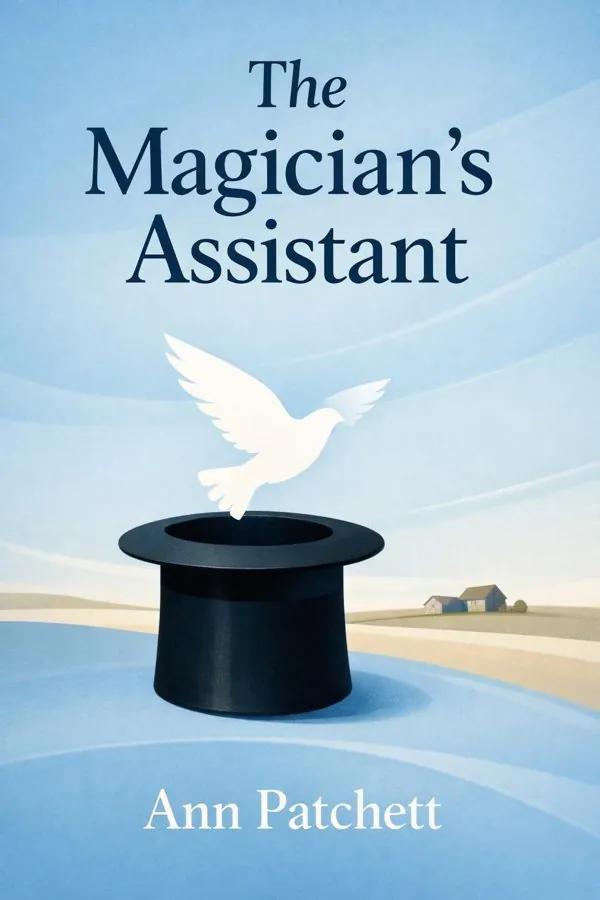
The Magician’s Assistant: Summary & Key Insights
by Ann Patchett
 10 min9 chaptersAudio available
Key Takeaways from The Magician’s Assistant
One of the novel’s most piercing insights is that intimacy does not guarantee full knowledge.
Loss rarely behaves in tidy, rational ways, and Patchett captures that with remarkable tenderness through Sabine’s dreams of Parsifal.
Sometimes healing requires a change of landscape, and in The Magician’s Assistant Nebraska becomes the opposite of Los Angeles in every symbolic sense.
A painful revelation often tempts us toward all-or-nothing thinking: if part of what I believed was false, then maybe everything was false.
The world of magic in the novel is not just a colorful setting; it is a philosophy of survival.
What Is The Magician’s Assistant About?
The Magician’s Assistant by Ann Patchett is a bestsellers book spanning 4 pages. Ann Patchett’s The Magician’s Assistant is a luminous novel about grief, secrets, and the unsettling gap between the people we love and the people we truly know. At its center is Sabine, the devoted assistant and widow of the magician Parsifal, whose death leaves her not only heartbroken but disoriented. In the aftermath, she learns that the elegant life they built in Los Angeles rested on a profound concealment: Parsifal had a mother, sisters, and a whole past in Nebraska that he had erased from the story of himself. As Sabine travels from a world of velvet curtains and stage illusions to the stark winter plains of the Midwest, she is forced to confront the difference between performance and truth, fantasy and memory, possession and love. Patchett, celebrated for her emotional intelligence, precise prose, and deep compassion for flawed people, turns what could have been a simple revelation into a meditation on identity and survival. This is a novel that matters because it understands a difficult truth: love can be genuine even when it is incomplete, and discovering what was hidden does not cancel what was real.
This FizzRead summary covers all 9 key chapters of The Magician’s Assistant in approximately 10 minutes, distilling the most important ideas, arguments, and takeaways from Ann Patchett's work. Also available as an audio summary and Key Quotes Podcast.
The Magician’s Assistant
Ann Patchett’s The Magician’s Assistant is a luminous novel about grief, secrets, and the unsettling gap between the people we love and the people we truly know. At its center is Sabine, the devoted assistant and widow of the magician Parsifal, whose death leaves her not only heartbroken but disoriented. In the aftermath, she learns that the elegant life they built in Los Angeles rested on a profound concealment: Parsifal had a mother, sisters, and a whole past in Nebraska that he had erased from the story of himself. As Sabine travels from a world of velvet curtains and stage illusions to the stark winter plains of the Midwest, she is forced to confront the difference between performance and truth, fantasy and memory, possession and love. Patchett, celebrated for her emotional intelligence, precise prose, and deep compassion for flawed people, turns what could have been a simple revelation into a meditation on identity and survival. This is a novel that matters because it understands a difficult truth: love can be genuine even when it is incomplete, and discovering what was hidden does not cancel what was real.
Who Should Read The Magician’s Assistant?
This book is perfect for anyone interested in bestsellers and looking to gain actionable insights in a short read. Whether you're a student, professional, or lifelong learner, the key ideas from The Magician’s Assistant by Ann Patchett will help you think differently.
- ✓Readers who enjoy bestsellers and want practical takeaways
- ✓Professionals looking to apply new ideas to their work and life
- ✓Anyone who wants the core insights of The Magician’s Assistant in just 10 minutes
Want the full summary?
Get instant access to this book summary and 100K+ more with Fizz Moment.
Get Free SummaryAvailable on App Store • Free to download
Key Chapters
One of the novel’s most piercing insights is that intimacy does not guarantee full knowledge. Sabine believed she understood Parsifal because they shared a life, a home, a profession, and a bond built on loyalty and tenderness. Yet after his death, she discovers that he had concealed an entire family and personal history in Nebraska. The shock is not simply that he lied; it is that a person can be deeply loved and still remain partly unknowable.
Patchett uses the world of stage magic to sharpen this idea. Magic depends on directing attention, on making the audience look in one place while the truth happens elsewhere. Sabine’s marriage worked similarly. What she saw was real—companionship, affection, routine, artistic partnership—but it was not the whole picture. That makes her grief especially complicated. She must mourn not only Parsifal’s death, but the collapse of her own certainty.
This idea reaches far beyond the novel. In everyday life, we often mistake familiarity for understanding. We assume that a spouse, friend, or parent is fully visible to us because we know their habits and history. But every person contains private fears, old wounds, and unspoken loyalties. Recognizing this does not make love meaningless; it makes love humbler. It asks us to replace possession with curiosity.
A practical application is to hold relationships with a little more openness. Instead of thinking, I already know who this person is, ask what experiences shaped them before you arrived. Ask about family stories, losses, reinventions, and silences. The actionable takeaway: treat the people you love not as solved mysteries, but as living, changing human beings whose full story always deserves fresh attention.
Loss rarely behaves in tidy, rational ways, and Patchett captures that with remarkable tenderness through Sabine’s dreams of Parsifal. After his death, he visits her in vivid nighttime encounters that feel more convincing than memory. These dreams are not treated as cheap supernatural tricks; instead, they reveal how grief bends reality. When someone central to our lives disappears, the mind keeps reaching for them, refusing the finality that language insists upon.
In Sabine’s case, the dreams function as emotional truth. Parsifal appears intimate, calm, and oddly present, as though the relationship continues just beyond the edge of waking life. This complicates the common assumption that healing means severing attachment. Patchett suggests something subtler: grief may require us to maintain an inner conversation with the dead until we are strong enough to let their place in us change.
Many readers will recognize this experience in ordinary forms. People keep hearing a lost parent’s voice when making decisions, continue setting a table as if a spouse might walk in, or revisit certain places because they make absence feel briefly reversible. Rather than mocking these responses, the novel dignifies them. It shows that mourning is not a straight path from pain to acceptance.
The practical lesson is to stop demanding perfect logic from grief. If memories return vividly, if dreams feel strangely real, or if mourning unfolds in circles rather than stages, that does not mean something is wrong. It means love is adjusting to a new condition. The actionable takeaway: give grief room to speak in its own language—through memory, ritual, dreams, and reflection—without rushing yourself toward neat closure.
Sometimes healing requires a change of landscape, and in The Magician’s Assistant Nebraska becomes the opposite of Los Angeles in every symbolic sense. Los Angeles is performance, polish, invention, and self-creation. Nebraska is winter, family history, bluntness, and the unadorned persistence of real life. When Sabine travels there to meet Parsifal’s mother and sisters, she enters a place that cannot be controlled by glamour or illusion.
This move matters because truth is often easier to avoid in environments built around reinvention. Parsifal had crafted himself in California, leaving behind the painful facts of his earlier life. But his family remains as evidence that no one entirely escapes their origins. In Nebraska, Sabine must confront not just his deception, but the human reasons behind it: shame, longing, fear, and the desire to survive by becoming someone else.
The family she encounters is not a tidy solution to mystery. They are ordinary, wounded, curious people grieving their own version of the same man. Their existence forces Sabine to accept that Parsifal belonged to more than one story. This is often true in life. A colleague is one person at work and another in their hometown. A parent has a self that existed before the children knew them. Place can unlock those hidden dimensions.
A practical application is to remember that context changes understanding. If you want to know a person more deeply, learn where they came from—their town, family system, class background, and formative struggles. The actionable takeaway: when you feel trapped in a single version of a situation, step into a new context; sometimes a different landscape reveals the truth more clearly than more analysis ever could.
A painful revelation often tempts us toward all-or-nothing thinking: if part of what I believed was false, then maybe everything was false. Patchett resists that simplification. Sabine learns that Parsifal hid essential facts from her, yet the novel never suggests that their bond was therefore meaningless. Instead, it asks a more mature question: can love be real even when it is incomplete, asymmetrical, or shaped by concealment? Patchett’s answer is yes, though not without sorrow.
This is one of the book’s most generous insights. Human relationships are rarely built on total disclosure. People protect themselves, revise their histories, and tell partial truths. Sometimes they do this selfishly; sometimes they do it because they are ashamed, frightened, or trying to preserve a fragile identity. None of that erases the tenderness they may also have genuinely offered.
Sabine’s task is not to excuse Parsifal, nor to condemn him entirely. It is to hold two truths at once: he deceived her, and he loved her. That emotional doubleness is difficult, but it is also emotionally realistic. In everyday life, many people must reckon with similar complexity after discovering a family secret, an old betrayal, or a hidden struggle. Maturity lies in resisting simplistic verdicts.
A practical way to apply this idea is to evaluate relationships with nuance. Ask: What was real here? What was hidden? What needs grieving, and what still deserves gratitude? This approach does not deny pain; it organizes it. The actionable takeaway: when a relationship’s story breaks open, do not rush to erase the good or minimize the harm—practice holding both, because honest healing often begins in that tension.
The world of magic in the novel is not just a colorful setting; it is a philosophy of survival. Sabine and Parsifal have made a life from misdirection, costume, timing, and spectacle. In that environment, performance becomes second nature. The novel suggests that this happens in ordinary life too. We all learn roles—competent adult, loyal spouse, successful professional, agreeable friend—and over time those roles can become so polished that they replace direct emotional truth.
Parsifal’s life is the most dramatic example. He reinvents himself so thoroughly that even the person closest to him does not see the original scaffolding. But Sabine also participates in performance, not through outright deception but through emotional habit. She is trained to support the act, maintain composure, and preserve the show. Her journey after Parsifal’s death is, in part, the story of what happens when the curtain falls and she no longer has a role to play.
This insight is highly practical. Many people function skillfully while hiding confusion, loneliness, or fear beneath routines that look admirable from the outside. A career may become a costume. A marriage may be sustained by scripts rather than honesty. A public identity may crowd out inner life. The danger is not performance itself; some roles are necessary. The danger comes when we forget that the role is not the whole self.
To apply this idea, notice where in your life you are performing competence or certainty instead of expressing what is true. That might mean admitting grief, asking for help, or speaking a difficult truth. The actionable takeaway: identify one role you are overplaying and make one small move toward authenticity, even if it feels less polished than the performance.
No one arrives in adulthood untouched by family, and The Magician’s Assistant makes this clear by contrasting Sabine’s relative detachment with Parsifal’s unresolved past. His attempt to sever himself from his Nebraska family does not free him from them; it leaves the relationship frozen, distorted, and powerful in absence. What is buried remains active. The family story continues to shape the self, whether acknowledged or not.
When Sabine meets his mother and sisters, she is not just gathering information. She is witnessing the emotional architecture that helped make Parsifal who he became. Their expectations, grief, memories, and disappointments illuminate the pressures he escaped and the losses he carried. Patchett portrays family not as destiny but as a formative language. Even rebellion speaks in that language.
This matters because many adults imagine that independence means outgrowing family influence. Yet patterns of shame, loyalty, conflict avoidance, ambition, and self-protection often originate long before we can name them. Someone who left home at eighteen may still be living in response to that home at forty. Someone who never discusses their childhood may still be organized by it.
A practical use of this idea is to examine your recurring emotional patterns through the lens of family history. Why does a certain criticism feel unbearable? Why do you over-function, disappear, appease, or perform? Often the answer lies in old roles learned early. Understanding these roots does not trap you; it creates freedom to choose differently. The actionable takeaway: map one persistent behavior in your life back to a family pattern, then ask what a healthier version of that behavior would look like now.
A lesser novel might turn Parsifal’s hidden family into a moral puzzle with clear heroes and villains. Patchett chooses compassion instead. She allows each character to retain dignity even while causing or carrying pain. Sabine is devastated but not cruel. Parsifal’s family is wounded but not sentimentalized. Even Parsifal, in absence, is portrayed as deeply flawed yet profoundly human. This ethical spaciousness is one of the book’s greatest strengths.
Compassion in the novel does not mean excusing deception. It means widening the frame enough to see why people act as they do. Fear of rejection, sexual identity, family pressure, class differences, and the longing to reinvent oneself all shape behavior. Once these forces come into view, judgment becomes less satisfying than understanding. Readers are invited to ask not simply, Was this right? but also, What pain made this feel necessary?
That shift has practical power. In conflict, people often reduce one another to the most recent wound: liar, deserter, cold parent, selfish sibling. But durable understanding requires a thicker account of human behavior. This does not eliminate accountability; it makes accountability more humane. In workplaces, friendships, and families, problems often de-escalate when someone feels accurately seen rather than merely accused.
To apply this idea, try separating action from essence. Instead of concluding, This person is unforgivable, ask, What fear, history, or limitation might be driving this behavior? You may still set boundaries, but your response will be wiser. The actionable takeaway: the next time someone disappoints you, pause long enough to imagine their hidden context before deciding how to respond.
Modern life often celebrates reinvention as liberation: move away, change your name, build a new career, become the person you choose. Patchett does not reject this dream, but she subjects it to emotional reality. Parsifal reinvents himself brilliantly, crafting a life that reflects talent, longing, and escape. Yet his new self is not fully free because the old self has not been integrated. Reinvention without reconciliation creates fracture.
Sabine’s journey reveals a healthier model. She too must reinvent herself after Parsifal’s death. Widowhood strips away her role, her routine, and much of her social identity. But unlike Parsifal, she cannot simply disappear into a new costume. She has to move through the wreckage, gather truths she did not ask for, and build a future that includes rather than erases the past.
This is relevant to anyone navigating a major life transition—divorce, migration, career change, sobriety, illness, or grief. New beginnings are often necessary, but they become unstable when they are built on denial. A person who declares, That old life has nothing to do with me, usually remains haunted by exactly what they refuse to name. Sustainable change requires incorporating old wounds, not pretending they never existed.
A practical application is to rethink self-transformation as editing rather than deletion. Keep what is valuable, name what was painful, and understand what you are leaving for. The actionable takeaway: if you are trying to begin again, write down three parts of your past you need to acknowledge—not erase—so your next chapter can rest on truth instead of avoidance.
One of the novel’s quiet miracles is that solace comes from the very people who seem most likely to intensify pain. Sabine travels to Nebraska expecting discomfort, resentment, and emotional displacement. Instead, although the encounter is awkward and sorrowful, she gradually finds connection with Parsifal’s family. They too are grieving. They too were excluded from parts of his life. Shared loss becomes the basis for a fragile but meaningful kinship.
Patchett shows that healing is not always found by returning to familiar comfort. Sometimes it comes through new relationships that enlarge our understanding of what belonging can mean. Sabine does not replace Parsifal by knowing his family, nor do they solve her grief. What they offer is something subtler: a wider emotional container for the truth. They help her see that love radiates outward in ways no single person can control.
This insight matters in real life because people often isolate after betrayal or bereavement, assuming that the pain is too singular to be shared. Yet support sometimes appears from surprising corners: an in-law after divorce, a friend of the deceased, a support group of strangers, or a family member once considered distant. When loss reorganizes life, the map of belonging may need to change as well.
To apply this idea, remain open to companionship that does not fit your original expectations. Help may come from people connected to your pain rather than separate from it. The actionable takeaway: in a season of loss or transition, reach out to one unexpected person whose experience overlaps with yours; mutual understanding can become a bridge back to life.
All Chapters in The Magician’s Assistant
About the Author
Ann Patchett is an acclaimed American novelist and essayist celebrated for her graceful prose, emotional intelligence, and deeply human storytelling. Born in Los Angeles in 1963 and raised in Tennessee, she studied at Sarah Lawrence College and later at the Iowa Writers’ Workshop. Patchett rose to international prominence with Bel Canto, and she has since written a string of admired books including The Magician’s Assistant, Run, State of Wonder, Commonwealth, and The Dutch House. Her work often explores family, moral complexity, memory, and the hidden lives people carry beneath ordinary appearances. In addition to her literary career, Patchett is a prominent advocate for independent bookselling and the co-owner of Parnassus Books in Nashville. She is widely regarded as one of the most thoughtful and accomplished contemporary American writers.
Get This Summary in Your Preferred Format
Read or listen to the The Magician’s Assistant summary by Ann Patchett anytime, anywhere. FizzRead offers multiple formats so you can learn on your terms — all free.
Available formats: App · Audio · PDF · EPUB — All included free with FizzRead
Download The Magician’s Assistant PDF and EPUB Summary
Key Quotes from The Magician’s Assistant
“One of the novel’s most piercing insights is that intimacy does not guarantee full knowledge.”
“Loss rarely behaves in tidy, rational ways, and Patchett captures that with remarkable tenderness through Sabine’s dreams of Parsifal.”
“Sometimes healing requires a change of landscape, and in The Magician’s Assistant Nebraska becomes the opposite of Los Angeles in every symbolic sense.”
“A painful revelation often tempts us toward all-or-nothing thinking: if part of what I believed was false, then maybe everything was false.”
“The world of magic in the novel is not just a colorful setting; it is a philosophy of survival.”
Frequently Asked Questions about The Magician’s Assistant
The Magician’s Assistant by Ann Patchett is a bestsellers book that explores key ideas across 9 chapters. Ann Patchett’s The Magician’s Assistant is a luminous novel about grief, secrets, and the unsettling gap between the people we love and the people we truly know. At its center is Sabine, the devoted assistant and widow of the magician Parsifal, whose death leaves her not only heartbroken but disoriented. In the aftermath, she learns that the elegant life they built in Los Angeles rested on a profound concealment: Parsifal had a mother, sisters, and a whole past in Nebraska that he had erased from the story of himself. As Sabine travels from a world of velvet curtains and stage illusions to the stark winter plains of the Midwest, she is forced to confront the difference between performance and truth, fantasy and memory, possession and love. Patchett, celebrated for her emotional intelligence, precise prose, and deep compassion for flawed people, turns what could have been a simple revelation into a meditation on identity and survival. This is a novel that matters because it understands a difficult truth: love can be genuine even when it is incomplete, and discovering what was hidden does not cancel what was real.
More by Ann Patchett




You Might Also Like

The Godfather
Mario Puzo
10 min
The Handmaid's Tale
Margaret Atwood
10 min
The Hunger Games
Suzanne Collins
10 min
The Nightingale
Kristin Hannah
10 min
The Seven Husbands of Evelyn Hugo
Taylor Jenkins Reid
10 min
Backwater Justice
Fern Michaels
10 minBrowse by Category
Ready to read The Magician’s Assistant?
Get the full summary and 100K+ more books with Fizz Moment.