
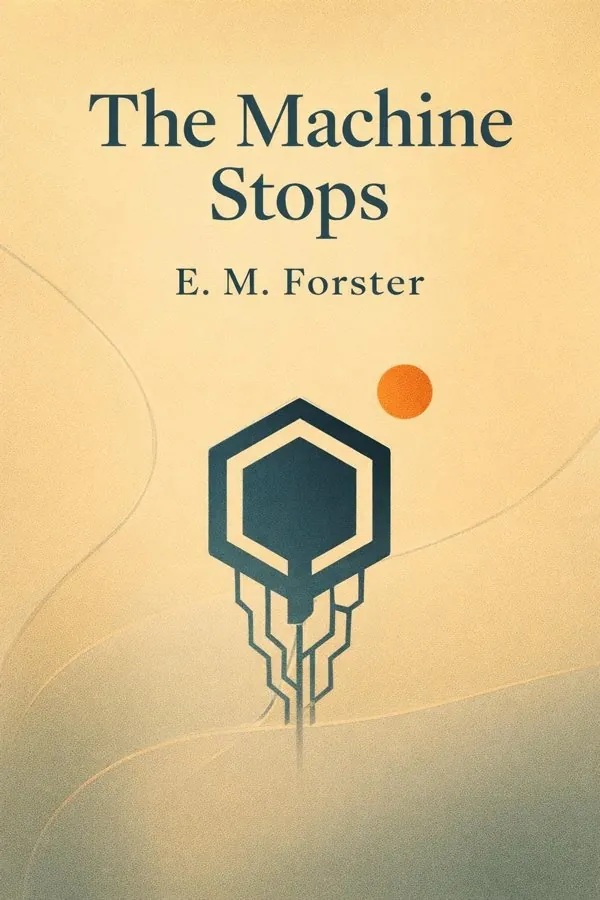
The Machine Stops: Summary & Key Insights
 10 min9 chaptersAudio available
Key Takeaways from The Machine Stops
Comfort can become a cage when it removes not only pain, but also effort, encounter, and freedom.
People rarely worship machines as machines; they worship what machines seem to guarantee.
The desire for reality often begins as a discomfort that polite society cannot understand.
A society becomes fragile when people stop understanding the systems they rely on.
Civilizations often decline gradually, not dramatically, and their members explain away warning signs until explanation is no longer possible.
What Is The Machine Stops About?
The Machine Stops by E. M. Forster is a scifi_fantasy book spanning 5 pages. E. M. Forster’s “The Machine Stops,” first published in 1909, is one of the most astonishingly forward-looking works in early science fiction. Set in a future where human beings live alone in underground cells, relying on a vast global Machine for food, air, entertainment, communication, and even thought, the story follows Vashti, a devoted believer in this system, and her son Kuno, who senses that something essential in human life has been lost. What begins as a strange futuristic tale becomes a powerful warning about convenience, passivity, and the dangers of surrendering human judgment to technological systems. The story matters because it anticipated so much of modern life: remote communication, algorithmic dependence, social isolation, and the replacement of direct experience with mediated experience. Long before the internet, video calls, and platform culture, Forster imagined a civilization that confuses connection with contact and knowledge with endless information exchange. Best known for novels such as “Howards End” and “A Passage to India,” Forster brings unusual literary depth to science fiction, using a dystopian setting not just to predict the future, but to ask what makes life truly human.
This FizzRead summary covers all 9 key chapters of The Machine Stops in approximately 10 minutes, distilling the most important ideas, arguments, and takeaways from E. M. Forster's work. Also available as an audio summary and Key Quotes Podcast.
The Machine Stops
E. M. Forster’s “The Machine Stops,” first published in 1909, is one of the most astonishingly forward-looking works in early science fiction. Set in a future where human beings live alone in underground cells, relying on a vast global Machine for food, air, entertainment, communication, and even thought, the story follows Vashti, a devoted believer in this system, and her son Kuno, who senses that something essential in human life has been lost. What begins as a strange futuristic tale becomes a powerful warning about convenience, passivity, and the dangers of surrendering human judgment to technological systems.
The story matters because it anticipated so much of modern life: remote communication, algorithmic dependence, social isolation, and the replacement of direct experience with mediated experience. Long before the internet, video calls, and platform culture, Forster imagined a civilization that confuses connection with contact and knowledge with endless information exchange. Best known for novels such as “Howards End” and “A Passage to India,” Forster brings unusual literary depth to science fiction, using a dystopian setting not just to predict the future, but to ask what makes life truly human.
Who Should Read The Machine Stops?
This book is perfect for anyone interested in scifi_fantasy and looking to gain actionable insights in a short read. Whether you're a student, professional, or lifelong learner, the key ideas from The Machine Stops by E. M. Forster will help you think differently.
- ✓Readers who enjoy scifi_fantasy and want practical takeaways
- ✓Professionals looking to apply new ideas to their work and life
- ✓Anyone who wants the core insights of The Machine Stops in just 10 minutes
Want the full summary?
Get instant access to this book summary and 100K+ more with Fizz Moment.
Get Free SummaryAvailable on App Store • Free to download
Key Chapters
Comfort can become a cage when it removes not only pain, but also effort, encounter, and freedom. In “The Machine Stops,” humanity lives beneath the earth in standardized cells, each equipped with buttons and mechanisms that provide music, lectures, food, baths, medicine, and instant communication. Everything is available on demand. At first, this seems like civilization’s triumph: no scarcity, no travel burden, no physical hardship. Yet Forster quickly reveals the hidden cost. People no longer make, build, explore, or even meet one another in person unless absolutely necessary. Their world is frictionless, but also lifeless.
Forster’s genius lies in showing that the Machine does more than serve bodily needs. It shapes expectations. People begin to believe that anything inconvenient is undesirable, and anything unmediated is primitive. The cell becomes not just a residence but a worldview. Individuals lose practical skills because the system performs every task. They lose resilience because they never confront difficulty. They lose texture in life because everything arrives filtered, regulated, and standardized.
This idea feels intensely modern. We, too, increasingly outsource memory, navigation, shopping, social interaction, and entertainment to systems designed to remove inconvenience. The problem is not technology itself, but total dependency on it. When every discomfort is optimized away, people may also lose patience, adaptability, and curiosity.
A practical way to apply Forster’s warning is to notice where convenience has quietly replaced capability. Can you entertain yourself without a screen? Solve a problem without instant search? Spend meaningful time without digital mediation? The actionable takeaway: deliberately preserve a few forms of productive inconvenience in your life, because the skills and presence they demand are part of what keep you human.
People rarely worship machines as machines; they worship what machines seem to guarantee. Vashti, one of the story’s central figures, is not a villain but an ordinary believer in comfort, efficiency, and managed existence. She spends her life delivering ideas through the Machine, listening to lectures, and participating in a culture of constant intellectual exchange that is strangely detached from reality. She is physically weak, emotionally flattened, and deeply resistant to direct experience. She does not merely use the Machine. She reveres it.
What makes Vashti compelling is that her devotion feels respectable. She values refinement, order, and civilized distance. She dislikes touching, traveling, and looking at the unprocessed world. For her, the Machine is not oppression; it is progress. That is exactly Forster’s point. Systems become most powerful when they are not enforced only by fear, but embraced as moral goods. Vashti sees dependence as sophistication.
This mindset appears today whenever people begin treating mediation as superior to reality itself: preferring summaries to books, feeds to conversations, reaction to reflection, and remote abstraction to embodied experience. Vashti represents the temptation to replace life with commentary on life. She also shows how ideology can form around convenience. Once comfort becomes sacred, anyone who questions the system appears backward or dangerous.
In practical terms, Vashti challenges readers to examine what they defend automatically. Do you justify habits simply because they are efficient? Do you avoid difficult experiences because they feel unnecessary? Are you consuming second-hand interpretations instead of forming first-hand understanding?
The actionable takeaway: identify one area where you have mistaken convenience for wisdom, and reintroduce direct experience there, whether that means meeting in person, learning by doing, or engaging reality before consuming commentary about it.
The desire for reality often begins as a discomfort that polite society cannot understand. Kuno, Vashti’s son, is the story’s dissenter. Unlike the people around him, he feels suffocated by life underground and longs for something older, harsher, and truer than the Machine’s curated existence. He wants to see the surface of the earth, breathe unregulated air, and encounter life without technological mediation. His rebellion is not mainly political. It is existential.
Kuno’s importance comes from what he senses before others do: a life organized entirely around comfort and control cannot satisfy the human spirit. He experiences the Machine’s world as spiritually deadening. He climbs toward the forbidden surface not because it is practical, but because it is real. In doing so, he becomes one of literature’s early defenders of embodiment, risk, and independent perception.
Forster uses Kuno to show that rebellion is sometimes less about ideology than about recovering forgotten instincts. In a society trained to avoid effort, Kuno chooses struggle. In a culture that distrusts the body, he trusts his own physical experience. In a world of accepted systems, he asks whether the system deserves obedience at all.
This has clear modern applications. Many people feel a similar unease when life becomes overly virtual, managed, or optimized. They seek hiking, craft, exercise, face-to-face conversation, travel, gardening, or silence not as hobbies alone, but as forms of recovery. These activities restore contact with effort, place, and physical reality.
Kuno reminds us that longing can be diagnostic. Sometimes dissatisfaction is not a flaw in us but evidence that something around us is fundamentally impoverished. The actionable takeaway: pay attention to the forms of experience that make you feel vividly present, and protect them, because they may be pointing you back to a more grounded way of living.
A society becomes fragile when people stop understanding the systems they rely on. In Forster’s world, the Machine was once built to serve humanity, but over time it becomes so complex and so total that no one truly comprehends it. People know how to use its interfaces, but not how it functions. Worse, they no longer believe understanding is necessary. Technical mastery disappears, replaced by ritualized dependence and passive trust.
This is one of the story’s most profound insights. Collapse does not begin only when machines fail. It begins earlier, when human beings surrender responsibility for maintenance, interpretation, and judgment. The Machine’s users treat instructions as sacred and inherited procedures as unquestionable. They mistake operational familiarity for real knowledge. In effect, they become consumers of civilization rather than participants in it.
That pattern is highly recognizable today. Many of us rely on infrastructures we barely understand: digital networks, cloud services, logistics systems, recommendation engines, payment rails, and software ecosystems. Again, the issue is not that everyone must become an engineer. It is that societies need enough understanding, skepticism, and distributed competence to avoid total helplessness. When users lose agency, institutions become brittle.
Forster suggests that dependence is not merely technical but intellectual. The people in the story no longer ask foundational questions. They are content to operate within a system they consider beyond scrutiny. This mindset turns tools into authorities.
A practical application is to become more literate about the systems governing your life. Learn how your data is used, how your communications are mediated, how your essentials are delivered, and what backups exist if systems fail. The actionable takeaway: choose one critical system you depend on and deepen your understanding of it this month, because informed dependence is safer than blind dependence.
Civilizations often decline gradually, not dramatically, and their members explain away warning signs until explanation is no longer possible. In “The Machine Stops,” small malfunctions begin to appear: music quality declines, repairs become less effective, and disruptions are dismissed as temporary irregularities. The public remains calm because they cannot imagine genuine failure. Faith in the system substitutes for evidence.
Forster captures a timeless psychological truth here. People adapt to deterioration if it arrives in increments. They normalize inconvenience, excuse dysfunction, and trust that experts or institutions will restore order. In the story, this passivity is intensified by dogma. The Machine has become almost religious, so criticism feels impious. Citizens respond to warning not with investigation but with reverence.
This idea applies far beyond technology. Organizations, cultures, and relationships often show subtle signs of decay before visible collapse: delayed accountability, reduced quality, brittle norms, vague communication, and dependence on ceremonial language rather than competence. When members are too invested in the myth of stability, they miss the evidence of decline.
Forster also highlights the danger of losing repair culture. The people using the Machine can consume outputs, but they can no longer meaningfully maintain the system. As a result, every failure becomes existential. A resilient society needs not just innovation, but stewardship.
In everyday life, this lesson encourages a different relationship to breakdown. Instead of treating small failures as annoyances to ignore, see them as information. Ask what they reveal about structure, maintenance, and hidden fragility. Whether in a workplace, a digital tool, or a personal routine, recurring glitches often point to deeper dependency.
The actionable takeaway: do not wait for a total collapse to take warning seriously; identify one recurring “small failure” in your life or work and address its root cause before it becomes systemic.
A culture can be saturated with communication and still starve for human contact. One of Forster’s most prophetic ideas is that the people in his future are always connected through the Machine, constantly exchanging lectures, messages, and ideas, yet profoundly isolated. They rarely meet physically. They avoid touch. Their interactions are abundant but thin, immediate but disembodied. Communication has expanded while communion has collapsed.
This distinction is central to the story’s power. Forster saw that technology could multiply contact without deepening relationship. In the Machine’s world, people are visible to one another as voices, images, or abstractions, but not as full embodied persons. They share opinions more easily than presence. As a result, emotional and social life becomes flattened. Even family bonds weaken under the pressure of convenience and mediated distance.
Modern readers can hardly miss the relevance. Social media, video calls, group chats, and content platforms create the feeling of continual sociality. Yet many people report loneliness, alienation, and emotional exhaustion despite constant connectivity. Forster helps explain why: connection without shared physical reality can become performative, fragmented, and low-trust.
This does not mean mediated communication is worthless. In many cases it is indispensable. But the story insists on asking what kinds of relationships technology can support well, and what kinds it cannot replace. Presence carries forms of attention, accountability, and subtlety that no system fully captures.
A practical response is to audit the quality, not just quantity, of your interactions. Are your most important relationships sustained by convenience alone? Are you substituting updates for intimacy? Are you consuming voices more often than truly listening to people?
The actionable takeaway: strengthen one relationship through a higher-bandwidth form of connection this week, such as an in-person meeting, a long phone conversation, or uninterrupted shared time.
A society can become intellectually active while losing touch with reality. In Forster’s underground world, people love ideas, but mainly in the form of lectures, second-hand interpretations, and endless commentary. Vashti herself specializes in discussing concepts detached from lived experience. Knowledge circulates constantly, yet wisdom shrinks. The result is a civilization rich in discourse and poor in understanding.
Forster is not attacking thought. He is attacking thought severed from contact with the world. When people no longer travel, build, observe, endure, or encounter difference directly, their ideas become self-referential. They discuss symbols of life instead of life. This creates a strange inversion: abstract sophistication increases even as actual human capacity declines.
This criticism feels especially relevant in environments shaped by constant content consumption. It is easy to accumulate opinions, frameworks, and analyses without testing them in practice. People may read about courage, health, friendship, politics, or creativity endlessly while rarely acting, experimenting, or observing firsthand. Information creates the illusion of growth.
Forster suggests that real understanding requires friction between idea and experience. We learn not only by hearing but by doing, noticing, failing, and revising. A culture that prizes commentary above encounter becomes vulnerable to emptiness, conformity, and intellectual vanity.
In practical terms, this is an invitation to pair learning with embodiment. If you read about art, make something. If you study leadership, lead something. If you care about community, show up in one. If you discuss nature, spend time outdoors. The point is not anti-intellectualism, but integration.
The actionable takeaway: for every major idea you consume this week, ask what direct experience could test, deepen, or challenge it, and then take one small concrete step toward that experience.
To reject the body is ultimately to reject part of what makes us human. A recurring tension in “The Machine Stops” is the contrast between the Machine’s controlled environment and the surface world of earth, sky, air, and physical danger. The underground civilization treats the body as a problem to be minimized. Exercise is limited, touch is distasteful, movement is unnecessary, and direct exposure to nature is considered barbaric. But Forster implies that in escaping vulnerability, people have also escaped vitality.
Kuno’s longing for the surface is therefore not nostalgia. It is a recovery of embodiment. He wants to climb, breathe, see, and struggle. Nature in the story represents more than scenery; it represents reality that resists total design. Human beings, Forster suggests, need some contact with what is not optimized for them. Limits, uncertainty, and physicality are not merely obstacles. They are conditions through which meaning emerges.
This idea has practical force in an age when more of life is sedentary, indoor, and screen-based. Many forms of contemporary stress arise not only from too much work, but from too little embodied life. Time in nature, physical exertion, manual activity, and sensory attention often restore clarity because they reconnect people with scale, mortality, and immediate presence.
Forster’s warning is subtle: a civilization that despises human limits may end by becoming less human, not more advanced. The body is not an embarrassing legacy to transcend completely; it is part of our intelligence.
The actionable takeaway: build one regular embodied practice into your week, such as walking outdoors, strength training, gardening, or hands-on craft, and treat it not as a luxury but as essential maintenance of your humanity.
When systems fail, borrowed identities disappear and fundamental realities return. In the final movement of “The Machine Stops,” the collapse that seemed unthinkable becomes unavoidable. The Machine breaks down entirely, and the civilization built upon it crumbles with terrifying speed. Yet Forster does not end only in despair. Amid destruction, he suggests that what has been suppressed may still survive: human affection, courage, memory, and the possibility of renewal.
This ending matters because it reframes catastrophe. The collapse is horrific, but it also exposes the false permanence of the system. The Machine had convinced people that it was life itself. Once it falls, they are forced to confront a simpler truth: tools are not meaning, infrastructure is not civilization, and efficiency is not salvation. What endures are the human capacities that cannot be fully mechanized.
Forster also hints that recovery may come not from the most adapted citizens of the Machine, but from those who preserved some relationship to reality. This is a profound social insight. Resilience often resides at the margins, among those who retained practical knowledge, independence, or alternative ways of living.
The lesson is not to romanticize disaster, but to ask what in your life would remain if your systems failed. Which relationships are real? Which skills are portable? Which values are intrinsic rather than platform-dependent? What forms of meaning do not require seamless infrastructure?
In a world built on complex networks, these questions are not paranoid. They are clarifying. The actionable takeaway: invest in at least one enduring source of resilience now, whether a practical skill, a strong local relationship, or a value-based habit that would still matter even if your usual systems went offline.
All Chapters in The Machine Stops
About the Author
Edward Morgan Forster (1879–1970) was an English novelist, essayist, and short story writer whose work explored class, culture, morality, and the search for genuine human connection. Educated at King’s College, Cambridge, he became one of the major literary voices of the early twentieth century. His best-known novels include “A Room with a View,” “Howards End,” and “A Passage to India,” each marked by psychological insight, social critique, and elegant prose. Although Forster is not usually grouped with science fiction writers, “The Machine Stops” demonstrates his extraordinary ability to imagine the social consequences of technological change. Across his work, he returned again and again to questions of personal integrity, emotional honesty, and the importance of relationships over rigid systems or conventions.
Get This Summary in Your Preferred Format
Read or listen to the The Machine Stops summary by E. M. Forster anytime, anywhere. FizzRead offers multiple formats so you can learn on your terms — all free.
Available formats: App · Audio · PDF · EPUB — All included free with FizzRead
Download The Machine Stops PDF and EPUB Summary
Key Quotes from The Machine Stops
“Comfort can become a cage when it removes not only pain, but also effort, encounter, and freedom.”
“People rarely worship machines as machines; they worship what machines seem to guarantee.”
“The desire for reality often begins as a discomfort that polite society cannot understand.”
“A society becomes fragile when people stop understanding the systems they rely on.”
“Civilizations often decline gradually, not dramatically, and their members explain away warning signs until explanation is no longer possible.”
Frequently Asked Questions about The Machine Stops
The Machine Stops by E. M. Forster is a scifi_fantasy book that explores key ideas across 9 chapters. E. M. Forster’s “The Machine Stops,” first published in 1909, is one of the most astonishingly forward-looking works in early science fiction. Set in a future where human beings live alone in underground cells, relying on a vast global Machine for food, air, entertainment, communication, and even thought, the story follows Vashti, a devoted believer in this system, and her son Kuno, who senses that something essential in human life has been lost. What begins as a strange futuristic tale becomes a powerful warning about convenience, passivity, and the dangers of surrendering human judgment to technological systems. The story matters because it anticipated so much of modern life: remote communication, algorithmic dependence, social isolation, and the replacement of direct experience with mediated experience. Long before the internet, video calls, and platform culture, Forster imagined a civilization that confuses connection with contact and knowledge with endless information exchange. Best known for novels such as “Howards End” and “A Passage to India,” Forster brings unusual literary depth to science fiction, using a dystopian setting not just to predict the future, but to ask what makes life truly human.
More by E. M. Forster
You Might Also Like
Red Rising
Pierce Brown
10 min
Stranger in a Strange Land
Robert A. Heinlein
10 min
AI Valley
Chen Qiufan
10 min
Bloodchild
Octavia E. Butler
10 min
Do Androids Dream of Electric Sheep?
Philip K. Dick
10 min
Jujutsu Kaisen, Vol. 24
Gege Akutami
10 minBrowse by Category
Ready to read The Machine Stops?
Get the full summary and 100K+ more books with Fizz Moment.