
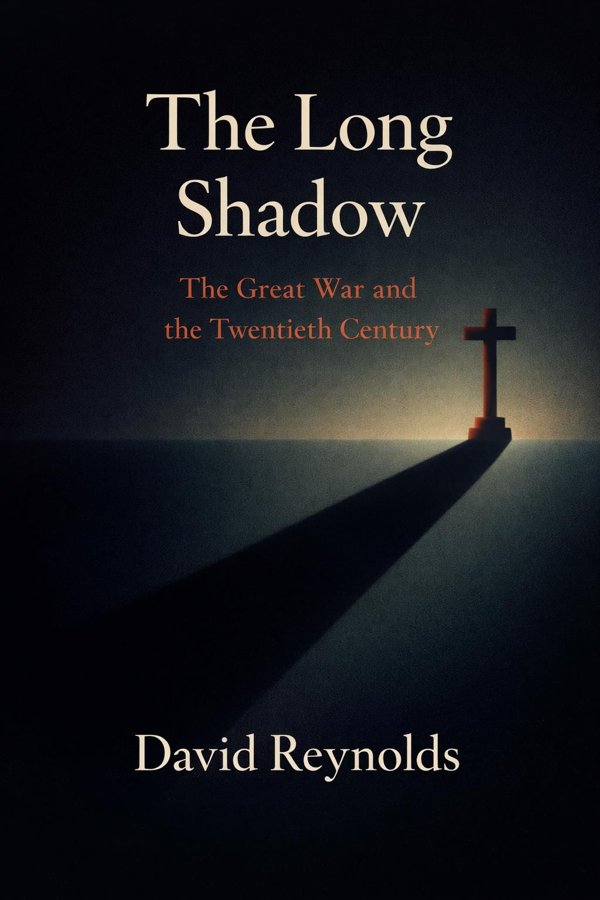
The Long Shadow: The Great War and the Twentieth Century: Summary & Key Insights
 10 min10 chaptersAudio available
Key Takeaways from The Long Shadow: The Great War and the Twentieth Century
The end of fighting did not mean the beginning of stability.
A settlement designed to end war can also preserve its logic.
How societies remember the dead can shape how they imagine the nation.
The period between 1918 and 1939 is often treated as a pause between two world wars, but Reynolds insists it was a decisive era in its own right.
The Second World War did not emerge from nowhere; in crucial ways, it resumed unresolved struggles from the first.
What Is The Long Shadow: The Great War and the Twentieth Century About?
The Long Shadow: The Great War and the Twentieth Century by David Reynolds is a world_history book spanning 10 pages. Some wars end with treaties; others continue by shaping everything that follows. In The Long Shadow: The Great War and the Twentieth Century, historian David Reynolds argues that World War I did not simply devastate Europe between 1914 and 1918—it fundamentally reordered the political, cultural, and moral landscape of the modern world. Rather than focusing only on trench warfare and battlefield suffering, Reynolds traces how the conflict reverberated through the collapse of empires, the rise of new ideologies, the making of World War II, the Cold War, decolonization, and the ever-changing politics of memory. His central insight is that the Great War mattered not only because of what happened during it, but because later generations kept returning to it, reinterpreting it, and using it to explain their own crises. That makes this book especially relevant today, when public debates about nationalism, remembrance, trauma, and international order remain deeply shaped by twentieth-century precedents. As a distinguished Cambridge historian of war and global politics, Reynolds brings wide-ranging scholarship, narrative clarity, and intellectual balance to a subject too often reduced to clichés.
This FizzRead summary covers all 10 key chapters of The Long Shadow: The Great War and the Twentieth Century in approximately 10 minutes, distilling the most important ideas, arguments, and takeaways from David Reynolds's work. Also available as an audio summary and Key Quotes Podcast.
The Long Shadow: The Great War and the Twentieth Century
Some wars end with treaties; others continue by shaping everything that follows. In The Long Shadow: The Great War and the Twentieth Century, historian David Reynolds argues that World War I did not simply devastate Europe between 1914 and 1918—it fundamentally reordered the political, cultural, and moral landscape of the modern world. Rather than focusing only on trench warfare and battlefield suffering, Reynolds traces how the conflict reverberated through the collapse of empires, the rise of new ideologies, the making of World War II, the Cold War, decolonization, and the ever-changing politics of memory. His central insight is that the Great War mattered not only because of what happened during it, but because later generations kept returning to it, reinterpreting it, and using it to explain their own crises. That makes this book especially relevant today, when public debates about nationalism, remembrance, trauma, and international order remain deeply shaped by twentieth-century precedents. As a distinguished Cambridge historian of war and global politics, Reynolds brings wide-ranging scholarship, narrative clarity, and intellectual balance to a subject too often reduced to clichés.
Who Should Read The Long Shadow: The Great War and the Twentieth Century?
This book is perfect for anyone interested in world_history and looking to gain actionable insights in a short read. Whether you're a student, professional, or lifelong learner, the key ideas from The Long Shadow: The Great War and the Twentieth Century by David Reynolds will help you think differently.
- ✓Readers who enjoy world_history and want practical takeaways
- ✓Professionals looking to apply new ideas to their work and life
- ✓Anyone who wants the core insights of The Long Shadow: The Great War and the Twentieth Century in just 10 minutes
Want the full summary?
Get instant access to this book summary and 100K+ more with Fizz Moment.
Get Free SummaryAvailable on App Store • Free to download
Key Chapters
The end of fighting did not mean the beginning of stability. Reynolds shows that 1918 is often misunderstood as a clean dividing line between war and peace, when in reality it opened a period of chaos, uncertainty, and unfinished conflict. Empires that had dominated Europe for generations—the German, Austro-Hungarian, Ottoman, and Russian—collapsed or fractured, leaving behind power vacuums, contested borders, and fragile new states. Soldiers came home to wounded economies, bitter political divisions, and societies struggling to absorb mass grief. Influenza, revolution, famine, and civil war compounded the damage. In many places, the violence simply changed form.
This matters because it challenges the comforting idea that wars conclude when the shooting stops. Reynolds invites us to see aftermaths as historical events in their own right. The social consequences of demobilization, the political shock of regime change, and the psychological burden of loss all shaped what followed. Germany wrestled with defeat and humiliation. Russia plunged into revolution and civil war. Across Central and Eastern Europe, communities found themselves abruptly recategorized as minorities or enemies within newly created states.
A practical way to apply this insight is to think more carefully about postwar transitions in any era. Whether studying Iraq after 2003, the Balkans in the 1990s, or post-conflict reconstruction elsewhere, Reynolds reminds us that peace requires more than an armistice. It requires institutions, legitimacy, and social repair.
Actionable takeaway: when assessing any major conflict, examine the aftermath as seriously as the war itself—because unresolved endings often become the seeds of the next crisis.
A settlement designed to end war can also preserve its logic. Reynolds treats the Paris Peace Conference and the Treaty of Versailles not as simple morality tales of justice or revenge, but as flawed efforts to build order from wreckage. The peacemakers faced impossible pressures: punish aggression, satisfy nationalist demands, prevent revolution, preserve imperial interests, and construct a durable international framework. Their solutions produced mixed results. Some principles, such as national self-determination, sounded noble but proved selective and destabilizing in practice. New borders created new minorities. Reparations fueled resentment. The League of Nations represented innovation, yet lacked sufficient power and universal commitment.
Reynolds does not argue that Versailles alone caused World War II. Instead, he shows how the settlement became politically explosive because it was fragile, contested, and repeatedly reinterpreted. Germans saw it as a diktat. Victorious powers disagreed over enforcement. Economic turmoil and nationalist politics made compromise harder over time. The peace held enough legitimacy to survive briefly, but not enough to absorb the shocks of the 1920s and 1930s.
This idea has a modern application in diplomacy and institution-building. Agreements are not judged only by the ideals they express, but by whether they are enforceable, broadly accepted, and resilient under stress. Corporate mergers, constitutional settlements, and international accords all fail when they ignore how losers will react or how pressures will evolve.
Actionable takeaway: evaluate any settlement not by whether it looks decisive on paper, but by whether it creates a workable order that opponents can live with over time.
How societies remember the dead can shape how they imagine the nation. Reynolds pays close attention to memory and mourning after World War I, showing that mass death was not only a private tragedy but a public force. With millions killed and many bodies never returned home, families and states created new forms of remembrance: cenotaphs, tombs of unknown soldiers, annual ceremonies, local memorials, and rituals of silence. These practices helped grieving communities cope, but they also gave political meaning to sacrifice.
In Britain and France, remembrance often reinforced national endurance and collective duty. In Germany, mourning could merge with resentment and the search for betrayal narratives. In newly formed states, memorial culture became part of national founding myths. Reynolds demonstrates that memory is never neutral. Even apparently solemn rituals carry assumptions about heroism, victimhood, blame, and belonging.
The practical relevance is striking. Public memorials today—whether for wars, genocides, terrorist attacks, or slavery—are still battlegrounds over meaning. Which names are included? What story is told? Is the emphasis on sacrifice, warning, guilt, or reconciliation? Reynolds helps readers understand that memory politics is not a side issue; it is central to how societies define themselves.
For individuals, this chapter encourages a more critical approach to commemorations. Visiting a memorial or observing a national day of remembrance becomes an opportunity to ask: what is being remembered, and what is being left unsaid?
Actionable takeaway: treat collective remembrance as a powerful political language, and always ask whose story a memorial preserves, elevates, or excludes.
The period between 1918 and 1939 is often treated as a pause between two world wars, but Reynolds insists it was a decisive era in its own right. The interwar years were a laboratory of political experimentation, social anxiety, and institutional weakness. Liberal democracy survived in some places, but elsewhere it buckled under the pressure of inflation, mass unemployment, class conflict, and nationalist backlash. Fascism, communism, and authoritarian conservatism all gained force by promising certainty where parliamentary politics seemed ineffective.
Reynolds emphasizes that these developments were linked to World War I not just by chronology but by causation. Veterans returned brutalized or disillusioned. Economies remained distorted by wartime borrowing and reparations. Borders drawn after the war left unresolved ethnic and territorial grievances. The global depression then intensified every vulnerability. What looked like peace was in many respects a continuation of wartime instability by other means.
This interpretation is useful beyond historical study. It reminds us that democratic systems cannot be assumed to recover automatically after trauma. Political moderation needs social trust, economic credibility, and institutions capable of channeling discontent. When these fail, extremist movements gain space by presenting themselves as the only serious alternatives.
In practical terms, Reynolds encourages readers to connect economic disorder, wounded national identity, and democratic fragility rather than viewing them separately. That framework helps explain not only the 1930s but many moments of political radicalization.
Actionable takeaway: when evaluating a society under stress, look at how economic pain, identity politics, and weak institutions interact—because their combination can turn instability into regime change.
The Second World War did not emerge from nowhere; in crucial ways, it resumed unresolved struggles from the first. Reynolds does not collapse the two conflicts into one event, but he shows how deeply connected they were. Territorial disputes, grievances over the peace settlements, ideological polarization, and unresolved questions of power all carried forward from 1918. Hitler exploited memories of defeat, humiliation, and lost greatness. Eastern Europe remained volatile. The Japanese and Italian imperial projects also reflected dissatisfaction with the post-1918 order.
At the same time, Reynolds notes important differences. World War II was even more ideological, more total, and more genocidal. Yet its origins cannot be understood without the legacy of World War I. The first war damaged the old European order, weakened liberal authority, normalized mass violence, and fostered a generation willing to think in civilizational terms. In that sense, 1939 was not a simple restart, but an escalation of earlier breakdowns.
This continuity has practical implications for how we think about historical causation. Major crises are often cumulative. Financial collapses, constitutional failures, and regional wars may look distinct, but they often share root causes and unresolved tensions. Reynolds’s method encourages long-range analysis rather than event-by-event thinking.
For readers, this insight deepens understanding of twentieth-century history as a chain of interlocking consequences. It also cautions against shallow claims that one decisive moment explains everything.
Actionable takeaway: when studying any major catastrophe, trace the unresolved problems that preceded it—because historical explosions are usually built from long-burning fuses.
Each generation remembers old wars through the lens of its own fears. Reynolds shows that the meaning of World War I changed dramatically after 1945 because the Cold War reorganized political priorities and historical interpretation. In Western Europe and the United States, attention shifted toward the struggle against communism, nuclear deterrence, and the lessons of appeasement. World War II, with its clearer moral narrative of anti-fascist victory, often overshadowed the more ambiguous memory of 1914–1918. In Eastern Europe and the Soviet bloc, official narratives recast the earlier conflict through Marxist and revolutionary frameworks.
As a result, the Great War’s place in public memory became unstable. In some countries it was remembered as pointless slaughter; in others, as patriotic sacrifice; in still others, as a prelude to revolution or national rebirth. Reynolds’s broader point is that memory is not fixed by facts alone. Political context determines which facts seem important.
This matters in present-day debates over education, monuments, and national identity. School curricula do not simply transmit neutral history; they prioritize certain events because those events serve contemporary civic purposes. Reynolds helps readers see why historical memory changes even when the past itself does not.
A practical application is to compare history textbooks, museum exhibits, or public anniversaries across countries and decades. Doing so reveals how collective memory is constantly revised to meet current needs.
Actionable takeaway: whenever a society invokes the past, ask what present concerns are shaping that version of history—because remembrance often tells us as much about now as about then.
World War I was never only a European story. Reynolds expands the frame to show that the war mobilized colonial troops, redrew imperial hierarchies, and helped trigger the global transformations that later became decolonization. Soldiers and laborers from India, Africa, the Caribbean, Australia, New Zealand, and other parts of the imperial world were drawn into a conflict presented as a struggle for civilization and freedom. Yet the empires demanding their loyalty often denied them political equality. That contradiction did not disappear after 1918; it deepened.
The war weakened European powers economically and morally. It exposed imperial dependence on colonial manpower and resources. It also spread political consciousness. Veterans returned home with new expectations, sharper grievances, and wider horizons. Anti-colonial leaders used wartime rhetoric about rights and self-determination to challenge imperial rule, even when the peace settlements applied those principles selectively.
Reynolds’s contribution here is to connect the Great War to the global twentieth century: not just European diplomacy, but nationalism in Asia and Africa, mandates in the Middle East, and the eventual dismantling of formal empire. This wider lens is especially valuable for readers who know World War I primarily through the Western Front.
In practical terms, the book encourages readers to examine how global systems rely on peripheral actors who are often omitted from mainstream narratives. Whether in economics, politics, or war, the center is rarely self-sufficient.
Actionable takeaway: widen your historical lens beyond Europe and ask how imperial subjects, not just imperial leaders, experienced and transformed the legacy of the war.
Wars endure not only in archives and treaties, but in novels, poems, films, schools, and family stories. Reynolds explores the cultural and intellectual legacies of World War I by showing how artists, writers, and public commentators turned the conflict into one of the defining symbols of modernity. The war became associated with disillusionment, mechanized brutality, shattered innocence, and the collapse of old certainties. Literary works by trench poets, memoirists, and later novelists helped establish a powerful image of the war as futile slaughter directed by incompetent elites.
Yet Reynolds complicates that familiar picture. Cultural memory is selective. The Western Front dominates English-language imagination, while other theaters and experiences are marginalized. Some societies emphasized trauma; others stressed endurance or national awakening. Over time, cinema, television, and commemorative media further standardized certain interpretations, making them feel universal when they were actually historical constructions.
This insight has practical value for media literacy. Popular representations can illuminate emotional truth while still narrowing historical understanding. A famous film, poem, or school lesson may shape our assumptions more powerfully than scholarship does. Reynolds encourages readers to ask not only whether a cultural portrayal is moving, but what it omits.
For anyone teaching or learning history, this chapter is a reminder that stories create memory just as powerfully as monuments do. The past reaches us through narrative form.
Actionable takeaway: engage cultural portrayals of war critically—appreciate their emotional force, but compare them with wider historical evidence before treating them as the whole truth.
What societies remember is important; when and why they remember it may be even more revealing. Reynolds traces how public memory of World War I shifted over decades through anniversaries, political speeches, museum exhibitions, television documentaries, and school curricula. The war’s image was never settled. In some periods, it receded behind newer crises. In others—such as major anniversaries—it returned with renewed intensity. Commemorations reflected contemporary concerns: pacifism after Vietnam, European reconciliation after the Cold War, or renewed interest in national identity in the early twenty-first century.
Reynolds argues that remembrance is an active process of selection and framing. Public institutions decide which anniversaries deserve attention, which symbols are elevated, and which moral lessons are emphasized. This is why the same war can be remembered as tragedy, warning, sacrifice, or origin story depending on the historical moment.
The practical application is immediate. Public history today is shaped by media cycles, political agendas, and institutional priorities. Museums and memorial events are not passive containers of facts; they are curated narratives. Understanding that helps readers become more discerning citizens and consumers of history.
It also suggests a personal practice: revisit historical assumptions periodically. What you learned about World War I in school may reflect the concerns of that educational moment more than a final historical verdict.
Actionable takeaway: treat anniversaries and commemorations as interpretive events, and ask what present-day message is being attached to the past each time history is publicly revived.
Some historical events remain influential because they continue to supply the language through which later generations understand crisis. Reynolds concludes that the Great War casts a long shadow into the twenty-first century because it established patterns that still shape political thought: fears of alliance entanglement, debates over international order, anxieties about nationalism, and awareness of how modern states mobilize entire societies for conflict. It also left durable institutional and psychological legacies, from border disputes and Middle Eastern mandates to the rhetoric of “never again.”
The book’s most important claim is not that everything in modern history stems from 1914, but that World War I became a foundational reference point. Policymakers compared later crises to 1914 to justify caution or intervention. Citizens and intellectuals revisited the war to think about trauma, state power, and the failure of civilization. Even today, public debates about remembrance, military sacrifice, and democratic fragility often draw on narratives forged in response to the Great War.
This perspective is useful whenever people invoke historical analogies. Reynolds encourages skepticism toward simplistic comparisons while showing why analogies remain unavoidable. The past helps societies interpret uncertainty, but it can also mislead if used lazily.
For modern readers, the practical lesson is to see history as an active resource rather than a closed chapter. The Great War matters because we still use it to understand ourselves.
Actionable takeaway: when historical analogies appear in politics or public debate, ask not only whether they are emotionally powerful, but whether they are historically precise and genuinely illuminating.
All Chapters in The Long Shadow: The Great War and the Twentieth Century
About the Author
David Reynolds is a British historian and professor of international history at the University of Cambridge, known for his influential work on twentieth-century politics, war, and diplomacy. His scholarship often explores how global conflicts reshape international order and how later generations remember those upheavals. Reynolds has written widely on the two world wars, the Cold War, Anglo-American relations, and the interaction between historical events and public memory. He is especially admired for combining rigorous research with clear, accessible writing that speaks to both academic and general audiences. In The Long Shadow, he brings his expertise in international history to one of the defining questions of modern times: how World War I continued to shape the political and cultural life of the century that followed.
Get This Summary in Your Preferred Format
Read or listen to the The Long Shadow: The Great War and the Twentieth Century summary by David Reynolds anytime, anywhere. FizzRead offers multiple formats so you can learn on your terms — all free.
Available formats: App · Audio · PDF · EPUB — All included free with FizzRead
Download The Long Shadow: The Great War and the Twentieth Century PDF and EPUB Summary
Key Quotes from The Long Shadow: The Great War and the Twentieth Century
“The end of fighting did not mean the beginning of stability.”
“A settlement designed to end war can also preserve its logic.”
“How societies remember the dead can shape how they imagine the nation.”
“The period between 1918 and 1939 is often treated as a pause between two world wars, but Reynolds insists it was a decisive era in its own right.”
“The Second World War did not emerge from nowhere; in crucial ways, it resumed unresolved struggles from the first.”
Frequently Asked Questions about The Long Shadow: The Great War and the Twentieth Century
The Long Shadow: The Great War and the Twentieth Century by David Reynolds is a world_history book that explores key ideas across 10 chapters. Some wars end with treaties; others continue by shaping everything that follows. In The Long Shadow: The Great War and the Twentieth Century, historian David Reynolds argues that World War I did not simply devastate Europe between 1914 and 1918—it fundamentally reordered the political, cultural, and moral landscape of the modern world. Rather than focusing only on trench warfare and battlefield suffering, Reynolds traces how the conflict reverberated through the collapse of empires, the rise of new ideologies, the making of World War II, the Cold War, decolonization, and the ever-changing politics of memory. His central insight is that the Great War mattered not only because of what happened during it, but because later generations kept returning to it, reinterpreting it, and using it to explain their own crises. That makes this book especially relevant today, when public debates about nationalism, remembrance, trauma, and international order remain deeply shaped by twentieth-century precedents. As a distinguished Cambridge historian of war and global politics, Reynolds brings wide-ranging scholarship, narrative clarity, and intellectual balance to a subject too often reduced to clichés.
You Might Also Like
The Age of Capital
Eric Hobsbawm
10 min
The Gulag Archipelago
Aleksandr Solzhenitsyn
10 min
Jerusalem: The Biography
Simon Sebag Montefiore
10 min
The Anglo-Saxons
James Campbell
10 min
The Boer War
Thomas Pakenham
10 min
The Industrial Revolutionaries: The Making of the Modern World 1776–1914
Gavin Weightman
10 minBrowse by Category
Ready to read The Long Shadow: The Great War and the Twentieth Century?
Get the full summary and 100K+ more books with Fizz Moment.