
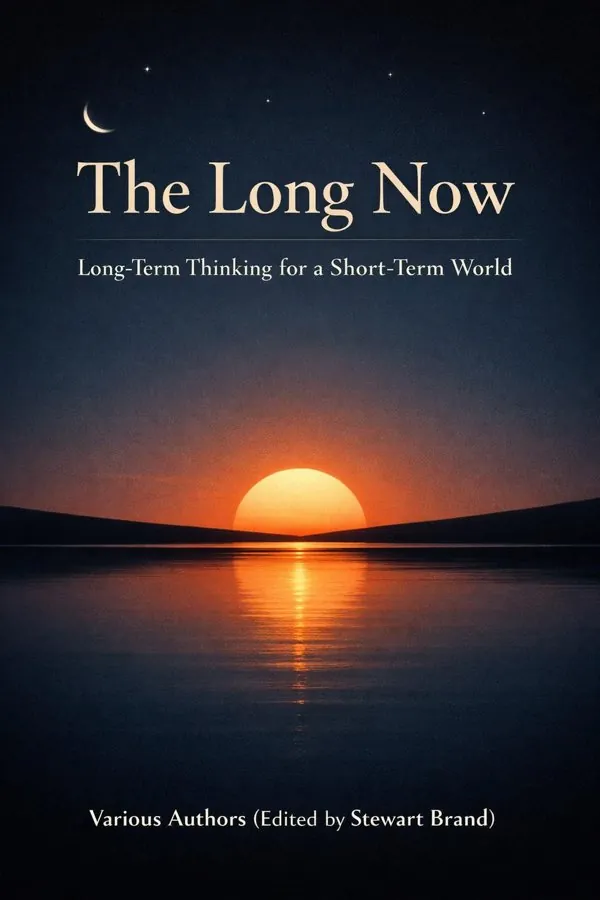
The Long Now: Long-Term Thinking for a Short-Term World: Summary & Key Insights
by Various Authors (Edited by Stewart Brand)
 10 min9 chaptersAudio available
What Is The Long Now: Long-Term Thinking for a Short-Term World About?
The Long Now: Long-Term Thinking for a Short-Term World by Various Authors (Edited by Stewart Brand) is a future_trends book spanning 9 pages. A collection of essays and reflections exploring the concept of long-term thinking and responsibility for the future, inspired by the Long Now Foundation’s mission to foster slower, deeper, and more durable perspectives in a fast-paced world.
This FizzRead summary covers all 9 key chapters of The Long Now: Long-Term Thinking for a Short-Term World in approximately 10 minutes, distilling the most important ideas, arguments, and takeaways from Various Authors (Edited by Stewart Brand)'s work. Also available as an audio summary and Key Quotes Podcast.
The Long Now: Long-Term Thinking for a Short-Term World
A collection of essays and reflections exploring the concept of long-term thinking and responsibility for the future, inspired by the Long Now Foundation’s mission to foster slower, deeper, and more durable perspectives in a fast-paced world.
Who Should Read The Long Now: Long-Term Thinking for a Short-Term World?
This book is perfect for anyone interested in future_trends and looking to gain actionable insights in a short read. Whether you're a student, professional, or lifelong learner, the key ideas from The Long Now: Long-Term Thinking for a Short-Term World by Various Authors (Edited by Stewart Brand) will help you think differently.
- ✓Readers who enjoy future_trends and want practical takeaways
- ✓Professionals looking to apply new ideas to their work and life
- ✓Anyone who wants the core insights of The Long Now: Long-Term Thinking for a Short-Term World in just 10 minutes
Want the full summary?
Get instant access to this book summary and 100K+ more with Fizz Moment.
Get Free SummaryAvailable on App Store • Free to download
Key Chapters
Modern culture did not choose short-term thinking consciously—it evolved into it through technology, economics, and politics that reward immediate results. In the book, several contributors trace this history back to the industrial and information revolutions, when speed became synonymous with progress. As Stewart Brand and others reflect, civilization’s pace increased while its attention span contracted. Democratic institutions, the media, and financial markets learned to value acceleration, leading individuals to measure success by quarterly returns or instant fame.
These essays explore how short-termism created an illusion of control. When your metrics are short, you appear active and decisive. But beneath the surface, such behavior erodes sustainability and foresight. Contributors point out that when governments strategize only through the next election cycle, infrastructure and education suffer. When corporations pursue next-quarter profits, long-term innovation dies. Technology’s acceleration amplifies this tendency—an environment of constant updates and obsolescence drives an existential restlessness.
From my perspective, this isn’t a moral failing so much as an evolutionary misstep. We adapted well to short feedback loops, the immediate cause and effect that defined survival. But now those instincts operate in global systems whose real consequences unfold over centuries. The essays serve as a warning: impatience has become systemic, and awareness of time is civilization’s missing technology. Understanding that cultural disease is the first step toward curing it.
When we founded the Long Now Foundation, our aim was to create cultural mechanisms that fostered responsibility across millennia. The name itself proposes a new scale for thinking: the 'long now' stretches the moment we inhabit into a 20,000-year frame—10,000 years back, 10,000 years forward. Inside that timespan, our brief lives take on richer context, reminding us that humans stand not at the apex of time but within an ongoing narrative.
The essays describe projects designed to anchor this mindset. Chief among them is the Clock of the Long Now—a timepiece conceived to keep accurate time for 10,000 years, ticking once a year, with a bell that rings once every millennium. The clock is both a technological challenge and a cultural gesture: a monument to patience and continuity in an age ruled by disposability. Building it forced us to ask fundamental questions: what materials endure? what societal structure supports maintenance longer than any individual life?
Through this project and others—libraries of deep time, discussions on intergenerational equity—the Foundation models practical methods for embedding longer attention spans within institutions. It’s an ongoing experiment in re-teaching civilization to measure progress by durability rather than novelty. Our mission is not nostalgia; it’s innovation stretched along time’s axis.
+ 7 more chapters — available in the FizzRead app
All Chapters in The Long Now: Long-Term Thinking for a Short-Term World
About the Author
Stewart Brand is an American writer, environmentalist, and founder of the Whole Earth Catalog and the Long Now Foundation. He has been a leading advocate for long-term thinking and sustainable innovation.
Get This Summary in Your Preferred Format
Read or listen to the The Long Now: Long-Term Thinking for a Short-Term World summary by Various Authors (Edited by Stewart Brand) anytime, anywhere. FizzRead offers multiple formats so you can learn on your terms — all free.
Available formats: App · Audio · PDF · EPUB — All included free with FizzRead
Download The Long Now: Long-Term Thinking for a Short-Term World PDF and EPUB Summary
Key Quotes from The Long Now: Long-Term Thinking for a Short-Term World
“Modern culture did not choose short-term thinking consciously—it evolved into it through technology, economics, and politics that reward immediate results.”
“When we founded the Long Now Foundation, our aim was to create cultural mechanisms that fostered responsibility across millennia.”
Frequently Asked Questions about The Long Now: Long-Term Thinking for a Short-Term World
The Long Now: Long-Term Thinking for a Short-Term World by Various Authors (Edited by Stewart Brand) is a future_trends book that explores key ideas across 9 chapters. A collection of essays and reflections exploring the concept of long-term thinking and responsibility for the future, inspired by the Long Now Foundation’s mission to foster slower, deeper, and more durable perspectives in a fast-paced world.
You Might Also Like
Futureproof: 9 Rules for Humans in the Age of Automation
Kevin Roose
10 min
The Third Wave
Alvin Toffler
10 min
2030: How Today's Biggest Trends Will Collide and Reshape the Future of Everything
Mauro F. Guillén
10 min
A Very Human Future: Enriching Humanity in a Digitized World
Rohit Talwar, Steve Wells, Alexandra Whittington
10 min
AI 2041: Ten Visions for Our Future
Kai-Fu Lee, Chen Qiufan
10 min
Abundance: The Future Is Better Than You Think
Peter H. Diamandis, Steven Kotler
10 minBrowse by Category
Ready to read The Long Now: Long-Term Thinking for a Short-Term World?
Get the full summary and 100K+ more books with Fizz Moment.