
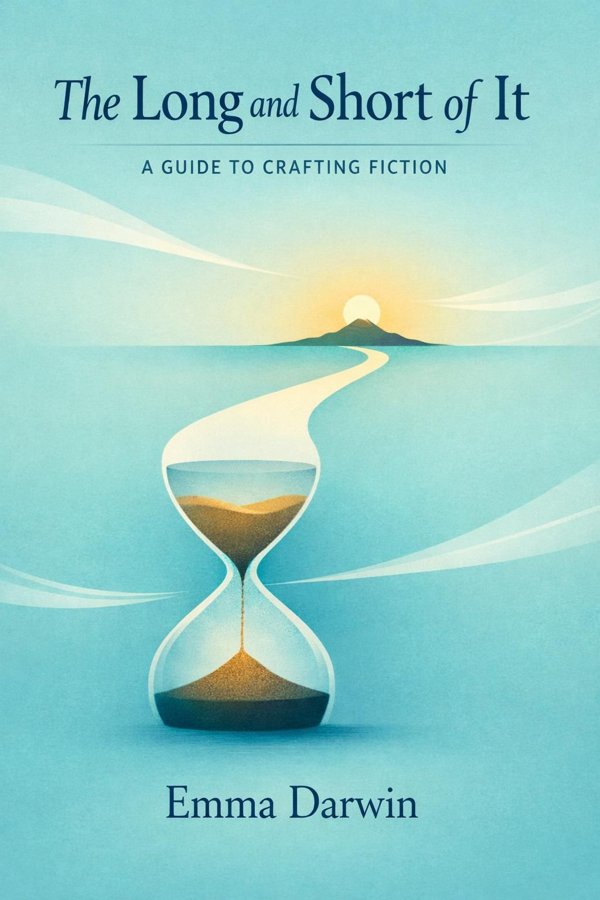
The Long and Short of It: A Guide to Crafting Fiction: Summary & Key Insights
by Emma Darwin
 10 min10 chaptersAudio available
What Is The Long and Short of It: A Guide to Crafting Fiction About?
The Long and Short of It: A Guide to Crafting Fiction by Emma Darwin is a writing book spanning 10 pages. This book offers practical guidance on the craft of fiction writing, focusing on how to shape narrative time, structure, and perspective. Emma Darwin, an experienced novelist and writing teacher, explores techniques for managing pace, tension, and emotional resonance in both short stories and novels. The work is widely used by creative writing students and professional authors seeking to refine their storytelling skills.
This FizzRead summary covers all 10 key chapters of The Long and Short of It: A Guide to Crafting Fiction in approximately 10 minutes, distilling the most important ideas, arguments, and takeaways from Emma Darwin's work. Also available as an audio summary and Key Quotes Podcast.
The Long and Short of It: A Guide to Crafting Fiction
This book offers practical guidance on the craft of fiction writing, focusing on how to shape narrative time, structure, and perspective. Emma Darwin, an experienced novelist and writing teacher, explores techniques for managing pace, tension, and emotional resonance in both short stories and novels. The work is widely used by creative writing students and professional authors seeking to refine their storytelling skills.
Who Should Read The Long and Short of It: A Guide to Crafting Fiction?
This book is perfect for anyone interested in writing and looking to gain actionable insights in a short read. Whether you're a student, professional, or lifelong learner, the key ideas from The Long and Short of It: A Guide to Crafting Fiction by Emma Darwin will help you think differently.
- ✓Readers who enjoy writing and want practical takeaways
- ✓Professionals looking to apply new ideas to their work and life
- ✓Anyone who wants the core insights of The Long and Short of It: A Guide to Crafting Fiction in just 10 minutes
Want the full summary?
Get instant access to this book summary and 100K+ more with Fizz Moment.
Get Free SummaryAvailable on App Store • Free to download
Key Chapters
When we speak of time in fiction, we inhabit two overlapping worlds. There’s *story time*: what happens, when, and how long it takes within the world of the story. And then there’s *narrative time*: the duration the story takes to *tell*. A single day in story time can take three chapters, while a decade can vanish in half a sentence. The health of your narrative depends on how these two move together.
Writers often confuse chronology with momentum. But momentum isn’t merely chronological—it’s emotional. A story can leap backward to a memory or forward to a prophecy and still feel urgent, provided we feel its inner necessity. Our task as writers is to ensure that the relationship between story and narrative time is alive with intention. When a moment slows, it must do so to reveal, not to drift. When it speeds, it must do so to propel.
Think of narrative time as a lens. You can zoom in—letting readers feel a heartbeat, a breath—or pull back, summarizing months in a line. This choice determines not merely pace but intimacy. A writer who controls time with awareness shapes the reader’s emotional rhythm: when to hold their breath, when to exhale.
So when you write, ask not only, 'What happens next?' but 'How long does it take us to experience this?' That unit of experience is where your story’s power truly lies.
A story’s length is not an afterthought; it’s part of its DNA. The short story and the novel handle time differently, not only because of word count but because of narrative philosophy. In the short story, time behaves like a spark—it must catch instantly, burn brightly, and vanish before it’s explained. In the novel, time is more architectural—it needs corridors, echoes, and rooms for reflection.
In my own practice and teaching, I often encourage writers to discover what their story naturally demands. Some ideas bloom briefly, like wildflowers; others require the slow cultivation of an orchard. Forcing a short story to behave like a novel, or vice versa, is one of the common ways we strip away vitality from our writing.
What’s essential is to let form and length speak to each other. A story’s brevity should amplify its precision; its length should expand its complexity. If the short form is about compression, the long form is about orchestration. The writer’s mission is not to inflate or constrain but to let the story find its natural volume.
Ultimately, the form you choose teaches you how to handle time. A short piece thrives on suggestion, omission, and impressionistic leaps through time. A novel thrives on accumulation, layers, and cycles. Understanding both gives you fluency in time’s grammar, enabling you to craft stories of any scale with equal authority.
+ 8 more chapters — available in the FizzRead app
All Chapters in The Long and Short of It: A Guide to Crafting Fiction
About the Author
Emma Darwin is a British novelist and writing coach known for her works 'The Mathematics of Love' and 'A Secret Alchemy'. She teaches creative writing and has contributed extensively to the study of narrative craft through her blog and workshops.
Get This Summary in Your Preferred Format
Read or listen to the The Long and Short of It: A Guide to Crafting Fiction summary by Emma Darwin anytime, anywhere. FizzRead offers multiple formats so you can learn on your terms — all free.
Available formats: App · Audio · PDF · EPUB — All included free with FizzRead
Download The Long and Short of It: A Guide to Crafting Fiction PDF and EPUB Summary
Key Quotes from The Long and Short of It: A Guide to Crafting Fiction
“When we speak of time in fiction, we inhabit two overlapping worlds.”
“A story’s length is not an afterthought; it’s part of its DNA.”
Frequently Asked Questions about The Long and Short of It: A Guide to Crafting Fiction
The Long and Short of It: A Guide to Crafting Fiction by Emma Darwin is a writing book that explores key ideas across 10 chapters. This book offers practical guidance on the craft of fiction writing, focusing on how to shape narrative time, structure, and perspective. Emma Darwin, an experienced novelist and writing teacher, explores techniques for managing pace, tension, and emotional resonance in both short stories and novels. The work is widely used by creative writing students and professional authors seeking to refine their storytelling skills.
You Might Also Like
The Art of Perspective
Christopher Castellani
10 min
Making a Point: The Persnickety Story of English Punctuation
David Crystal
10 min
The Elements Of Eloquence: How To Turn The Perfect English Phrase
Mark Forsyth
10 min
The Pocket Muse: Ideas and Inspirations for Writing
Monica Wood
10 min
A Little Book on Form: An Exploration into the Formal Imagination of Poetry
Robert Hass
10 min
Adventures In The Screen Trade: A Personal View Of Hollywood And Screenwriting
William Goldman
10 minBrowse by Category
Ready to read The Long and Short of It: A Guide to Crafting Fiction?
Get the full summary and 100K+ more books with Fizz Moment.