
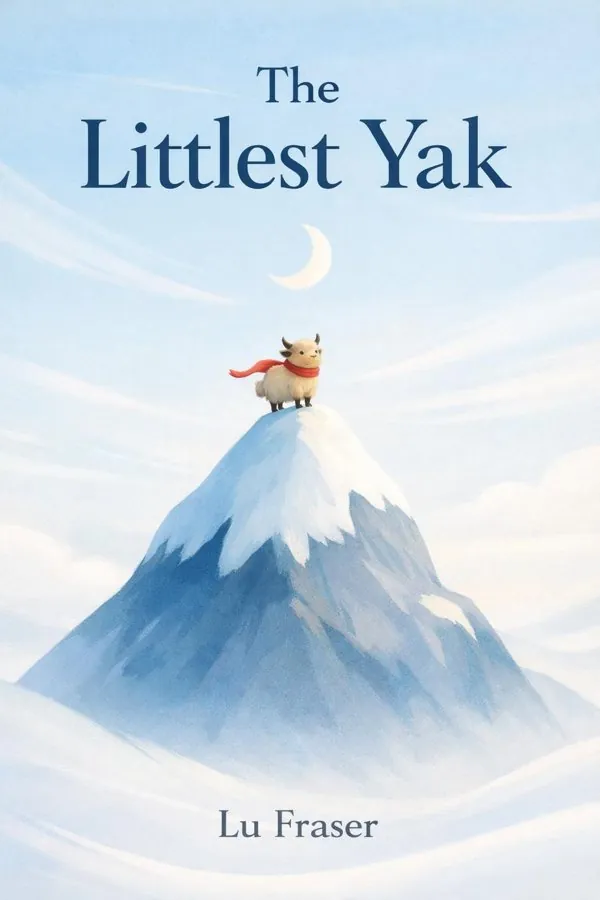
The Littlest Yak: Summary & Key Insights
by Lu Fraser
 10 min8 chaptersAudio available
Key Takeaways from The Littlest Yak
The desire to be different often begins with comparison.
Feeling loved is not always the same as feeling understood.
What adults see as a phase, children often experience as a defining truth.
Growth rarely arrives through wishing alone; it often comes through meeting a challenge.
We often confuse visible strength with real strength.
What Is The Littlest Yak About?
The Littlest Yak by Lu Fraser is a parenting book spanning 4 pages. Some of the most important lessons children learn do not come from grand adventures, but from small emotional moments that feel deeply true. The Littlest Yak by Lu Fraser is one of those stories. Set high in a snowy mountain landscape, this charming picture book follows Gertie, the smallest yak in her herd, as she wrestles with a feeling many readers instantly recognize: the belief that being bigger, older, faster, or stronger would make everything easier. Gertie wants to keep up. She wants to be capable. Most of all, she wants to feel enough. What makes this book matter is its gentle understanding of childhood insecurity. Rather than dismissing Gertie’s frustration, Fraser treats it with warmth and respect, showing how comparison can cloud self-worth and how confidence often grows through experience rather than reassurance alone. The story’s playful rhymes and emotional clarity make it appealing to very young readers, while its message resonates just as strongly with parents, caregivers, and educators. Fraser, known for writing lyrical, emotionally intelligent children’s books, has a gift for turning everyday feelings into memorable stories. The Littlest Yak is a tender celebration of self-acceptance, resilience, and discovering that small does not mean lesser.
This FizzRead summary covers all 8 key chapters of The Littlest Yak in approximately 10 minutes, distilling the most important ideas, arguments, and takeaways from Lu Fraser's work. Also available as an audio summary and Key Quotes Podcast.
The Littlest Yak
Some of the most important lessons children learn do not come from grand adventures, but from small emotional moments that feel deeply true. The Littlest Yak by Lu Fraser is one of those stories. Set high in a snowy mountain landscape, this charming picture book follows Gertie, the smallest yak in her herd, as she wrestles with a feeling many readers instantly recognize: the belief that being bigger, older, faster, or stronger would make everything easier. Gertie wants to keep up. She wants to be capable. Most of all, she wants to feel enough.
What makes this book matter is its gentle understanding of childhood insecurity. Rather than dismissing Gertie’s frustration, Fraser treats it with warmth and respect, showing how comparison can cloud self-worth and how confidence often grows through experience rather than reassurance alone. The story’s playful rhymes and emotional clarity make it appealing to very young readers, while its message resonates just as strongly with parents, caregivers, and educators. Fraser, known for writing lyrical, emotionally intelligent children’s books, has a gift for turning everyday feelings into memorable stories. The Littlest Yak is a tender celebration of self-acceptance, resilience, and discovering that small does not mean lesser.
Who Should Read The Littlest Yak?
This book is perfect for anyone interested in parenting and looking to gain actionable insights in a short read. Whether you're a student, professional, or lifelong learner, the key ideas from The Littlest Yak by Lu Fraser will help you think differently.
- ✓Readers who enjoy parenting and want practical takeaways
- ✓Professionals looking to apply new ideas to their work and life
- ✓Anyone who wants the core insights of The Littlest Yak in just 10 minutes
Want the full summary?
Get instant access to this book summary and 100K+ more with Fizz Moment.
Get Free SummaryAvailable on App Store • Free to download
Key Chapters
The desire to be different often begins with comparison. At the opening of The Littlest Yak, Gertie looks up at the older, bigger yaks around her and sees not just their size, but what she believes their size represents: competence, confidence, and belonging. She is little, and in her mind, little means limited. Fraser captures a feeling common to children everywhere—the impatience of wanting to skip ahead to the version of yourself that seems more capable.
Gertie’s longing to grow is not vanity. It is a deeply human wish to feel ready for the world. She watches others walking with ease, handling mountain life with apparent certainty, and concludes that her smallness is a problem that needs fixing. This is what makes the story so emotionally accurate. Children often do not simply want to be older; they want the freedom, respect, and ability they imagine older children possess.
For parents and caregivers, Gertie’s early frustration is a useful reminder that a child’s complaints about being “too small” or “not big enough” usually mask a deeper need for confidence and participation. A child who cannot zip a coat, reach a shelf, or keep up on a walk may not need correction so much as empathy and support.
In everyday life, this can mean naming the feeling without dismissing it: “You wish you could do what they do already.” It can also mean offering age-appropriate responsibility so children feel growth happening in real time.
Actionable takeaway: When a child expresses frustration about being small or behind, respond first to the emotion, then help them notice what they can do now instead of focusing only on what comes later.
Feeling loved is not always the same as feeling understood. As Gertie moves through life with her herd, her disappointment deepens because the larger yaks seem comfortable in a world that constantly reminds her of her limitations. They are not cruel, but they do not fully grasp how intensely she experiences being the smallest. That gap between external care and internal loneliness is one of the book’s quiet emotional strengths.
Children often live inside this gap. Adults may assume a child is fine because they are surrounded by affection, yet the child may still feel invisible in one specific struggle. Gertie’s herd carries on with climbing, grazing, and resting, while she privately wrestles with envy and discouragement. Fraser shows that insecurity can grow even in loving environments when a child believes no one really sees the problem from their perspective.
This idea matters in parenting because children do not always need a solution first; they need attunement. A child who says, “Nobody gets it,” is often asking to have their difficulty witnessed. The adults around them may be supportive in general, but if they move too quickly into encouragement—“You’re fine,” “You’ll grow,” “Don’t worry”—they may accidentally skip over the child’s real experience.
A practical response is to become more specific and observant. Instead of broad reassurance, try: “It looks frustrating when everyone else can step over that rock and you have to work harder.” Such comments communicate, “I see your challenge, and your feelings make sense.” That recognition can lower emotional intensity and build trust.
Actionable takeaway: When a child feels discouraged, avoid generic comfort alone; show them you understand the exact struggle they are facing, because feeling seen is often the first step toward feeling stronger.
What adults see as a phase, children often experience as a defining truth. One reason The Littlest Yak connects so deeply is that it understands scale from a child’s point of view. To the outside world, Gertie is simply a little yak who will grow in time. To Gertie, however, being small shapes everything—how she moves, what she can reach, how others treat her, and how she sees herself.
This is an important insight for anyone raising or teaching children. Young children live in the present tense. They do not always find comfort in the promise that things will be easier “one day.” If they are struggling now, the future can feel abstract and unhelpful. Gertie’s emotional world reminds us that childhood frustrations are not miniature versions of real problems; for children, they are real problems.
This perspective shift has practical value. When a child melts down because they cannot keep pace with siblings, pour their own drink, or complete a task independently, adults may feel tempted to minimize it. Yet treating the challenge as meaningful helps children regulate more effectively. You can acknowledge the problem while still offering perspective: “This is hard right now, and you are still learning.” That phrase respects the present without trapping the child in it.
The story also encourages adults to look for repeated moments where a child feels small socially, not just physically. Being interrupted, overlooked, or constantly helped can reinforce a sense of inadequacy. Giving children chances to lead, decide, and contribute can counterbalance that feeling.
Actionable takeaway: Treat a child’s “small” frustrations as significant to them, and respond in ways that honor the present challenge while reinforcing that growth is already underway.
Growth rarely arrives through wishing alone; it often comes through meeting a challenge. In the turning point of The Littlest Yak, Gertie faces a mountain moment that forces her beyond comparison and into action. Instead of simply thinking about what she lacks, she must use what she has. This shift is crucial. Confidence does not usually appear because someone tells us we are enough. It appears when experience gives us evidence that we can cope.
Fraser uses the mountain setting beautifully here. The landscape itself symbolizes effort, uncertainty, and the demands of life. Gertie cannot become bigger on command, but she can discover that courage, alertness, persistence, and problem-solving are not reserved for the largest members of the herd. In fact, what seems like a disadvantage may contain hidden strengths. Her smaller size may shape how she moves, notices, or responds.
This is a valuable parenting lesson. Children build self-belief through manageable risk, not protection from every difficulty. A child who is always rescued before trying may remain convinced they are incapable. By contrast, when adults create safe opportunities for effort—climbing a little higher, carrying something small, helping with a real task, speaking for themselves—the child gathers proof of competence.
The key is calibration. The challenge should stretch a child without overwhelming them. Too much difficulty leads to panic; too little leads to dependence. Gertie’s story models the kind of challenge that reveals ability rather than crushing it.
Actionable takeaway: Give children age-appropriate chances to struggle productively, because the most durable confidence comes from discovering, through action, that they can do hard things even before they feel fully ready.
We often confuse visible strength with real strength. One of the book’s most powerful messages is that bravery is not measured in height, age, or physical presence. Gertie assumes the bigger yaks are naturally more capable because they look the part. But the story gradually reveals a deeper truth: courage belongs to the one who keeps going despite fear, uncertainty, or disadvantage.
This distinction matters for children who do not see themselves as the “big,” “loud,” or “naturally confident” ones. Many children assume that courage means feeling bold from the start. Fraser offers a healthier definition. Courage is not the absence of self-doubt; it is movement in spite of it. Gertie does not need to become someone else to be brave. She only needs the chance to act from where she is.
For adults, this creates a better language for praise. Instead of complimenting fixed traits—“You’re so strong,” “You’re fearless,” “You’re the brave one”—we can highlight effort and choices: “You were nervous and still tried,” “You kept going when it felt hard,” “You asked for help and stayed with it.” This helps children understand bravery as accessible rather than innate.
It also supports quieter children who may be overlooked because their courage is less dramatic. A child who joins a group slowly, attempts a new food reluctantly, or sleeps in their own bed after weeks of hesitation is showing real bravery. When we name those moments, children begin to recognize their own strength.
Actionable takeaway: Teach children that courage is not about appearing big or fearless; it is about taking the next step even when they feel small, unsure, or afraid.
One of childhood’s deepest fears is that difference might lead to exclusion. Gertie worries, in effect, that because she is smaller than the others, she is somehow less complete or less fitted to the life of the herd. The emotional arc of The Littlest Yak pushes gently against that belief. Belonging does not come from matching everyone else. It comes from being valued within the group as you are.
This is an especially helpful message in families with multiple children. Siblings often measure themselves against one another—who is taller, faster, louder, calmer, better at school, or more independent. Without meaning to, adults can reinforce these comparisons through labels such as “the sporty one,” “the baby,” or “the sensitive one.” Gertie’s story reminds us that children need to feel they have a place that is not conditional on becoming more like someone else.
A practical application is to celebrate contribution over comparison. Instead of saying, “Look how your sister can do it,” we can say, “Here is what you bring,” or “This is the way you did it.” In classrooms and homes alike, children thrive when individuality is seen as part of the group’s strength rather than a deviation from the norm.
The story also offers a subtle model for inclusive belonging: the herd does not have to erase Gertie’s differences for her to matter. Her journey leads her to discover that she can participate meaningfully without becoming a copy of the bigger yaks. That is a lesson many children need to hear repeatedly.
Actionable takeaway: Help children see that they do not have to match others to belong; regularly name the unique qualities and contributions that make their presence valuable in the family or community.
Self-acceptance becomes possible when a child realizes that worth is not postponed until some future version of the self arrives. In the resolution of The Littlest Yak, Gertie’s transformation is not simply that she feels happier. It is that she begins to understand a radical idea for any child: she does not need to be bigger in order to be enough. This is the emotional heart of the book.
Many children live with hidden conditions for self-worth. They believe they will feel good about themselves when they are older, taller, better at reading, less shy, more athletic, or more like someone they admire. Adults do this too. Fraser gently interrupts that pattern by showing that growth in self-understanding can happen before external change does. Gertie may still be the littlest yak, but “littlest” no longer means least.
This message is especially useful in parenting cultures that overemphasize achievement. Children can begin to think their value depends on speed, performance, or early mastery. Books like this restore a more humane truth: development is not a race, and identity should not be reduced to a deficit. Being in process does not make a child inadequate.
One practical application is to watch for language that ties worth to future improvement. Instead of saying, “When you’re bigger, you’ll be able to help,” try, “Here’s how you can help now.” Instead of, “One day you’ll be brave,” say, “You are practicing bravery already.” Such shifts anchor dignity in the present.
Actionable takeaway: Reinforce the idea that children are already worthy and capable of meaningful participation now, not only after they become older, bigger, or better at something.
The way a story sounds can shape how a child receives its message. Part of The Littlest Yak’s appeal lies in Lu Fraser’s use of lively rhyme and musical language. The rhythm gives the story warmth and momentum, but it also does something more subtle: it creates emotional safety. Hard feelings—envy, frustration, insecurity—become easier for children to approach when they are held inside playful, predictable language.
This matters because young readers often process emotion indirectly. A child may not sit down for a direct lesson about self-esteem, but they will eagerly enter a rhyming story about a little yak in the snow. Through sound, repetition, and humor, the book lowers defensiveness and invites reflection. Children can recognize themselves in Gertie without feeling exposed.
Parents and educators can apply this principle beyond reading time. Songs, rhymes, repeated phrases, and familiar storytelling patterns help children absorb difficult lessons more gently. A recurring family phrase like “little doesn’t mean less” or “you can try in your own way” can become a comforting internal script over time. Re-reading beloved books also matters. Children often revisit the same story because repetition builds mastery—not just over the words, but over the emotions the story contains.
The book’s accessible style makes it especially useful for conversations after reading. Adults can ask simple, open questions: “Why did Gertie want to be bigger?” “Have you ever felt like that?” “What did she learn?” The rhyme may entertain, but it also opens the door to emotional literacy.
Actionable takeaway: Use rhythmic, repeated language and re-read emotionally rich stories often, because children internalize reassurance more deeply when it comes through familiar, pleasurable patterns.
All Chapters in The Littlest Yak
About the Author
Lu Fraser is a British children’s author celebrated for her lively read-aloud style, playful rhyme, and emotionally perceptive storytelling. Her books often center on themes that matter deeply to young readers, including belonging, self-confidence, friendship, kindness, and the challenge of growing into oneself. Fraser has a gift for taking familiar childhood feelings—such as frustration, jealousy, or uncertainty—and shaping them into stories that feel both comforting and memorable. That balance of warmth, humor, and emotional honesty has made her work popular with families, teachers, and librarians. In The Littlest Yak, she demonstrates the qualities for which she is best known: musical language, a lovable central character, and a message that reassures children they are valuable exactly as they are, even while they are still learning and growing.
Get This Summary in Your Preferred Format
Read or listen to the The Littlest Yak summary by Lu Fraser anytime, anywhere. FizzRead offers multiple formats so you can learn on your terms — all free.
Available formats: App · Audio · PDF · EPUB — All included free with FizzRead
Download The Littlest Yak PDF and EPUB Summary
Key Quotes from The Littlest Yak
“The desire to be different often begins with comparison.”
“Feeling loved is not always the same as feeling understood.”
“What adults see as a phase, children often experience as a defining truth.”
“Growth rarely arrives through wishing alone; it often comes through meeting a challenge.”
“We often confuse visible strength with real strength.”
Frequently Asked Questions about The Littlest Yak
The Littlest Yak by Lu Fraser is a parenting book that explores key ideas across 8 chapters. Some of the most important lessons children learn do not come from grand adventures, but from small emotional moments that feel deeply true. The Littlest Yak by Lu Fraser is one of those stories. Set high in a snowy mountain landscape, this charming picture book follows Gertie, the smallest yak in her herd, as she wrestles with a feeling many readers instantly recognize: the belief that being bigger, older, faster, or stronger would make everything easier. Gertie wants to keep up. She wants to be capable. Most of all, she wants to feel enough. What makes this book matter is its gentle understanding of childhood insecurity. Rather than dismissing Gertie’s frustration, Fraser treats it with warmth and respect, showing how comparison can cloud self-worth and how confidence often grows through experience rather than reassurance alone. The story’s playful rhymes and emotional clarity make it appealing to very young readers, while its message resonates just as strongly with parents, caregivers, and educators. Fraser, known for writing lyrical, emotionally intelligent children’s books, has a gift for turning everyday feelings into memorable stories. The Littlest Yak is a tender celebration of self-acceptance, resilience, and discovering that small does not mean lesser.
You Might Also Like
Never Enough
Jennifer Breheny Wallace
10 min
Bluey: Sleepytime
Joe Brumm
10 min
In My Heart: A Book of Feelings
Jo Witek
10 min
Love From The Crayons
Drew Daywalt, Oliver Jeffers
10 min
Pete The Cat: Big Easter Adventure
James Dean, Kimberly Dean
10 min
Smart Money Smart Kids: Raising the Next Generation to Win with Money
Dave Ramsey, Rachel Cruze
10 minBrowse by Category
Ready to read The Littlest Yak?
Get the full summary and 100K+ more books with Fizz Moment.