
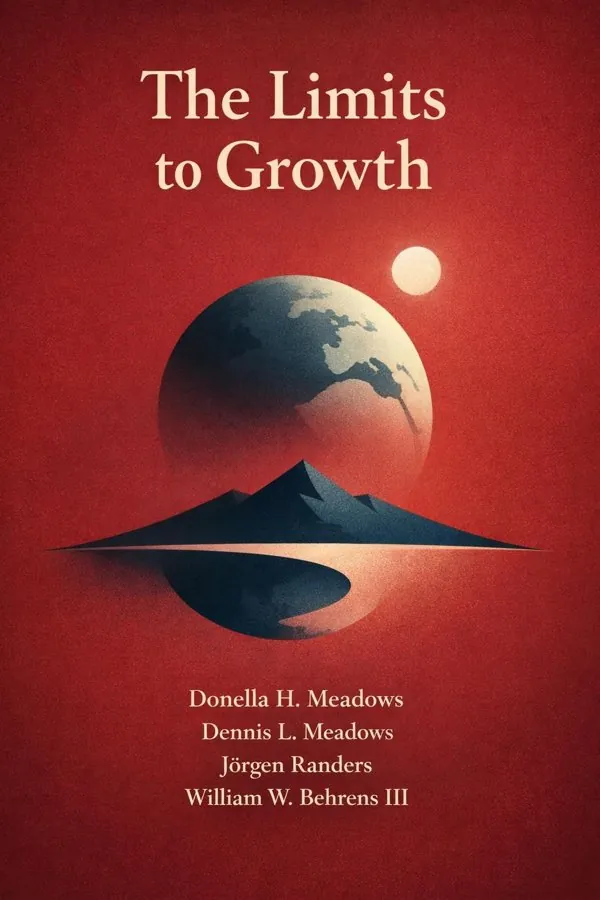
The Limits to Growth: A Report for the Club of Rome's Project on the Predicament of Mankind: Summary & Key Insights
by Donella H. Meadows, Dennis L. Meadows, Jørgen Randers, William W. Behrens III
 10 min9 chaptersAudio available
Key Takeaways from The Limits to Growth: A Report for the Club of Rome's Project on the Predicament of Mankind
The most dangerous mistakes often come from treating connected problems as if they were separate.
One of the book’s most powerful insights is that exponential growth feels harmless at first.
A finite planet does not care about human optimism, ideology, or market confidence.
The future is not a single destination; it is a range of possibilities shaped by choices, delays, and system behavior.
This result appears in the standard run, the scenario that assumes no major shift in values or structural policy.
What Is The Limits to Growth: A Report for the Club of Rome's Project on the Predicament of Mankind About?
The Limits to Growth: A Report for the Club of Rome's Project on the Predicament of Mankind by Donella H. Meadows, Dennis L. Meadows, Jørgen Randers, William W. Behrens III is a environment book spanning 8 pages. What happens when endless economic and population growth meets a planet with finite land, energy, and resources? That is the unsettling question at the heart of The Limits to Growth, one of the most influential environmental books of the twentieth century. First published in 1972, the book presents the findings of an MIT research team commissioned by the Club of Rome to examine the long-term consequences of global expansion. Using a computer model called World3, the authors explored how population, industrial output, food production, resource depletion, and pollution interact over time. The book matters because it shifted the debate from isolated problems to whole systems. Instead of asking whether one resource might run short, it asked how multiple pressures reinforce one another and create instability. Donella H. Meadows, Dennis L. Meadows, Jørgen Randers, and William W. Behrens III brought together expertise in systems analysis, management, and environmental thinking to produce a work that remains strikingly relevant in an age of climate change, ecological overshoot, and recurring economic stress. It is not a prophecy of doom, but a warning that humanity must learn to live within planetary boundaries.
This FizzRead summary covers all 9 key chapters of The Limits to Growth: A Report for the Club of Rome's Project on the Predicament of Mankind in approximately 10 minutes, distilling the most important ideas, arguments, and takeaways from Donella H. Meadows, Dennis L. Meadows, Jørgen Randers, William W. Behrens III's work. Also available as an audio summary and Key Quotes Podcast.
The Limits to Growth: A Report for the Club of Rome's Project on the Predicament of Mankind
What happens when endless economic and population growth meets a planet with finite land, energy, and resources? That is the unsettling question at the heart of The Limits to Growth, one of the most influential environmental books of the twentieth century. First published in 1972, the book presents the findings of an MIT research team commissioned by the Club of Rome to examine the long-term consequences of global expansion. Using a computer model called World3, the authors explored how population, industrial output, food production, resource depletion, and pollution interact over time.
The book matters because it shifted the debate from isolated problems to whole systems. Instead of asking whether one resource might run short, it asked how multiple pressures reinforce one another and create instability. Donella H. Meadows, Dennis L. Meadows, Jørgen Randers, and William W. Behrens III brought together expertise in systems analysis, management, and environmental thinking to produce a work that remains strikingly relevant in an age of climate change, ecological overshoot, and recurring economic stress. It is not a prophecy of doom, but a warning that humanity must learn to live within planetary boundaries.
Who Should Read The Limits to Growth: A Report for the Club of Rome's Project on the Predicament of Mankind?
This book is perfect for anyone interested in environment and looking to gain actionable insights in a short read. Whether you're a student, professional, or lifelong learner, the key ideas from The Limits to Growth: A Report for the Club of Rome's Project on the Predicament of Mankind by Donella H. Meadows, Dennis L. Meadows, Jørgen Randers, William W. Behrens III will help you think differently.
- ✓Readers who enjoy environment and want practical takeaways
- ✓Professionals looking to apply new ideas to their work and life
- ✓Anyone who wants the core insights of The Limits to Growth: A Report for the Club of Rome's Project on the Predicament of Mankind in just 10 minutes
Want the full summary?
Get instant access to this book summary and 100K+ more with Fizz Moment.
Get Free SummaryAvailable on App Store • Free to download
Key Chapters
The most dangerous mistakes often come from treating connected problems as if they were separate. That insight drives the construction of World3, the computer model at the center of The Limits to Growth. The authors did not try to reproduce every detail of the real world. Instead, they built a simplified systems model that captured the relationships among five large global variables: population, industrial production, food production, nonrenewable resources, and pollution. The purpose was not precision in every short-term forecast, but clarity about long-term patterns.
World3 works by tracing feedback loops. Population growth raises demand for food, energy, housing, and manufactured goods. More industrial output can improve living standards, but it also consumes resources and generates pollution. Pollution can harm health and agriculture. Declining resources can increase extraction costs, reducing the capital available for food, services, or further production. These interactions create delays, amplifications, and unintended consequences that are difficult to grasp intuitively.
This systems approach matters because many modern crises still emerge from the same blind spot. A government may pursue growth without considering water stress. A company may optimize production while ignoring waste. A city may expand housing while neglecting transport and energy constraints. In each case, success in one area can generate strain elsewhere.
The model teaches a practical lesson: when managing complex problems, look for structure, not just events. Ask what variables are linked, where feedback loops exist, and which delayed effects may be hiding beneath current success. The actionable takeaway is simple: before scaling any policy, business, or infrastructure system, map its key dependencies and likely feedbacks, because what looks like progress in isolation may become failure in the whole.
One of the book’s most powerful insights is that exponential growth feels harmless at first. A quantity growing by a constant percentage each year does not rise in a straight line; it compounds. Population, capital stock, pollution, and industrial output can all grow this way. Early increases seem manageable, even beneficial. But after enough doubling cycles, the scale becomes enormous, and systems built for slower change begin to break.
The authors emphasize that human intuition is poorly suited to exponential processes. People tend to think linearly. If a city gains a little population each year, it appears to be a gradual challenge. Yet if population doubles within a few decades, demands on food systems, housing, roads, schools, health care, and energy can suddenly outpace planning capacity. The same is true for resource extraction and waste generation. What was once a minor pressure can become overwhelming simply because the base has grown.
A practical way to understand this is to look at compound interest, viral spread, or electricity demand from rapidly digitalizing economies. A business enjoying 7 percent annual growth may celebrate the trend without noticing how quickly it multiplies material needs. A nation may welcome rising consumption without asking whether the supporting ecosystems can keep up. By the time stress becomes visible, correction is often costly.
The book’s message is not that all growth is evil. It is that exponential growth on a finite planet cannot continue forever in physical terms. The actionable takeaway is to examine any system growing steadily by percentages, then ask: what doubles, how fast, and what hard limits or social costs appear when it does? Decision-makers who understand doubling time gain a vital tool for avoiding future crises.
A finite planet does not care about human optimism, ideology, or market confidence. This is the blunt reality behind the book’s concept of limits. The Earth contains bounded stocks of nonrenewable resources, limited capacity to absorb pollution, and ecosystems that can regenerate only so fast. Economic systems may expand rapidly, but the biophysical foundation beneath them does not become infinite simply because technology improves or demand rises.
The authors do not argue that humanity will suddenly run out of everything at once. Their point is more subtle and more important: limits emerge through interaction. Resources become harder and more expensive to extract. Soil can be degraded faster than it recovers. Fisheries can be depleted beyond their ability to regenerate. Air and water pollution can accumulate until health and productivity decline. In each case, the limit may first appear as falling efficiency, rising costs, or declining resilience rather than absolute exhaustion.
This framework remains highly practical. Consider groundwater depletion in agriculture, congestion in growing cities, or climate change driven by fossil fuel use. These are all examples of systems pushing against ecological thresholds. Even when substitutes exist, transitions take time, capital, and institutional capacity. Delaying action until scarcity becomes obvious often means acting too late.
The book challenges the comforting belief that markets alone will solve every constraint. Prices can signal scarcity, but they cannot instantly restore ecosystems or undo accumulated damage. The actionable takeaway is to identify where your community, organization, or country depends on finite resources or fragile sinks, then build plans around conservation, substitution, regeneration, and reduced throughput before those limits tighten into crisis.
The future is not a single destination; it is a range of possibilities shaped by choices, delays, and system behavior. That is why The Limits to Growth relies on scenarios rather than fixed predictions. The authors used World3 to test different assumptions about population trends, resource availability, pollution controls, technological improvements, and social priorities. The goal was not to say exactly what year a collapse would happen, but to understand what kinds of outcomes emerge when growth meets limits under different conditions.
This is one of the book’s most misunderstood contributions. Critics often treated its scenarios as rigid prophecies. In reality, the method is closer to strategic stress-testing. If current trends continue, what is the likely pattern? If technology improves, does that solve the problem or merely delay it? If society acts early to stabilize growth and reduce pollution, can it avoid overshoot? Scenarios help decision-makers see the consequences of assumptions that usually remain invisible.
The value of scenario thinking is obvious today in climate policy, public health, energy planning, and business strategy. A company may prepare for low-demand and high-demand futures. A city may model heat stress, sea-level rise, and migration. A government may test food security under drought conditions. Scenarios do not eliminate uncertainty, but they make it manageable by turning vague fears into structured possibilities.
The key lesson is to stop asking, “What will happen?” and start asking, “What happens if we continue this pattern?” and “What changes if we intervene early?” The actionable takeaway is to build at least three scenarios for any long-term plan: business as usual, technology-improved continuation, and deliberate sustainability transition. Then compare where each path becomes unstable.
Perhaps the book’s most famous conclusion is also its most unsettling: if prevailing growth trends in population, industrialization, pollution, food production, and resource use continue unchanged, global society is likely to overshoot ecological limits and then decline. This result appears in the standard run, the scenario that assumes no major shift in values or structural policy. Growth continues for a time, often longer than people expect, which creates a false sense of security. Then the system’s hidden constraints begin to bite.
Overshoot occurs when a society expands beyond what its support systems can sustain. It can happen because resources are depleted, pollution accumulates, agricultural yields fall, or investment is diverted from maintenance to crisis response. The crucial insight is that overshoot is often driven by delays. People continue building factories, expanding cities, and increasing consumption because the damage is not yet visible. By the time the warning signs are clear, the system has already gone too far.
This pattern is easy to recognize in modern life. Credit bubbles expand before crashing. Fisheries collapse after years of strong catches. Traffic systems function until congestion becomes chronic. Carbon emissions create warming with delayed but lasting effects. In all these cases, apparent strength masks structural fragility.
The standard run is not a prediction that history must obey. It is a warning about what inertia produces. Systems do not remain stable just because they have been stable so far. The actionable takeaway is to treat smooth growth trends with suspicion. Ask whether current success depends on depleting stocks, overloading sinks, or postponing maintenance. If it does, the goal is not faster growth but earlier correction.
One of the book’s most important and controversial arguments is that technological progress, though essential, is not a magic escape from biophysical limits. The authors tested scenarios in which resources were more abundant, pollution controls were stronger, and agricultural productivity improved. In many cases, these advances delayed crisis but did not eliminate it. Why? Because efficiency gains inside a growth-driven system can be overwhelmed by the scale of continued expansion.
This does not mean the authors reject innovation. Quite the opposite. Better technology can reduce harm, improve productivity, and buy precious time. But if lower costs or higher output simply encourage more total consumption, the system may still overshoot. This is the core problem of pursuing efficiency without sufficiency. Cleaner production helps, but not if the volume of production keeps rising faster than environmental pressure falls.
Modern examples make the point clear. Cars have become more efficient, yet transport emissions remain high in many places because total travel has grown. Agriculture has increased yields, yet soil erosion, biodiversity loss, and water depletion continue under intensive farming. Data centers can become greener, but digital demand may still drive rising energy use.
The authors push readers to distinguish between relative improvements and absolute reductions. A product that uses fewer materials per unit is not enough if overall material throughput keeps increasing. The actionable takeaway is to pair innovation with limits, goals, and metrics that track total impact. When evaluating a new technology, ask not only, “Is it more efficient?” but also, “Will it reduce total pressure on resources and ecosystems at scale?”
The book’s hopeful message is often overlooked: humanity can choose a stable and desirable future, but only by acting before limits force harsh corrections. In alternative scenarios, the authors show that sustainability becomes more achievable when societies deliberately stabilize population, moderate industrial expansion, reduce pollution, conserve resources, and direct investment toward long-term well-being rather than short-term output growth.
The crucial word is early. Delayed action makes transition far harder because population, capital stock, and pollution continue to build momentum. Once a system has overshot, even aggressive reforms may arrive too late to avoid decline. Early restraint, by contrast, is not deprivation for its own sake. It is strategic moderation designed to preserve capacity, prevent breakdown, and maintain quality of life over time.
This insight applies far beyond global ecology. A company that caps unsustainable growth can preserve culture and cash flow. A city that limits sprawl can reduce infrastructure burdens. A household that avoids overborrowing gains resilience. In each case, voluntary discipline is preferable to forced contraction.
The authors imagine a world in which enough food, material comfort, and social services can be provided for all without chasing endless throughput. That requires changing goals. Instead of maximizing output, societies must optimize durability, equity, health, education, and ecological balance. The actionable takeaway is to identify one area where expansion is currently treated as success by default, then redefine success around resilience and sufficiency. Long-term stability begins when decision-makers accept that not all growth is progress.
A civilization does not have to choose between misery and endless expansion. The book proposes another possibility: a dynamic equilibrium, often described as a steady-state world. In such a system, population and material throughput are stabilized at levels compatible with ecological capacity, while human development continues through better design, fairer distribution, cultural enrichment, and improved institutions.
This idea is frequently misunderstood as stagnation. The authors mean something more sophisticated. A steady-state society can still innovate, educate, create art, improve medicine, and deepen democracy. What changes is the assumption that success must always mean more extraction, more production, and more consumption. Instead, prosperity is measured by durability, health, security, meaningful work, and the ability of natural systems to regenerate.
Practical examples already exist in partial form. Circular economy initiatives try to keep materials in use longer. Compact urban design reduces resource intensity while improving livability. Preventive health care raises well-being without requiring massive material growth. Product-service models can deliver utility with fewer physical goods. These approaches suggest that quality can rise even when throughput is constrained.
Steady-state thinking is especially relevant in wealthy societies where basic needs are largely met but environmental footprints remain unsustainably high. There, the challenge is not producing more of everything, but producing enough of what matters with less waste and inequality. The actionable takeaway is to audit your definition of progress. Replace at least one growth-centered metric, such as sales volume or raw output, with a well-being-centered metric, such as longevity, repairability, access, or ecological impact.
Good intentions are not enough in complex systems. Policies fail when they ignore delays, feedback loops, and the time required for change to work. The Limits to Growth repeatedly shows that social systems can continue moving in a damaging direction long after the need for correction is known. Population momentum persists after birth rates begin to fall. Pollution can continue accumulating after regulations are introduced. Resource depletion can worsen even while alternatives are being developed. This lag between action and result is central to the book’s warning.
Because of these delays, reactive policymaking is often inadequate. If leaders wait for unmistakable crisis signals, they are likely already behind. Preventive policy may look costly in the short term, but it is usually far cheaper than managing collapse. This is true for climate adaptation, energy transition, public infrastructure maintenance, and biodiversity conservation. A bridge is easier to maintain than rebuild. Emissions are easier to avoid than remove. Soil is easier to protect than restore.
The authors therefore call for long-range planning and institutional courage. Policies should not merely respond to quarterly indicators or election cycles. They must be designed around system behavior over decades. That means investing in data, creating incentives for conservation, setting enforceable limits, and aligning social goals with ecological realities.
For individuals and organizations, the lesson is similar. Do not wait for emergency conditions to validate what the trends already imply. The actionable takeaway is to build early-warning indicators into decision-making: track resource intensity, waste accumulation, maintenance backlogs, and ecological dependencies. Then intervene while adaptation is still affordable, not after failure makes it unavoidable.
All Chapters in The Limits to Growth: A Report for the Club of Rome's Project on the Predicament of Mankind
About the Authors
Donella H. Meadows, Dennis L. Meadows, Jørgen Randers, and William W. Behrens III were the MIT-based team behind The Limits to Growth, one of the landmark works in environmental systems analysis. Donella Meadows was an environmental scientist, writer, and professor best known for making systems thinking accessible to broad audiences. Dennis Meadows is a systems scholar and management professor whose work has focused on global modeling, sustainability, and societal transition. Jørgen Randers is a Norwegian economist, professor, and sustainability strategist who later became a leading voice on climate and long-term policy. William W. Behrens III contributed to the original analytical and modeling work of the project. Together, they helped shape modern thinking about planetary limits, feedback loops, and the challenge of building a sustainable future.
Get This Summary in Your Preferred Format
Read or listen to the The Limits to Growth: A Report for the Club of Rome's Project on the Predicament of Mankind summary by Donella H. Meadows, Dennis L. Meadows, Jørgen Randers, William W. Behrens III anytime, anywhere. FizzRead offers multiple formats so you can learn on your terms — all free.
Available formats: App · Audio · PDF · EPUB — All included free with FizzRead
Download The Limits to Growth: A Report for the Club of Rome's Project on the Predicament of Mankind PDF and EPUB Summary
Key Quotes from The Limits to Growth: A Report for the Club of Rome's Project on the Predicament of Mankind
“The most dangerous mistakes often come from treating connected problems as if they were separate.”
“One of the book’s most powerful insights is that exponential growth feels harmless at first.”
“A finite planet does not care about human optimism, ideology, or market confidence.”
“The future is not a single destination; it is a range of possibilities shaped by choices, delays, and system behavior.”
“This result appears in the standard run, the scenario that assumes no major shift in values or structural policy.”
Frequently Asked Questions about The Limits to Growth: A Report for the Club of Rome's Project on the Predicament of Mankind
The Limits to Growth: A Report for the Club of Rome's Project on the Predicament of Mankind by Donella H. Meadows, Dennis L. Meadows, Jørgen Randers, William W. Behrens III is a environment book that explores key ideas across 9 chapters. What happens when endless economic and population growth meets a planet with finite land, energy, and resources? That is the unsettling question at the heart of The Limits to Growth, one of the most influential environmental books of the twentieth century. First published in 1972, the book presents the findings of an MIT research team commissioned by the Club of Rome to examine the long-term consequences of global expansion. Using a computer model called World3, the authors explored how population, industrial output, food production, resource depletion, and pollution interact over time. The book matters because it shifted the debate from isolated problems to whole systems. Instead of asking whether one resource might run short, it asked how multiple pressures reinforce one another and create instability. Donella H. Meadows, Dennis L. Meadows, Jørgen Randers, and William W. Behrens III brought together expertise in systems analysis, management, and environmental thinking to produce a work that remains strikingly relevant in an age of climate change, ecological overshoot, and recurring economic stress. It is not a prophecy of doom, but a warning that humanity must learn to live within planetary boundaries.
You Might Also Like

A Life on Our Planet: My Witness Statement and a Vision for the Future
David Attenborough
10 min
A Sky Full Of Birds
Matt Merritt
10 min
Carbon Zero: Imagining Cities That Can Save the Planet
Alex Steffen
10 min
Eaarth: Making a Life on a Tough New Planet
Bill McKibben
10 min
The Social Contract and Environmental Governance
Various Editors
10 min
The Wild Places
Robert Macfarlane
10 minBrowse by Category
Ready to read The Limits to Growth: A Report for the Club of Rome's Project on the Predicament of Mankind?
Get the full summary and 100K+ more books with Fizz Moment.