
Dennis L. Meadows Books
Meadows fue una científica ambiental y profesora en Dartmouth College, reconocida por su trabajo en sistemas y sostenibilidad. Junto con Dennis Meadows, Jørgen Randers y William Behrens, formó parte del equipo del MIT que elaboró el informe para el Club de Roma.
Known for: The Limits to Growth: A Report for the Club of Rome's Project on the Predicament of Mankind
Books by Dennis L. Meadows
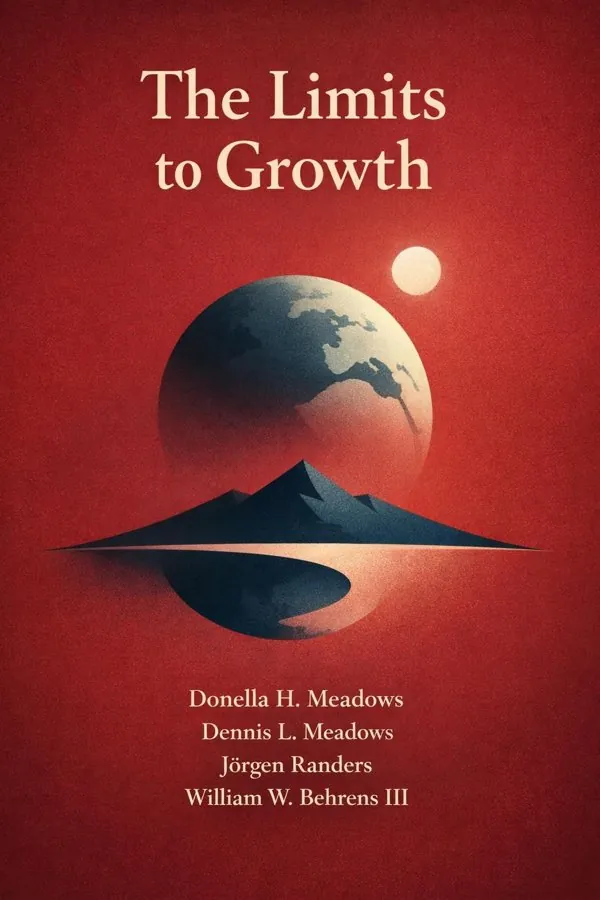
The Limits to Growth: A Report for the Club of Rome's Project on the Predicament of Mankind
What happens when endless economic and population growth meets a planet with finite land, energy, and resources? That is the unsettling question at the heart of The Limits to Growth, one of the most influential environmental books of the twentieth century. First published in 1972, the book presents the findings of an MIT research team commissioned by the Club of Rome to examine the long-term consequences of global expansion. Using a computer model called World3, the authors explored how population, industrial output, food production, resource depletion, and pollution interact over time. The book matters because it shifted the debate from isolated problems to whole systems. Instead of asking whether one resource might run short, it asked how multiple pressures reinforce one another and create instability. Donella H. Meadows, Dennis L. Meadows, Jørgen Randers, and William W. Behrens III brought together expertise in systems analysis, management, and environmental thinking to produce a work that remains strikingly relevant in an age of climate change, ecological overshoot, and recurring economic stress. It is not a prophecy of doom, but a warning that humanity must learn to live within planetary boundaries.
Read SummaryKey Insights from Dennis L. Meadows
World3 Reveals a Connected Planet
The most dangerous mistakes often come from treating connected problems as if they were separate. That insight drives the construction of World3, the computer model at the center of The Limits to Growth. The authors did not try to reproduce every detail of the real world. Instead, they built a simpl...
From The Limits to Growth: A Report for the Club of Rome's Project on the Predicament of Mankind
Exponential Growth Starts Small, Then Surges
One of the book’s most powerful insights is that exponential growth feels harmless at first. A quantity growing by a constant percentage each year does not rise in a straight line; it compounds. Population, capital stock, pollution, and industrial output can all grow this way. Early increases seem m...
From The Limits to Growth: A Report for the Club of Rome's Project on the Predicament of Mankind
Planetary Limits Cannot Be Negotiated
A finite planet does not care about human optimism, ideology, or market confidence. This is the blunt reality behind the book’s concept of limits. The Earth contains bounded stocks of nonrenewable resources, limited capacity to absorb pollution, and ecosystems that can regenerate only so fast. Econo...
From The Limits to Growth: A Report for the Club of Rome's Project on the Predicament of Mankind
Scenarios Clarify Futures, Not Certainties
The future is not a single destination; it is a range of possibilities shaped by choices, delays, and system behavior. That is why The Limits to Growth relies on scenarios rather than fixed predictions. The authors used World3 to test different assumptions about population trends, resource availabil...
From The Limits to Growth: A Report for the Club of Rome's Project on the Predicament of Mankind
Business as Usual Leads to Overshoot
Perhaps the book’s most famous conclusion is also its most unsettling: if prevailing growth trends in population, industrialization, pollution, food production, and resource use continue unchanged, global society is likely to overshoot ecological limits and then decline. This result appears in the s...
From The Limits to Growth: A Report for the Club of Rome's Project on the Predicament of Mankind
Technology Alone Cannot Save Growth
One of the book’s most important and controversial arguments is that technological progress, though essential, is not a magic escape from biophysical limits. The authors tested scenarios in which resources were more abundant, pollution controls were stronger, and agricultural productivity improved. ...
From The Limits to Growth: A Report for the Club of Rome's Project on the Predicament of Mankind
About Dennis L. Meadows
Meadows fue una científica ambiental y profesora en Dartmouth College, reconocida por su trabajo en sistemas y sostenibilidad. Junto con Dennis Meadows, Jørgen Randers y William Behrens, formó parte del equipo del MIT que elaboró el informe para el Club de Roma.


Frequently Asked Questions
Meadows fue una científica ambiental y profesora en Dartmouth College, reconocida por su trabajo en sistemas y sostenibilidad. Junto con Dennis Meadows, Jørgen Randers y William Behrens, formó parte del equipo del MIT que elaboró el informe para el Club de Roma.
Read Dennis L. Meadows's books in 15 minutes
Get AI-powered summaries with key insights from 1 book by Dennis L. Meadows.