
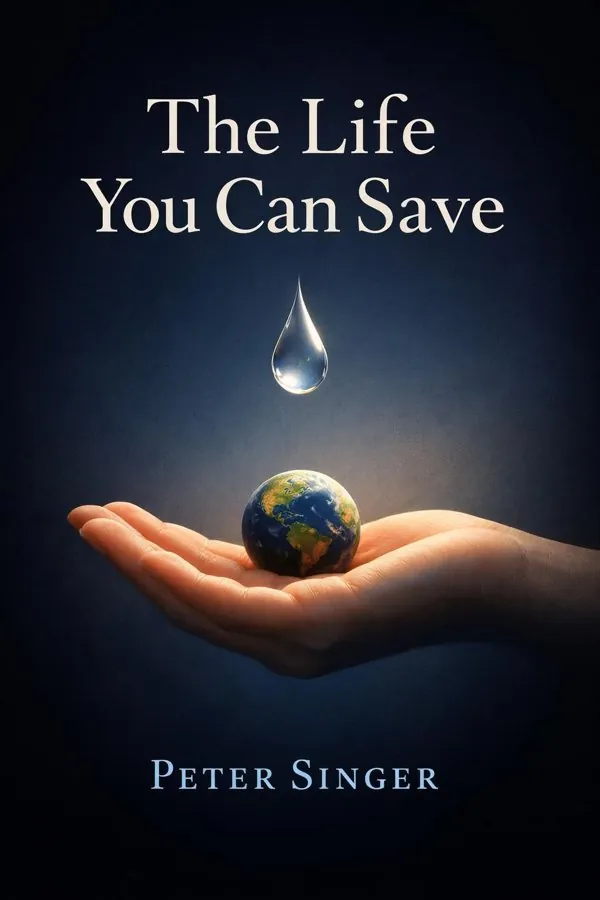
The Life You Can Save: Acting Now to End World Poverty: Summary & Key Insights
by Peter Singer
 10 min9 chaptersAudio available
What Is The Life You Can Save: Acting Now to End World Poverty About?
The Life You Can Save: Acting Now to End World Poverty by Peter Singer is a ethics book spanning 9 pages. In this influential work, philosopher Peter Singer argues that affluent individuals have a moral obligation to help those living in extreme poverty. Drawing on ethical reasoning and real-world examples, Singer challenges readers to rethink their spending habits and to take practical steps toward reducing global suffering. The book outlines effective ways to give and demonstrates how small contributions can make a significant difference in saving lives and improving global well-being.
This FizzRead summary covers all 9 key chapters of The Life You Can Save: Acting Now to End World Poverty in approximately 10 minutes, distilling the most important ideas, arguments, and takeaways from Peter Singer's work. Also available as an audio summary and Key Quotes Podcast.
The Life You Can Save: Acting Now to End World Poverty
In this influential work, philosopher Peter Singer argues that affluent individuals have a moral obligation to help those living in extreme poverty. Drawing on ethical reasoning and real-world examples, Singer challenges readers to rethink their spending habits and to take practical steps toward reducing global suffering. The book outlines effective ways to give and demonstrates how small contributions can make a significant difference in saving lives and improving global well-being.
Who Should Read The Life You Can Save: Acting Now to End World Poverty?
This book is perfect for anyone interested in ethics and looking to gain actionable insights in a short read. Whether you're a student, professional, or lifelong learner, the key ideas from The Life You Can Save: Acting Now to End World Poverty by Peter Singer will help you think differently.
- ✓Readers who enjoy ethics and want practical takeaways
- ✓Professionals looking to apply new ideas to their work and life
- ✓Anyone who wants the core insights of The Life You Can Save: Acting Now to End World Poverty in just 10 minutes
Want the full summary?
Get instant access to this book summary and 100K+ more with Fizz Moment.
Get Free SummaryAvailable on App Store • Free to download
Key Chapters
The ethical foundation of *The Life You Can Save* rests on one uncomplicated principle: if it is within our power to prevent something bad from happening, without sacrificing anything of comparable moral value, we ought to do it. This premise is not abstract; it is the core of everyday morality. Imagine again the drowning child — an immediate situation where inaction feels morally indefensible. Yet poverty and suffering are just as immediate, even if they occur far from where we stand. Geographic distance does not alter moral obligation.
My argument begins with reason and ends with empathy. When we possess resources beyond what we need to lead a decent life, those resources carry an ethical weight. They are means by which we can alleviate suffering — not merely optional tokens of goodwill. The cost of inaction is immense: preventable deaths, wasted potential, and the perpetuation of unnecessary misery. The question, therefore, is not whether we should give, but how much and how effectively.
To many, such reasoning might seem demanding, even unrealistic. Yet I argue that morality demands consistency. If you accept that saving a nearby child is obligatory, you must also accept that saving distant children, within your capacity, is equally obligatory. Ethics cannot hinge on proximity or convenience. In stating this, I am not asking for sainthood; I am asking for integrity. Living ethically in a world of affluence means recognizing that your comfort may carry the cost of others’ survival. Once you see this clearly, the choice to act becomes both rational and emotionally compelling.
Indeed, this moral stance offers liberation rather than burden. By acknowledging responsibility, you free yourself from apathy and connect with the world’s deepest moral currents. To act generously is to live truthfully with what you already believe about right and wrong. The moral argument is simple; its challenge is in the courage to accept its implications.
To grasp why moral action is urgent, we must first see the reality of what we are choosing to confront. Nearly a billion people live in extreme poverty, surviving on less than two dollars a day. The consequences of this deprivation are brutal: malnutrition, preventable diseases, unsafe drinking water, and the continual loss of children whose lives could have been saved for the cost of a single restaurant meal.
In writing this book, I examined data from the World Bank, UNICEF, and global health organizations to quantify the scale of suffering. Numbers alone, however, cannot convey the human cost. Behind each statistic lies a person — someone with aspirations, emotions, and potential equal to our own. Poverty, contrary to common belief, is not an inevitable fact of life. It is a condition perpetuated by inequality and neglect, not necessity.
I emphasize that the global economy produces enough wealth to eradicate extreme poverty. The tragedy lies not in scarcity but in distribution. When the richest individuals possess more wealth than entire nations, the ethical imbalance becomes clear. This disparity demands collective introspection: What responsibilities come with affluence? What kind of world allows preventable suffering when solutions are known and affordable?
This scale of injustice should not paralyze us. On the contrary, it should energize us. Each life saved, each community supported, represents concrete progress. Knowing the scope of poverty is the first step in understanding the magnitude of what we can change. Once we see it not as abstract despair but as human urgency, we can begin to act, with reason and compassion guiding our choices.
+ 7 more chapters — available in the FizzRead app
All Chapters in The Life You Can Save: Acting Now to End World Poverty
About the Author
Peter Singer is an Australian moral philosopher best known for his work in applied ethics and his advocacy for animal rights and effective altruism. He is a professor of bioethics at Princeton University and the University of Melbourne. Singer’s writings have profoundly influenced contemporary discussions on ethics, global poverty, and moral responsibility.
Get This Summary in Your Preferred Format
Read or listen to the The Life You Can Save: Acting Now to End World Poverty summary by Peter Singer anytime, anywhere. FizzRead offers multiple formats so you can learn on your terms — all free.
Available formats: App · Audio · PDF · EPUB — All included free with FizzRead
Download The Life You Can Save: Acting Now to End World Poverty PDF and EPUB Summary
Key Quotes from The Life You Can Save: Acting Now to End World Poverty
“This premise is not abstract; it is the core of everyday morality.”
“To grasp why moral action is urgent, we must first see the reality of what we are choosing to confront.”
Frequently Asked Questions about The Life You Can Save: Acting Now to End World Poverty
The Life You Can Save: Acting Now to End World Poverty by Peter Singer is a ethics book that explores key ideas across 9 chapters. In this influential work, philosopher Peter Singer argues that affluent individuals have a moral obligation to help those living in extreme poverty. Drawing on ethical reasoning and real-world examples, Singer challenges readers to rethink their spending habits and to take practical steps toward reducing global suffering. The book outlines effective ways to give and demonstrates how small contributions can make a significant difference in saving lives and improving global well-being.
More by Peter Singer
You Might Also Like
What We Owe the Future
William MacAskill
10 min
Abortion
David Boonin
10 min
Blind Spots: Why We Fail to Do What's Right and What to Do About It
Max H. Bazerman, Ann E. Tenbrunsel
10 min
Digital Ethics: Research and Practice
Christopher Burr, Luciano Floridi (Editors)
10 min
Doing Good Better: Effective Altruism and a Radical New Way to Make a Difference
William MacAskill
10 min
Eating Animals
Jonathan Safran Foer
10 minBrowse by Category
Ready to read The Life You Can Save: Acting Now to End World Poverty?
Get the full summary and 100K+ more books with Fizz Moment.