
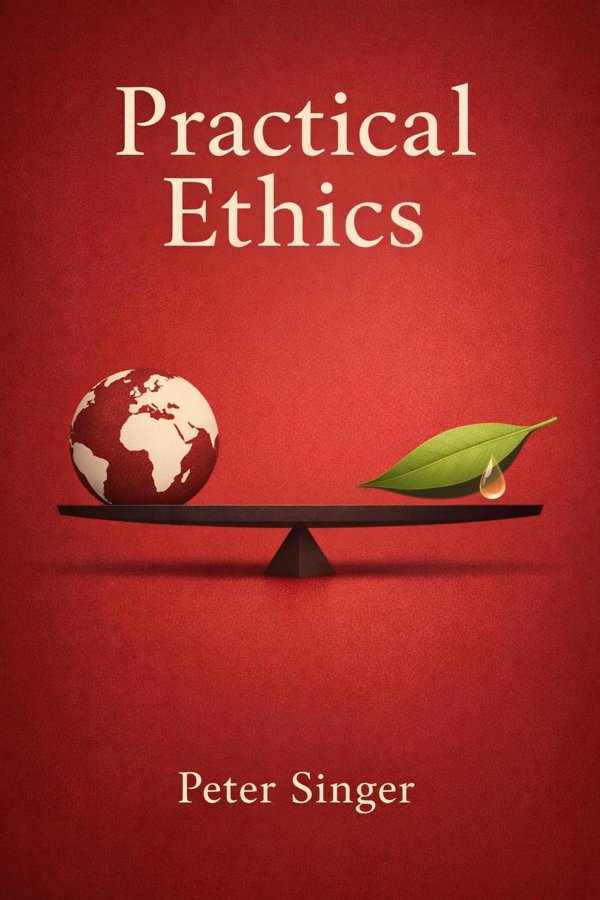
Practical Ethics: Summary & Key Insights
by Peter Singer
 10 min8 chaptersAudio available
What Is Practical Ethics About?
Practical Ethics by Peter Singer is a ethics book spanning 8 pages. Practical Ethics is a foundational work in applied ethics by philosopher Peter Singer. It explores how ethical theory can be applied to real-world moral issues such as animal rights, euthanasia, global poverty, and environmental responsibility. Singer argues from a utilitarian perspective, emphasizing the importance of reducing suffering and promoting well-being for all sentient beings.
This FizzRead summary covers all 8 key chapters of Practical Ethics in approximately 10 minutes, distilling the most important ideas, arguments, and takeaways from Peter Singer's work. Also available as an audio summary and Key Quotes Podcast.
Practical Ethics
Practical Ethics is a foundational work in applied ethics by philosopher Peter Singer. It explores how ethical theory can be applied to real-world moral issues such as animal rights, euthanasia, global poverty, and environmental responsibility. Singer argues from a utilitarian perspective, emphasizing the importance of reducing suffering and promoting well-being for all sentient beings.
Who Should Read Practical Ethics?
This book is perfect for anyone interested in ethics and looking to gain actionable insights in a short read. Whether you're a student, professional, or lifelong learner, the key ideas from Practical Ethics by Peter Singer will help you think differently.
- ✓Readers who enjoy ethics and want practical takeaways
- ✓Professionals looking to apply new ideas to their work and life
- ✓Anyone who wants the core insights of Practical Ethics in just 10 minutes
Want the full summary?
Get instant access to this book summary and 100K+ more with Fizz Moment.
Get Free SummaryAvailable on App Store • Free to download
Key Chapters
The starting point of moral reasoning is equality—not in the sense that everyone is the same, but that everyone’s interests deserve equal weight. Historically, humanity’s moral progress can be viewed as an expanding circle: first considering only one’s tribe or family, then one’s nation, then one’s race, and, gradually, all humans. I argue that the circle should extend still further, to all sentient beings capable of suffering or enjoyment.
Equal consideration of interests demands impartiality. When we evaluate an action, we must not privilege our own perspective simply because it is ours. Pain is pain, regardless of who experiences it. The implications are profound. If a being can suffer, that suffering must be counted in our moral deliberations. This conclusion challenges anthropocentrism—the view that humans have a unique moral status simply because they are human.
It also challenges other forms of bias—sexism, racism, speciesism. Whether someone has two legs or four, whether they possess rational language or not, cannot by itself determine the seriousness of wounding, confining, or killing them. The moral point of view requires that we transcend such arbitrary distinctions. To be ethical, we must see beyond species boundaries, beyond the mere fact of belonging to Homo sapiens.
This shift from partiality to impartiality changes how we assess the rightness of actions. The utility principle anchors moral reasoning in the capacity to experience pleasure and pain. Reason thus functions as a leveling force, pushing us to consider equally the welfare of all who can suffer. Once we embrace that perspective, our attitudes toward animals, people with profound cognitive disabilities, and even future generations begin to change. The seemingly abstract demand of equality becomes a revolutionary lens on everyday practice.
Traditional moral thought has placed heavy emphasis on the 'sanctity of human life'—the idea that human life possesses an intrinsic, inviolable value. This view has deep religious roots, but within a secular ethical framework, we must ask: why should life be sacred simply because it is human? If our goal is to reduce suffering and enhance well-being, then the moral value of a life must depend on factors such as consciousness, self-awareness, and the ability to experience pleasure or pain.
I argue that 'life' in itself is not sacred. What matters morally is the quality of the experiences that life makes possible. When we make decisions about life and death—in healthcare, in law, in end-of-life care—we must abandon rigid dogmas and evaluate the consequences on sentient welfare. If maintaining a life means preserving a being who has permanently lost all capacity for consciousness, then keeping that body functioning holds no moral necessity.
This position often provokes discomfort, for it overturns centuries of moral teaching that treat human life as uniquely precious regardless of circumstances. But our desire for consistency pushes us toward this conclusion: to value life because of the experiences it can sustain, not because of species membership. Thus, ethics based on utilitarianism does not care for human life per se; it cares for sentient life, wherever it occurs, and for the flourishing that sentience makes possible.
+ 6 more chapters — available in the FizzRead app
All Chapters in Practical Ethics
About the Author
Peter Singer is an Australian moral philosopher known for his work in bioethics and his role in founding the animal rights movement. He is a professor of bioethics at Princeton University and laureate professor at the University of Melbourne. His utilitarian approach has influenced debates on global ethics, animal welfare, and effective altruism.
Get This Summary in Your Preferred Format
Read or listen to the Practical Ethics summary by Peter Singer anytime, anywhere. FizzRead offers multiple formats so you can learn on your terms — all free.
Available formats: App · Audio · PDF · EPUB — All included free with FizzRead
Download Practical Ethics PDF and EPUB Summary
Key Quotes from Practical Ethics
“The starting point of moral reasoning is equality—not in the sense that everyone is the same, but that everyone’s interests deserve equal weight.”
“Traditional moral thought has placed heavy emphasis on the 'sanctity of human life'—the idea that human life possesses an intrinsic, inviolable value.”
Frequently Asked Questions about Practical Ethics
Practical Ethics by Peter Singer is a ethics book that explores key ideas across 8 chapters. Practical Ethics is a foundational work in applied ethics by philosopher Peter Singer. It explores how ethical theory can be applied to real-world moral issues such as animal rights, euthanasia, global poverty, and environmental responsibility. Singer argues from a utilitarian perspective, emphasizing the importance of reducing suffering and promoting well-being for all sentient beings.
More by Peter Singer


You Might Also Like

What We Owe the Future
William MacAskill
10 min
Abortion
David Boonin
10 min
Blind Spots: Why We Fail to Do What's Right and What to Do About It
Max H. Bazerman, Ann E. Tenbrunsel
10 min
Digital Ethics: Research and Practice
Christopher Burr, Luciano Floridi (Editors)
10 min
Doing Good Better: Effective Altruism and a Radical New Way to Make a Difference
William MacAskill
10 min
Eating Animals
Jonathan Safran Foer
10 minBrowse by Category
Ready to read Practical Ethics?
Get the full summary and 100K+ more books with Fizz Moment.