
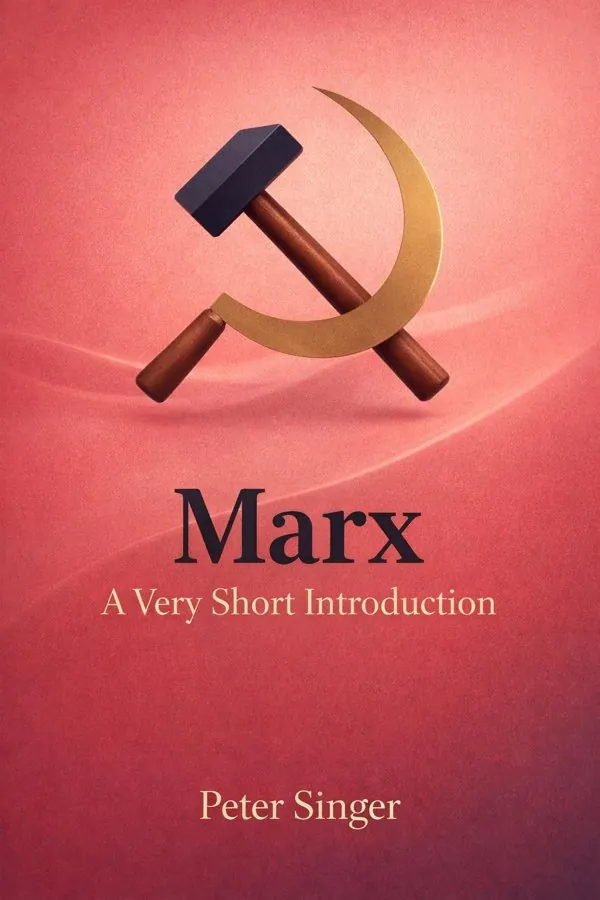
Marx: A Very Short Introduction: Summary & Key Insights
by Peter Singer
 10 min9 chaptersAudio available
What Is Marx: A Very Short Introduction About?
Marx: A Very Short Introduction by Peter Singer is a western_phil book spanning 9 pages. This concise introduction by philosopher Peter Singer provides an accessible overview of Karl Marx’s life, ideas, and enduring influence. It explores Marx’s theory of history, his critique of capitalism, and his vision of a classless society, while also examining how his ideas have been interpreted and applied in the modern world.
This FizzRead summary covers all 9 key chapters of Marx: A Very Short Introduction in approximately 10 minutes, distilling the most important ideas, arguments, and takeaways from Peter Singer's work. Also available as an audio summary and Key Quotes Podcast.
Marx: A Very Short Introduction
This concise introduction by philosopher Peter Singer provides an accessible overview of Karl Marx’s life, ideas, and enduring influence. It explores Marx’s theory of history, his critique of capitalism, and his vision of a classless society, while also examining how his ideas have been interpreted and applied in the modern world.
Who Should Read Marx: A Very Short Introduction?
This book is perfect for anyone interested in western_phil and looking to gain actionable insights in a short read. Whether you're a student, professional, or lifelong learner, the key ideas from Marx: A Very Short Introduction by Peter Singer will help you think differently.
- ✓Readers who enjoy western_phil and want practical takeaways
- ✓Professionals looking to apply new ideas to their work and life
- ✓Anyone who wants the core insights of Marx: A Very Short Introduction in just 10 minutes
Want the full summary?
Get instant access to this book summary and 100K+ more with Fizz Moment.
Get Free SummaryAvailable on App Store • Free to download
Key Chapters
To understand Marx’s ideas, we must first encounter the man himself. Born in Trier in 1818 into a middle-class Jewish family, Marx’s early life already mirrored the contradictions he would later theorize: he was both part of privilege and marginal to it. His father, converted to Lutheranism to escape anti-Jewish restrictions, encouraged his son to pursue an intellectual career. At the University of Berlin, Marx immersed himself in philosophy, drawn to Hegel’s vast system that saw reality as a dialectical process — a dynamic movement of contradictions and their resolution.
For Marx, however, Hegel’s idealism stood on its head: it treated ideas as the drivers of history rather than the material conditions of life. The young Marx, influenced by Ludwig Feuerbach’s critique of religion, began to turn Hegel right side up. Feuerbach argued that religion was a human projection; Marx took this further, seeing all ideology as a product of social conditions. Between Hegel’s dialectics and Feuerbach’s materialism lay the foundation for what Marx called a “scientific” understanding of society.
His intellectual partnership with Friedrich Engels deepened this vision. Engels, with his experience as a factory owner’s son and his sharp eye for the brutal realities of industrial Britain, grounded Marx’s theory in concrete observation. Their collaboration yielded *The Communist Manifesto* in 1848 — a text as much a call to action as a philosophical synthesis. Together, they shaped a program not for detached reflection but for revolutionary change.
In tracing Marx’s life, we also confront his personal struggle — the poverty, exile, and illness that plagued him in London, where he labored over *Das Kapital.* Yet these hardships never broke his conviction that understanding the logic of capitalism was essential to freeing humanity from its grip. His life was both a study and a testament: theory forged in the furnace of necessity.
At the heart of Marx’s thought lies historical materialism — a view of history that rejects the idea that ideas or heroes drive progress. Instead, Marx argued that material conditions — the methods and relations of production — form the real foundation of society. The way people produce and distribute their means of life determines the shape of politics, law, religion, and culture.
This conception stands in sharp contrast with idealist histories that treat human thought as autonomous. For Marx, the “superstructure” of ideas rests on an “economic base.” When the productive forces — the tools, knowledge, and organization of labor — advance beyond the constraints of old social relations, conflict ensues, and the entire society undergoes transformation. Thus, the transition from feudalism to capitalism was not a moral story but a result of economic evolution.
Why does this matter? Because historical materialism redefines responsibility and possibility. If social structures are products of material conditions, then they can also change when those conditions change. Marx did not deny human agency; he reframed it as collective action grounded in real social life, not abstract will. The worker who toils at the machine participates, often unknowingly, in a vast historical process that could ultimately overturn the system that exploits him.
In our contemporary context, this method remains remarkably powerful. When we examine climate policy, global supply chains, or digital economies, the same logic applies: technology and production shape consciousness. Historical materialism invites us to look beneath moral appearances to the economic engine that drives them. As I emphasize throughout this book, agreeing or disagreeing with Marx is less important than recognizing the depth of his question — what social forces truly mold our world?
+ 7 more chapters — available in the FizzRead app
All Chapters in Marx: A Very Short Introduction
About the Author
Peter Singer is an Australian moral philosopher best known for his work in applied ethics and his advocacy of effective altruism. He is a professor of bioethics at Princeton University and laureate professor at the University of Melbourne.
Get This Summary in Your Preferred Format
Read or listen to the Marx: A Very Short Introduction summary by Peter Singer anytime, anywhere. FizzRead offers multiple formats so you can learn on your terms — all free.
Available formats: App · Audio · PDF · EPUB — All included free with FizzRead
Download Marx: A Very Short Introduction PDF and EPUB Summary
Key Quotes from Marx: A Very Short Introduction
“To understand Marx’s ideas, we must first encounter the man himself.”
“At the heart of Marx’s thought lies historical materialism — a view of history that rejects the idea that ideas or heroes drive progress.”
Frequently Asked Questions about Marx: A Very Short Introduction
Marx: A Very Short Introduction by Peter Singer is a western_phil book that explores key ideas across 9 chapters. This concise introduction by philosopher Peter Singer provides an accessible overview of Karl Marx’s life, ideas, and enduring influence. It explores Marx’s theory of history, his critique of capitalism, and his vision of a classless society, while also examining how his ideas have been interpreted and applied in the modern world.
More by Peter Singer

You Might Also Like
A Little History of Philosophy
Nigel Warburton
10 min
Areopagitica
John Milton
10 min
How To Think Like A Philosopher: Essential Principles For Clear Thinking
Peter Cave
10 min
Language, Truth and Logic
A. J. Ayer
10 min
The Age of Reason
Thomas Paine
10 min
The Essays
Michel De Montaigne
10 minBrowse by Category
Ready to read Marx: A Very Short Introduction?
Get the full summary and 100K+ more books with Fizz Moment.