
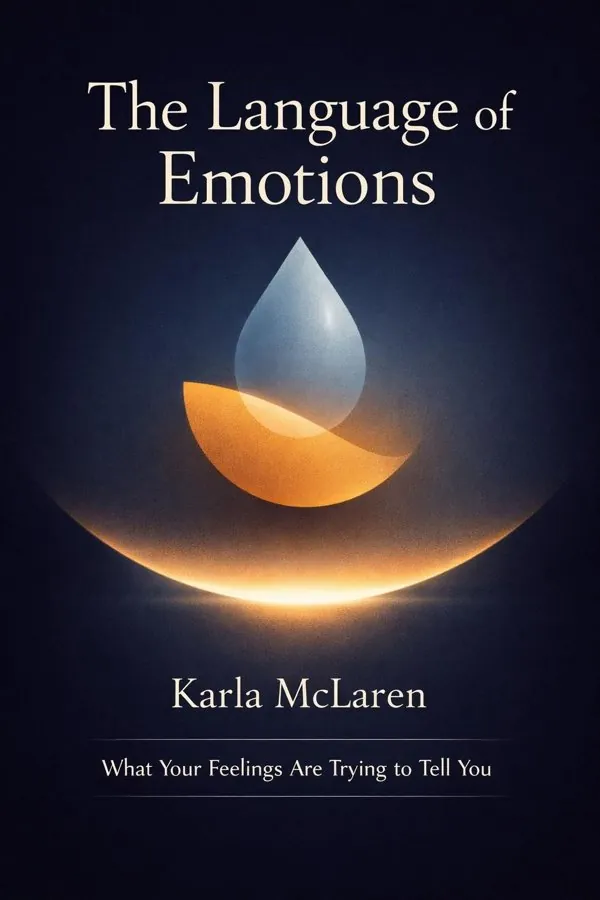
The Language of Emotions: What Your Feelings Are Trying to Tell You: Summary & Key Insights
 10 min8 chaptersAudio available
What Is The Language of Emotions: What Your Feelings Are Trying to Tell You About?
The Language of Emotions: What Your Feelings Are Trying to Tell You by Karla McLaren is a mental_health book spanning 8 pages. In this groundbreaking work, Karla McLaren explores the intelligence and purpose of emotions, offering readers a new framework for understanding and working with their feelings. She presents practical tools for emotional awareness, empathy, and healing, helping readers transform their relationship with emotions from confusion and resistance to insight and empowerment.
This FizzRead summary covers all 8 key chapters of The Language of Emotions: What Your Feelings Are Trying to Tell You in approximately 10 minutes, distilling the most important ideas, arguments, and takeaways from Karla McLaren's work. Also available as an audio summary and Key Quotes Podcast.
The Language of Emotions: What Your Feelings Are Trying to Tell You
In this groundbreaking work, Karla McLaren explores the intelligence and purpose of emotions, offering readers a new framework for understanding and working with their feelings. She presents practical tools for emotional awareness, empathy, and healing, helping readers transform their relationship with emotions from confusion and resistance to insight and empowerment.
Who Should Read The Language of Emotions: What Your Feelings Are Trying to Tell You?
This book is perfect for anyone interested in mental_health and looking to gain actionable insights in a short read. Whether you're a student, professional, or lifelong learner, the key ideas from The Language of Emotions: What Your Feelings Are Trying to Tell You by Karla McLaren will help you think differently.
- ✓Readers who enjoy mental_health and want practical takeaways
- ✓Professionals looking to apply new ideas to their work and life
- ✓Anyone who wants the core insights of The Language of Emotions: What Your Feelings Are Trying to Tell You in just 10 minutes
Want the full summary?
Get instant access to this book summary and 100K+ more with Fizz Moment.
Get Free SummaryAvailable on App Store • Free to download
Key Chapters
For centuries, we’ve been taught that emotions are irrational or inferior to thought. In my research and teaching, I’ve seen how deeply this message injures us. When a culture praises stoicism or emotional detachment, it cuts people off from an essential guidance system. We begin to distrust our inner voices, to feel shame about our emotional reactions, and to hide the very signals that could help us respond intelligently to life’s challenges.
This misunderstanding also shows up in psychology and spirituality alike: one side often tries to analyze or medicate emotions away, while the other pushes people toward perpetual bliss or positivity. But emotions are neither problems to solve nor obstacles to transcend. They are messengers carrying specific information. Every emotion—even the ones we fear most—has a job to do.
Consider anger. Most of us are taught to suppress it, fearing that it will lead to violence or rejection. Yet anger’s core message is about boundaries and integrity; it arises to alert you that something is not right, that a principle or personal space has been violated. If we repress it, we lose connection to our sense of justice and self-protection. If we express it blindly, we create conflict. But if we pause to listen—to understand what anger is telling us—it becomes a guide to action that restores balance.
This shift in perspective—seeing emotions as allies rather than enemies—rests at the foundation of emotional literacy. It rewrites the entire story of what it means to feel.
I call emotions ‘the language of the soul’ because they speak directly to your deepest knowing. To understand this language, you need to develop what I term emotional awareness—the ability to sense, name, and work consciously with what you feel. This book provides step-by-step methods for doing exactly that.
Every emotion arises with purpose. To understand it, you must meet it where it lives—in the body, where sensations first register, and in your attention, where thought patterns begin to form around those sensations. By slowing down enough to notice where an emotion lives in you, you begin to reclaim your natural fluency. Instead of drowning in the emotion or repressing it, you learn to stay present with it long enough to decipher its message.
My framework divides emotions into families—such as fear, anger, sadness, happiness—each with its own spectrum. Fear, for example, ranges from mild caution to full panic; anger can manifest as irritation or righteous outrage. Each shade of feeling carries different nuances of meaning. Developing awareness means you learn to listen to those subtleties instead of labeling everything as either ‘good’ or ‘bad.’
With emotional awareness, emotions stop being storms that sweep through you without warning. They become conversations. This is not about controlling emotions but forming a partnership with them—an ongoing dialogue between your body, your psyche, and your soul.
+ 6 more chapters — available in the FizzRead app
All Chapters in The Language of Emotions: What Your Feelings Are Trying to Tell You
About the Author
Karla McLaren is an American author, social science researcher, and empathy expert known for her work on emotional intelligence and the psychology of empathy. Her writings integrate insights from sociology, psychology, and spirituality to help readers develop emotional fluency and self-understanding.
Get This Summary in Your Preferred Format
Read or listen to the The Language of Emotions: What Your Feelings Are Trying to Tell You summary by Karla McLaren anytime, anywhere. FizzRead offers multiple formats so you can learn on your terms — all free.
Available formats: App · Audio · PDF · EPUB — All included free with FizzRead
Download The Language of Emotions: What Your Feelings Are Trying to Tell You PDF and EPUB Summary
Key Quotes from The Language of Emotions: What Your Feelings Are Trying to Tell You
“For centuries, we’ve been taught that emotions are irrational or inferior to thought.”
“I call emotions ‘the language of the soul’ because they speak directly to your deepest knowing.”
Frequently Asked Questions about The Language of Emotions: What Your Feelings Are Trying to Tell You
The Language of Emotions: What Your Feelings Are Trying to Tell You by Karla McLaren is a mental_health book that explores key ideas across 8 chapters. In this groundbreaking work, Karla McLaren explores the intelligence and purpose of emotions, offering readers a new framework for understanding and working with their feelings. She presents practical tools for emotional awareness, empathy, and healing, helping readers transform their relationship with emotions from confusion and resistance to insight and empowerment.
You Might Also Like
Big Feelings: How to Be Okay When Things Are Not Okay
Liz Fosslien, Mollie West Duffy
10 min
Creative Arts Therapies Handbook: Art, Music and Dance Therapy Practices for Wellbeing
Susan I. Buchalter
10 min
Emotional First Aid: Healing Rejection, Guilt, Failure, and Other Everyday Hurts
Guy Winch
10 min
Lost Connections: Why You're Depressed and How to Find Hope
Johann Hari
10 min
No Time to Panic: How to Stop Worrying and Embrace Life
Matt Gutman
10 min
Overcoming Mobbing: A Recovery Guide for Workplace Aggression and Bullying
Maureen Duffy, Len Sperry
10 minBrowse by Category
Ready to read The Language of Emotions: What Your Feelings Are Trying to Tell You?
Get the full summary and 100K+ more books with Fizz Moment.