
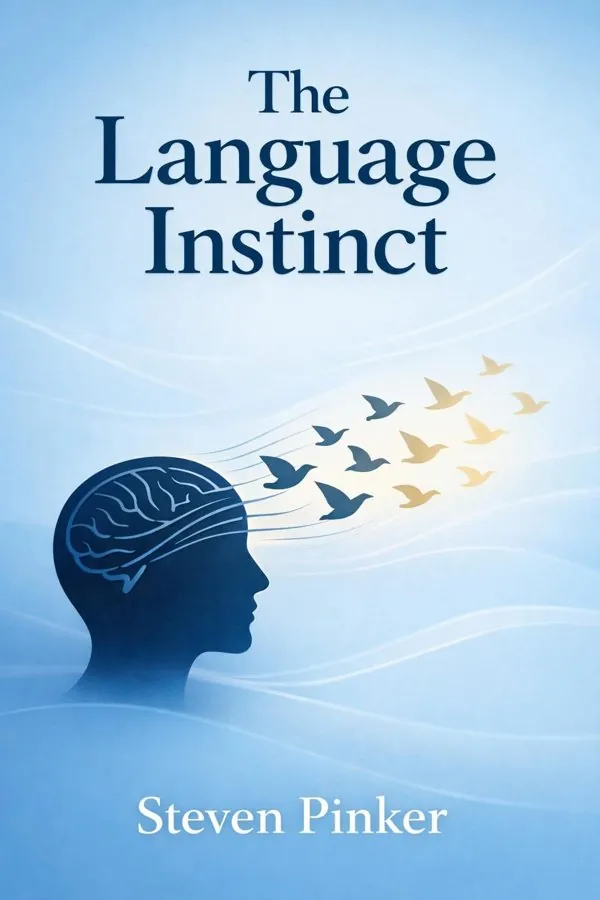
The Language Instinct: How the Mind Creates Language: Summary & Key Insights
 10 min13 chaptersAudio available
What Is The Language Instinct: How the Mind Creates Language About?
The Language Instinct: How the Mind Creates Language by Steven Pinker is a popular_sci book spanning 13 pages. In this groundbreaking work, cognitive scientist Steven Pinker argues that humans are born with an innate capacity for language. Drawing on research from linguistics, psychology, and evolutionary biology, Pinker explores how language develops in children, how it shapes thought, and how it evolved as a fundamental part of human nature. The book challenges the notion that language is purely a cultural invention, presenting it instead as a biological adaptation shaped by natural selection.
This FizzRead summary covers all 13 key chapters of The Language Instinct: How the Mind Creates Language in approximately 10 minutes, distilling the most important ideas, arguments, and takeaways from Steven Pinker's work. Also available as an audio summary and Key Quotes Podcast.
The Language Instinct: How the Mind Creates Language
In this groundbreaking work, cognitive scientist Steven Pinker argues that humans are born with an innate capacity for language. Drawing on research from linguistics, psychology, and evolutionary biology, Pinker explores how language develops in children, how it shapes thought, and how it evolved as a fundamental part of human nature. The book challenges the notion that language is purely a cultural invention, presenting it instead as a biological adaptation shaped by natural selection.
Who Should Read The Language Instinct: How the Mind Creates Language?
This book is perfect for anyone interested in popular_sci and looking to gain actionable insights in a short read. Whether you're a student, professional, or lifelong learner, the key ideas from The Language Instinct: How the Mind Creates Language by Steven Pinker will help you think differently.
- ✓Readers who enjoy popular_sci and want practical takeaways
- ✓Professionals looking to apply new ideas to their work and life
- ✓Anyone who wants the core insights of The Language Instinct: How the Mind Creates Language in just 10 minutes
Want the full summary?
Get instant access to this book summary and 100K+ more with Fizz Moment.
Get Free SummaryAvailable on App Store • Free to download
Key Chapters
To understand what language truly is, we must first strip away many of the myths surrounding it. People often confuse language with writing, logic, or communication in general. But language, in its essence, is an intricate system of mental rules—a computational faculty—that allows us to express an infinite range of thoughts. Even before writing was invented, every known human community had a spoken language. Writing, by contrast, is scarcely six thousand years old, a recent cultural technology superimposed on an ancient biological function.
When we compare human language to animal communication, the difference is staggering. Honeybees dance to indicate distance and direction, vervet monkeys emit distinct calls for predators, and songbirds learn melodies. Yet none possess what linguists call generativity—the ability to create and understand sentences never heard before. Human language is recursive: we can embed phrases within phrases, stack ideas within ideas. From a finite set of words and rules, we generate an infinite mental universe.
This property—the open-endedness of human speech—shows that language is not just behavior but computation. When you speak, your mind executes algorithms, arranging words according to abstract syntactic rules. And because of this computational nature, language provides a window into the architecture of thought itself. Grammar, in all its complexity, reflects cognitive design, not social convention.
Every parent has witnessed the miracle of language acquisition: their child, seemingly from nowhere, begins to combine words, create sentences, and eventually debate bedtime with impeccable syntax. How do they do it? Not through imitation or correction, despite what generations of educators have believed.
Children are exposed to incomplete, inconsistent language from adults, filled with interruptions and ungrammatical slips. Yet they converge on a consistent grammar that often surpasses what they hear. They invent forms never modeled for them—such as saying 'goed' instead of 'went'—revealing that they are unconsciously applying rules rather than memorizing words. This phenomenon, known as overregularization, provides powerful evidence that children construct an internal model of language.
Experiments and observations show that this acquisition happens on a universal timetable, largely independent of intelligence or environment. Deaf children invent fully grammatical sign languages in isolation; toddlers of every culture pass through the same stages of babbling, one-word utterances, and grammatical explosion. These patterns point to an innate blueprint—a specialized mental organ for language, unfolding through development just as limbs or vision do.
+ 11 more chapters — available in the FizzRead app
All Chapters in The Language Instinct: How the Mind Creates Language
About the Author
Steven Pinker is a Canadian-American cognitive psychologist, linguist, and popular science author. He is known for his research on language and the mind, and for his accessible books on cognitive science and human nature. Pinker is a professor at Harvard University and a leading advocate of evolutionary psychology and computational theory of mind.
Get This Summary in Your Preferred Format
Read or listen to the The Language Instinct: How the Mind Creates Language summary by Steven Pinker anytime, anywhere. FizzRead offers multiple formats so you can learn on your terms — all free.
Available formats: App · Audio · PDF · EPUB — All included free with FizzRead
Download The Language Instinct: How the Mind Creates Language PDF and EPUB Summary
Key Quotes from The Language Instinct: How the Mind Creates Language
“To understand what language truly is, we must first strip away many of the myths surrounding it.”
“Every parent has witnessed the miracle of language acquisition: their child, seemingly from nowhere, begins to combine words, create sentences, and eventually debate bedtime with impeccable syntax.”
Frequently Asked Questions about The Language Instinct: How the Mind Creates Language
The Language Instinct: How the Mind Creates Language by Steven Pinker is a popular_sci book that explores key ideas across 13 chapters. In this groundbreaking work, cognitive scientist Steven Pinker argues that humans are born with an innate capacity for language. Drawing on research from linguistics, psychology, and evolutionary biology, Pinker explores how language develops in children, how it shapes thought, and how it evolved as a fundamental part of human nature. The book challenges the notion that language is purely a cultural invention, presenting it instead as a biological adaptation shaped by natural selection.
More by Steven Pinker

You Might Also Like

Structures: Or Why Things Don"t Fall Down
J.E. Gordon
10 min
The Road to Wigan Pier
George Orwell
10 min
Bonk: The Curious Coupling of Science and Sex
Mary Roach
10 min
First Bite: How We Learn to Eat
Bee Wilson
10 min
In Pursuit Of The Unknown: 17 Equations That Changed The World
Ian Stewart
10 min
Napoleon's Buttons: 17 Molecules That Changed History
Penny Le Couteur and Jay Burreson
10 minBrowse by Category
Ready to read The Language Instinct: How the Mind Creates Language?
Get the full summary and 100K+ more books with Fizz Moment.