
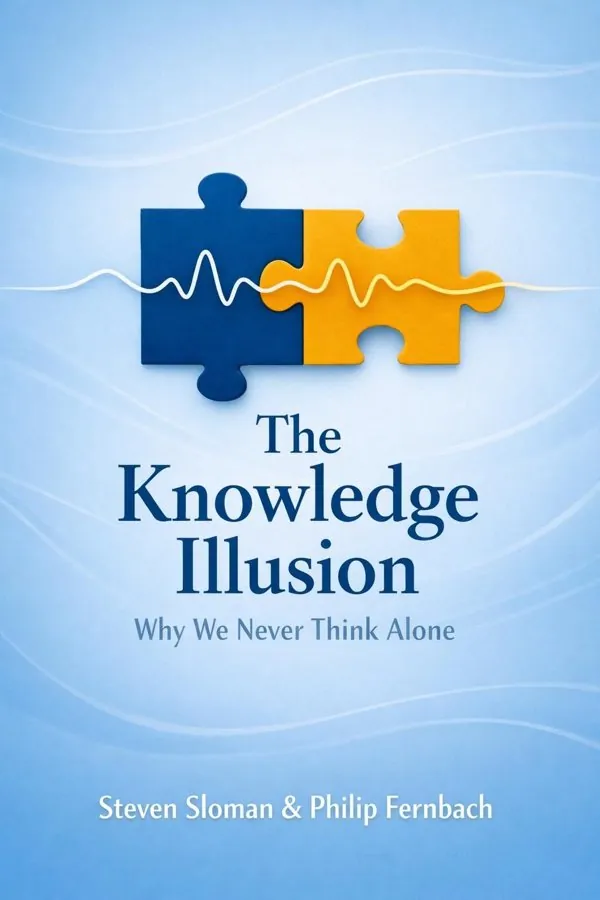
The Knowledge Illusion: Why We Never Think Alone: Summary & Key Insights
by Steven Sloman, Philip Fernbach
 10 min9 chaptersAudio available
Key Takeaways from The Knowledge Illusion: Why We Never Think Alone
Human intelligence looks individual, but it works collectively.
Confidence often collapses at the moment explanation begins.
What makes humans uniquely intelligent may not be individual brilliance, but our ability to think together.
No one understands a city, a market, or a scientific field in full, yet these systems still function.
Words often make us feel smarter than we are.
What Is The Knowledge Illusion: Why We Never Think Alone About?
The Knowledge Illusion: Why We Never Think Alone by Steven Sloman & Philip Fernbach is a cognition book spanning 6 pages. What do you really understand on your own? More importantly, how much of what feels like personal knowledge is actually borrowed from other people, institutions, and tools? In The Knowledge Illusion, cognitive scientists Steven Sloman and Philip Fernbach challenge one of our deepest assumptions: that thinking happens primarily inside individual minds. Their central argument is both unsettling and liberating. Human intelligence is powerful not because each of us knows very much, but because we participate in networks of shared understanding. We rely on experts, communities, language, and social systems to think far beyond our personal mental limits. This matters because modern life constantly rewards confidence while concealing ignorance. We vote, argue online, buy products, and take moral positions while often knowing far less than we believe. Sloman, a leading scholar of reasoning and cognition at Brown University, and Fernbach, a cognitive scientist known for research on judgment and decision-making, bring decades of scientific expertise to this problem. The result is an accessible, provocative book about overconfidence, political polarization, cooperation, and intellectual humility. It helps explain not just why people are wrong, but why all of us so often mistake access to knowledge for understanding itself.
This FizzRead summary covers all 9 key chapters of The Knowledge Illusion: Why We Never Think Alone in approximately 10 minutes, distilling the most important ideas, arguments, and takeaways from Steven Sloman & Philip Fernbach's work. Also available as an audio summary and Key Quotes Podcast.
The Knowledge Illusion: Why We Never Think Alone
What do you really understand on your own? More importantly, how much of what feels like personal knowledge is actually borrowed from other people, institutions, and tools? In The Knowledge Illusion, cognitive scientists Steven Sloman and Philip Fernbach challenge one of our deepest assumptions: that thinking happens primarily inside individual minds. Their central argument is both unsettling and liberating. Human intelligence is powerful not because each of us knows very much, but because we participate in networks of shared understanding. We rely on experts, communities, language, and social systems to think far beyond our personal mental limits.
This matters because modern life constantly rewards confidence while concealing ignorance. We vote, argue online, buy products, and take moral positions while often knowing far less than we believe. Sloman, a leading scholar of reasoning and cognition at Brown University, and Fernbach, a cognitive scientist known for research on judgment and decision-making, bring decades of scientific expertise to this problem. The result is an accessible, provocative book about overconfidence, political polarization, cooperation, and intellectual humility. It helps explain not just why people are wrong, but why all of us so often mistake access to knowledge for understanding itself.
Who Should Read The Knowledge Illusion: Why We Never Think Alone?
This book is perfect for anyone interested in cognition and looking to gain actionable insights in a short read. Whether you're a student, professional, or lifelong learner, the key ideas from The Knowledge Illusion: Why We Never Think Alone by Steven Sloman & Philip Fernbach will help you think differently.
- ✓Readers who enjoy cognition and want practical takeaways
- ✓Professionals looking to apply new ideas to their work and life
- ✓Anyone who wants the core insights of The Knowledge Illusion: Why We Never Think Alone in just 10 minutes
Want the full summary?
Get instant access to this book summary and 100K+ more with Fizz Moment.
Get Free SummaryAvailable on App Store • Free to download
Key Chapters
Human intelligence looks individual, but it works collectively. One of the book’s most important claims is that much of what we call knowledge is distributed across other people’s minds. You may know how to drive a car, use a smartphone, or vote on tax policy, yet you likely cannot explain in detail how engines work, how wireless signals are processed, or how fiscal systems are structured. What makes society function is not that each person understands everything, but that knowledge is divided among specialists and linked through cooperation.
Sloman and Fernbach call this the cognitive division of labor. Just as economic productivity increases when people specialize in different tasks, intellectual productivity increases when people specialize in different domains of knowledge. Engineers know one set of things, doctors another, electricians another, and mechanics another. We benefit from all of it without personally carrying it all.
This arrangement is not a flaw in human thinking. It is one of the great achievements of civilization. Language, institutions, professions, and education allow us to tap into expertise we do not possess ourselves. The danger begins when we confuse access with ownership. Because we can consult Google, ask a friend, rely on a professional, or use a working device, we often feel as if the understanding behind it is ours.
A practical example is home ownership. Many people feel knowledgeable about plumbing or electricity because they live with these systems every day. But when something breaks, they quickly discover how dependent they are on skilled experts. The same is true in medicine, finance, and public policy.
Actionable takeaway: Before forming a strong opinion, ask yourself, “Do I truly understand this, or do I simply know who understands it?” That distinction can make you more careful, collaborative, and accurate.
Confidence often collapses at the moment explanation begins. The book highlights a striking psychological finding: people routinely believe they understand ordinary objects and processes far better than they actually do. Researchers asked participants how well they understood things like toilets, zippers, helicopters, and ballpoint pens. Initial self-ratings were high. But once people were asked to explain the mechanisms step by step, their confidence dropped sharply.
This gap between feeling knowledgeable and being able to explain is called the illusion of explanatory depth. It reveals that our minds use a shortcut. If something is familiar, visible, or usable, we assume it is understood. But recognition is not explanation. Functionality is not comprehension. We know what an object does, and perhaps how to interact with it, yet lack a causal model of how it works.
The illusion matters because it extends far beyond gadgets. We think we understand economic policy, climate systems, legal reforms, healthcare plans, and educational interventions with the same false confidence. This overestimation shapes decision-making, public debate, and personal judgment. It also feeds dogmatism, since people who overestimate their understanding are less likely to seek expert input.
A useful example is nutrition advice. Many people confidently repeat simple claims about metabolism, sugar, or dieting, but struggle to explain the biological mechanisms involved. Once asked to clarify cause and effect, their certainty often weakens.
This is not bad news. It is a diagnostic tool. When you force yourself to explain something clearly, you expose the difference between surface familiarity and real understanding. That creates space for learning.
Actionable takeaway: Use the “explain it aloud” test. If you cannot explain a concept simply and sequentially, treat your opinion as provisional and go learn more before acting with certainty.
No one understands a city, a market, or a scientific field in full, yet these systems still function. That is the power of collective intelligence. The book shows how many of the world’s greatest achievements emerge not from isolated genius, but from networks of partial knowledge coordinated across institutions. Science, law, transportation, medicine, technology, and democratic governance all depend on distributed cognition.
In science, breakthroughs rarely arise from a single mind grasping everything. Researchers build on previous findings, use specialized instruments, collaborate across disciplines, and rely on peer review. The same principle applies to hospitals, where diagnosis, treatment, and recovery often involve technicians, nurses, pharmacists, specialists, administrators, and software systems. Each participant knows part of the picture.
This means effective societies do not require universal understanding. They require well-structured systems of trust, specialization, communication, and error correction. Problems arise when these systems break down or when people underestimate their dependence on them. Anti-expert attitudes often grow from the false belief that common sense alone is enough to replace institutional knowledge.
A practical example is air travel. Most passengers know almost nothing about aerodynamics, weather routing, aircraft maintenance, or air traffic control, yet they safely reach their destinations because a complex web of expertise works in concert. The same hidden cooperation supports clean water, internet connectivity, and food supply chains.
Recognizing this should not make us passive. It should make us more attentive to institutional quality. We need robust systems precisely because individuals are limited.
Actionable takeaway: When evaluating a decision or policy, ask not just “What do I think?” but “What system of expertise, incentives, and accountability supports this conclusion?” Better judgments come from understanding the network behind the answer.
Words often make us feel smarter than we are. Language is one of the main tools that creates the knowledge illusion because it lets us refer to concepts without understanding their underlying structure. We can say “inflation,” “blockchain,” “immune response,” or “constitutional law” and feel oriented, even if our grasp is shallow. Vocabulary gives us social fluency, but fluency is not mastery.
Sloman and Fernbach show that language works efficiently because meanings are often shared across communities rather than stored fully in each individual. A person may know enough about a term to use it appropriately in context while depending on experts to hold the deeper content. This is normal and often useful. You do not need a chemist’s understanding of polymers to ask for a plastic container.
The problem begins when labels substitute for reasoning. Political slogans, ideological identities, and abstract terms can create an illusion of comprehension while blocking deeper inquiry. Once we attach a familiar phrase to a problem, we may stop asking how the process actually works. That shallow understanding can harden into strong opinion.
Think of debates about “free markets” or “social justice.” These phrases carry emotional and social meaning, but different people attach different assumptions, examples, and causal beliefs to them. Two people may use the same words while imagining entirely different mechanisms and outcomes.
A practical response is to move conversations from labels to explanations. Instead of debating which side a person supports, ask what they think will happen, through what steps, and why.
Actionable takeaway: When you encounter a powerful phrase or concept, translate it into concrete mechanisms. Ask, “What exactly does this term mean here, and how is it supposed to work in practice?”
One of the book’s most practical findings is that explanation can make people less extreme. Researchers found that when individuals were asked to explain in detail how a policy would achieve its intended results, their positions often became more moderate. The effect did not occur as strongly when they were asked merely to list reasons for their views. Reasons preserve confidence; mechanisms expose limits.
This distinction matters in political life. Public discourse usually rewards slogans, moral declarations, and reason lists. People become skilled at defending positions with talking points gathered from media and peers. But the causal complexity of policy is hard to fake. When someone must spell out how healthcare reform lowers costs, how border policy changes labor markets, or how tax cuts stimulate growth, uncertainty becomes more visible.
The value here is not that everyone becomes centrist. It is that explanation promotes epistemic humility. It shifts discussion from identity performance to problem-solving. It reminds us that many public issues involve trade-offs, second-order effects, and uncertain outcomes.
This method can also improve workplace decisions. Teams often become overconfident about strategic plans because members agree on broad goals without testing causal assumptions. Asking each person to explain how a proposal will create value, affect behavior, or avoid risk can uncover weak reasoning early.
In personal life, the same principle applies to parenting choices, investment decisions, and health habits. We often have preferences before we have understanding.
Actionable takeaway: Whenever a topic becomes emotionally charged, pause and ask for a causal walkthrough. “What happens first, then next, then after that?” Detailed explanation is one of the simplest tools for reducing overconfidence and improving judgment.
The more information we can access instantly, the easier it is to confuse retrieval with understanding. Modern technology amplifies the knowledge illusion by surrounding us with searchable facts, tutorials, summaries, and expert commentary. Because answers are always nearby, we can feel cognitively powerful without building durable mental models of our own.
This is not entirely negative. External memory systems have always extended human thought, from writing to libraries to calculators. Digital tools are part of the broader cognitive ecosystem that allows humans to accomplish more than biology alone would permit. The problem is psychological. Ready access to information can create a false sense that we already know it, or could easily reason through it if needed.
Search engines also flatten distinctions between familiarity and expertise. Reading a thread, scanning an article, or watching a short explainer can make a topic feel mastered. Social media intensifies this effect by rewarding quick opinions and identity-aligned certainty over depth and nuance.
Take personal finance. Someone who watches a few videos about inflation, real estate, and investing may feel equipped to make sweeping claims about economic policy or retirement strategy, even while lacking an integrated understanding of risk, taxation, diversification, and time horizon.
The answer is not to reject technology, but to use it more consciously. External tools are powerful when they support inquiry, verification, and collaboration. They are dangerous when they substitute for reflection.
Actionable takeaway: Separate “I can look this up” from “I understand this.” After using digital sources, close the browser and try to explain the idea from memory. If you cannot do that clearly, you have access to information, not yet understanding.
Real wisdom begins when confidence becomes calibrated. The book’s deepest lesson is not that people are ignorant, but that human thought works best when it acknowledges its own limits. Intellectual humility is not self-doubt for its own sake. It is the disciplined recognition that your mind is partial, dependent, and fallible. Far from making you weaker, this awareness makes you more open to evidence, better at learning, and less vulnerable to error.
Humility matters because overconfidence distorts almost everything. It makes us dismiss experts too quickly, cling to identities too tightly, and make decisions without testing assumptions. By contrast, a humble thinker asks better questions, seeks explanatory depth, and knows when to defer. Such a person can still hold convictions, but those convictions are connected to a realistic sense of what is known personally and what is known socially.
In organizations, intellectual humility improves collaboration. Teams function better when members admit uncertainty, surface blind spots, and consult those with relevant expertise. In relationships, it reduces pointless conflict by making room for curiosity. In citizenship, it supports healthier democratic debate by weakening the illusion that complicated public problems have simple obvious answers.
A practical habit is to replace performative certainty with calibrated language: “My understanding is...,” “I may be missing something...,” or “Here is what I think the mechanism is.” These phrases do not signal weakness. They signal seriousness.
Actionable takeaway: Build a habit of epistemic check-ins. Before making a strong claim, ask: What do I know firsthand? What am I trusting from others? What would change my mind? That small pause can transform how you think, decide, and relate to others.
All Chapters in The Knowledge Illusion: Why We Never Think Alone
About the Authors
Steven Sloman is a professor of cognitive, linguistic, and psychological sciences at Brown University and a leading researcher in human reasoning, causal thinking, and decision-making. His work explores how people form explanations, make judgments, and navigate complex ideas with limited understanding. Philip Fernbach is a cognitive scientist and professor of marketing at the University of Colorado Boulder, where he studies consumer behavior, judgment, and the ways people rely on collective intelligence. Together, Sloman and Fernbach combine academic rigor with clear, engaging writing. In The Knowledge Illusion, they draw on decades of research in cognitive science to explain why human understanding is less individual than it appears and why recognizing that fact can improve thinking, communication, and public life.
Get This Summary in Your Preferred Format
Read or listen to the The Knowledge Illusion: Why We Never Think Alone summary by Steven Sloman & Philip Fernbach anytime, anywhere. FizzRead offers multiple formats so you can learn on your terms — all free.
Available formats: App · Audio · PDF · EPUB — All included free with FizzRead
Download The Knowledge Illusion: Why We Never Think Alone PDF and EPUB Summary
Key Quotes from The Knowledge Illusion: Why We Never Think Alone
“Human intelligence looks individual, but it works collectively.”
“Confidence often collapses at the moment explanation begins.”
“What makes humans uniquely intelligent may not be individual brilliance, but our ability to think together.”
“No one understands a city, a market, or a scientific field in full, yet these systems still function.”
“Words often make us feel smarter than we are.”
Frequently Asked Questions about The Knowledge Illusion: Why We Never Think Alone
The Knowledge Illusion: Why We Never Think Alone by Steven Sloman & Philip Fernbach is a cognition book that explores key ideas across 9 chapters. What do you really understand on your own? More importantly, how much of what feels like personal knowledge is actually borrowed from other people, institutions, and tools? In The Knowledge Illusion, cognitive scientists Steven Sloman and Philip Fernbach challenge one of our deepest assumptions: that thinking happens primarily inside individual minds. Their central argument is both unsettling and liberating. Human intelligence is powerful not because each of us knows very much, but because we participate in networks of shared understanding. We rely on experts, communities, language, and social systems to think far beyond our personal mental limits. This matters because modern life constantly rewards confidence while concealing ignorance. We vote, argue online, buy products, and take moral positions while often knowing far less than we believe. Sloman, a leading scholar of reasoning and cognition at Brown University, and Fernbach, a cognitive scientist known for research on judgment and decision-making, bring decades of scientific expertise to this problem. The result is an accessible, provocative book about overconfidence, political polarization, cooperation, and intellectual humility. It helps explain not just why people are wrong, but why all of us so often mistake access to knowledge for understanding itself.
You Might Also Like
A Field Guide to Lies: Critical Thinking in the Information Age
Daniel J. Levitin
10 min
A Theory of Cognitive Dissonance
Leon Festinger
10 min
Black-And-White Thinking: The Burden of a Binary Brain in a Complex World
Kevin Dutton
10 min
Born Liars: Why We Can’t Live Without Deceit
Ian Leslie
10 min
Collective Illusions: Conformity, Complicity, and the Science of Why We Make Bad Decisions
Todd Rose
10 min
Concrete Mathematics: A Foundation for Computer Science
Ronald L. Graham, Donald E. Knuth, Oren Patashnik
10 minBrowse by Category
Ready to read The Knowledge Illusion: Why We Never Think Alone?
Get the full summary and 100K+ more books with Fizz Moment.