
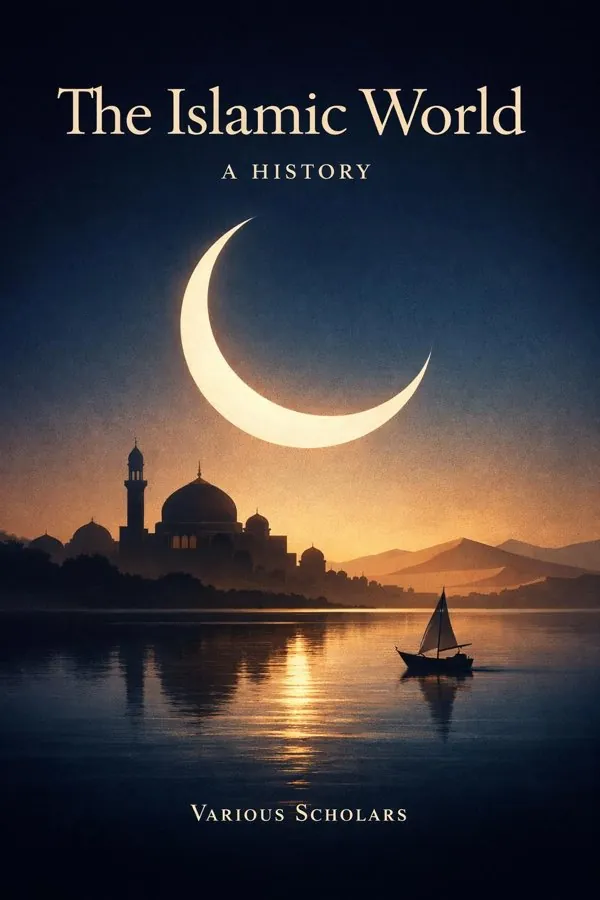
The Islamic World: A History: Summary & Key Insights
 10 min9 chaptersAudio available
Key Takeaways from The Islamic World: A History
Great civilizations often begin not in stability, but in crisis.
What happens after a founder dies often determines whether a movement endures or fragments.
A civilization reaches maturity when it becomes confident enough to learn from others.
Empires are held together not only by armies, but by shared rules and trusted institutions.
Religions do not spread only by conquest; often they travel most effectively through trust, exchange, and daily example.
What Is The Islamic World: A History About?
The Islamic World: A History by Various Scholars is a world_history book spanning 5 pages. The Islamic World: A History offers a sweeping account of one of the most influential civilizations in human history, tracing its development from the rise of Islam in seventh-century Arabia to the political, intellectual, and social transformations of the modern age. Rather than reducing Islamic history to dynasties, battles, or theology alone, this volume shows how faith, law, trade, art, scholarship, and empire interacted to shape a vast world stretching from Spain to Southeast Asia and beyond. It matters because the Islamic world has been central to global history: preserving and expanding knowledge, building commercial networks across continents, and generating rich traditions in philosophy, science, architecture, and governance. Just as important, the book helps readers move beyond stereotypes by revealing Islam’s internal diversity and its long record of dialogue, conflict, adaptation, and renewal. Written by distinguished historians and specialists in Islamic studies, the volume brings together deep expertise and a balanced scholarly perspective. The result is an authoritative, accessible guide for readers who want to understand how Islamic civilization emerged, flourished, diversified, and continues to shape the modern world.
This FizzRead summary covers all 9 key chapters of The Islamic World: A History in approximately 10 minutes, distilling the most important ideas, arguments, and takeaways from Various Scholars's work. Also available as an audio summary and Key Quotes Podcast.
The Islamic World: A History
The Islamic World: A History offers a sweeping account of one of the most influential civilizations in human history, tracing its development from the rise of Islam in seventh-century Arabia to the political, intellectual, and social transformations of the modern age. Rather than reducing Islamic history to dynasties, battles, or theology alone, this volume shows how faith, law, trade, art, scholarship, and empire interacted to shape a vast world stretching from Spain to Southeast Asia and beyond. It matters because the Islamic world has been central to global history: preserving and expanding knowledge, building commercial networks across continents, and generating rich traditions in philosophy, science, architecture, and governance. Just as important, the book helps readers move beyond stereotypes by revealing Islam’s internal diversity and its long record of dialogue, conflict, adaptation, and renewal. Written by distinguished historians and specialists in Islamic studies, the volume brings together deep expertise and a balanced scholarly perspective. The result is an authoritative, accessible guide for readers who want to understand how Islamic civilization emerged, flourished, diversified, and continues to shape the modern world.
Who Should Read The Islamic World: A History?
This book is perfect for anyone interested in world_history and looking to gain actionable insights in a short read. Whether you're a student, professional, or lifelong learner, the key ideas from The Islamic World: A History by Various Scholars will help you think differently.
- ✓Readers who enjoy world_history and want practical takeaways
- ✓Professionals looking to apply new ideas to their work and life
- ✓Anyone who wants the core insights of The Islamic World: A History in just 10 minutes
Want the full summary?
Get instant access to this book summary and 100K+ more with Fizz Moment.
Get Free SummaryAvailable on App Store • Free to download
Key Chapters
Great civilizations often begin not in stability, but in crisis. The story of Islam starts in seventh-century Arabia, a region marked by tribal rivalries, caravan trade, social inequality, and a religious landscape shaped by polytheism, Judaism, Christianity, and local spiritual traditions. Mecca stood at the center of this world as a commercial and religious hub, yet its prosperity did not eliminate moral tension. Wealth was unevenly distributed, kinship loyalties overrode universal ethics, and vulnerable groups often had little protection.
Into this setting came Muhammad ibn Abd Allah, a merchant known for integrity and reflection. According to Islamic tradition, his revelations called for radical moral reform: worship one God, care for the poor, act justly, and recognize human accountability before divine judgment. These teachings were not only theological but social. They challenged entrenched privilege, condemned exploitation, and proposed a new basis for community beyond tribe alone.
The migration to Medina in 622, the Hijra, became a turning point because it transformed a persecuted message into an organized community. In Medina, religious belief, political leadership, legal principles, and social obligations were woven together. This early Islamic community demonstrated that faith could serve as the foundation for public order and collective identity.
A practical way to apply this idea is to see how transformative movements grow: they succeed when they answer both spiritual and social needs. Islam spread not simply because of doctrine, but because it offered a compelling moral vision and a workable communal framework. Actionable takeaway: when studying any civilization, begin by asking what problems it promised to solve for ordinary people.
What happens after a founder dies often determines whether a movement endures or fragments. After Muhammad’s death in 632, the Muslim community faced a pressing question: who would lead, and how would unity be preserved? The Rashidun Caliphs, Abu Bakr, Umar, Uthman, and Ali, guided the community through this uncertain transition. Their rule established key administrative, military, and political foundations that allowed Islam to survive internal conflict and expand rapidly beyond Arabia.
Under Abu Bakr, the Ridda wars reasserted political unity. Umar oversaw extraordinary territorial expansion into Byzantine and Sasanian lands, while also developing systems for taxation, military stipends, and provincial governance. Uthman’s era is often remembered for the standardization of the Quranic text, a decisive step in preserving the faith’s scriptural core. Ali’s caliphate, by contrast, revealed the costs of political division, as civil war exposed unresolved disputes over legitimacy and authority.
The Umayyads, who followed, transformed the caliphate into a more centralized imperial structure with Damascus as its capital. Arabic became an administrative language, coinage was standardized, and imperial governance was made more coherent across vast territories. Yet this consolidation also sharpened debates over power, piety, and justice, including tensions that contributed to Sunni-Shia distinctions.
The lesson is that institutions matter as much as ideals. Belief alone does not sustain a civilization; leadership, administration, and legal organization give it durability. In modern terms, any expanding organization must build reliable systems without losing its moral core. Actionable takeaway: whenever you examine a historical success, look beyond conquest and ask which institutions made long-term stability possible.
A civilization reaches maturity when it becomes confident enough to learn from others. The Abbasid period, especially from the eighth to the tenth centuries, is often seen as a golden age because it turned the Islamic world into a center of intellectual, scientific, and cultural production. With Baghdad as a major capital, the Abbasids cultivated scholarship on a remarkable scale, drawing from Greek, Persian, Indian, and earlier Near Eastern traditions while reshaping them within Arabic and Islamic frameworks.
The translation movement is one of the era’s most famous achievements. Works in philosophy, medicine, mathematics, astronomy, and logic were translated into Arabic, studied, critiqued, and expanded. Scholars such as al-Khwarizmi, al-Razi, al-Farabi, and Ibn Sina did not merely preserve knowledge; they generated new syntheses. Algebra, hospital medicine, optics, geography, and philosophical theology all advanced within this environment. Literature, too, flourished through poetry, adab writing, and narrative forms that reflected urban sophistication and moral inquiry.
This flourishing was made possible by patronage, cosmopolitan trade, paper production, libraries, and institutions of learning. It also reflected a broader Islamic confidence that knowledge, whether religious or worldly, could reveal aspects of God’s creation and improve society. Debates between theologians, jurists, philosophers, and scientists were often intense, but they energized intellectual life.
The practical insight here is that innovation thrives where cultures remain open, curious, and institutionally supported. The Abbasid world reminds us that borrowing knowledge is not weakness; it is often the path to originality. Actionable takeaway: cultivate excellence by combining respect for inherited traditions with disciplined openness to ideas from outside your own world.
Empires are held together not only by armies, but by shared rules and trusted institutions. One of the most enduring contributions of the Islamic world was the development of Islamic law, or sharia, as a framework for religious practice, ethics, commerce, family life, and governance. Across centuries and regions, jurists worked to interpret the Quran and the prophetic tradition, building legal methodologies that could guide everyday life in changing social conditions.
The major Sunni schools of law, along with Shia legal traditions, developed distinct methods but shared a commitment to disciplined interpretation. They addressed practical issues such as inheritance, contracts, charitable giving, marriage, criminal responsibility, and public order. Because Muslim societies were geographically vast and ethnically diverse, law helped create a common civilizational vocabulary. A merchant in Cairo, a judge in Cordoba, and a scholar in Bukhara might differ in local custom, yet they operated within recognizable legal and moral frameworks.
Importantly, Islamic law was not static. Jurists used analogy, consensus, and reasoned judgment to respond to new realities. Legal opinions could vary by time and place, showing a blend of continuity and flexibility. Courts, judges, endowments, and market inspectors made law visible in daily life, not merely in theory.
For modern readers, this idea clarifies why Islamic civilization lasted so long without cultural uniformity. Cohesion came from institutions capable of handling complexity. In practical terms, healthy communities need principles that are stable enough to inspire trust and flexible enough to address new problems. Actionable takeaway: when evaluating a society or organization, pay close attention to how its rules are interpreted, adapted, and applied in ordinary life.
Religions do not spread only by conquest; often they travel most effectively through trust, exchange, and daily example. The expansion of the Islamic world was deeply connected to trade routes, port cities, migration, and urban culture. Muslim merchants, scholars, and travelers linked the Mediterranean, the Indian Ocean, the Sahara, Central Asia, and Southeast Asia into a dynamic network of commerce and ideas.
Cities such as Cairo, Baghdad, Damascus, Timbuktu, Samarkand, and Malacca became crossroads where goods and beliefs moved together. Merchants carried textiles, spices, metals, and manuscripts, but they also carried ethical norms, legal practices, and communal habits. In many regions, including parts of West Africa, East Africa, and Southeast Asia, Islam spread gradually through commercial contact, intermarriage, teaching, and the prestige of literacy and law rather than through military domination.
Urban institutions played a crucial role. Mosques served not just as places of worship but as centers of learning and community organization. Caravanserais, markets, and charitable endowments reinforced the practical infrastructure of Islamic life. Shared religious practices such as prayer, fasting, and pilgrimage gave a sense of belonging to a transregional ummah, even as local cultures adapted Islam in distinct ways.
This history offers a useful lesson in how influence works. Durable cultural expansion usually depends less on force than on networks people find beneficial and meaningful. Whether in business, education, or civic life, values spread when they are embodied in trusted relationships and useful institutions. Actionable takeaway: if you want ideas to travel, build networks of credibility, reciprocity, and everyday usefulness rather than relying on authority alone.
There has never been just one Islamic world; there have always been many Islamic worlds connected by faith yet shaped by region, language, and local history. As Islam spread beyond Arabia, it entered Persian, Berber, Turkic, African, South Asian, and Malay environments, among others. The result was not a single uniform civilization but a richly layered mosaic of societies sharing religious reference points while expressing them differently.
Persianate culture deeply influenced courts, literature, political thought, and aesthetics from Iran to India. In al-Andalus, Muslim Spain became a site of cultural creativity and interreligious interaction, producing achievements in philosophy, architecture, and music. In West Africa, Islam mingled with older political and social structures, helping create centers of scholarship such as Timbuktu. In South Asia, Muslim rule interacted with Hindu, Buddhist, and regional traditions, generating both creative synthesis and political tension. In the Ottoman, Safavid, and Mughal empires, Islamic governance took imperial forms that reflected different ethnic, sectarian, and administrative priorities.
This diversity matters because it prevents simplistic thinking. Islam provided shared beliefs, rituals, and legal traditions, but it never erased local identity. Instead, communities negotiated what it meant to be both Muslim and Persian, Muslim and Indian, Muslim and African, Muslim and Malay. The history of Islam is therefore one of adaptation as much as expansion.
For readers today, this is a reminder that large traditions are strongest when they can accommodate variation without losing coherence. We see the same pattern in modern global cultures and institutions. Actionable takeaway: avoid speaking of any major civilization as if it were monolithic; ask how local contexts reshape universal ideals.
A civilization reveals its deepest values in what it builds, writes, and beautifies. Islamic civilization is often discussed in political or military terms, but its cultural legacy is equally central. Across centuries, Muslim societies produced architecture, calligraphy, poetry, historiography, music, education systems, and charitable institutions that expressed a vision of order, beauty, and devotion.
Mosques, madrasas, gardens, palaces, and tombs were not just monuments; they embodied ideas about harmony, sacred space, geometry, and community. The visual importance of calligraphy reflected reverence for revelation, while arabesque and geometric design suggested pattern, unity, and transcendence. Literary culture flourished in Arabic, Persian, Turkish, and other languages, producing mystical poetry, ethical prose, chronicles, and courtly narratives. Sufi traditions also helped shape devotional culture, emphasizing inward transformation, love of God, and spiritual discipline.
Education and charity formed another major part of this civilizational fabric. Endowments funded schools, hospitals, fountains, lodgings, and public services. Knowledge was treated not merely as private advancement but as a communal good. This integration of worship, learning, and welfare gave Islamic societies a durable social infrastructure.
The broader point is that ideas become sustainable when they are embedded in culture and institutions. Belief becomes visible in architecture, habits, language, and public service. In our own lives, values are most persuasive when they are embodied consistently rather than stated abstractly. Actionable takeaway: if you want to understand any society’s priorities, study not only its politics but also its art, education, and everyday forms of generosity.
No civilization develops in isolation; every major tradition is shaped by shocks from outside and crises from within. The Islamic world experienced repeated tests, including the Crusades, the Mongol invasions, shifting trade routes, dynastic rivalry, and internal fragmentation. Yet one of the most striking themes of this history is not collapse alone, but resilience through adaptation.
The Crusades were militarily disruptive and symbolically important, especially in the eastern Mediterranean, but they did not define Islamic history as a whole. More devastating in many respects were the Mongol invasions of the thirteenth century, culminating in the sack of Baghdad in 1258. This event shattered the prestige of the Abbasid caliphate and forced Muslim societies to rethink political legitimacy and institutional continuity. Yet the aftermath also demonstrated extraordinary flexibility. New centers of power emerged, and over time even Mongol elites in several regions converted to Islam.
Later, large imperial formations such as the Ottomans, Safavids, and Mughals reorganized Islamic political life on new foundations. They built military states, patronized scholarship and art, and governed religiously mixed populations with varying degrees of pragmatism and coercion. Their histories show that renewal often occurs after dislocation, though never without loss.
The practical lesson is that historical endurance depends less on avoiding crisis than on responding creatively to it. Individuals and institutions alike cannot control every disruption, but they can cultivate resilience, memory, and strategic adaptation. Actionable takeaway: when facing upheaval, focus on what can be rebuilt, reimagined, and transmitted rather than assuming disruption means the end of a tradition.
Modern history did not arrive as a simple break from the past; it arrived as a demanding conversation with it. From the eighteenth century onward, Muslim societies confronted European imperial expansion, military competition, industrial change, new political ideas, and intensified global integration. These pressures raised urgent questions: Why had once-powerful Muslim empires weakened? How should Islamic law, education, and governance respond to modern institutions? Could one modernize without becoming culturally subordinate?
Different responses emerged. Some rulers pursued state reforms, military reorganization, and bureaucratic centralization. Intellectuals debated constitutionalism, nationalism, secularism, pan-Islamism, and religious renewal. Reformers such as Jamal al-Din al-Afghani, Muhammad Abduh, and others argued that Islam was compatible with reason, science, and renewal if interpreted dynamically rather than rigidly. Meanwhile, colonial rule disrupted older elites and institutions, often producing both reformist and revivalist reactions.
The twentieth century intensified these tensions. The end of empires, the rise of nation-states, oil wealth, anti-colonial struggle, Islamist movements, and global migration all reshaped what it meant to belong to the Islamic world. In many places, debates over identity became contests over education, law, gender, public morality, and political legitimacy.
For readers today, the central insight is that modern Muslim societies are not simply caught between tradition and change. They are actively reinterpreting inherited resources under new conditions. This is true of many cultures facing globalization. Actionable takeaway: approach modern Islamic debates with historical humility, recognizing that reform is rarely about abandoning tradition and more often about arguing over how best to renew it.
All Chapters in The Islamic World: A History
About the Author
Various Scholars refers to a team of distinguished historians and subject specialists whose expertise spans Islamic studies, Middle Eastern history, world history, religious thought, art, law, and political institutions. Together, these contributors bring a multidisciplinary perspective to the study of the Islamic world, allowing the book to cover a wide geographic range and more than a millennium of historical change with both authority and nuance. Such collaborative volumes are especially valuable in Islamic history, where no single scholar can easily master every region, language, and period. The contributors’ combined academic backgrounds help ensure that the narrative is balanced, well-researched, and attentive to diversity within Muslim societies. Their shared strength lies in presenting complex scholarship in a form accessible to students, general readers, and anyone seeking a deeper understanding of Islamic civilization.
Get This Summary in Your Preferred Format
Read or listen to the The Islamic World: A History summary by Various Scholars anytime, anywhere. FizzRead offers multiple formats so you can learn on your terms — all free.
Available formats: App · Audio · PDF · EPUB — All included free with FizzRead
Download The Islamic World: A History PDF and EPUB Summary
Key Quotes from The Islamic World: A History
“Great civilizations often begin not in stability, but in crisis.”
“What happens after a founder dies often determines whether a movement endures or fragments.”
“A civilization reaches maturity when it becomes confident enough to learn from others.”
“Empires are held together not only by armies, but by shared rules and trusted institutions.”
“Religions do not spread only by conquest; often they travel most effectively through trust, exchange, and daily example.”
Frequently Asked Questions about The Islamic World: A History
The Islamic World: A History by Various Scholars is a world_history book that explores key ideas across 9 chapters. The Islamic World: A History offers a sweeping account of one of the most influential civilizations in human history, tracing its development from the rise of Islam in seventh-century Arabia to the political, intellectual, and social transformations of the modern age. Rather than reducing Islamic history to dynasties, battles, or theology alone, this volume shows how faith, law, trade, art, scholarship, and empire interacted to shape a vast world stretching from Spain to Southeast Asia and beyond. It matters because the Islamic world has been central to global history: preserving and expanding knowledge, building commercial networks across continents, and generating rich traditions in philosophy, science, architecture, and governance. Just as important, the book helps readers move beyond stereotypes by revealing Islam’s internal diversity and its long record of dialogue, conflict, adaptation, and renewal. Written by distinguished historians and specialists in Islamic studies, the volume brings together deep expertise and a balanced scholarly perspective. The result is an authoritative, accessible guide for readers who want to understand how Islamic civilization emerged, flourished, diversified, and continues to shape the modern world.
You Might Also Like
The Age of Capital
Eric Hobsbawm
10 min
The Gulag Archipelago
Aleksandr Solzhenitsyn
10 min
Jerusalem: The Biography
Simon Sebag Montefiore
10 min
The Anglo-Saxons
James Campbell
10 min
The Boer War
Thomas Pakenham
10 min
The Industrial Revolutionaries: The Making of the Modern World 1776–1914
Gavin Weightman
10 minBrowse by Category
Ready to read The Islamic World: A History?
Get the full summary and 100K+ more books with Fizz Moment.