
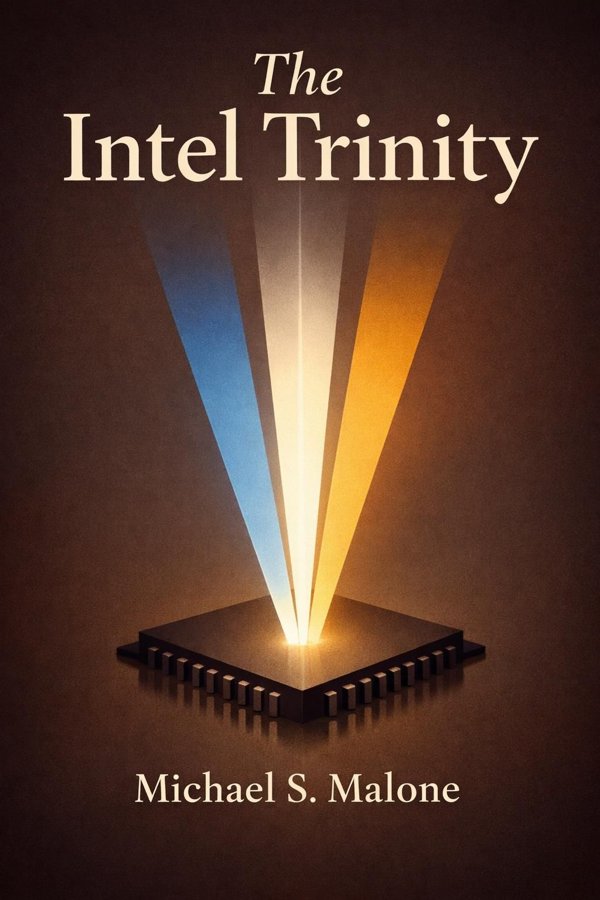
The Intel Trinity: How Robert Noyce, Gordon Moore, and Andy Grove Built the World's Most Important Company: Summary & Key Insights
 10 min5 chaptersAudio available
What Is The Intel Trinity: How Robert Noyce, Gordon Moore, and Andy Grove Built the World's Most Important Company About?
The Intel Trinity: How Robert Noyce, Gordon Moore, and Andy Grove Built the World's Most Important Company by Michael S. Malone is a biographies book spanning 5 pages. A detailed history of Intel Corporation, focusing on the three men who shaped its culture and success: Robert Noyce, Gordon Moore, and Andy Grove. The book explores their personalities, leadership styles, and the technological and business innovations that made Intel a cornerstone of the modern digital age.
This FizzRead summary covers all 5 key chapters of The Intel Trinity: How Robert Noyce, Gordon Moore, and Andy Grove Built the World's Most Important Company in approximately 10 minutes, distilling the most important ideas, arguments, and takeaways from Michael S. Malone's work. Also available as an audio summary and Key Quotes Podcast.
The Intel Trinity: How Robert Noyce, Gordon Moore, and Andy Grove Built the World's Most Important Company
A detailed history of Intel Corporation, focusing on the three men who shaped its culture and success: Robert Noyce, Gordon Moore, and Andy Grove. The book explores their personalities, leadership styles, and the technological and business innovations that made Intel a cornerstone of the modern digital age.
Who Should Read The Intel Trinity: How Robert Noyce, Gordon Moore, and Andy Grove Built the World's Most Important Company?
This book is perfect for anyone interested in biographies and looking to gain actionable insights in a short read. Whether you're a student, professional, or lifelong learner, the key ideas from The Intel Trinity: How Robert Noyce, Gordon Moore, and Andy Grove Built the World's Most Important Company by Michael S. Malone will help you think differently.
- ✓Readers who enjoy biographies and want practical takeaways
- ✓Professionals looking to apply new ideas to their work and life
- ✓Anyone who wants the core insights of The Intel Trinity: How Robert Noyce, Gordon Moore, and Andy Grove Built the World's Most Important Company in just 10 minutes
Want the full summary?
Get instant access to this book summary and 100K+ more with Fizz Moment.
Get Free SummaryAvailable on App Store • Free to download
Key Chapters
Robert Noyce, known by many as the ‘Mayor of Silicon Valley,’ was not only the co-inventor of the integrated circuit but also the spirit that animated the Valley’s collaborative culture. His upbringing in the small town of Grinnell, Iowa, shaped a man of unpretentious charm, equal parts scientist and dreamer. At Fairchild Semiconductor, Noyce fostered a culture that shattered traditional corporate hierarchies. He trusted his engineers, gave them freedom, and believed innovation thrived in autonomy.
When he co-founded Intel in 1968 with Gordon Moore, Noyce’s leadership set the tone for what Silicon Valley would become. He believed that individual creativity flourished best without bureaucratic interference. His corner office doors were never closed. Jeans were favored over suits, first names replaced titles, and brilliance mattered more than seniority. Noyce’s leadership wasn’t managerial—it was inspirational.
He carried forward the ‘fair children’ ethos from Fairchild, but this time imbued it with a mission: to push the boundaries of microelectronics. Under his guidance, engineers enjoyed freedom rare in corporate America. Yet, Noyce’s greatest gift was his ability to align that freedom with purpose. He was a catalyst, allowing the spontaneity of invention to merge with the discipline of production.
Noyce’s optimism mirrored the age’s spirit—it was the 1960s and technology represented hope. He believed that integrated circuits could democratize computing, making intelligence cheap and available to all. His eventual passing left a symbolic void in Silicon Valley; yet his imprint remains—the startup culture, the flat hierarchy, the belief in the power of small teams changing the world—all trace back to Noyce’s Intel.
If Noyce gave Intel its soul, Gordon Moore gave it its compass. His scientific curiosity defined Intel’s long-term direction, and his now-famous observation—that the number of transistors on a chip would double approximately every two years—became both prophecy and mission. Moore’s Law was not just a prediction; it was a self-fulfilling roadmap that guided engineering decisions and corporate investment.
Moore’s style was understated. He rarely raised his voice or sought attention, but his clarity of thought commanded respect. A chemist by training, Moore saw technology as an evolutionary process, where progress was measured not in leaps of genius but in methodical refinement. He encouraged long-term thinking at Intel when others focused on immediate results.
Under his influence, Intel transitioned from memory chips to microprocessors—a decision that would redefine not only the company but the entire computing industry. Moore recognized that while memory chips were becoming commodities, microprocessors represented the future—the core brains of a new computing era. His ability to blend strategic foresight with scientific discipline ensured Intel’s dominance through decades of shifting markets.
What set Moore apart was his refusal to compromise long-term innovation for short-term gain. He insisted that technology must drive business, not the other way around. His worldview shaped Intel into a company perpetually ahead of its time—always preparing for the next breakthrough, always measuring progress against the geometric growth he once envisioned with pencil lines on graph paper. Through Moore, Intel learned that progress itself could be engineered.
+ 3 more chapters — available in the FizzRead app
All Chapters in The Intel Trinity: How Robert Noyce, Gordon Moore, and Andy Grove Built the World's Most Important Company
About the Author
Michael S. Malone is an American author, journalist, and editor known for his extensive coverage of Silicon Valley and the technology industry. He has written for major publications such as Forbes and The Wall Street Journal and authored several books on technology and business history.
Get This Summary in Your Preferred Format
Read or listen to the The Intel Trinity: How Robert Noyce, Gordon Moore, and Andy Grove Built the World's Most Important Company summary by Michael S. Malone anytime, anywhere. FizzRead offers multiple formats so you can learn on your terms — all free.
Available formats: App · Audio · PDF · EPUB — All included free with FizzRead
Download The Intel Trinity: How Robert Noyce, Gordon Moore, and Andy Grove Built the World's Most Important Company PDF and EPUB Summary
Key Quotes from The Intel Trinity: How Robert Noyce, Gordon Moore, and Andy Grove Built the World's Most Important Company
“Robert Noyce, known by many as the ‘Mayor of Silicon Valley,’ was not only the co-inventor of the integrated circuit but also the spirit that animated the Valley’s collaborative culture.”
“If Noyce gave Intel its soul, Gordon Moore gave it its compass.”
Frequently Asked Questions about The Intel Trinity: How Robert Noyce, Gordon Moore, and Andy Grove Built the World's Most Important Company
The Intel Trinity: How Robert Noyce, Gordon Moore, and Andy Grove Built the World's Most Important Company by Michael S. Malone is a biographies book that explores key ideas across 5 chapters. A detailed history of Intel Corporation, focusing on the three men who shaped its culture and success: Robert Noyce, Gordon Moore, and Andy Grove. The book explores their personalities, leadership styles, and the technological and business innovations that made Intel a cornerstone of the modern digital age.
More by Michael S. Malone
Team Genius: The New Science of High-Performing Organizations
Rich Karlgaard, Michael S. Malone
10 min
Exponential Organizations: Why New Organizations Are Ten Times Better, Faster, and Cheaper Than Yours (and What to Do About It)
Salim Ismail, Michael S. Malone, Yuri van Geest
10 minYou Might Also Like

An American Marriage
Tayari Jones
10 min
Benjamin Franklin: An American Life
Walter Isaacson
10 min
I Know Why The Caged Bird Sings
Maya Angelou
10 min
Long Walk to Freedom
Nelson Mandela
10 min
Persepolis
Marjane Satrapi
10 min
Surely You're Joking, Mr. Feynman!
Richard P. Feynman
10 minBrowse by Category
Ready to read The Intel Trinity: How Robert Noyce, Gordon Moore, and Andy Grove Built the World's Most Important Company?
Get the full summary and 100K+ more books with Fizz Moment.