
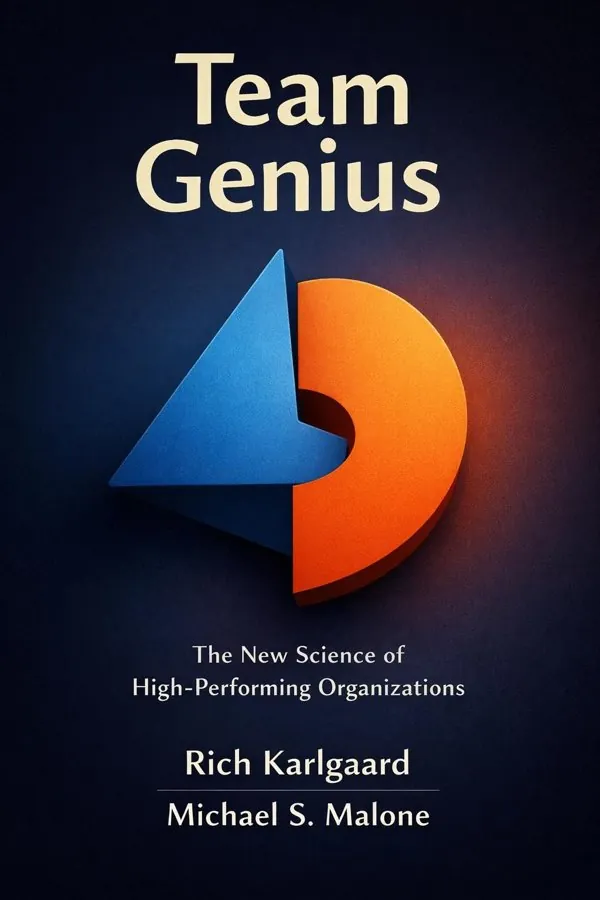
Team Genius: The New Science of High-Performing Organizations: Summary & Key Insights
by Rich Karlgaard, Michael S. Malone
 10 min6 chaptersAudio available
What Is Team Genius: The New Science of High-Performing Organizations About?
Team Genius: The New Science of High-Performing Organizations by Rich Karlgaard, Michael S. Malone is a leadership book spanning 6 pages. Team Genius explores how the size, composition, and dynamics of teams determine their success. Drawing on research in neuroscience, psychology, and organizational behavior, the authors argue that the future of business depends on understanding how to build and manage teams that can adapt to rapid change. The book provides insights into why some teams thrive while others fail, offering practical guidance for leaders seeking to create high-performing organizations.
This FizzRead summary covers all 6 key chapters of Team Genius: The New Science of High-Performing Organizations in approximately 10 minutes, distilling the most important ideas, arguments, and takeaways from Rich Karlgaard, Michael S. Malone's work. Also available as an audio summary and Key Quotes Podcast.
Team Genius: The New Science of High-Performing Organizations
Team Genius explores how the size, composition, and dynamics of teams determine their success. Drawing on research in neuroscience, psychology, and organizational behavior, the authors argue that the future of business depends on understanding how to build and manage teams that can adapt to rapid change. The book provides insights into why some teams thrive while others fail, offering practical guidance for leaders seeking to create high-performing organizations.
Who Should Read Team Genius: The New Science of High-Performing Organizations?
This book is perfect for anyone interested in leadership and looking to gain actionable insights in a short read. Whether you're a student, professional, or lifelong learner, the key ideas from Team Genius: The New Science of High-Performing Organizations by Rich Karlgaard, Michael S. Malone will help you think differently.
- ✓Readers who enjoy leadership and want practical takeaways
- ✓Professionals looking to apply new ideas to their work and life
- ✓Anyone who wants the core insights of Team Genius: The New Science of High-Performing Organizations in just 10 minutes
Want the full summary?
Get instant access to this book summary and 100K+ more with Fizz Moment.
Get Free SummaryAvailable on App Store • Free to download
Key Chapters
Long before the modern corporation, before sports teams or military hierarchies, humanity’s survival hinged on our ability to work together. Karlgaard and Malone remind us that cooperation is not a recent invention—it is one of our oldest evolutionary advantages. Early human bands that learned to collaborate hunted more effectively, protected their young, and innovated more rapidly than those who clung to solitary survival.
But the lesson extends beyond anthropology. The authors reveal a continuous throughline from the first groups of hunters to today’s research labs and start-up founders. Successful teams, in every era, share two core functions: specialization and trust. Each member brings a unique skill, yet trusts others to do the same. When either element breaks—when specialization becomes silo or trust erodes—performance collapses.
This history also underscores a profound truth: teams exist to solve adaptive challenges. They evolve when the environment demands change. That’s why, in today’s volatile economy, understanding the fluid nature of teams is not optional—it’s essential. The teams that adapt, as early humans once did, will be the ones that innovate and endure.
One of the most counterintuitive messages of *Team Genius* is that more people rarely mean more performance. Drawing on research into cognitive load and social dynamics, Karlgaard and Malone identify key thresholds in team size. Around five is ideal for creative, high-trust environments—small enough for intimacy, large enough for diversity. Beyond twelve, cohesion decays. Communication becomes formalized, trust turns procedural, and emotional bonds weaken.
The authors reference the work of British anthropologist Robin Dunbar, whose research suggests humans can maintain only about 150 meaningful social relationships. Within organizations, these natural cognitive limits shape how we connect. That’s why elite military units, startup teams, and successful innovation labs often cap their membership at a small, self-organizing number.
What matters most is not absolute size but proportional design—balancing the team’s mission with the level of communication needed to pursue it. The key insight here is dynamic sizing: knowing when a team should expand for scale or contract for focus. Leaders who understand these patterns can prevent the inefficiency that kills momentum and fosters disengagement.
+ 4 more chapters — available in the FizzRead app
All Chapters in Team Genius: The New Science of High-Performing Organizations
About the Authors
Rich Karlgaard is the publisher of Forbes and a respected business journalist focusing on innovation and leadership. Michael S. Malone is a veteran Silicon Valley journalist and author known for his work on technology and corporate culture.
Get This Summary in Your Preferred Format
Read or listen to the Team Genius: The New Science of High-Performing Organizations summary by Rich Karlgaard, Michael S. Malone anytime, anywhere. FizzRead offers multiple formats so you can learn on your terms — all free.
Available formats: App · Audio · PDF · EPUB — All included free with FizzRead
Download Team Genius: The New Science of High-Performing Organizations PDF and EPUB Summary
Key Quotes from Team Genius: The New Science of High-Performing Organizations
“Long before the modern corporation, before sports teams or military hierarchies, humanity’s survival hinged on our ability to work together.”
“One of the most counterintuitive messages of *Team Genius* is that more people rarely mean more performance.”
Frequently Asked Questions about Team Genius: The New Science of High-Performing Organizations
Team Genius: The New Science of High-Performing Organizations by Rich Karlgaard, Michael S. Malone is a leadership book that explores key ideas across 6 chapters. Team Genius explores how the size, composition, and dynamics of teams determine their success. Drawing on research in neuroscience, psychology, and organizational behavior, the authors argue that the future of business depends on understanding how to build and manage teams that can adapt to rapid change. The book provides insights into why some teams thrive while others fail, offering practical guidance for leaders seeking to create high-performing organizations.
You Might Also Like

Extreme Ownership
Jocko Willink
10 min
Dare to Lead
Brene Brown
10 min
Leaders Eat Last
Simon Sinek
10 min
The 21 Irrefutable Laws of Leadership
John Maxwell
10 min
Start With Why
Simon Sinek
10 min
How to Lead When You're Not in Charge
Clay Scroggins
10 minBrowse by Category
Ready to read Team Genius: The New Science of High-Performing Organizations?
Get the full summary and 100K+ more books with Fizz Moment.