
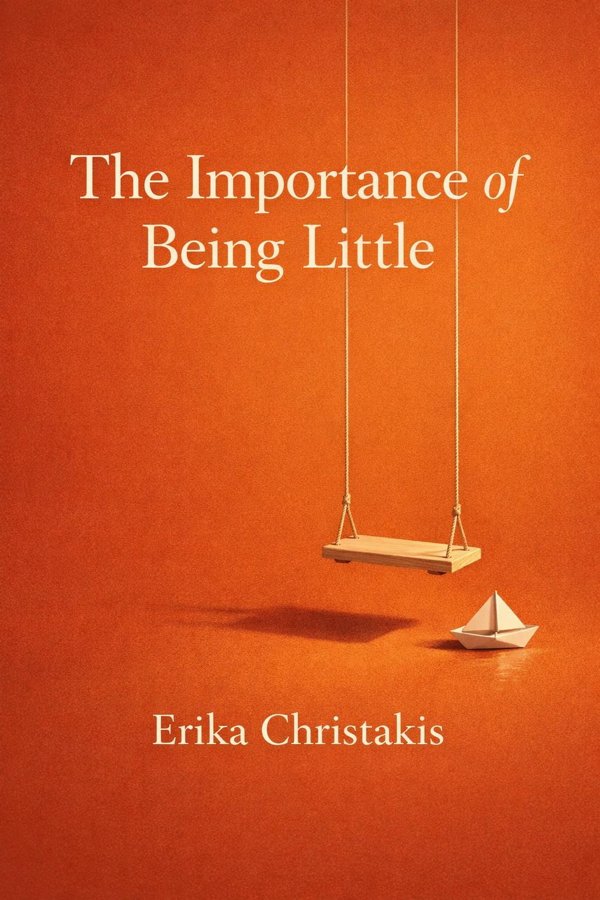
The Importance of Being Little: What Young Children Really Need from Grownups: Summary & Key Insights
 10 min7 chaptersAudio available
What Is The Importance of Being Little: What Young Children Really Need from Grownups About?
The Importance of Being Little: What Young Children Really Need from Grownups by Erika Christakis is a education book spanning 7 pages. In this insightful work, Erika Christakis explores how adults can better understand and support the learning and development of young children. Drawing on research in early childhood education, she argues that society often underestimates the intelligence and emotional depth of young children, and that meaningful relationships and play are essential for their growth. The book challenges conventional approaches to early education and advocates for environments that respect children’s natural curiosity and capacity for learning.
This FizzRead summary covers all 7 key chapters of The Importance of Being Little: What Young Children Really Need from Grownups in approximately 10 minutes, distilling the most important ideas, arguments, and takeaways from Erika Christakis's work. Also available as an audio summary and Key Quotes Podcast.
The Importance of Being Little: What Young Children Really Need from Grownups
In this insightful work, Erika Christakis explores how adults can better understand and support the learning and development of young children. Drawing on research in early childhood education, she argues that society often underestimates the intelligence and emotional depth of young children, and that meaningful relationships and play are essential for their growth. The book challenges conventional approaches to early education and advocates for environments that respect children’s natural curiosity and capacity for learning.
Who Should Read The Importance of Being Little: What Young Children Really Need from Grownups?
This book is perfect for anyone interested in education and looking to gain actionable insights in a short read. Whether you're a student, professional, or lifelong learner, the key ideas from The Importance of Being Little: What Young Children Really Need from Grownups by Erika Christakis will help you think differently.
- ✓Readers who enjoy education and want practical takeaways
- ✓Professionals looking to apply new ideas to their work and life
- ✓Anyone who wants the core insights of The Importance of Being Little: What Young Children Really Need from Grownups in just 10 minutes
Want the full summary?
Get instant access to this book summary and 100K+ more with Fizz Moment.
Get Free SummaryAvailable on App Store • Free to download
Key Chapters
We live in a culture that often expects children to behave as if they were adults in smaller bodies. We read their hesitations as stubbornness, their messy play as distraction, their curiosity as inefficiency. But the truth is that childhood has its own logic and rhythm, a way of knowing that cannot be compressed into adult frameworks. Too often in classrooms and homes, adults approach children as data points to be managed rather than complex souls to be understood. I call this the 'miniature adult' myth, and its influence can be profoundly limiting.
Children learn differently than adults. They do not simply absorb information—they construct meaning through sensory experience, through dialogue, through trial and error. When we impose adult logic too quickly, we strip away the context that makes learning meaningful. For instance, we expect a four-year-old to sit still during group time, yet the very movement we discourage is part of how young bodies think and process. The problem, then, isn’t that children fail to pay attention; it’s that we fail to pay attention to what attention looks like for a child.
Recognizing this truth changes everything. It reframes our role as educators and parents—not as masters imparting knowledge, but as companions in discovery. When we shed the illusion of the ‘mini adult,’ we give ourselves permission to see the brilliance in a child’s confusion, the creativity in her mistakes, and the purpose in her play. That shift is the foundation of meaningful learning.
To understand the child’s world, we need to slow down long enough to see what they see. Children live in the immediacy of experience; they notice detail and pattern in ways adults overlook. A puddle to an adult is an inconvenience, but to a child it’s a universe of motion, light, and cause-and-effect waiting to be explored. When we honor this curiosity, we acknowledge that real education begins with observation, not instruction.
Observation is a powerful tool for adults, too. It teaches us humility—to realize how easily our interpretations overwrite the child’s intentions. When a child insists on pouring her own juice, it may not be defiance but an earnest experiment in control and competence. Much of what appears as ‘behavior problems’ is often a child’s natural drive for mastery and understanding. The job of an adult is to translate this language of curiosity rather than to silence it.
In practice, this means creating pauses in our routines for wonder. It means attuning ourselves to tone, gesture, and silence—the myriad ways children communicate before they have all the words. Most of all, it requires faith: faith that exploration, though messy and unpredictable, yields a deeper, more resilient kind of learning than rote instruction ever can.
+ 5 more chapters — available in the FizzRead app
All Chapters in The Importance of Being Little: What Young Children Really Need from Grownups
About the Author
Erika Christakis is an early childhood educator and former faculty member at the Yale Child Study Center. She has written extensively on education and child development, and her work focuses on how adults can create nurturing and intellectually stimulating environments for young children.
Get This Summary in Your Preferred Format
Read or listen to the The Importance of Being Little: What Young Children Really Need from Grownups summary by Erika Christakis anytime, anywhere. FizzRead offers multiple formats so you can learn on your terms — all free.
Available formats: App · Audio · PDF · EPUB — All included free with FizzRead
Download The Importance of Being Little: What Young Children Really Need from Grownups PDF and EPUB Summary
Key Quotes from The Importance of Being Little: What Young Children Really Need from Grownups
“We live in a culture that often expects children to behave as if they were adults in smaller bodies.”
“To understand the child’s world, we need to slow down long enough to see what they see.”
Frequently Asked Questions about The Importance of Being Little: What Young Children Really Need from Grownups
The Importance of Being Little: What Young Children Really Need from Grownups by Erika Christakis is a education book that explores key ideas across 7 chapters. In this insightful work, Erika Christakis explores how adults can better understand and support the learning and development of young children. Drawing on research in early childhood education, she argues that society often underestimates the intelligence and emotional depth of young children, and that meaningful relationships and play are essential for their growth. The book challenges conventional approaches to early education and advocates for environments that respect children’s natural curiosity and capacity for learning.
You Might Also Like

Bedtime Biography: Florence Nightingale
Isabel Thomas
10 min
Introduction To Museum Studies
Howard H. Hoyt
10 min
A Mind for Numbers: How to Excel at Math and Science (Even If You Flunked Algebra)
Barbara Oakley
10 min
AI for Educators: Learning Strategies, Teacher Empowerment, and the Future of Education
Matt Miller
10 min
Animation For Beginners
Morr Meroz
10 min
Artificial Intelligence for Learning
Donald Clark
10 minBrowse by Category
Ready to read The Importance of Being Little: What Young Children Really Need from Grownups?
Get the full summary and 100K+ more books with Fizz Moment.