
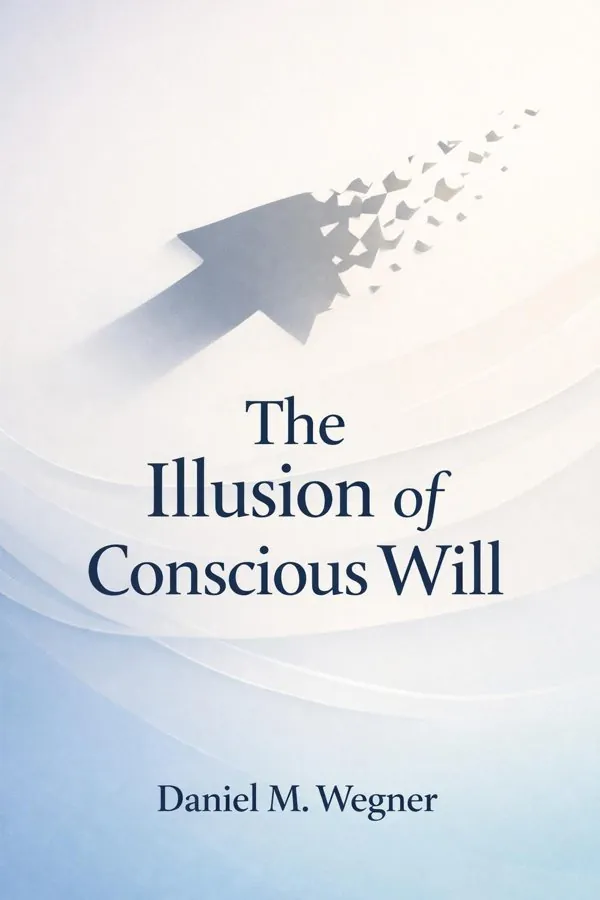
The Illusion of Conscious Will: Summary & Key Insights
 10 min9 chaptersAudio available
What Is The Illusion of Conscious Will About?
The Illusion of Conscious Will by Daniel M. Wegner is a cognition book spanning 9 pages. In this influential work, Daniel M. Wegner explores the psychological and philosophical foundations of human agency, arguing that the experience of conscious will is largely an illusion created by the mind. Drawing on experimental psychology, cognitive science, and philosophy, Wegner demonstrates how our sense of control over actions arises from mental processes that occur after the fact, rather than from direct causal control. The book challenges traditional notions of free will and has become a cornerstone in the study of consciousness and human behavior.
This FizzRead summary covers all 9 key chapters of The Illusion of Conscious Will in approximately 10 minutes, distilling the most important ideas, arguments, and takeaways from Daniel M. Wegner's work. Also available as an audio summary and Key Quotes Podcast.
The Illusion of Conscious Will
In this influential work, Daniel M. Wegner explores the psychological and philosophical foundations of human agency, arguing that the experience of conscious will is largely an illusion created by the mind. Drawing on experimental psychology, cognitive science, and philosophy, Wegner demonstrates how our sense of control over actions arises from mental processes that occur after the fact, rather than from direct causal control. The book challenges traditional notions of free will and has become a cornerstone in the study of consciousness and human behavior.
Who Should Read The Illusion of Conscious Will?
This book is perfect for anyone interested in cognition and looking to gain actionable insights in a short read. Whether you're a student, professional, or lifelong learner, the key ideas from The Illusion of Conscious Will by Daniel M. Wegner will help you think differently.
- ✓Readers who enjoy cognition and want practical takeaways
- ✓Professionals looking to apply new ideas to their work and life
- ✓Anyone who wants the core insights of The Illusion of Conscious Will in just 10 minutes
Want the full summary?
Get instant access to this book summary and 100K+ more with Fizz Moment.
Get Free SummaryAvailable on App Store • Free to download
Key Chapters
The belief in conscious will is one of the oldest and most persistent stories human beings have told. Philosophers like René Descartes drew a sharp line between mind and body, suggesting that the mental realm possesses a kind of causal sovereignty. To will an action, Descartes claimed, is to have a mental cause produce a physical effect. Hume, by contrast, doubted this linkage. He noticed that we never truly perceive causation—only sequences of events, one following another. Our sense of cause is an inference, a habit of mind formed by constant conjunctions. In many ways, the illusion of conscious will follows exactly the same logic: we do not perceive our will causing our actions; we infer the causal relationship because thoughts precede behavior in time and match it in content.
As the scientific revolution advanced, the domain of the mind became the last refuge for freedom in an otherwise mechanistic universe. Even as biology, chemistry, and physics explained nature through determinate laws, human beings insisted that consciousness—this inner witnessing voice—remained a sanctuary of free choice. Yet psychology and neuroscience eventually began to invade that last bastion. With the rise of behaviorism in the early twentieth century and, later, cognitive science, scholars started examining the automatic and unconscious underpinnings of thought and decision.
I situate my work at the crossroads of this long debate. Our culture still cherishes freedom and moral responsibility, but the scientific picture increasingly portrays the human organism as a causal system operating by physical law. The apparent conflict between these two views leads us to my central question: what if conscious will is not a cause, but an interpretation—one derived from cues that merely accompany our actions?
The mind’s sense of will arises through a process I call apparent mental causation. Three factors combine to produce it. First, the thought about an action must precede the action in time. Second, the thought must be consistent with the action—in other words, the content of the thought must match what actually happens. Third, there must be no competing alternative cause that explains the behavior better. When these conditions are met, we feel as though we willed the event. When they are violated, we do not.
This model neatly parallels David Hume’s concept of causation, which depends on temporal priority, consistency, and contiguity. Our sense of will works the same way—it is a perceptual judgment, not an internal force. Just as we see causation in billiard balls because one strikes the other before it moves, we see causation between thought and action because they align in time and meaning.
When I first proposed this framework, it challenged deeply held intuitions. The model does not deny that people think, act, and experience intention. It argues that the conscious experience of intention is not the mechanism driving the act. It is a product of the same cognitive architecture that generates the illusion of causation more generally. The brain produces both the thoughts and the actions, but consciousness receives only the summary narrative afterward, packaged as a feeling of will.
+ 7 more chapters — available in the FizzRead app
All Chapters in The Illusion of Conscious Will
About the Author
Daniel M. Wegner (1948–2013) was an American social psychologist known for his pioneering research on thought suppression, conscious will, and the psychology of mental control. He was a professor of psychology at Harvard University and a fellow of the American Academy of Arts and Sciences. His work profoundly influenced the fields of cognitive and social psychology.
Get This Summary in Your Preferred Format
Read or listen to the The Illusion of Conscious Will summary by Daniel M. Wegner anytime, anywhere. FizzRead offers multiple formats so you can learn on your terms — all free.
Available formats: App · Audio · PDF · EPUB — All included free with FizzRead
Download The Illusion of Conscious Will PDF and EPUB Summary
Key Quotes from The Illusion of Conscious Will
“The belief in conscious will is one of the oldest and most persistent stories human beings have told.”
“The mind’s sense of will arises through a process I call apparent mental causation.”
Frequently Asked Questions about The Illusion of Conscious Will
The Illusion of Conscious Will by Daniel M. Wegner is a cognition book that explores key ideas across 9 chapters. In this influential work, Daniel M. Wegner explores the psychological and philosophical foundations of human agency, arguing that the experience of conscious will is largely an illusion created by the mind. Drawing on experimental psychology, cognitive science, and philosophy, Wegner demonstrates how our sense of control over actions arises from mental processes that occur after the fact, rather than from direct causal control. The book challenges traditional notions of free will and has become a cornerstone in the study of consciousness and human behavior.
More by Daniel M. Wegner
You Might Also Like

A Field Guide to Lies: Critical Thinking in the Information Age
Daniel J. Levitin
10 min
A Theory of Cognitive Dissonance
Leon Festinger
10 min
Black-And-White Thinking: The Burden of a Binary Brain in a Complex World
Kevin Dutton
10 min
Born Liars: Why We Can’t Live Without Deceit
Ian Leslie
10 min
Collective Illusions: Conformity, Complicity, and the Science of Why We Make Bad Decisions
Todd Rose
10 min
Concrete Mathematics: A Foundation for Computer Science
Ronald L. Graham, Donald E. Knuth, Oren Patashnik
10 minBrowse by Category
Ready to read The Illusion of Conscious Will?
Get the full summary and 100K+ more books with Fizz Moment.