
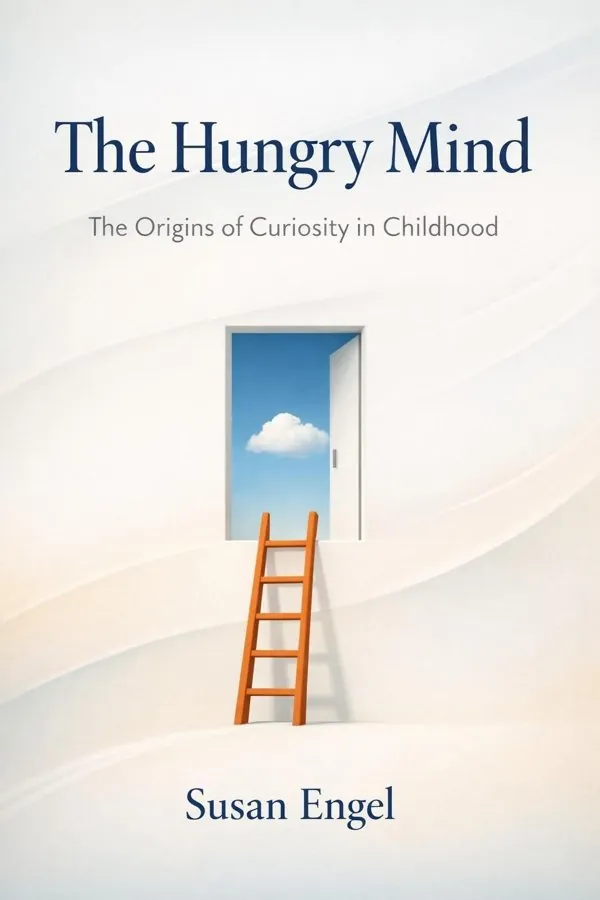
The Hungry Mind: The Origins of Curiosity in Childhood: Summary & Key Insights
by Susan Engel
 10 min12 chaptersAudio available
What Is The Hungry Mind: The Origins of Curiosity in Childhood About?
The Hungry Mind: The Origins of Curiosity in Childhood by Susan Engel is a education book spanning 12 pages. This book explores how curiosity develops in children and how it shapes their learning and intellectual growth. Drawing on psychological research and classroom observations, Susan Engel examines the social and cognitive factors that foster or inhibit curiosity, offering insights into how parents and educators can nurture inquisitiveness and creativity.
This FizzRead summary covers all 12 key chapters of The Hungry Mind: The Origins of Curiosity in Childhood in approximately 10 minutes, distilling the most important ideas, arguments, and takeaways from Susan Engel's work. Also available as an audio summary and Key Quotes Podcast.
The Hungry Mind: The Origins of Curiosity in Childhood
This book explores how curiosity develops in children and how it shapes their learning and intellectual growth. Drawing on psychological research and classroom observations, Susan Engel examines the social and cognitive factors that foster or inhibit curiosity, offering insights into how parents and educators can nurture inquisitiveness and creativity.
Who Should Read The Hungry Mind: The Origins of Curiosity in Childhood?
This book is perfect for anyone interested in education and looking to gain actionable insights in a short read. Whether you're a student, professional, or lifelong learner, the key ideas from The Hungry Mind: The Origins of Curiosity in Childhood by Susan Engel will help you think differently.
- ✓Readers who enjoy education and want practical takeaways
- ✓Professionals looking to apply new ideas to their work and life
- ✓Anyone who wants the core insights of The Hungry Mind: The Origins of Curiosity in Childhood in just 10 minutes
Want the full summary?
Get instant access to this book summary and 100K+ more with Fizz Moment.
Get Free SummaryAvailable on App Store • Free to download
Key Chapters
Curiosity has been a subject of fascination since early philosophical thought. From Aristotle’s observation that all humans, by nature, desire to know, to Dewey’s linking of curiosity with genuine inquiry, intellectual history has always been intertwined with this drive. Yet only in the twentieth century did psychologists begin to treat curiosity as a distinct topic of study. The behaviorists of the early 1900s saw curiosity merely as a form of exploratory behavior—a response to novelty or uncertainty. Later, cognitive theorists reframed it as a complex mental pursuit aimed not just at novelty but at resolving gaps in knowledge. Berlyne’s distinction between perceptual and epistemic curiosity helped clarify why infants stare at new stimuli, while older children pepper adults with endless questions. My role in this lineage has been to bridge these theories with real classroom observation, grounding the abstract in the lived experiences of learners.
As I examined historical models, I noticed something crucial: most theories treated curiosity as an internal drive independent of context. Yet anyone who has watched a child in a school setting knows how dependent curiosity is on environment. A child’s cognitive itch only becomes productive if the social climate allows it. My own framework thus situates curiosity within a triangle—the child, their cognitive processes, and their social world. This intersection, rather than any isolated factor, explains how curiosity actually manifests in daily life.
Over years of research, I spent hours watching children’s natural behavior in classrooms and homes. True curiosity, I found, rarely announces itself in grand gestures. It emerges in the smallest exchanges—a child turning an object over and over, testing how far a spoon can bend before it breaks, or whispering to a peer, ‘what happens if we mix these colors?’ These moments are as delicate as they are revealing. They tell us where a child’s attention goes when no one is directing it.
One scene that remains vivid to me involved a six-year-old named Ben who could not stop staring at the class aquarium. He wanted to know why the fish never seemed tired. The teacher, pressed for time, simply said, ‘Fish don’t sleep like people do.’ Ben paused, but the glimmer in his eyes dimmed. In moments like that, I saw the fragile transaction between adult efficiency and a child’s drive to understand. Curiosity is incredibly dependent on response—it either flourishes with engagement or fades with dismissal.
Through systematic observation, I identified patterns: curiosity often spikes in situations of partial understanding, where the child knows just enough to sense an unanswered question. The challenge for us as adults is to recognize these moments and treat them not as interruptions but as starting points for learning. When children are allowed to pursue such moments, their learning becomes self-propelled.
+ 10 more chapters — available in the FizzRead app
All Chapters in The Hungry Mind: The Origins of Curiosity in Childhood
About the Author
Susan Engel is a developmental psychologist and senior lecturer in psychology at Williams College. Her research focuses on curiosity, learning, and the development of narrative and imagination in children. She has authored several books on child development and education.
Get This Summary in Your Preferred Format
Read or listen to the The Hungry Mind: The Origins of Curiosity in Childhood summary by Susan Engel anytime, anywhere. FizzRead offers multiple formats so you can learn on your terms — all free.
Available formats: App · Audio · PDF · EPUB — All included free with FizzRead
Download The Hungry Mind: The Origins of Curiosity in Childhood PDF and EPUB Summary
Key Quotes from The Hungry Mind: The Origins of Curiosity in Childhood
“Curiosity has been a subject of fascination since early philosophical thought.”
“Over years of research, I spent hours watching children’s natural behavior in classrooms and homes.”
Frequently Asked Questions about The Hungry Mind: The Origins of Curiosity in Childhood
The Hungry Mind: The Origins of Curiosity in Childhood by Susan Engel is a education book that explores key ideas across 12 chapters. This book explores how curiosity develops in children and how it shapes their learning and intellectual growth. Drawing on psychological research and classroom observations, Susan Engel examines the social and cognitive factors that foster or inhibit curiosity, offering insights into how parents and educators can nurture inquisitiveness and creativity.
You Might Also Like

Bedtime Biography: Florence Nightingale
Isabel Thomas
10 min
Introduction To Museum Studies
Howard H. Hoyt
10 min
A Mind for Numbers: How to Excel at Math and Science (Even If You Flunked Algebra)
Barbara Oakley
10 min
AI for Educators: Learning Strategies, Teacher Empowerment, and the Future of Education
Matt Miller
10 min
Animation For Beginners
Morr Meroz
10 min
Artificial Intelligence for Learning
Donald Clark
10 minBrowse by Category
Ready to read The Hungry Mind: The Origins of Curiosity in Childhood?
Get the full summary and 100K+ more books with Fizz Moment.