
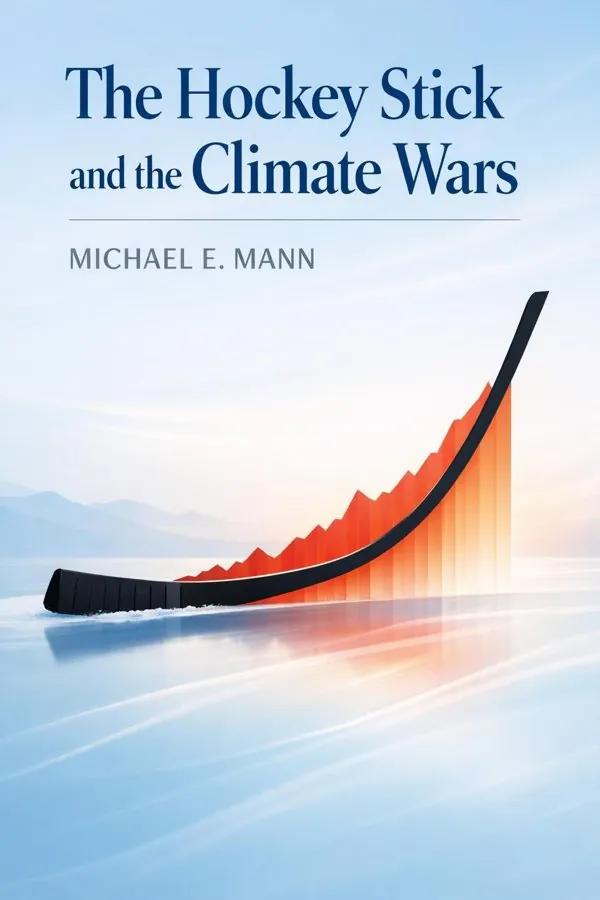
The Hockey Stick and the Climate Wars: Dispatches from the Front Lines: Summary & Key Insights
 10 min11 chaptersAudio available
What Is The Hockey Stick and the Climate Wars: Dispatches from the Front Lines About?
The Hockey Stick and the Climate Wars: Dispatches from the Front Lines by Michael E. Mann is a environment book spanning 11 pages. In this book, climatologist Michael E. Mann recounts his experiences at the center of the climate change debate. He explains the science behind the 'hockey stick' graph, which illustrates the rapid rise in global temperatures, and describes the political and media battles that followed its publication. Mann offers an insider’s view of the scientific process, the attacks on climate researchers, and the broader struggle to communicate climate science to the public.
This FizzRead summary covers all 11 key chapters of The Hockey Stick and the Climate Wars: Dispatches from the Front Lines in approximately 10 minutes, distilling the most important ideas, arguments, and takeaways from Michael E. Mann's work. Also available as an audio summary and Key Quotes Podcast.
The Hockey Stick and the Climate Wars: Dispatches from the Front Lines
In this book, climatologist Michael E. Mann recounts his experiences at the center of the climate change debate. He explains the science behind the 'hockey stick' graph, which illustrates the rapid rise in global temperatures, and describes the political and media battles that followed its publication. Mann offers an insider’s view of the scientific process, the attacks on climate researchers, and the broader struggle to communicate climate science to the public.
Who Should Read The Hockey Stick and the Climate Wars: Dispatches from the Front Lines?
This book is perfect for anyone interested in environment and looking to gain actionable insights in a short read. Whether you're a student, professional, or lifelong learner, the key ideas from The Hockey Stick and the Climate Wars: Dispatches from the Front Lines by Michael E. Mann will help you think differently.
- ✓Readers who enjoy environment and want practical takeaways
- ✓Professionals looking to apply new ideas to their work and life
- ✓Anyone who wants the core insights of The Hockey Stick and the Climate Wars: Dispatches from the Front Lines in just 10 minutes
Want the full summary?
Get instant access to this book summary and 100K+ more with Fizz Moment.
Get Free SummaryAvailable on App Store • Free to download
Key Chapters
In the 1990s, we were piecing together fragments of Earth's past, attempting to reconstruct temperature changes long before thermometers existed. The challenge was formidable: how could we know what the climate was centuries or millennia ago? The answer lay in proxies—natural recorders like tree rings, corals, and ice cores that captured the environmental conditions of their times. Working with colleagues like Ray Bradley and Malcolm Hughes, I began combining these data sources to build a continuous climate record stretching back thousands of years.
It was a process rooted in innovation and skepticism. We were venturing into statistical techniques that had to account for uncertainty, correlations, and regional differences. Each dataset carried its own limitations, yet together they revealed a coherent story: for roughly a millennium, global temperatures had been relatively steady, with modest variations corresponding to events like the Medieval Warm Period and the Little Ice Age. But then came the sharp, unprecedented rise of the past century—a sudden jump that gave the curve its unmistakable 'hockey stick' shape.
The moment of discovery was exhilarating and sobering. We realized this wasn't just another research paper—it was a window into how dramatically humans were altering the planet. Our findings were published in *Nature* in 1998 and expanded in 1999. We didn’t anticipate fame or notoriety. What we sought was understanding—a scientific contribution to a larger puzzle. But soon, our results would find their way beyond the quiet corridors of academia and into a far louder arena.
The publication of the hockey stick graph attracted immediate attention within the scientific community. For decades, climate scientists had suspected that modern warming was anomalous, but our study offered a clear, quantitative depiction. The simplicity of the image—a long flat handle and a sharp, modern upturn—was both its power and its vulnerability. When the Intergovernmental Panel on Climate Change included our graph in its 2001 Third Assessment Report, it quickly became an icon of global warming.
At first, the reaction was largely positive. The clarity of the presentation helped policymakers and the public visualize centuries of climate change at a glance. Yet even in those early days, critics began to emerge—not just from within scientific debate, which is normal and welcome, but from corners deeply invested in maintaining doubt about climate science. I hadn’t yet realized that we had stepped into a political minefield. The fossil fuel industry and aligned think tanks recognized that the 'hockey stick' was powerful because it communicated the essence of human influence on the climate without needing words. A simple visual could threaten decades of messaging designed to preserve the illusion that climate change remained uncertain.
+ 9 more chapters — available in the FizzRead app
All Chapters in The Hockey Stick and the Climate Wars: Dispatches from the Front Lines
About the Author
Michael E. Mann is an American climatologist and geophysicist, currently Distinguished Professor of Atmospheric Science at Penn State University. He is known for his pioneering work on climate reconstructions and for developing the 'hockey stick' graph that became central to discussions of global warming.
Get This Summary in Your Preferred Format
Read or listen to the The Hockey Stick and the Climate Wars: Dispatches from the Front Lines summary by Michael E. Mann anytime, anywhere. FizzRead offers multiple formats so you can learn on your terms — all free.
Available formats: App · Audio · PDF · EPUB — All included free with FizzRead
Download The Hockey Stick and the Climate Wars: Dispatches from the Front Lines PDF and EPUB Summary
Key Quotes from The Hockey Stick and the Climate Wars: Dispatches from the Front Lines
“In the 1990s, we were piecing together fragments of Earth's past, attempting to reconstruct temperature changes long before thermometers existed.”
“The publication of the hockey stick graph attracted immediate attention within the scientific community.”
Frequently Asked Questions about The Hockey Stick and the Climate Wars: Dispatches from the Front Lines
The Hockey Stick and the Climate Wars: Dispatches from the Front Lines by Michael E. Mann is a environment book that explores key ideas across 11 chapters. In this book, climatologist Michael E. Mann recounts his experiences at the center of the climate change debate. He explains the science behind the 'hockey stick' graph, which illustrates the rapid rise in global temperatures, and describes the political and media battles that followed its publication. Mann offers an insider’s view of the scientific process, the attacks on climate researchers, and the broader struggle to communicate climate science to the public.
More by Michael E. Mann

You Might Also Like

A Life on Our Planet: My Witness Statement and a Vision for the Future
David Attenborough
10 min
A Sky Full Of Birds
Matt Merritt
10 min
Carbon Zero: Imagining Cities That Can Save the Planet
Alex Steffen
10 min
Eaarth: Making a Life on a Tough New Planet
Bill McKibben
10 min
The Social Contract and Environmental Governance
Various Editors
10 min
The Wild Places
Robert Macfarlane
10 minBrowse by Category
Ready to read The Hockey Stick and the Climate Wars: Dispatches from the Front Lines?
Get the full summary and 100K+ more books with Fizz Moment.