
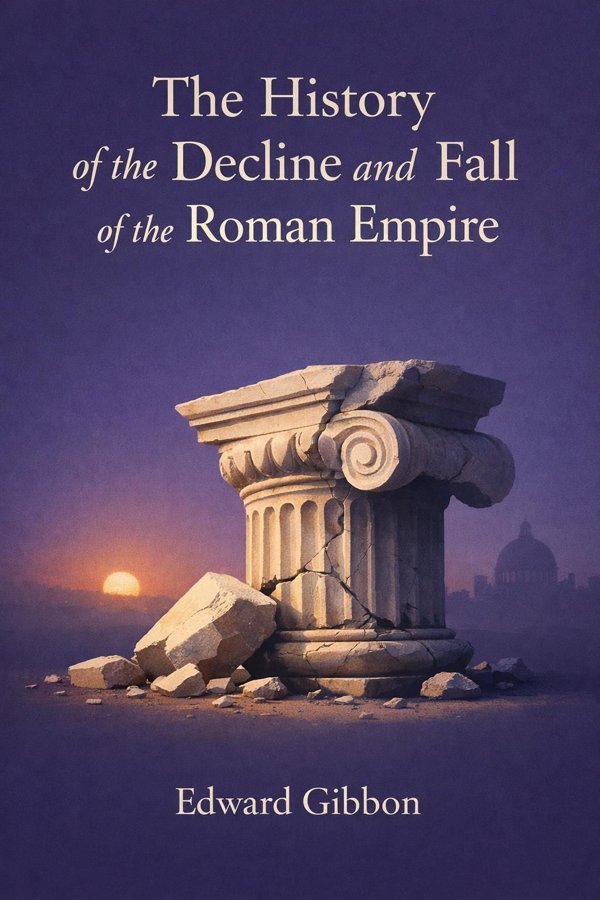
The History of the Decline and Fall of the Roman Empire: Summary & Key Insights
 10 min9 chaptersAudio available
Key Takeaways from The History of the Decline and Fall of the Roman Empire
Great civilizations often reveal their future weaknesses at the very moment of their greatest success.
A single ruler does not destroy a great empire overnight, but he can expose how much its survival depends on character.
When the army decides who governs, politics becomes a contest of force rather than law.
Decline does not mean passivity; failing systems often survive by transforming themselves.
Ideas can reshape empires as profoundly as armies.
What Is The History of the Decline and Fall of the Roman Empire About?
The History of the Decline and Fall of the Roman Empire by Edward Gibbon is a world_history book spanning 9 pages. Edward Gibbon’s The History of the Decline and Fall of the Roman Empire is one of the most ambitious works ever written about the ancient world. Spanning from the high point of Roman power under the Antonine emperors to the fall of Constantinople in 1453, it is far more than a chronicle of battles and emperors. Gibbon investigates why civilizations weaken, how institutions lose discipline, and what happens when military strength, civic virtue, and political legitimacy drift apart. His central concern is not simply that Rome fell, but how a seemingly invincible empire became vulnerable from within before it was overwhelmed from without. What makes the work endure is the combination of scale, style, and argument. Gibbon writes with elegance, irony, and immense confidence, but he also pioneered a more critical, source-based approach to history than many of his predecessors. His interpretations—especially on Christianity, imperial bureaucracy, and moral decline—have been debated for centuries, yet that debate is part of the book’s greatness. Gibbon remains essential because he teaches readers to see empire as a living system: powerful, adaptive, and always at risk of decay.
This FizzRead summary covers all 9 key chapters of The History of the Decline and Fall of the Roman Empire in approximately 10 minutes, distilling the most important ideas, arguments, and takeaways from Edward Gibbon's work. Also available as an audio summary and Key Quotes Podcast.
The History of the Decline and Fall of the Roman Empire
Edward Gibbon’s The History of the Decline and Fall of the Roman Empire is one of the most ambitious works ever written about the ancient world. Spanning from the high point of Roman power under the Antonine emperors to the fall of Constantinople in 1453, it is far more than a chronicle of battles and emperors. Gibbon investigates why civilizations weaken, how institutions lose discipline, and what happens when military strength, civic virtue, and political legitimacy drift apart. His central concern is not simply that Rome fell, but how a seemingly invincible empire became vulnerable from within before it was overwhelmed from without.
What makes the work endure is the combination of scale, style, and argument. Gibbon writes with elegance, irony, and immense confidence, but he also pioneered a more critical, source-based approach to history than many of his predecessors. His interpretations—especially on Christianity, imperial bureaucracy, and moral decline—have been debated for centuries, yet that debate is part of the book’s greatness. Gibbon remains essential because he teaches readers to see empire as a living system: powerful, adaptive, and always at risk of decay.
Who Should Read The History of the Decline and Fall of the Roman Empire?
This book is perfect for anyone interested in world_history and looking to gain actionable insights in a short read. Whether you're a student, professional, or lifelong learner, the key ideas from The History of the Decline and Fall of the Roman Empire by Edward Gibbon will help you think differently.
- ✓Readers who enjoy world_history and want practical takeaways
- ✓Professionals looking to apply new ideas to their work and life
- ✓Anyone who wants the core insights of The History of the Decline and Fall of the Roman Empire in just 10 minutes
Want the full summary?
Get instant access to this book summary and 100K+ more with Fizz Moment.
Get Free SummaryAvailable on App Store • Free to download
Key Chapters
Great civilizations often reveal their future weaknesses at the very moment of their greatest success. Gibbon begins by presenting the age of Nerva, Trajan, Hadrian, Antoninus Pius, and Marcus Aurelius as the happiest and most prosperous period in Roman history. In his view, this was the empire at its zenith: its frontiers were broadly secure, its laws were respected, commerce flourished, and provincial life was increasingly integrated into a shared Roman order. Power and restraint seemed, for a rare moment, to coexist.
What mattered most was not just military strength, but the character of governance. The best emperors ruled with moderation, delegated effectively, and understood that legitimacy depends on more than fear. The empire did not need constant theatrical displays of power because its institutions still functioned. Roads, taxation, urban administration, and legal order gave ordinary subjects practical reasons to accept Roman rule.
This idea has clear modern relevance. Organizations, states, and companies often mistake visible success for permanent stability. Yet periods of strength should be used to reinforce institutions, develop successors, and protect standards. Marcus Aurelius governed wisely, but his choice to elevate Commodus showed how fragile good systems become when succession is mishandled.
Gibbon’s deeper point is that prosperity is never self-sustaining. It depends on habits of discipline, competence, and public trust. When those habits weaken, decline may begin long before collapse becomes visible. Actionable takeaway: judge any powerful institution not by its wealth or reach alone, but by the quality of its leadership, succession, and civic discipline.
A single ruler does not destroy a great empire overnight, but he can expose how much its survival depends on character. For Gibbon, the death of Marcus Aurelius marked the end of Rome’s age of reason and the start of a more dangerous era. Commodus inherited a stable empire yet governed as if imperial office were a stage for vanity, indulgence, and cruelty. His reign symbolized the shift from stewardship to self-display.
Gibbon treats Commodus not merely as a bad emperor, but as evidence that Roman political health had become too dependent on the accident of personal virtue. Under capable rulers, the machinery of empire could appear strong. Under an unworthy one, corruption, favoritism, and public humiliation spread quickly. Institutions that should have constrained folly instead adapted to it. Courtiers competed for influence, military loyalty became transactional, and imperial dignity was squandered.
This is one of Gibbon’s most enduring insights: decline often starts when leadership stops serving the institution and begins exploiting it. The damage is cultural as well as administrative. Once standards fall at the top, others learn that advancement comes from flattery, spectacle, or force rather than merit.
The pattern applies well beyond ancient Rome. In governments, businesses, and communities, weak leaders often reveal structural vulnerabilities that better leaders had merely concealed. A system that cannot withstand incompetence is less stable than it appears.
Gibbon’s account encourages vigilance about succession, accountability, and the moral example set by those in authority. Actionable takeaway: whenever leadership becomes centered on ego, entertainment, or personal loyalty over competence, treat it as an early warning sign of institutional decline.
When the army decides who governs, politics becomes a contest of force rather than law. After Commodus, Rome entered a period of repeated civil wars in which emperors rose and fell through assassination, military backing, and short-lived claims to legitimacy. Gibbon sees this era as a decisive transformation: the empire was no longer guided by stable succession or civic principle, but increasingly by the preferences of armed men.
The consequences were severe. Armies stationed in different provinces proclaimed rival emperors, each promising rewards to soldiers in exchange for support. This raised the cost of rule and weakened long-term governance. Resources that should have protected the frontiers or strengthened administration were consumed by internal struggle. Worse, military promotion and imperial office became fused in ways that rewarded ambition over statesmanship.
Gibbon’s analysis shows how civil conflict corrodes states from the inside. It weakens confidence, drains finances, and normalizes emergency methods. Even when a victor emerges, the system is often left more brittle, more expensive, and more dependent on coercion than before. Rome survived these crises, but it emerged with altered political habits. The emperor increasingly resembled a military master rather than the head of a lawful commonwealth.
Modern readers can apply this lesson broadly. Any institution that repeatedly resolves disputes through power plays instead of accepted procedures invites long-term instability. Whether in politics or corporate life, factions that prioritize immediate victory over durable legitimacy may win today while damaging the system that sustains everyone tomorrow.
Gibbon’s warning is clear: no empire is secure when the instruments of defense become the arbiters of authority. Actionable takeaway: strengthen transparent rules for succession and conflict resolution before crisis forces decisions into the hands of those who command force.
Decline does not mean passivity; failing systems often survive by transforming themselves. Gibbon gives serious attention to the reforms of Diocletian and Constantine, who recognized that the old Roman model could no longer govern a vast and threatened empire effectively. Their response was not to restore the past, but to redesign the state through centralization, administrative expansion, and a more openly monarchical style of rule.
Diocletian divided responsibilities, multiplied offices, and imposed greater order on taxation and military command. Constantine continued and reshaped these reforms while also founding Constantinople, shifting the empire’s center of gravity eastward. These changes prolonged imperial survival, especially in the East, but they also altered the character of Rome. The emperor became more distant and ceremonial, bureaucracy grew heavier, and subjects bore increasing fiscal pressure.
Gibbon admires the energy of these reforms while remaining skeptical of their cost. He suggests that states can save themselves temporarily through more elaborate administration, but such measures may also reduce civic freedom and deepen dependence on centralized control. A system under stress can become more durable in the short term while less healthy in spirit.
This insight remains relevant for modern institutions facing crisis. Restructuring can be necessary, but emergency fixes often create new burdens: more hierarchy, more reporting, more compliance, and less initiative. Reform should not be judged only by whether it stabilizes a problem, but by what kind of organization it leaves behind.
Gibbon’s account teaches that adaptation is essential, yet every adaptation carries trade-offs. Actionable takeaway: when redesigning a troubled system, ask not only whether the reform works immediately, but whether it preserves flexibility, legitimacy, and human energy over the long run.
Ideas can reshape empires as profoundly as armies. One of Gibbon’s most famous and controversial arguments concerns the rise of Christianity. He does not claim that Christianity alone caused Rome’s fall, but he argues that its growing influence changed the moral and social priorities of the empire. In his view, attention that had once been directed toward civic duty, military service, and public life increasingly turned toward spiritual concerns, ecclesiastical disputes, and the rewards of the next world.
Gibbon writes as an Enlightenment historian, so his treatment is skeptical and often ironic. He suggests that the Church gained wealth, influence, and organizational power even as the state struggled to preserve unity. Religious controversy could divide populations, draw imperial attention into theological quarrels, and elevate clerical authority alongside or above traditional civic obligations. At the same time, Christianity helped create new networks of charity, identity, and moral order that outlasted the political structures of the West.
The lasting value of this discussion lies in its broader lesson: shifts in belief systems alter what societies honor, reward, and defend. Whether one agrees with Gibbon’s interpretation or not, he shows that political stability depends partly on cultural values. If a civilization no longer esteems sacrifice, discipline, and common purpose in the same way, its institutions may function differently.
For modern readers, the practical application is to pay attention to the moral assumptions embedded in institutions. Organizations are never sustained by procedure alone; they rest on shared beliefs about duty, meaning, and legitimacy.
Actionable takeaway: examine how changes in a society’s values are influencing its priorities, incentives, and willingness to bear burdens for the common good.
Empires rarely fall because enemies appear; they fall because they can no longer respond with consistency, confidence, and strength. Gibbon’s account of the barbarian invasions shows that the Western Roman Empire faced not one sudden catastrophe, but a long series of migrations, pressures, bargains, betrayals, and military failures. Goths, Vandals, Huns, and other groups did not simply smash a healthy empire from outside. They encountered a Roman world already weakened by internal division, fiscal strain, and unreliable leadership.
A crucial part of Gibbon’s analysis is that Rome increasingly depended on barbarian recruits and commanders to defend itself. This was practical in the short term but dangerous in the long term, because it blurred the line between imperial authority and external power. Treaties with migrant groups brought temporary calm, yet they also created semi-autonomous forces inside imperial territory. When the state failed to manage them justly or effectively, these arrangements collapsed into war.
The sack of Rome, the loss of provinces, and the deposition of the last Western emperor were not isolated shocks. They were symptoms of cumulative exhaustion. The West had lost the administrative, military, and financial coherence needed to maintain imperial order.
This has broad application today. External competition becomes truly threatening when internal capacity has already eroded. States, companies, and institutions often blame outsiders for failures rooted in poor preparation, weak coordination, or strategic drift.
Gibbon’s lesson is sober but practical: threats from beyond are most dangerous when systems within have become brittle. Actionable takeaway: prepare for external disruption by strengthening internal competence, cohesion, and resilience before crisis arrives.
Survival is not the same as continuity. Gibbon shows that while the Western Empire collapsed, the Eastern Empire endured for centuries as Byzantium. Richer cities, stronger administration, and strategic geography helped the East survive shocks that the West could not withstand. Constantinople became the heir of Roman statecraft, preserving law, ceremony, and imperial identity long after Rome itself had lost political control.
Yet Gibbon portrays Byzantium with mixed admiration. He acknowledges its resilience and sophistication, but he often criticizes its court intrigues, theological disputes, and defensive habits. His narrative suggests that endurance without renewal can preserve a civilization while narrowing its vitality. The Eastern Empire remained formidable, but it faced recurring pressure from Persians, Slavs, Turks, and, most dramatically, the rise of Islam.
Gibbon treats the emergence of Islam as one of the great transformations of world history. In astonishingly rapid fashion, Arab armies and a new religious civilization seized territories that had belonged to Rome and Persia. This was not merely a military shift but a reordering of trade, faith, and political power across the Mediterranean and Near East.
The broader lesson is that history does not pause when one civilization weakens. New powers, often energized by clearer purpose and stronger social cohesion, rise to fill the vacuum. Established institutions can survive for a long time on accumulated advantages, but they cannot assume permanent superiority.
For present-day readers, this is a reminder to study not only decline within dominant powers but growth within emerging rivals. Actionable takeaway: never assess a system in isolation; evaluate both its internal durability and the energy, coherence, and ambition of the forces rising around it.
Allies can damage a civilization almost as much as enemies when short-term interest overwhelms shared purpose. In Gibbon’s later volumes, the story of Byzantium becomes entangled with the Crusades, Latin ambitions, and the gradual rise of Ottoman power. What should have been a united Christian response to eastern threats often became a theater of rivalry, greed, and misunderstanding.
Gibbon is especially attentive to the Fourth Crusade and the sack of Constantinople in 1204, a turning point that exposed the fatal weakness of Byzantine-Christian unity. Western crusaders, diverted by politics and finance, attacked the very city they were meant to defend. The result was not merely plunder but a deep fracture in the eastern Mediterranean. Byzantium survived in diminished form after this disaster, but its authority, resources, and prestige were permanently damaged.
By the time the Ottomans advanced, the empire was a shadow of its former self. Constantinople’s fall in 1453 marked the symbolic end of the Roman imperial tradition that had endured in the East for a thousand years after the Western collapse. For Gibbon, this final act demonstrates that civilizations often perish through accumulated injuries rather than one decisive blow.
This pattern is highly applicable. Teams, nations, and organizations are frequently weakened less by open enemies than by internal divisions among nominal partners. Shared labels do not guarantee shared interests, and delayed conflict resolution can turn cooperation into catastrophe.
Gibbon’s conclusion is severe but useful: fractured alliances may accelerate decline faster than declared hostility. Actionable takeaway: protect partnerships through clarity, trust, and aligned incentives, because internal betrayal can destroy what external attack alone could not.
The fall of Rome was not a mystery to Gibbon; it was the accumulated result of many small abandonments. His deepest argument is that decline is rarely caused by a single event. Instead, it unfolds through the interaction of political corruption, military overreach, loss of civic virtue, economic burden, religious change, administrative overcomplexity, and repeated failures of leadership. Rome fell, in this view, because the qualities that built it could not be preserved at imperial scale forever.
What gives Gibbon lasting power is his insistence on connecting events to character. He is interested not only in what happened, but in what kind of people and institutions made those outcomes possible. A civilization decays when comfort weakens discipline, when office becomes a route to private advantage, when force replaces law, and when citizens cease to identify their own fate with that of the commonwealth.
This framework remains useful even for readers who dispute some of Gibbon’s judgments. His history encourages systemic thinking. It asks us to look beyond headlines and ask how cultures shape institutions over time. Why do some systems recover from crisis while others merely postpone collapse? Why do certain reforms restore strength while others harden fragility?
The practical application is wide. In public life, business, education, and community leadership, durable success depends on habits that are easy to admire and difficult to maintain: competence, restraint, accountability, and shared purpose. Decline begins when these become optional.
Actionable takeaway: treat institutional health as a moral and cultural achievement, not just a technical one, and strengthen everyday habits of responsibility before visible crisis makes repair far more costly.
All Chapters in The History of the Decline and Fall of the Roman Empire
About the Author
Edward Gibbon (1737–1794) was an English historian, scholar, and politician whose masterpiece, The History of the Decline and Fall of the Roman Empire, became one of the most influential works of historical writing ever produced. Born in Putney and educated partly at Oxford and partly through intensive self-study, Gibbon developed a lifelong fascination with classical civilization, religion, and political power. His years in Lausanne and his extensive reading shaped the skeptical, cosmopolitan outlook associated with the Enlightenment. Gibbon served briefly in the militia and later sat in Parliament, but his lasting reputation rests on his six-volume history of Rome, published between 1776 and 1789. Combining literary brilliance with critical use of sources, he helped establish a more analytical, modern approach to historiography.
Get This Summary in Your Preferred Format
Read or listen to the The History of the Decline and Fall of the Roman Empire summary by Edward Gibbon anytime, anywhere. FizzRead offers multiple formats so you can learn on your terms — all free.
Available formats: App · Audio · PDF · EPUB — All included free with FizzRead
Download The History of the Decline and Fall of the Roman Empire PDF and EPUB Summary
Key Quotes from The History of the Decline and Fall of the Roman Empire
“Great civilizations often reveal their future weaknesses at the very moment of their greatest success.”
“A single ruler does not destroy a great empire overnight, but he can expose how much its survival depends on character.”
“When the army decides who governs, politics becomes a contest of force rather than law.”
“Decline does not mean passivity; failing systems often survive by transforming themselves.”
“Ideas can reshape empires as profoundly as armies.”
Frequently Asked Questions about The History of the Decline and Fall of the Roman Empire
The History of the Decline and Fall of the Roman Empire by Edward Gibbon is a world_history book that explores key ideas across 9 chapters. Edward Gibbon’s The History of the Decline and Fall of the Roman Empire is one of the most ambitious works ever written about the ancient world. Spanning from the high point of Roman power under the Antonine emperors to the fall of Constantinople in 1453, it is far more than a chronicle of battles and emperors. Gibbon investigates why civilizations weaken, how institutions lose discipline, and what happens when military strength, civic virtue, and political legitimacy drift apart. His central concern is not simply that Rome fell, but how a seemingly invincible empire became vulnerable from within before it was overwhelmed from without. What makes the work endure is the combination of scale, style, and argument. Gibbon writes with elegance, irony, and immense confidence, but he also pioneered a more critical, source-based approach to history than many of his predecessors. His interpretations—especially on Christianity, imperial bureaucracy, and moral decline—have been debated for centuries, yet that debate is part of the book’s greatness. Gibbon remains essential because he teaches readers to see empire as a living system: powerful, adaptive, and always at risk of decay.
You Might Also Like
The Age of Capital
Eric Hobsbawm
10 min
The Gulag Archipelago
Aleksandr Solzhenitsyn
10 min
Jerusalem: The Biography
Simon Sebag Montefiore
10 min
The Anglo-Saxons
James Campbell
10 min
The Boer War
Thomas Pakenham
10 min
The Industrial Revolutionaries: The Making of the Modern World 1776–1914
Gavin Weightman
10 minBrowse by Category
Ready to read The History of the Decline and Fall of the Roman Empire?
Get the full summary and 100K+ more books with Fizz Moment.