
Edward Gibbon Books
Edward Gibbon (1737–1794) was an English historian and Member of Parliament best known for his six-volume work 'The History of the Decline and Fall of the Roman Empire'. His scholarship and literary mastery established him as one of the greatest historians of the Enlightenment era.
Known for: The History of the Decline and Fall of the Roman Empire
Books by Edward Gibbon
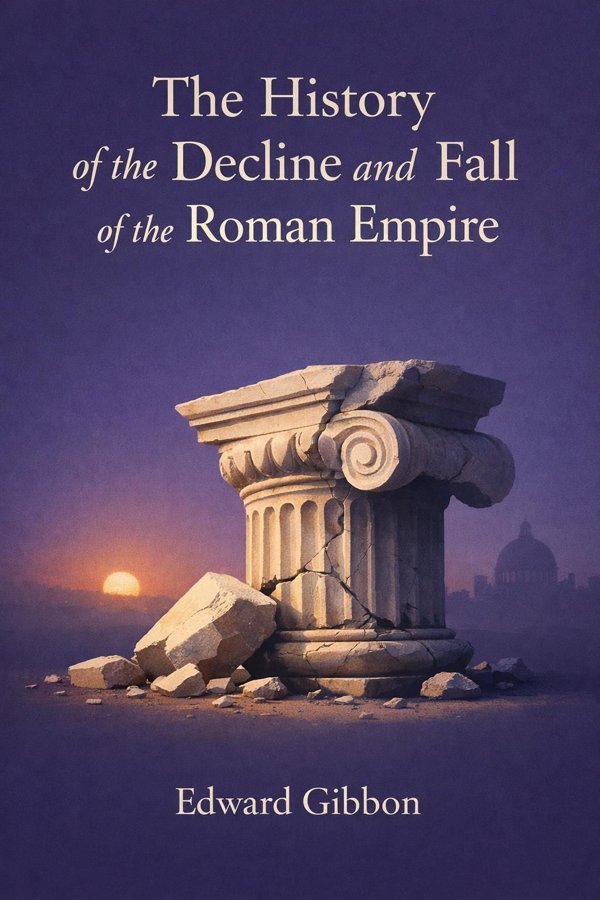
The History of the Decline and Fall of the Roman Empire
Edward Gibbon’s The History of the Decline and Fall of the Roman Empire is one of the most ambitious works ever written about the ancient world. Spanning from the high point of Roman power under the Antonine emperors to the fall of Constantinople in 1453, it is far more than a chronicle of battles and emperors. Gibbon investigates why civilizations weaken, how institutions lose discipline, and what happens when military strength, civic virtue, and political legitimacy drift apart. His central concern is not simply that Rome fell, but how a seemingly invincible empire became vulnerable from within before it was overwhelmed from without. What makes the work endure is the combination of scale, style, and argument. Gibbon writes with elegance, irony, and immense confidence, but he also pioneered a more critical, source-based approach to history than many of his predecessors. His interpretations—especially on Christianity, imperial bureaucracy, and moral decline—have been debated for centuries, yet that debate is part of the book’s greatness. Gibbon remains essential because he teaches readers to see empire as a living system: powerful, adaptive, and always at risk of decay.
Read SummaryKey Insights from Edward Gibbon
The Antonine Age at Rome’s Height
Great civilizations often reveal their future weaknesses at the very moment of their greatest success. Gibbon begins by presenting the age of Nerva, Trajan, Hadrian, Antoninus Pius, and Marcus Aurelius as the happiest and most prosperous period in Roman history. In his view, this was the empire at i...
From The History of the Decline and Fall of the Roman Empire
Commodus and the Beginning of Decay
A single ruler does not destroy a great empire overnight, but he can expose how much its survival depends on character. For Gibbon, the death of Marcus Aurelius marked the end of Rome’s age of reason and the start of a more dangerous era. Commodus inherited a stable empire yet governed as if imperia...
From The History of the Decline and Fall of the Roman Empire
Civil Wars and Military Rule
When the army decides who governs, politics becomes a contest of force rather than law. After Commodus, Rome entered a period of repeated civil wars in which emperors rose and fell through assassination, military backing, and short-lived claims to legitimacy. Gibbon sees this era as a decisive trans...
From The History of the Decline and Fall of the Roman Empire
Diocletian, Constantine, and Imperial Reinvention
Decline does not mean passivity; failing systems often survive by transforming themselves. Gibbon gives serious attention to the reforms of Diocletian and Constantine, who recognized that the old Roman model could no longer govern a vast and threatened empire effectively. Their response was not to r...
From The History of the Decline and Fall of the Roman Empire
Christianity and the Shift in Values
Ideas can reshape empires as profoundly as armies. One of Gibbon’s most famous and controversial arguments concerns the rise of Christianity. He does not claim that Christianity alone caused Rome’s fall, but he argues that its growing influence changed the moral and social priorities of the empire. ...
From The History of the Decline and Fall of the Roman Empire
Barbarian Pressure and Western Collapse
Empires rarely fall because enemies appear; they fall because they can no longer respond with consistency, confidence, and strength. Gibbon’s account of the barbarian invasions shows that the Western Roman Empire faced not one sudden catastrophe, but a long series of migrations, pressures, bargains,...
From The History of the Decline and Fall of the Roman Empire
About Edward Gibbon
Edward Gibbon (1737–1794) was an English historian and Member of Parliament best known for his six-volume work 'The History of the Decline and Fall of the Roman Empire'. His scholarship and literary mastery established him as one of the greatest historians of the Enlightenment era.


Frequently Asked Questions
Edward Gibbon (1737–1794) was an English historian and Member of Parliament best known for his six-volume work 'The History of the Decline and Fall of the Roman Empire'. His scholarship and literary mastery established him as one of the greatest historians of the Enlightenment era.
Read Edward Gibbon's books in 15 minutes
Get AI-powered summaries with key insights from 1 book by Edward Gibbon.