
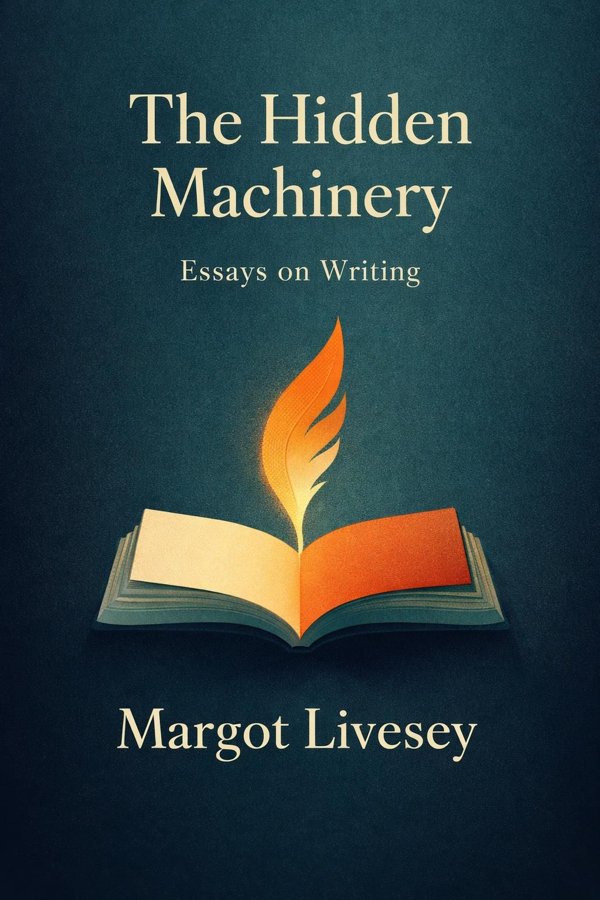
The Hidden Machinery: Essays on Writing: Summary & Key Insights
 10 min10 chaptersAudio available
What Is The Hidden Machinery: Essays on Writing About?
The Hidden Machinery: Essays on Writing by Margot Livesey is a writing book spanning 10 pages. In this collection of essays, acclaimed novelist Margot Livesey explores the art and craft of fiction writing. Drawing on her own experiences as both writer and teacher, she examines how great authors construct their works, offering insights into character, plot, and the moral dimensions of storytelling. Through close readings and personal reflections, Livesey provides a thoughtful guide for readers and aspiring writers alike.
This FizzRead summary covers all 10 key chapters of The Hidden Machinery: Essays on Writing in approximately 10 minutes, distilling the most important ideas, arguments, and takeaways from Margot Livesey's work. Also available as an audio summary and Key Quotes Podcast.
The Hidden Machinery: Essays on Writing
In this collection of essays, acclaimed novelist Margot Livesey explores the art and craft of fiction writing. Drawing on her own experiences as both writer and teacher, she examines how great authors construct their works, offering insights into character, plot, and the moral dimensions of storytelling. Through close readings and personal reflections, Livesey provides a thoughtful guide for readers and aspiring writers alike.
Who Should Read The Hidden Machinery: Essays on Writing?
This book is perfect for anyone interested in writing and looking to gain actionable insights in a short read. Whether you're a student, professional, or lifelong learner, the key ideas from The Hidden Machinery: Essays on Writing by Margot Livesey will help you think differently.
- ✓Readers who enjoy writing and want practical takeaways
- ✓Professionals looking to apply new ideas to their work and life
- ✓Anyone who wants the core insights of The Hidden Machinery: Essays on Writing in just 10 minutes
Want the full summary?
Get instant access to this book summary and 100K+ more with Fizz Moment.
Get Free SummaryAvailable on App Store • Free to download
Key Chapters
Every act of storytelling carries a moral dimension. When I speak of morality, I do not mean preaching or prescribing right behavior, but rather exploring how characters choose, justify, and live with their actions. Fiction, I believe, places us within the moral landscape of the imagination—a place where we can weigh motives and consequences with an intimacy that daily life rarely allows.
When I read Austen or George Eliot, I see how narrative becomes a moral laboratory. Their characters’ smallest decisions—who to trust, when to speak, whether to forgive—ripple through the structure of the novel. As writers, our task is not to dictate morality but to ask: What is at stake for this person? What does their choice reveal about the world they inhabit? In my own work, I’ve often found that an authentic story emerges only when I begin listening for the moral question at its heart. Whether I’m writing about betrayal, courage, or empathy, that silent question—what is the right thing here?—is the current that animates the page.
Writing fiction ethically also means respecting the reader’s intelligence. We must resist the urge to manipulate or simplify. The moral power of fiction lies in ambiguity, in allowing the reader to inhabit conflicting perspectives. Ultimately, the moral dimension is not a constraint but a source of vitality. It is where story and spirit collide to illuminate what it means to act, to love, to err, to forgive.
Creating a character who feels both alive and inevitable is perhaps the greatest mystery of writing fiction. I have come to think of characters not as puppets we manipulate but as personalities we discover through language, circumstance, and contradiction. Character, as E.M. Forster argued, depends on both flatness and depth—on recognizable traits that anchor the reader and unpredictable impulses that surprise us.
When I look at novels that endure, from Tolstoy’s *Anna Karenina* to Toni Morrison’s *Beloved*, I see that memorable characters arise from finely observed moral and psychological detail. The writer must know far more than she shows, and yet what she reveals must feel sufficient. Part of our task is to understand how external choices reflect internal struggle—the way a missed phone call, a borrowed dress, or a half-finished letter can suggest an entire world of desire and regret. Observation, empathy, and courage are our tools.
In my teaching, I often ask students to write scenes in which a character wants something urgent but cannot say it. This exercise teaches that action and subtext reveal more than exposition ever could. Fiction thrives on contradiction: we are brave and fearful, generous and selfish, loyal and treacherous—often in the same breath. When we allow characters to inhabit those contradictions, they cease to be inventions and become instead our collaborators in discovery.
+ 8 more chapters — available in the FizzRead app
All Chapters in The Hidden Machinery: Essays on Writing
About the Author
Margot Livesey is a Scottish-born novelist and essayist known for her works of literary fiction, including 'Eva Moves the Furniture' and 'The Flight of Gemma Hardy'. She teaches at the Iowa Writers’ Workshop and has received numerous awards for her contributions to contemporary literature.
Get This Summary in Your Preferred Format
Read or listen to the The Hidden Machinery: Essays on Writing summary by Margot Livesey anytime, anywhere. FizzRead offers multiple formats so you can learn on your terms — all free.
Available formats: App · Audio · PDF · EPUB — All included free with FizzRead
Download The Hidden Machinery: Essays on Writing PDF and EPUB Summary
Key Quotes from The Hidden Machinery: Essays on Writing
“Every act of storytelling carries a moral dimension.”
“Creating a character who feels both alive and inevitable is perhaps the greatest mystery of writing fiction.”
Frequently Asked Questions about The Hidden Machinery: Essays on Writing
The Hidden Machinery: Essays on Writing by Margot Livesey is a writing book that explores key ideas across 10 chapters. In this collection of essays, acclaimed novelist Margot Livesey explores the art and craft of fiction writing. Drawing on her own experiences as both writer and teacher, she examines how great authors construct their works, offering insights into character, plot, and the moral dimensions of storytelling. Through close readings and personal reflections, Livesey provides a thoughtful guide for readers and aspiring writers alike.
You Might Also Like
The Art of Perspective
Christopher Castellani
10 min
Making a Point: The Persnickety Story of English Punctuation
David Crystal
10 min
The Elements Of Eloquence: How To Turn The Perfect English Phrase
Mark Forsyth
10 min
The Pocket Muse: Ideas and Inspirations for Writing
Monica Wood
10 min
A Little Book on Form: An Exploration into the Formal Imagination of Poetry
Robert Hass
10 min
Adventures In The Screen Trade: A Personal View Of Hollywood And Screenwriting
William Goldman
10 minBrowse by Category
Ready to read The Hidden Machinery: Essays on Writing?
Get the full summary and 100K+ more books with Fizz Moment.