
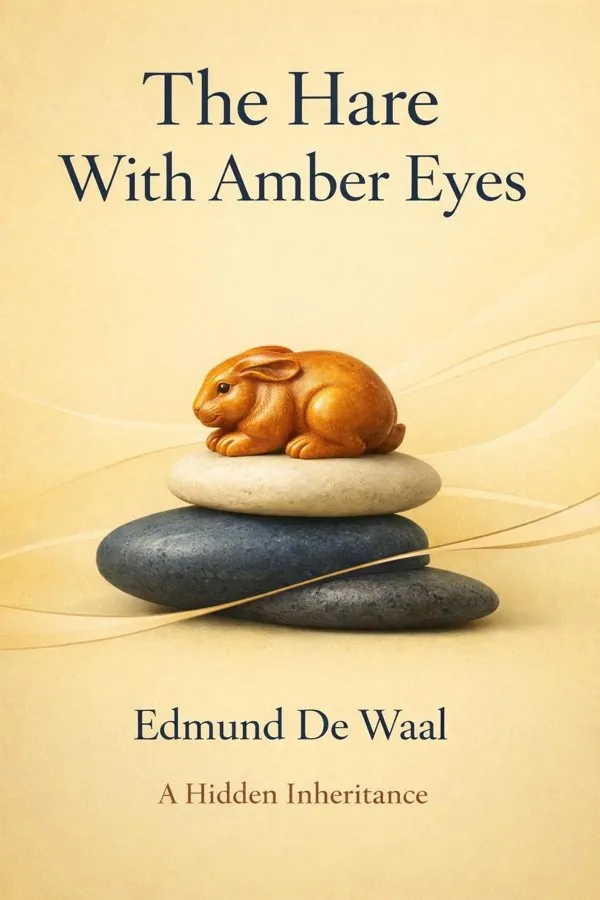
The Hare With Amber Eyes: A Hidden Inheritance: Summary & Key Insights
 10 min9 chaptersAudio available
Key Takeaways from The Hare With Amber Eyes: A Hidden Inheritance
Every inheritance begins long before the heir receives it.
Collecting art can be a way of declaring who you are before society decides for you.
Small things often survive because they are held close.
A family can appear fully established just before history turns against it.
Catastrophe often arrives not as chaos, but as administration.
What Is The Hare With Amber Eyes: A Hidden Inheritance About?
The Hare With Amber Eyes: A Hidden Inheritance by Edmund De Waal is a biographies book spanning 11 pages. The Hare With Amber Eyes: A Hidden Inheritance is a remarkable blend of family memoir, cultural history, and detective-like reconstruction. Edmund de Waal begins with 264 tiny Japanese netsuke—miniature carvings once used as toggles on kimono sashes—and follows their path through generations of the Ephrussi family, a wealthy Jewish banking dynasty whose influence stretched from Odessa to Paris and Vienna. As he traces these objects across continents and through catastrophe, de Waal uncovers a larger story about assimilation, collecting, anti-Semitism, exile, and survival. What makes the book so powerful is its scale: small objects reveal enormous histories. The netsuke pass through Belle Époque salons, aristocratic drawing rooms, Nazi plunder, postwar dislocation, and finally into the author’s own hands. De Waal writes not only as an heir, but as an artist deeply attentive to touch, surface, arrangement, and the emotional charge of objects. His authority comes from this dual perspective—part historian, part maker, part descendant. The result is a deeply human meditation on what families lose, what objects remember, and how fragments of the past can still guide us toward understanding.
This FizzRead summary covers all 9 key chapters of The Hare With Amber Eyes: A Hidden Inheritance in approximately 10 minutes, distilling the most important ideas, arguments, and takeaways from Edmund De Waal's work. Also available as an audio summary and Key Quotes Podcast.
The Hare With Amber Eyes: A Hidden Inheritance
The Hare With Amber Eyes: A Hidden Inheritance is a remarkable blend of family memoir, cultural history, and detective-like reconstruction. Edmund de Waal begins with 264 tiny Japanese netsuke—miniature carvings once used as toggles on kimono sashes—and follows their path through generations of the Ephrussi family, a wealthy Jewish banking dynasty whose influence stretched from Odessa to Paris and Vienna. As he traces these objects across continents and through catastrophe, de Waal uncovers a larger story about assimilation, collecting, anti-Semitism, exile, and survival.
What makes the book so powerful is its scale: small objects reveal enormous histories. The netsuke pass through Belle Époque salons, aristocratic drawing rooms, Nazi plunder, postwar dislocation, and finally into the author’s own hands. De Waal writes not only as an heir, but as an artist deeply attentive to touch, surface, arrangement, and the emotional charge of objects. His authority comes from this dual perspective—part historian, part maker, part descendant. The result is a deeply human meditation on what families lose, what objects remember, and how fragments of the past can still guide us toward understanding.
Who Should Read The Hare With Amber Eyes: A Hidden Inheritance?
This book is perfect for anyone interested in biographies and looking to gain actionable insights in a short read. Whether you're a student, professional, or lifelong learner, the key ideas from The Hare With Amber Eyes: A Hidden Inheritance by Edmund De Waal will help you think differently.
- ✓Readers who enjoy biographies and want practical takeaways
- ✓Professionals looking to apply new ideas to their work and life
- ✓Anyone who wants the core insights of The Hare With Amber Eyes: A Hidden Inheritance in just 10 minutes
Want the full summary?
Get instant access to this book summary and 100K+ more with Fizz Moment.
Get Free SummaryAvailable on App Store • Free to download
Key Chapters
Every inheritance begins long before the heir receives it. To understand the netsuke, Edmund de Waal goes back to Odessa, where the Ephrussi family first made its fortune in the grain trade. In the 19th century, Odessa was a fast-growing Black Sea port shaped by commerce, migration, and imperial ambition. The Ephrussis rose within this world by moving wheat across borders and converting trade into banking power. Their success was not just about money; it was about mastering circulation—of goods, people, languages, and influence.
This origin matters because it frames the entire story of the book. The family’s later elegance in Paris and Vienna did not emerge from ancient aristocratic roots, but from modern mercantile energy. They were Jewish outsiders who became insiders through intelligence, adaptability, and cosmopolitan ambition. Yet that achievement remained precarious. Wealth opened doors, but it could not fully erase ethnic prejudice or political vulnerability.
De Waal shows how family myths are often polished versions of more complicated realities. When we look back at ancestry, we tend to see stability and status; in fact, the story often begins with hustle, uncertainty, and reinvention. The Ephrussis embody this tension between security and fragility. Their rise demonstrates how mobility can generate both opportunity and exposure.
A practical way to apply this insight is to examine your own family narratives. Ask what forms of movement—migration, education, trade, language change, career shifts—made later stability possible. Often the polished present depends on earlier acts of risk.
Actionable takeaway: Trace one branch of your family or personal history back to a moment of transition, and identify how movement, rather than permanence, shaped what came after.
Collecting art can be a way of declaring who you are before society decides for you. In Paris, Charles Ephrussi becomes one of the book’s most captivating figures: a banker’s son turned scholar, collector, editor, and man about town. He moves confidently through Belle Époque culture, befriending artists, supporting Impressionists, and inhabiting a world of salons, taste, and refinement. Charles is not merely wealthy; he is a maker of cultural meaning.
De Waal uses Charles to explore the desire for belonging through connoisseurship. In a society where Jews could be accepted and excluded at the same time, aesthetic authority offered a kind of citizenship. To know paintings, patronize artists, and shape taste was to claim a place in the center of European life. But the book also hints at the cost of this performance. Belonging required fluency in codes of class, elegance, and discretion. Identity became curated.
Charles’s world also shows how culture and politics are never fully separate. Even as Paris glittered with artistic innovation, anti-Semitic tensions simmered beneath the surface. Reputation could be built carefully over decades and still prove vulnerable. De Waal suggests that collecting is not only about objects; it is also about proximity to power, and the hope that beauty may stabilize one’s place in history.
In modern life, people still build belonging through taste—through books, homes, clothes, playlists, and social networks. These choices can express real values, but they can also become defensive performances. The key question is whether what we gather reflects genuine curiosity or merely social camouflage.
Actionable takeaway: Look at one collection in your life—books, art, clothes, even digital playlists—and ask whether it expresses your real self or a version of yourself designed to win acceptance.
Small things often survive because they are held close. The netsuke enter the story in Paris as exquisite Japanese carvings collected during a wave of late-19th-century fascination with Japonisme. Unlike grand paintings or imposing furniture, these objects are tactile, private, and meant to be handled. A hare with amber eyes, a rat on a chestnut, a curled tiger: each object invites touch before interpretation. De Waal, as a ceramic artist, is especially alert to this physicality.
The netsuke matter because they contrast with the scale of the Ephrussi family’s public life. Bank palaces, salons, and formal portraits belong to the world of display. Netsuke belong to the hand. This intimacy becomes crucial later, when almost everything else is dispersed, confiscated, or destroyed. Their modest size makes them easy to overlook, but their emotional density makes them unforgettable.
De Waal’s treatment of the netsuke shows that objects carry memory not through magic, but through repeated use, placement, and attention. An object becomes meaningful when it is woven into daily life. That is why inherited items can feel more powerful than their market value suggests. The point is not rarity alone; it is accumulated contact.
This idea applies beyond heirlooms. The objects we keep on desks, shelves, or kitchen counters quietly shape our emotional landscape. A mug, a postcard, a keychain, or a small tool can become a vessel of continuity if it accompanies us through change. Meaning deepens through repetition.
Actionable takeaway: Choose one small object you already own, learn or write down its story, and place it somewhere you will handle or notice regularly so it can become an intentional anchor of memory.
Catastrophe often arrives not as chaos, but as administration. After the Anschluss in 1938, the annexation of Austria by Nazi Germany, the Ephrussi family’s life in Vienna is dismantled through a chillingly systematic process. Their home is invaded, their possessions cataloged, their bank accounts seized, and their status annihilated. De Waal records this not only as a family tragedy but as an anatomy of bureaucratic violence. Theft is made to look official. Humiliation is turned into procedure.
One of the book’s strongest insights is that persecution works by reducing people to inventories. The Nazis did not merely steal valuables; they stripped the family of narrative, privacy, and personhood. Rooms became lists. Collections became assets. Identity became a racial category imposed from outside. In that process, a cultivated European family was reclassified as disposable.
And yet within this machinery of erasure, tiny acts of humanity still mattered. The netsuke survive because Anna, the family’s maid, quietly hides them in her mattress and returns them after the war. Her act contrasts sharply with the impersonal mechanisms surrounding her. It shows that resistance can take intimate, practical forms.
This chapter has a modern resonance. Whenever institutions reduce people to categories, numbers, or files without regard for dignity, a similar moral danger emerges. Dehumanization often begins in language and paperwork before it appears in more visible forms.
Actionable takeaway: When dealing with systems—at work, in policy, or in daily life—make a habit of asking what human story may be disappearing behind labels, forms, or supposedly neutral procedures.
Loss is never tidy, and survival rarely looks heroic in the moment. After the war, what remains of the Ephrussi world is fragmentary. Houses are gone, status has vanished, archives are incomplete, and the family is dispersed across countries and languages. Recovery is partial at best. De Waal does not offer a comforting story of restoration; instead, he shows that postwar life is shaped by absences that cannot be repaired.
In this landscape of ruin, the survival of the netsuke becomes almost unbearably poignant. They are not enough to replace what was destroyed, but they are enough to keep a thread of continuity alive. They provide a way to speak about the family without pretending that the family can be made whole again. This distinction is essential. Memory is not reconstruction. It is often an act of careful attention to what remains.
The book also shows how survivors adapt by carrying fragments rather than total histories. A gesture, a phrase, a recipe, a box of letters, a single photograph, a small carving—these become workable units of remembrance. Rather than seeking complete closure, de Waal models a more honest practice: assembling meaning from surviving pieces.
This is useful for anyone trying to make sense of personal or collective disruption. After divorce, migration, bereavement, or career upheaval, it may be impossible to restore the old whole. But meaningful life can still be built around what remains trustworthy and alive.
Actionable takeaway: After any major loss, list three fragments that still connect you to what mattered—objects, habits, people, or places—and use them as starting points for rebuilding rather than waiting for full resolution.
Inheritance changes meaning when it crosses cultures. Ignace, known as Iggie, takes the netsuke to postwar Tokyo, where they enter a radically different setting from the European salons and Viennese dressing room they once inhabited. Iggie is stylish, cosmopolitan, and unconventional, and in Japan the netsuke regain a kind of cultural proximity to their place of origin. Yet they do not simply return home. They arrive carrying European history, Jewish exile, and family loss.
This part of the book is fascinating because it complicates any simple idea of return. Objects can travel back to their cultural source while still bearing the marks of all the places they have been. For Iggie, Tokyo offers freedom and reinvention. It is also a place where he can curate a life less constrained by the expectations that shaped earlier generations. The netsuke fit this atmosphere: portable, elegant, and open to new arrangements.
De Waal suggests that inheritance is not just preservation; it is reinterpretation. Each generation receives objects in a different emotional and historical context. The task is not to freeze them in one meaning, but to let them speak anew without forgetting what they have endured.
This applies to families, traditions, and even professional legacies. A business, ritual, or archive handed down intact may still need to be recontextualized if it is to remain alive. Respect for the past does not require immobility.
Actionable takeaway: If you inherit a tradition, object, or responsibility, ask not only how to preserve it, but how to place it meaningfully in your current life so it remains active rather than merely stored.
We do not remember only through stories; we remember through touch. As de Waal receives the netsuke from Iggie and begins his own investigation, the book becomes a meditation on materiality itself. He handles the carvings, studies their wear, notices their weight, and arranges them in relation to one another. His training as a ceramic artist allows him to read objects as repositories of use, care, and presence. They are not mute evidence; they are textured prompts.
This idea expands the book beyond family history. De Waal argues, implicitly, that memory is embodied. We know the past not just by reading documents, but by standing in rooms, opening drawers, lifting objects, and attending to surfaces shaped by human contact. Material culture carries emotional knowledge that abstract history can miss.
At the same time, the book avoids fetishizing objects. Things do not automatically tell the truth. They require interpretation, context, and imagination. The netsuke matter because de Waal does the patient work of linking them to letters, places, archives, and silences. Objects become meaningful when inquiry meets attentiveness.
In everyday life, this suggests a healthier relationship with possessions. We do not need to keep everything. But the things we do keep should be chosen and understood. A curated set of meaningful objects can support identity far better than an accumulation of unattended belongings.
Actionable takeaway: Create a small personal archive of five meaningful objects, write a few lines about each one’s story, and review them occasionally to strengthen your sense of continuity and purpose.
The deepest journeys do not end in the past; they alter how we inhabit the present. By the end of The Hare With Amber Eyes, de Waal has not solved every mystery or restored every broken lineage. Instead, he arrives at a more mature understanding of inheritance: it is neither possession nor nostalgia, but responsibility. To inherit is to decide how to remember, what to carry forward, and how to honor complexity without smoothing it into sentimentality.
The title object—the hare with amber eyes—comes to symbolize this transformed way of seeing. It is beautiful, specific, elusive, and alive with suggestion. The netsuke no longer function merely as clues to a vanished world; they become companions in a continuing conversation about family, displacement, art, and survival. De Waal returns to his own life as an artist not unchanged, but deepened.
This final movement matters because it rescues the book from being only elegiac. Memory here is not passive dwelling. It is an active ethical practice. We are shaped by what came before us, but we also shape the meanings that the past will have in the future. That work requires attention, humility, and curation.
For readers, the lesson is broad and generous. You do not need a grand family archive to undertake this kind of work. Anyone can ask what has been handed down—stories, fears, tastes, prejudices, skills, silences—and decide what to examine, preserve, reinterpret, or release.
Actionable takeaway: Make a short inheritance inventory of what your family or history has passed on to you, then choose one element to preserve consciously and one to transform intentionally.
All Chapters in The Hare With Amber Eyes: A Hidden Inheritance
About the Author
Edmund de Waal is a British ceramic artist and writer renowned for his porcelain installations and his literary explorations of memory, collecting, and cultural inheritance. Born in Nottingham, England, in 1964, he studied at Cambridge and later developed an international reputation for minimalist ceramic works displayed in major museums and galleries. His artistic practice is deeply concerned with the placement of objects, the meanings of repetition, and the emotional charge of materials—concerns that also shape his prose. De Waal achieved wide literary acclaim with The Hare With Amber Eyes, which combines memoir, family history, and historical inquiry. His work stands out for its rare ability to connect art, touch, exile, and remembrance. He is also a respected essayist and has been recognized as a Fellow of the Royal Society of Literature.
Get This Summary in Your Preferred Format
Read or listen to the The Hare With Amber Eyes: A Hidden Inheritance summary by Edmund De Waal anytime, anywhere. FizzRead offers multiple formats so you can learn on your terms — all free.
Available formats: App · Audio · PDF · EPUB — All included free with FizzRead
Download The Hare With Amber Eyes: A Hidden Inheritance PDF and EPUB Summary
Key Quotes from The Hare With Amber Eyes: A Hidden Inheritance
“Every inheritance begins long before the heir receives it.”
“Collecting art can be a way of declaring who you are before society decides for you.”
“Small things often survive because they are held close.”
“A family can appear fully established just before history turns against it.”
“Catastrophe often arrives not as chaos, but as administration.”
Frequently Asked Questions about The Hare With Amber Eyes: A Hidden Inheritance
The Hare With Amber Eyes: A Hidden Inheritance by Edmund De Waal is a biographies book that explores key ideas across 9 chapters. The Hare With Amber Eyes: A Hidden Inheritance is a remarkable blend of family memoir, cultural history, and detective-like reconstruction. Edmund de Waal begins with 264 tiny Japanese netsuke—miniature carvings once used as toggles on kimono sashes—and follows their path through generations of the Ephrussi family, a wealthy Jewish banking dynasty whose influence stretched from Odessa to Paris and Vienna. As he traces these objects across continents and through catastrophe, de Waal uncovers a larger story about assimilation, collecting, anti-Semitism, exile, and survival. What makes the book so powerful is its scale: small objects reveal enormous histories. The netsuke pass through Belle Époque salons, aristocratic drawing rooms, Nazi plunder, postwar dislocation, and finally into the author’s own hands. De Waal writes not only as an heir, but as an artist deeply attentive to touch, surface, arrangement, and the emotional charge of objects. His authority comes from this dual perspective—part historian, part maker, part descendant. The result is a deeply human meditation on what families lose, what objects remember, and how fragments of the past can still guide us toward understanding.
More by Edmund De Waal
You Might Also Like

An American Marriage
Tayari Jones
10 min
Benjamin Franklin: An American Life
Walter Isaacson
10 min
I Know Why The Caged Bird Sings
Maya Angelou
10 min
Long Walk to Freedom
Nelson Mandela
10 min
Persepolis
Marjane Satrapi
10 min
Surely You're Joking, Mr. Feynman!
Richard P. Feynman
10 minBrowse by Category
Ready to read The Hare With Amber Eyes: A Hidden Inheritance?
Get the full summary and 100K+ more books with Fizz Moment.