
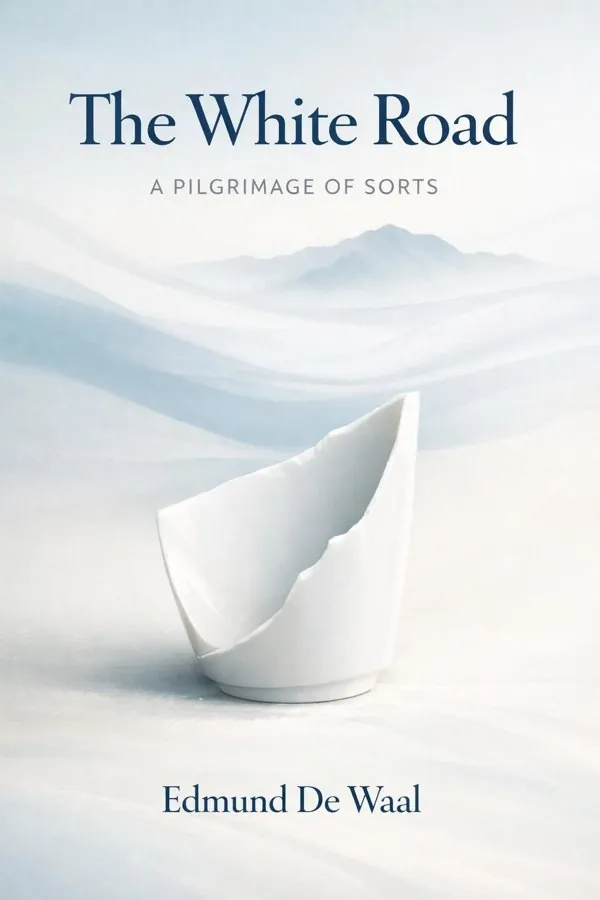
The White Road: A Pilgrimage of Sorts: Summary & Key Insights
 10 min8 chaptersAudio available
What Is The White Road: A Pilgrimage of Sorts About?
The White Road: A Pilgrimage of Sorts by Edmund De Waal is a art_history book spanning 8 pages. The White Road: A Pilgrimage of Sorts is a nonfiction work by British ceramic artist and writer Edmund de Waal. It traces the history and cultural significance of porcelain, following de Waal’s personal journey to the places where porcelain was first created and perfected — from Jingdezhen in China to Meissen in Germany and beyond. Blending memoir, travel writing, and history, the book explores the human obsession with white porcelain and its role in art, commerce, and empire.
This FizzRead summary covers all 8 key chapters of The White Road: A Pilgrimage of Sorts in approximately 10 minutes, distilling the most important ideas, arguments, and takeaways from Edmund De Waal's work. Also available as an audio summary and Key Quotes Podcast.
The White Road: A Pilgrimage of Sorts
The White Road: A Pilgrimage of Sorts is a nonfiction work by British ceramic artist and writer Edmund de Waal. It traces the history and cultural significance of porcelain, following de Waal’s personal journey to the places where porcelain was first created and perfected — from Jingdezhen in China to Meissen in Germany and beyond. Blending memoir, travel writing, and history, the book explores the human obsession with white porcelain and its role in art, commerce, and empire.
Who Should Read The White Road: A Pilgrimage of Sorts?
This book is perfect for anyone interested in art_history and looking to gain actionable insights in a short read. Whether you're a student, professional, or lifelong learner, the key ideas from The White Road: A Pilgrimage of Sorts by Edmund De Waal will help you think differently.
- ✓Readers who enjoy art_history and want practical takeaways
- ✓Professionals looking to apply new ideas to their work and life
- ✓Anyone who wants the core insights of The White Road: A Pilgrimage of Sorts in just 10 minutes
Want the full summary?
Get instant access to this book summary and 100K+ more with Fizz Moment.
Get Free SummaryAvailable on App Store • Free to download
Key Chapters
The story of porcelain begins in mystery. When I first stood on the hills surrounding Jingdezhen, I imagined the centuries of experimentation that preceded the discovery of true porcelain. One must understand that it was not a single invention, but a slow and patient collaboration between geology, chemistry, and craftsmanship. Porcelain was born from kaolin — a fine, pure white clay — and petuntse, a feldspathic stone. The alchemy lay in discovering the perfect balance between them, a balance that could withstand the fire and emerge translucent yet strong.
For the Chinese, porcelain was never merely matter; it was imbued with cosmological significance. The whiteness symbolized purity and order, mirroring Confucian ideals and Buddhist serenity. In Jingdezhen, furnaces burned for emperors. The kilns, fed by forests and rivers, became the beating heart of the Ming and Qing dynasties’ ambition to produce perfection. Standing amid those ancient ruins, I felt something akin to reverence. Every shard embedded in the soil was a record of belief in beauty as a moral pursuit. When a pot broke, it was not failure but testimony to the pursuit of limits.
This alchemy was literal and metaphorical. The transformation from clay to porcelain echoes our own longing to transcend the rawness of existence. The craftsman, hunched over his wheel, is engaged in a dialogue with nature, with time, and with the notion of what can be made eternal from dust. When I hold a cup made in Jingdezhen, I am holding an essence — an answer to the question of how matter itself can radiate spirit.
My journey to Jingdezhen was an act of homage. This city, sometimes called 'the porcelain capital of the world,' sits along rivers that once carried millions of pots toward the imperial court. I walked through its narrow streets, through markets buzzing with artisans still practicing ancient methods. The air smelled of clay dust and wood smoke. Here, porcelain is not history; it is life itself.
I met craftsmen whose families have worked for generations in tiny workshops that seem timeless. I watched them dig kaolin from local mountains, crush stones, mix slurries, and patiently prepare the clay for throwing. Each gesture is a ritual. Each act connects present to past. Yet Jingdezhen today also bears scars from its own legacy — the exhaustion of the forested hills that once provided fuel for the kilns, the environmental toll of centuries of production. Still, amid all this, there is profound pride. The artisans spoke of porcelain as something that defines them, that shapes their world.
Walking through ancient kiln sites, I felt how empire and artistry once intertwined. Imperial demand in the Ming era transformed Jingdezhen into a massive, centralized production machine. Officials monitored quality, artists signed their works in secret, and the flow of porcelain became a metaphor for China’s reach and refinement. What struck me most was how endurance and imagination coexist here. Even in ruins, Jingdezhen speaks of continuity — a city perpetually recreating itself around the pursuit of perfection.
+ 6 more chapters — available in the FizzRead app
All Chapters in The White Road: A Pilgrimage of Sorts
About the Author
Edmund de Waal is a British ceramic artist and author, best known for his large-scale installations of porcelain vessels and his acclaimed memoir The Hare with Amber Eyes. His work often explores themes of memory, material, and history, and he has exhibited internationally in major museums and galleries.
Get This Summary in Your Preferred Format
Read or listen to the The White Road: A Pilgrimage of Sorts summary by Edmund De Waal anytime, anywhere. FizzRead offers multiple formats so you can learn on your terms — all free.
Available formats: App · Audio · PDF · EPUB — All included free with FizzRead
Download The White Road: A Pilgrimage of Sorts PDF and EPUB Summary
Key Quotes from The White Road: A Pilgrimage of Sorts
“The story of porcelain begins in mystery.”
“My journey to Jingdezhen was an act of homage.”
Frequently Asked Questions about The White Road: A Pilgrimage of Sorts
The White Road: A Pilgrimage of Sorts by Edmund De Waal is a art_history book that explores key ideas across 8 chapters. The White Road: A Pilgrimage of Sorts is a nonfiction work by British ceramic artist and writer Edmund de Waal. It traces the history and cultural significance of porcelain, following de Waal’s personal journey to the places where porcelain was first created and perfected — from Jingdezhen in China to Meissen in Germany and beyond. Blending memoir, travel writing, and history, the book explores the human obsession with white porcelain and its role in art, commerce, and empire.
More by Edmund De Waal
You Might Also Like
Studies In Impressionism
John Rewald
10 min
Art Since 1900: Modernism, Antimodernism, Postmodernism
Hal Foster, Rosalind E. Krauss, Yve-Alain Bois, Benjamin H. D. Buchloh
10 min
Art Since 1940: Strategies of Being
Jonathan Fineberg
10 min
Color and Meaning: Art, Science, and Symbolism
John Gage
10 min
Color: Travels Through the Paintbox
Victoria Finlay
10 min
Curatorial Activism: Towards an Ethics of Curating
Maura Reilly
10 minBrowse by Category
Ready to read The White Road: A Pilgrimage of Sorts?
Get the full summary and 100K+ more books with Fizz Moment.