
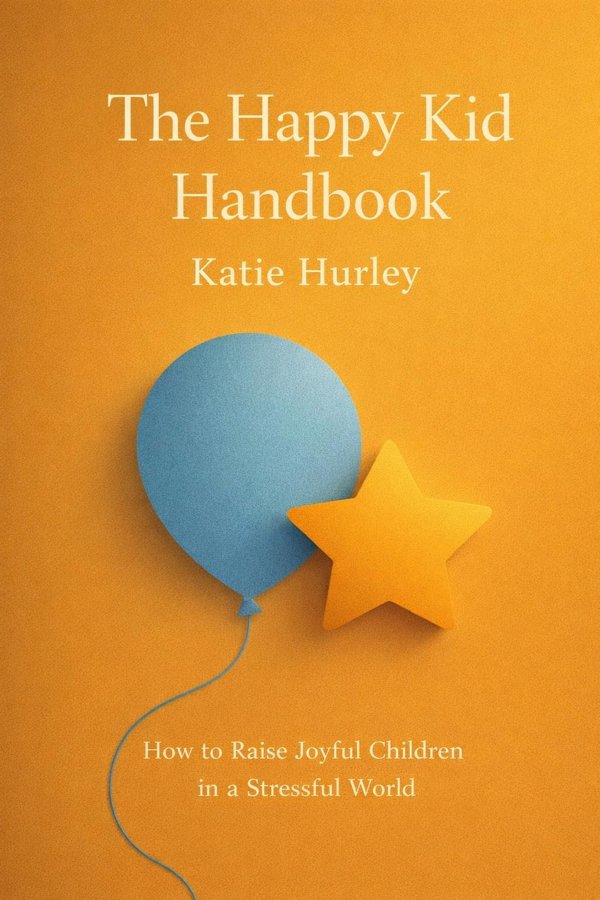
The Happy Kid Handbook: How to Raise Joyful Children in a Stressful World: Summary & Key Insights
by Katie Hurley
 10 min10 chaptersAudio available
Key Takeaways from The Happy Kid Handbook: How to Raise Joyful Children in a Stressful World
One of the most important mistakes parents make is assuming that happiness looks the same in every child.
A child deprived of play may still look productive, but inside they are missing one of the core building blocks of healthy development.
Children cannot manage feelings they do not understand.
Empathy is not a soft extra; it is a core life skill that shapes friendships, conflict resolution, and moral development.
Children often absorb stress long before they know how to describe it.
What Is The Happy Kid Handbook: How to Raise Joyful Children in a Stressful World About?
The Happy Kid Handbook: How to Raise Joyful Children in a Stressful World by Katie Hurley is a parenting book spanning 10 pages. In a culture that often equates good parenting with constant optimization, Katie Hurley offers a refreshing and deeply humane alternative: raising children who are not merely high-performing, but genuinely happy. The Happy Kid Handbook explores what children need in order to thrive emotionally in a world full of pressure, overstimulation, and anxiety. Rather than promising quick fixes or idealized family perfection, Hurley focuses on the everyday habits that build joy, resilience, empathy, confidence, and emotional balance. Drawing on her experience as a child and adolescent psychotherapist, Hurley combines clinical insight with practical parenting advice. She explains how temperament shapes behavior, why play is essential to mental health, how emotional intelligence can be taught, and what parents can do to reduce stress at home. Her approach is grounded, compassionate, and realistic, recognizing that children are individuals and that parents need support too. This book matters because it challenges achievement-driven parenting and asks a better question: not how to raise the most successful child, but how to raise a child who feels secure, connected, capable, and joyful.
This FizzRead summary covers all 10 key chapters of The Happy Kid Handbook: How to Raise Joyful Children in a Stressful World in approximately 10 minutes, distilling the most important ideas, arguments, and takeaways from Katie Hurley's work. Also available as an audio summary and Key Quotes Podcast.
The Happy Kid Handbook: How to Raise Joyful Children in a Stressful World
In a culture that often equates good parenting with constant optimization, Katie Hurley offers a refreshing and deeply humane alternative: raising children who are not merely high-performing, but genuinely happy. The Happy Kid Handbook explores what children need in order to thrive emotionally in a world full of pressure, overstimulation, and anxiety. Rather than promising quick fixes or idealized family perfection, Hurley focuses on the everyday habits that build joy, resilience, empathy, confidence, and emotional balance.
Drawing on her experience as a child and adolescent psychotherapist, Hurley combines clinical insight with practical parenting advice. She explains how temperament shapes behavior, why play is essential to mental health, how emotional intelligence can be taught, and what parents can do to reduce stress at home. Her approach is grounded, compassionate, and realistic, recognizing that children are individuals and that parents need support too.
This book matters because it challenges achievement-driven parenting and asks a better question: not how to raise the most successful child, but how to raise a child who feels secure, connected, capable, and joyful.
Who Should Read The Happy Kid Handbook: How to Raise Joyful Children in a Stressful World?
This book is perfect for anyone interested in parenting and looking to gain actionable insights in a short read. Whether you're a student, professional, or lifelong learner, the key ideas from The Happy Kid Handbook: How to Raise Joyful Children in a Stressful World by Katie Hurley will help you think differently.
- ✓Readers who enjoy parenting and want practical takeaways
- ✓Professionals looking to apply new ideas to their work and life
- ✓Anyone who wants the core insights of The Happy Kid Handbook: How to Raise Joyful Children in a Stressful World in just 10 minutes
Want the full summary?
Get instant access to this book summary and 100K+ more with Fizz Moment.
Get Free SummaryAvailable on App Store • Free to download
Key Chapters
One of the most important mistakes parents make is assuming that happiness looks the same in every child. Katie Hurley begins with temperament because a child’s natural wiring influences how they respond to stress, stimulation, change, relationships, and even praise. Some children are outgoing and adaptable; others are cautious, sensitive, or slow to warm up. Trouble starts when adults try to force a child into a mold that clashes with that child’s inborn style.
Hurley argues that understanding temperament is not about labeling children but about seeing them more accurately. A highly sensitive child may need downtime after school rather than another activity. A very active child may not be “difficult” but physically driven and in need of movement. A cautious child may not be defiant but overwhelmed by unpredictability. When parents interpret behavior through the lens of temperament, they respond with empathy rather than frustration.
This perspective also protects children from internalizing shame. A child repeatedly told to “stop being so shy” or “calm down” may conclude that who they are is wrong. Instead, parents can help children understand their own patterns: “You like to watch before joining in,” or “Your body feels better when you get to move.” That small shift builds self-awareness and self-acceptance.
Practical application begins with observation. Notice what energizes your child, what drains them, how they react to transitions, and what helps them recover. Adjust routines, expectations, and discipline accordingly. A one-size-fits-all parenting style often creates unnecessary conflict.
Actionable takeaway: Spend one week observing your child’s emotional rhythms without trying to change them, then identify one daily adjustment that better fits their natural temperament.
A child deprived of play may still look productive, but inside they are missing one of the core building blocks of healthy development. Hurley makes a passionate case that play is not a reward after “real work” is done; it is the work of childhood. Through play, children process emotions, practice social skills, develop creativity, learn problem-solving, and experience joy for its own sake.
In modern family life, play is often crowded out by overscheduling, academic pressure, screens, and a culture obsessed with measurable outcomes. Parents may feel they are helping by filling every hour with lessons, sports, and enrichment. But Hurley warns that when children lose unstructured time, they also lose opportunities to experiment, imagine, negotiate, and decompress. A child building forts, inventing games, or pretending with dolls is doing serious emotional and cognitive work.
Play also gives parents a valuable window into a child’s inner world. Themes that show up in pretend play can reveal fears, frustrations, and desires that children cannot yet express directly. Joining a child in play, without taking over or instructing, sends a powerful message: your ideas matter, your inner world is welcome, and our relationship is not only about correction and performance.
Families can protect play by reducing overscheduling, preserving after-school downtime, offering open-ended toys, and allowing boredom to exist long enough for imagination to emerge. Play does not need to be expensive, educationally branded, or expertly structured to be valuable. Often, the simplest forms are the richest.
Actionable takeaway: Carve out at least 30 minutes of unstructured, device-free play several times a week and let your child lead while you observe or participate without directing.
Children cannot manage feelings they do not understand. Hurley emphasizes that emotional intelligence begins with emotional fluency: the ability to identify, name, express, and work through emotions without shame. Many children are taught to calm down before they are taught what they are actually feeling, which leaves them with behavior correction but not emotional understanding.
Hurley encourages parents to treat emotions as information rather than problems. Anger may signal frustration or injustice. Sadness may point to disappointment or loss. Anxiety may reflect uncertainty or overstimulation. When adults respond with dismissal—“You’re fine,” “Don’t be dramatic,” or “Stop crying”—children learn to mistrust their own emotional experience. When adults respond with curiosity, children develop self-awareness and regulation over time.
Teaching emotional fluency can happen in ordinary moments. Parents can narrate feelings in real life: “You seem disappointed that the playdate ended,” or “It looks like you felt nervous walking into class.” Books, family conversations, and post-conflict reflections all become tools for emotional learning. The goal is not endless processing but helping children build a richer vocabulary than simply mad, sad, or fine.
Hurley also stresses that all feelings are acceptable, while not all behaviors are. A child may be furious, but hitting is still not okay. This distinction helps children feel seen without abandoning boundaries. Over time, children who can name their emotions become more capable of pausing, asking for help, and choosing healthier responses.
Actionable takeaway: Start a daily feeling check-in at dinner or bedtime where each family member names one emotion they felt that day and what triggered it.
Empathy is not a soft extra; it is a core life skill that shapes friendships, conflict resolution, and moral development. Hurley argues that children do not become empathetic simply because adults tell them to be kind. They learn empathy by experiencing it, observing it, and practicing perspective-taking in daily life.
At its heart, empathy means recognizing that other people have feelings, needs, and experiences separate from our own. Young children are naturally egocentric, so this ability develops gradually. Parents can support that development by asking thoughtful questions: “How do you think your brother felt when that happened?” or “What do you think your friend needed in that moment?” These conversations invite reflection without lecturing.
Hurley also points out that empathy starts at home. Children who feel listened to are more likely to listen. Children whose emotions are acknowledged are better able to acknowledge the emotions of others. Family life offers countless opportunities to practice: apologizing sincerely, noticing when someone is tired, helping a sibling, writing a thank-you note, or discussing characters’ motivations in stories.
Importantly, empathy does not mean forcing children to share everything or ignore their own boundaries. A child can be compassionate and still say no. Teaching empathy should include respect for self as well as others. This prevents kindness from turning into people-pleasing.
Parents model empathy most powerfully in moments of stress. When they slow down, listen before reacting, and repair after conflict, children see what compassionate relationships look like in real time.
Actionable takeaway: Once a day, ask your child one perspective-taking question about a real event, a book, or a movie to strengthen the habit of considering someone else’s feelings.
Children often absorb stress long before they know how to describe it. Hurley explains that in a fast, noisy, achievement-oriented world, many children live in a near-constant state of pressure. Overscheduled routines, family tension, academic expectations, social dynamics, and digital overstimulation can all raise a child’s stress load. When stress goes unaddressed, it may appear as irritability, sleep problems, stomachaches, avoidance, perfectionism, or emotional meltdowns.
A central insight of the book is that stress management is not only about helping children calm down after they are overwhelmed; it is about creating family rhythms that make overwhelm less likely. Children need predictable routines, sufficient sleep, open communication, and regular opportunities to recharge. They also need adults who can recognize early warning signs instead of waiting for behavior to escalate.
Hurley recommends simple calming tools tailored to the individual child. Some children benefit from movement, such as jumping, biking, or dancing. Others need sensory quiet, deep breathing, drawing, reading, or time alone. Stress relief is not one universal technique but a menu of supports. Parents can help children build a personal calm-down toolkit by experimenting and reflecting: “What helps your body feel better when your mind feels busy?”
Just as important, parents should examine the family environment. Are weekends too packed? Is homework dominating evenings? Is there enough downtime? Are adult anxieties spilling into the home? Reducing stress sometimes means removing demands, not just teaching coping skills.
Actionable takeaway: Identify your child’s top three stress signals and create a written list of three calming strategies that can be used before stress peaks.
Parents naturally want to protect children from pain, but Hurley reminds us that resilience is not built through permanent comfort. It grows when children face manageable challenges, experience disappointment, and learn that they can recover with support. A child who never struggles may appear secure, yet often becomes fragile when life fails to cooperate.
Hurley rejects both extremes: throwing children into hardship without support and overprotecting them from every setback. Healthy resilience develops in the middle ground, where children are allowed to try, fail, regroup, and try again while knowing that a trusted adult is nearby. This applies to school difficulties, friendship problems, sports losses, social discomfort, and everyday frustrations.
Parents can support resilience by resisting the urge to immediately fix everything. If a child forgets homework, loses a game, or has an argument with a friend, the first step is not rescue but reflection. Ask: “What happened?” “What did you learn?” “What might you do differently next time?” This helps children shift from helplessness to problem-solving.
Resilience also depends on the messages children receive about failure. If mistakes are treated as catastrophes or as signs of inadequacy, children become risk-averse. If mistakes are framed as part of learning, they become more willing to persist. Parents who normalize effort, repair, and growth create a climate where setbacks lose some of their power.
The goal is not raising children who never feel hurt; it is raising children who know they can handle hard feelings and keep moving.
Actionable takeaway: The next time your child faces a setback, pause before solving it and guide them through three questions: What happened, what did you feel, and what is one next step?
Confidence is often misunderstood as praise-based self-esteem, but Hurley shows that real confidence comes from competence, agency, and trust in one’s ability to make decisions. Children feel stronger when they have meaningful opportunities to choose, contribute, and solve problems. Overmanaged children may seem compliant, yet they often doubt themselves because adults have done too much thinking for them.
Promoting autonomy does not mean stepping back completely. It means giving children age-appropriate responsibility and room to practice independence. A young child can choose between two outfits, help pack a snack, or decide how to organize playtime. An older child can manage homework routines, contribute to household tasks, or help plan family activities. These experiences communicate, “You are capable.”
Hurley also notes that autonomy reduces power struggles. Children are less likely to resist every instruction when they feel some control over their lives. Small choices can preserve dignity and cooperation: “Do you want to brush teeth before or after pajamas?” or “Would you like to start with math or reading?” The structure remains, but the child has a voice.
Parents should expect mistakes when children take ownership. A forgotten item, a poor plan, or a missed detail is often part of learning responsibility. If adults swoop in too quickly, the lesson is lost. Guidance is important, but so is allowing natural consequences when the stakes are manageable.
Children who develop autonomy are better prepared for adolescence and adulthood because they have practiced judgment, self-direction, and accountability in gradual steps.
Actionable takeaway: Choose one task your child is currently capable of doing with less help, and transfer that responsibility to them this week with support but no takeover.
Children thrive not in chaos and not in control, but in the dynamic balance between security and flexibility. Hurley argues that happy children need both dependable structure and enough freedom to explore, rest, and be themselves. Too little structure can leave children anxious and dysregulated. Too much structure can leave them rigid, exhausted, or disconnected from intrinsic motivation.
Routines matter because they reduce uncertainty. Predictable bedtimes, mealtimes, homework windows, and family rituals create a sense of safety. Children relax when they know what to expect. This is especially true for sensitive or anxious children, who often struggle with abrupt transitions and unclear expectations.
At the same time, Hurley warns against turning the family into a productivity machine. If every hour is planned and every activity adult-directed, children lose the chance to develop initiative, creativity, and self-knowledge. Freedom allows them to choose, daydream, wander mentally, and discover what genuinely interests them.
The challenge for parents is finding the right rhythm. A stable morning routine can coexist with free play after school. A clear bedtime can coexist with flexible weekend adventures. A few responsibilities can coexist with unscheduled leisure. Instead of chasing perfect balance every day, parents can think in patterns across the week.
This idea also applies emotionally. Children need boundaries, but they also need room to express strong feelings. They need guidance, but not constant micromanagement. Family life works best when order supports development rather than suffocates it.
Actionable takeaway: Review your child’s weekly schedule and remove or loosen one commitment that is crowding out rest, play, or family connection.
Children learn emotional habits less from what parents say than from what parents repeatedly do. Hurley makes the essential point that parenting cannot be separated from parent self-care. When adults are chronically depleted, reactive, anxious, or emotionally unavailable, children feel it. The family climate becomes tense, rushed, or unpredictable, even when intentions are good.
This is not an argument for parental perfection. Hurley is realistic: all parents lose patience, feel overwhelmed, and struggle to stay calm. What matters is recognizing that emotional wellness in adults is part of raising emotionally healthy children. A parent who knows how to pause, repair after conflict, set limits, seek support, and manage stress is modeling the very skills children need.
Self-care, in this context, is broader than bubble baths and occasional breaks. It includes sleep, supportive relationships, healthy boundaries, realistic expectations, and the willingness to ask for help. It also includes letting go of comparison-driven parenting. When parents are constantly trying to meet impossible standards, family life becomes more performative and less connected.
Hurley encourages parents to notice their own triggers. Do certain behaviors evoke shame, anger, or fear? Are you parenting from your values, or from panic? Greater self-awareness allows adults to respond instead of react. Even small changes—taking a breath before answering, lowering your voice, postponing a discussion until calmer—can shift a household’s emotional tone.
Actionable takeaway: Identify one stress pattern in your parenting and create a simple pause ritual, such as three deep breaths or a glass of water, before responding during difficult moments.
Strong parent-child relationships are not built only through major talks or special outings. Hurley highlights a quieter truth: connection is created through ordinary, repeated moments of attention, warmth, and responsiveness. A child’s sense of security grows from being greeted with interest, listened to without interruption, comforted after setbacks, and welcomed as they are.
In busy families, connection can easily be replaced by logistics. Conversations become reminders, corrections, negotiations, and instructions. Parents may spend the day managing behavior while missing chances to simply enjoy the child in front of them. Hurley argues that these small relational moments are not optional extras; they are emotional nourishment.
Practical connection can look simple: a few unrushed minutes after school, one-on-one bedtime conversation, a shared joke, eye contact during breakfast, a note in a lunchbox, or a ritual walk around the block. These moments communicate safety and belonging. They also make discipline more effective because children are more receptive when the relationship feels secure.
Hurley emphasizes that connection is especially important during hard phases. When children act out, withdraw, or seem difficult, adults often instinctively increase correction and reduce warmth. But those are often the moments when connection is most needed. Closeness does not eliminate limits; it makes limits easier to accept.
The deeper lesson is that joy in family life is cumulative. It grows from tiny experiences of being known, noticed, and loved over time.
Actionable takeaway: Create one non-negotiable daily connection ritual with your child, even if it lasts only ten minutes, and protect it from distractions.
All Chapters in The Happy Kid Handbook: How to Raise Joyful Children in a Stressful World
About the Author
Katie Hurley, LCSW, is a child and adolescent psychotherapist, parenting educator, speaker, and author whose work focuses on children’s emotional well-being. Through her clinical practice and public writing, she has helped parents better understand issues such as anxiety, stress, resilience, social skills, and emotional intelligence. Hurley is known for translating therapeutic insight into practical strategies families can use in everyday life. Her approach emphasizes empathy, connection, and developmentally informed parenting rather than fear, pressure, or perfectionism. In The Happy Kid Handbook, she draws on years of professional experience working directly with children and teens to show how parents can foster joy, confidence, and emotional strength in a demanding world. Her work has made her a trusted voice for families seeking thoughtful, compassionate guidance.
Get This Summary in Your Preferred Format
Read or listen to the The Happy Kid Handbook: How to Raise Joyful Children in a Stressful World summary by Katie Hurley anytime, anywhere. FizzRead offers multiple formats so you can learn on your terms — all free.
Available formats: App · Audio · PDF · EPUB — All included free with FizzRead
Download The Happy Kid Handbook: How to Raise Joyful Children in a Stressful World PDF and EPUB Summary
Key Quotes from The Happy Kid Handbook: How to Raise Joyful Children in a Stressful World
“One of the most important mistakes parents make is assuming that happiness looks the same in every child.”
“A child deprived of play may still look productive, but inside they are missing one of the core building blocks of healthy development.”
“Children cannot manage feelings they do not understand.”
“Empathy is not a soft extra; it is a core life skill that shapes friendships, conflict resolution, and moral development.”
“Children often absorb stress long before they know how to describe it.”
Frequently Asked Questions about The Happy Kid Handbook: How to Raise Joyful Children in a Stressful World
The Happy Kid Handbook: How to Raise Joyful Children in a Stressful World by Katie Hurley is a parenting book that explores key ideas across 10 chapters. In a culture that often equates good parenting with constant optimization, Katie Hurley offers a refreshing and deeply humane alternative: raising children who are not merely high-performing, but genuinely happy. The Happy Kid Handbook explores what children need in order to thrive emotionally in a world full of pressure, overstimulation, and anxiety. Rather than promising quick fixes or idealized family perfection, Hurley focuses on the everyday habits that build joy, resilience, empathy, confidence, and emotional balance. Drawing on her experience as a child and adolescent psychotherapist, Hurley combines clinical insight with practical parenting advice. She explains how temperament shapes behavior, why play is essential to mental health, how emotional intelligence can be taught, and what parents can do to reduce stress at home. Her approach is grounded, compassionate, and realistic, recognizing that children are individuals and that parents need support too. This book matters because it challenges achievement-driven parenting and asks a better question: not how to raise the most successful child, but how to raise a child who feels secure, connected, capable, and joyful.
You Might Also Like
Never Enough
Jennifer Breheny Wallace
10 min
Bluey: Sleepytime
Joe Brumm
10 min
In My Heart: A Book of Feelings
Jo Witek
10 min
Love From The Crayons
Drew Daywalt, Oliver Jeffers
10 min
Pete The Cat: Big Easter Adventure
James Dean, Kimberly Dean
10 min
Smart Money Smart Kids: Raising the Next Generation to Win with Money
Dave Ramsey, Rachel Cruze
10 minBrowse by Category
Ready to read The Happy Kid Handbook: How to Raise Joyful Children in a Stressful World?
Get the full summary and 100K+ more books with Fizz Moment.