
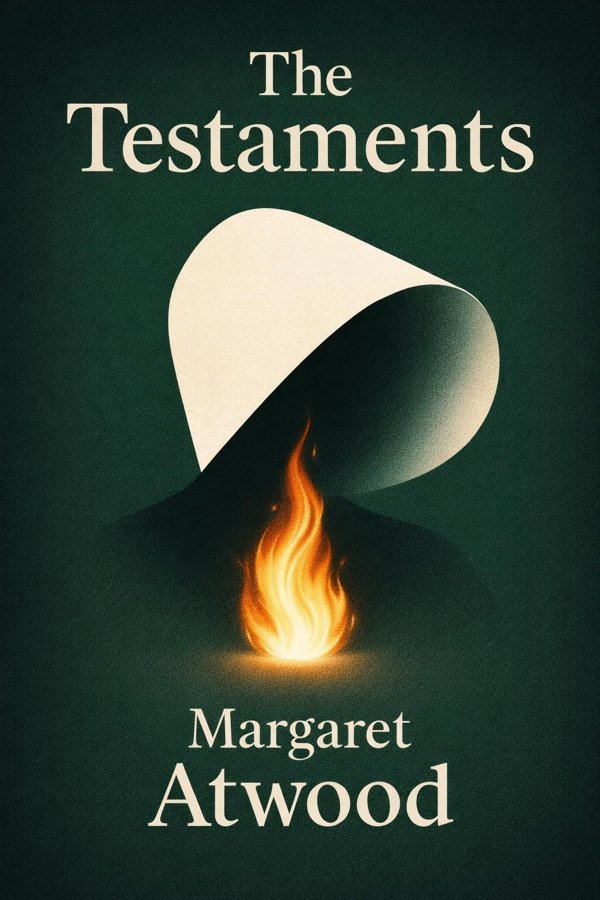
The Testaments: Summary & Key Insights
 10 min5 chaptersAudio available
What Is The Testaments About?
The Testaments by Margaret Atwood is a bestsellers book spanning 5 pages. Set fifteen years after the events of The Handmaid’s Tale, this novel continues the story of Gilead through the perspectives of three women whose lives intersect in unexpected ways. It explores themes of power, resistance, and redemption in a dystopian society built on oppression and control.
This FizzRead summary covers all 5 key chapters of The Testaments in approximately 10 minutes, distilling the most important ideas, arguments, and takeaways from Margaret Atwood's work. Also available as an audio summary and Key Quotes Podcast.
The Testaments
Set fifteen years after the events of The Handmaid’s Tale, this novel continues the story of Gilead through the perspectives of three women whose lives intersect in unexpected ways. It explores themes of power, resistance, and redemption in a dystopian society built on oppression and control.
Who Should Read The Testaments?
This book is perfect for anyone interested in bestsellers and looking to gain actionable insights in a short read. Whether you're a student, professional, or lifelong learner, the key ideas from The Testaments by Margaret Atwood will help you think differently.
- ✓Readers who enjoy bestsellers and want practical takeaways
- ✓Professionals looking to apply new ideas to their work and life
- ✓Anyone who wants the core insights of The Testaments in just 10 minutes
Want the full summary?
Get instant access to this book summary and 100K+ more with Fizz Moment.
Get Free SummaryAvailable on App Store • Free to download
Key Chapters
I begin with Lydia, because she embodies the paradox of survival under tyranny. We last saw her as an enforcer, handing down decrees to handmaids with iron and scripture. In this new account, she writes from within the heart of Ardua Hall, the fortress of the Aunts, addressing posterity through a clandestine memoir. Her tone is measured, her wit sharp, her remorse both genuine and calculated. Through her we glimpse the inner workings of power—the bureaucratic pettiness, the rivalries cloaked as piety—and the subtle art of endurance in a system designed to destroy personal will.
She recalls her early days: her capture during Gilead’s founding chaos, her forced conversion, and her subsequent rise. She narrates, too, the compromises that accompanied her ascent. Lydia has learned the price of survival, yet now, through the act of writing, she begins to pay a different debt. Secretly, she compiles incriminating documents about Commanders, their crimes, and their hypocrisies, storing them in a hidden archive. Her motives are layered—revenge, atonement, perhaps the simple satisfaction of reclaiming authority over the narrative after a lifetime of repression.
It is through Lydia that we understand Gilead’s rot from within. She reveals a world maintained not by faith but by fear and by those too weary or guilty to question their roles. Yet Lydia’s self-examination transforms over the course of the novel: she evolves from loyal functionary to self-aware saboteur. Her voice, half-poison and half-confession, frames the question that shapes the whole book: when does resistance begin—not in action, but in thought? Through her, I sought to show that even inside the machinery of oppression, a conscience can still spark, uncertain but alive.
Agnes Jemima’s world is one of serenity and supervision. From her first pages, she believes herself pure and protected, her destiny mapped by scripture and male decree. Her upbringing represents Gilead’s success at indoctrination: the modest dresses, the sanctioned learning, the creeping fear that curiosity is sin. Yet as her story unfolds, fractures appear. She learns unsettling truths about her supposed parents and begins to see the cruelty masked as godliness. The carefully scripted life laid out for her—marriage to an older man, confinement within domestic boundaries—suddenly feels intolerable.
Through Agnes, I wanted to portray the inner landscape of belief when it meets doubt. Her awakening is gradual, not dramatic; it occurs through exposure to forbidden knowledge and quiet observation of hypocrisy. Beneath her fear lies an instinctive sense of justice. When she is sent, after her “unsuitability for marriage,” to train as an Aunt, her education takes an unexpected turn. Inside Ardua Hall, under the tutelage of Lydia and others, she comes to glimpse another form of power—still bound by the system, but shaded with possibilities.
Agnes’s transformation is the slow unlearning of submission. Her innocence becomes her strength; her empathy, a counter to the cynicism surrounding her. It is no coincidence that Lydia chooses her as a confidante in the final act. To Lydia, she represents what might yet be salvaged—the generation that grew up entirely within Gilead but might also be the one to end it.
+ 3 more chapters — available in the FizzRead app
All Chapters in The Testaments
About the Author
Margaret Atwood is a Canadian author, poet, and literary critic known for her works of fiction, including The Handmaid’s Tale, Alias Grace, and Oryx and Crake. Her writing often examines gender, identity, and social structures through speculative and dystopian lenses.
Get This Summary in Your Preferred Format
Read or listen to the The Testaments summary by Margaret Atwood anytime, anywhere. FizzRead offers multiple formats so you can learn on your terms — all free.
Available formats: App · Audio · PDF · EPUB — All included free with FizzRead
Download The Testaments PDF and EPUB Summary
Key Quotes from The Testaments
“I begin with Lydia, because she embodies the paradox of survival under tyranny.”
“Agnes Jemima’s world is one of serenity and supervision.”
Frequently Asked Questions about The Testaments
The Testaments by Margaret Atwood is a bestsellers book that explores key ideas across 5 chapters. Set fifteen years after the events of The Handmaid’s Tale, this novel continues the story of Gilead through the perspectives of three women whose lives intersect in unexpected ways. It explores themes of power, resistance, and redemption in a dystopian society built on oppression and control.
More by Margaret Atwood
You Might Also Like

The Godfather
Mario Puzo
10 min
The Handmaid's Tale
Margaret Atwood
10 min
The Hunger Games
Suzanne Collins
10 min
The Nightingale
Kristin Hannah
10 min
The Seven Husbands of Evelyn Hugo
Taylor Jenkins Reid
10 min
Backwater Justice
Fern Michaels
10 minBrowse by Category
Ready to read The Testaments?
Get the full summary and 100K+ more books with Fizz Moment.