
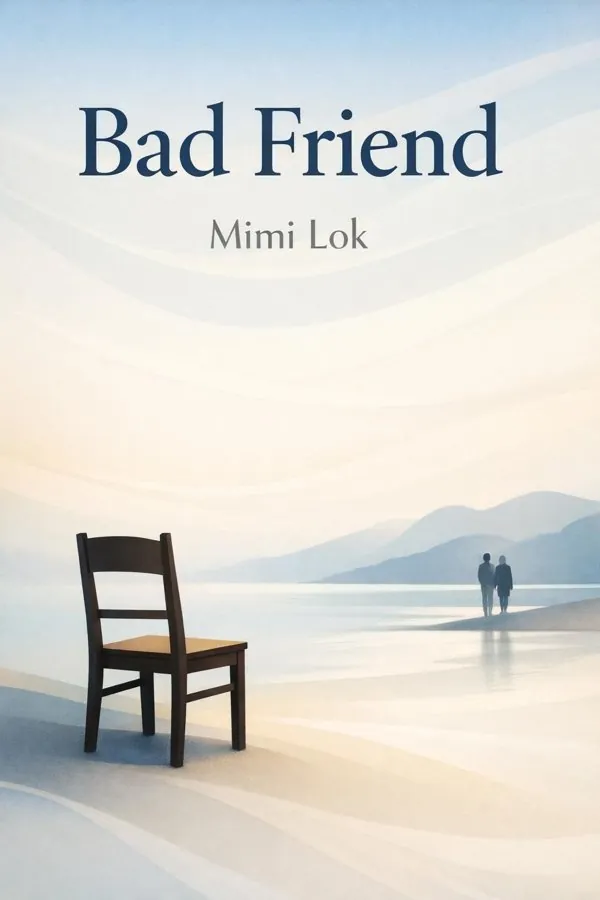
Bad Friend: Summary & Key Insights
by Mimi Lok
 10 min8 chaptersAudio available
Key Takeaways from Bad Friend
One of the most unsettling truths in Bad Friend is that belonging is not a place you arrive at once and for all—it is a feeling that can shift from moment to moment.
Lok is particularly insightful in showing how affection does not cancel out power; in fact, closeness can make imbalances harder to name.
Few books portray the contradictions of family love as deftly as Bad Friend.
In Bad Friend, language is never just a tool for communication; it is a force that determines who feels included, who feels small, and who gets to define reality.
A striking idea running through Bad Friend is that identity is not formed in isolation.
What Is Bad Friend About?
Bad Friend by Mimi Lok is a bestsellers book. What if the deepest betrayals in life are not dramatic acts, but the quiet misunderstandings that grow between people who love, need, or depend on one another? Bad Friend by Mimi Lok is a powerful short story collection that examines precisely those fragile spaces between intimacy and distance. Across stories shaped by migration, family tension, class difference, sexuality, and cultural dislocation, Lok explores what it means to belong to more than one world while never feeling fully at home in any of them. Her characters are often caught in moments of emotional uncertainty: trying to care well, trying to be understood, trying to survive the expectations placed on them by history, family, and society. What makes the book so compelling is its ability to turn ordinary encounters into profound reflections on identity and connection. Mimi Lok writes with emotional precision, sharp observation, and deep empathy, bringing to life people whose inner conflicts feel intensely real. Bad Friend matters because it shows how relationships are shaped by language, memory, and power—and how even imperfect, painful bonds can reveal the truth of who we are.
This FizzRead summary covers all 8 key chapters of Bad Friend in approximately 10 minutes, distilling the most important ideas, arguments, and takeaways from Mimi Lok's work. Also available as an audio summary and Key Quotes Podcast.
Bad Friend
What if the deepest betrayals in life are not dramatic acts, but the quiet misunderstandings that grow between people who love, need, or depend on one another? Bad Friend by Mimi Lok is a powerful short story collection that examines precisely those fragile spaces between intimacy and distance. Across stories shaped by migration, family tension, class difference, sexuality, and cultural dislocation, Lok explores what it means to belong to more than one world while never feeling fully at home in any of them. Her characters are often caught in moments of emotional uncertainty: trying to care well, trying to be understood, trying to survive the expectations placed on them by history, family, and society. What makes the book so compelling is its ability to turn ordinary encounters into profound reflections on identity and connection. Mimi Lok writes with emotional precision, sharp observation, and deep empathy, bringing to life people whose inner conflicts feel intensely real. Bad Friend matters because it shows how relationships are shaped by language, memory, and power—and how even imperfect, painful bonds can reveal the truth of who we are.
Who Should Read Bad Friend?
This book is perfect for anyone interested in bestsellers and looking to gain actionable insights in a short read. Whether you're a student, professional, or lifelong learner, the key ideas from Bad Friend by Mimi Lok will help you think differently.
- ✓Readers who enjoy bestsellers and want practical takeaways
- ✓Professionals looking to apply new ideas to their work and life
- ✓Anyone who wants the core insights of Bad Friend in just 10 minutes
Want the full summary?
Get instant access to this book summary and 100K+ more with Fizz Moment.
Get Free SummaryAvailable on App Store • Free to download
Key Chapters
One of the most unsettling truths in Bad Friend is that belonging is not a place you arrive at once and for all—it is a feeling that can shift from moment to moment. Mimi Lok’s stories repeatedly show characters standing between cultures, classes, generations, and emotional loyalties, discovering that home is often fragmented rather than whole. This makes the collection especially resonant for readers who have ever felt split between different versions of themselves.
Lok’s characters are often shaped by migration or cultural transition, but the book’s insight reaches beyond those specific experiences. To belong somewhere is not just to be accepted by others; it is also to recognize yourself in the world around you. Many of the people in these stories struggle because they are seen only partially by those closest to them. Family members remember an older version of them. Friends impose assumptions. Communities demand loyalty without making room for complexity. The result is a quiet but painful instability: people can be physically present in a home, a language, or a relationship and still feel emotionally displaced.
This idea has practical relevance in everyday life. Many people experience this when they move cities, change careers, marry into another culture, or evolve in ways their families cannot easily understand. The book encourages readers to stop treating identity as fixed and to instead see belonging as something negotiated through conversation, memory, and self-acceptance. For example, a first-generation professional may feel successful at work but alienated at family gatherings, while someone returning to their hometown may realize they no longer fit the role others expect.
The actionable takeaway is this: instead of asking, “Where do I fully belong?” ask, “Where can I be honestly seen, even in pieces?” That question often leads to more compassionate relationships and a more realistic understanding of selfhood.
Few books portray the contradictions of family love as deftly as Bad Friend. Lok understands that families can be sources of tenderness, duty, shame, memory, and pressure all at once. A central insight of the collection is that love within families is often real but not always freeing. It may be expressed through sacrifice, control, silence, or criticism rather than warmth. This makes familial bonds powerful but also deeply difficult to navigate.
The stories reveal how parents and children, siblings, and extended relatives can remain bound together by obligation even when mutual understanding is weak. Often, the tension comes from generational differences: older family members may equate love with protection or obedience, while younger ones seek recognition of their individuality. Migration intensifies this conflict. Parents who endured hardship may expect gratitude in the form of compliance. Children raised between worlds may feel indebted yet emotionally constrained. In this way, family becomes not only a private unit but also a repository of inherited fear, hope, and survival logic.
This theme has broad practical relevance. Many adults struggle to distinguish between honoring their families and disappearing inside family expectations. For instance, someone may pursue a stable but unwanted career to satisfy parents, hide parts of their identity to preserve peace, or tolerate manipulative behavior because “family comes first.” Lok’s work suggests that these compromises carry emotional costs, especially when they prevent authentic connection.
Importantly, the book does not argue that family bonds must be severed. Instead, it suggests that maturity often involves seeing relatives clearly: acknowledging both their love and their limitations. That recognition can reduce guilt and increase compassion without demanding self-erasure.
The actionable takeaway is to identify one family expectation you have accepted without question. Ask whether it reflects your values or simply inherited fear. Then consider one respectful boundary or conversation that could make the relationship more honest.
In Bad Friend, language is never just a tool for communication; it is a force that determines who feels included, who feels small, and who gets to define reality. Lok pays close attention to multilingual lives, translation gaps, and the emotional charge of words left unsaid. One of the collection’s most powerful insights is that relationships are often governed not only by what people mean, but by what they are able—or unable—to express.
For people living across languages, speech can become a site of both connection and fracture. A person may think, grieve, or desire in one language and function socially in another. Parents and children may share love but not vocabulary for vulnerability. Friends may assume mutual understanding while using the same words to mean different things. This creates subtle forms of loneliness. Even when conversation is constant, emotional precision may be missing.
The book also shows that silence is itself a kind of language. Avoidance, deflection, and carefully chosen omissions reveal fear, shame, or the wish to preserve fragile peace. In practical terms, this reflects what happens in many real relationships. A couple may argue about logistics instead of naming disappointment. A child may translate for a parent but never articulate their own burden. A colleague may appear agreeable because they lack the confidence to challenge a dominant voice.
Lok encourages readers to become more attentive to these hidden layers of communication. Ask not only what was said, but what was made impossible to say. Notice when fluency masks emotional distance or when awkward speech contains more truth than polished language.
The actionable takeaway is simple but powerful: in one important conversation this week, slow down and ask a clarifying question instead of assuming understanding. Greater intimacy often begins when people make room for imperfect, difficult, or incomplete speech.
A striking idea running through Bad Friend is that identity is not formed in isolation. We become ourselves partly through the people who name us, misread us, need us, or resist us. Lok’s characters are constantly negotiating who they are in response to social expectations and intimate relationships. This makes the collection an especially rich exploration of how selfhood is relational rather than purely individual.
Many contemporary discussions of identity emphasize personal authenticity, as if the main task is simply to look inward and declare who we are. Lok complicates that view. Her stories suggest that identity is also shaped by context: by family history, economic pressure, migration, sexuality, race, memory, and the stories others tell about us. Someone may feel bold in one setting and diminished in another. A person may understand themselves clearly in private but struggle when confronted by a parent’s disappointment or a friend’s stereotype.
This has practical significance because many readers know what it feels like to perform different selves in different environments. Consider the professional who downplays their background to fit corporate culture, the queer adult who becomes guarded around relatives, or the immigrant child who becomes a mediator between generations. These are not necessarily signs of dishonesty. They are often adaptive responses to social pressure. Yet over time, constant adaptation can create exhaustion and confusion.
Lok’s work invites readers to ask: Which versions of myself feel chosen, and which feel imposed? That question is more useful than the simplistic goal of being the “same person everywhere,” which may be impossible or unsafe. The deeper goal is integration—finding ways for your various selves to coexist without denial.
The actionable takeaway is to map the roles you play in three different settings—family, work, and close friendship. Notice where your behavior feels most constrained. That awareness can help you decide where greater honesty, support, or boundary-setting is needed.
Bad Friend demonstrates that life-changing insight often appears not in grand events but in brief, ordinary encounters. A passing remark, a tense meal, a failed conversation, or an awkward reunion can expose years of buried feeling. Lok’s stories are remarkable for their attention to these subtle moments, proving that emotional revelation does not require melodrama. In fact, the quietest scenes are often the most devastating.
This is one reason the collection feels so psychologically accurate. Real relationships rarely break or heal in dramatic speeches. More often, they shift through repeated minor interactions that accumulate meaning. A mother’s offhand comment can reopen an old wound. A friend’s lateness can signal more than bad scheduling. A joke at someone’s expense can reveal the limits of empathy. Lok captures how people interpret and misinterpret these moments, investing them with fear, hope, defensiveness, or longing.
For readers, this offers a valuable practice in observation. We tend to dismiss small incidents because they seem too trivial to address. But unexamined patterns often begin there. If one person always changes the subject when vulnerability appears, that matters. If you feel drained after every visit with a relative, that matters. If a friend consistently minimizes your concerns, that matters. Emotional reality is often encoded in routine interactions.
This insight can be applied personally and professionally. In leadership, for example, team trust is built less by mission statements than by how people respond in everyday meetings. In intimate life, care is communicated less by declarations than by attention, follow-through, and curiosity.
The actionable takeaway is to pay close attention to one recurring “small” interaction in your life that leaves a strong emotional residue. Instead of dismissing it, ask what larger truth it may be revealing about the relationship.
One of Mimi Lok’s greatest strengths is her refusal to flatten human conflict into moral certainty. Bad Friend is deeply compassionate, but it never suggests that empathy automatically resolves pain. Instead, the collection argues for a more mature understanding: people can be understandable and still harmful, wounded and still wounding, loving and still incapable of giving what is needed. This is one of the book’s most important emotional lessons.
In many stories, readers can see why characters act as they do. Their behavior is shaped by fear, loneliness, pride, trauma, cultural conditioning, or unmet need. Yet explanation is not the same as excuse. Lok allows readers to hold both realities at once. A parent may be controlling because they are afraid, but the control still constrains the child. A friend may be needy because they feel abandoned, but their demands still become suffocating. This refusal to choose between blame and understanding gives the book much of its moral depth.
In daily life, this distinction matters enormously. Many people remain trapped in harmful dynamics because they believe compassion requires endless tolerance. Others sever ties too quickly because they think understanding someone’s pain will weaken their boundaries. Lok points toward a wiser middle path: you can interpret someone generously while still protecting yourself from repeated harm.
This insight applies in family life, friendship, romance, and work. For example, a manager may understand an employee’s stress while still requiring accountability. An adult child may recognize a parent’s sacrifices while refusing emotional manipulation. A friend may empathize with another’s crisis without becoming their sole source of support.
The actionable takeaway is to practice a two-part statement in difficult relationships: “I understand why this may be happening, and I still need something different.” Compassion becomes healthier when it is paired with clarity.
Although Bad Friend engages strongly with migration and displacement, one of its deeper insights is that exile is not only geographic. A person can be exiled from family, from language, from childhood certainty, or from the version of themselves that once felt legible. Lok’s stories capture this emotional exile with remarkable delicacy, showing how people can feel estranged even while remaining physically close to what once defined them.
This broader concept of exile helps explain why the book resonates beyond immigrant experience. Anyone who has outgrown a community, hidden a crucial part of themselves, or returned to a familiar place and felt like a stranger will recognize the sensation. Emotional exile often emerges when external continuity masks inner change. The family home remains the same, but the self who lived there no longer exists. Old friends still use the same jokes, but they no longer fit. Cultural rituals continue, yet participation feels strained or performative.
Lok shows that this estrangement can produce grief, shame, and even self-doubt. People may wonder whether they have become disloyal, arrogant, or emotionally cold. But the book suggests another interpretation: alienation is sometimes the price of growth. The pain comes not only from leaving something behind, but from realizing that return is impossible in the old sense.
Practically, this idea can help readers navigate life transitions with greater self-compassion. A person leaving a restrictive community, changing belief systems, or coming out to family may feel both liberated and homeless. Naming that state as a form of exile can make it less confusing.
The actionable takeaway is to grieve what no longer fits instead of forcing yourself to pretend nothing has changed. Honest mourning often creates space for a more grounded and chosen form of belonging.
All Chapters in Bad Friend
About the Author
Mimi Lok is a fiction writer celebrated for her emotionally precise, socially observant literary work. Born in Hong Kong, she has lived and worked across multiple cultural contexts, an experience that informs her interest in migration, belonging, identity, and the tensions within family and friendship. Her fiction has appeared in prominent literary venues and has been recognized for its subtle characterization, elegant prose, and nuanced treatment of displacement and intimacy. Lok is particularly skilled at portraying people caught between languages, expectations, and worlds, making her an important voice in contemporary literary fiction. With Bad Friend, she demonstrates a rare ability to capture the quiet dramas of ordinary relationships and reveal the deeper histories, loyalties, and fractures that shape human connection.
Get This Summary in Your Preferred Format
Read or listen to the Bad Friend summary by Mimi Lok anytime, anywhere. FizzRead offers multiple formats so you can learn on your terms — all free.
Available formats: App · Audio · PDF · EPUB — All included free with FizzRead
Download Bad Friend PDF and EPUB Summary
Key Quotes from Bad Friend
“One of the most unsettling truths in Bad Friend is that belonging is not a place you arrive at once and for all—it is a feeling that can shift from moment to moment.”
“Friendship is often idealized as the purest form of human connection, but Bad Friend reminds us that even friendship can be shaped by inequality, resentment, need, and unspoken expectation.”
“Few books portray the contradictions of family love as deftly as Bad Friend.”
“In Bad Friend, language is never just a tool for communication; it is a force that determines who feels included, who feels small, and who gets to define reality.”
“A striking idea running through Bad Friend is that identity is not formed in isolation.”
Frequently Asked Questions about Bad Friend
Bad Friend by Mimi Lok is a bestsellers book that explores key ideas across 8 chapters. What if the deepest betrayals in life are not dramatic acts, but the quiet misunderstandings that grow between people who love, need, or depend on one another? Bad Friend by Mimi Lok is a powerful short story collection that examines precisely those fragile spaces between intimacy and distance. Across stories shaped by migration, family tension, class difference, sexuality, and cultural dislocation, Lok explores what it means to belong to more than one world while never feeling fully at home in any of them. Her characters are often caught in moments of emotional uncertainty: trying to care well, trying to be understood, trying to survive the expectations placed on them by history, family, and society. What makes the book so compelling is its ability to turn ordinary encounters into profound reflections on identity and connection. Mimi Lok writes with emotional precision, sharp observation, and deep empathy, bringing to life people whose inner conflicts feel intensely real. Bad Friend matters because it shows how relationships are shaped by language, memory, and power—and how even imperfect, painful bonds can reveal the truth of who we are.
You Might Also Like

The Godfather
Mario Puzo
10 min
The Handmaid's Tale
Margaret Atwood
10 min
The Hunger Games
Suzanne Collins
10 min
The Nightingale
Kristin Hannah
10 min
The Seven Husbands of Evelyn Hugo
Taylor Jenkins Reid
10 min
Backwater Justice
Fern Michaels
10 minBrowse by Category
Ready to read Bad Friend?
Get the full summary and 100K+ more books with Fizz Moment.