
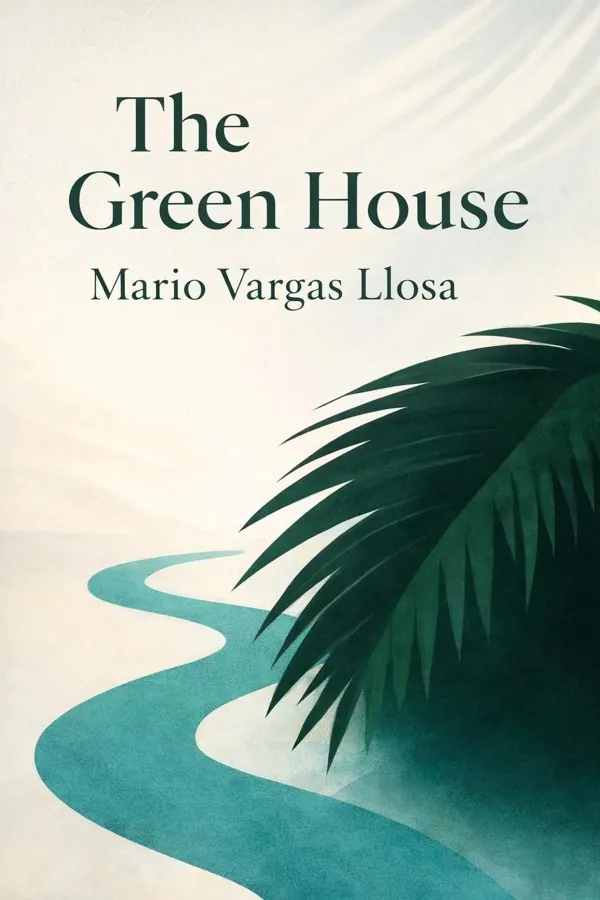
The Green House: Summary & Key Insights
 10 min9 chaptersAudio available
Key Takeaways from The Green House
A nation often reveals itself most clearly through its contradictions.
Order is often most fragile where it seems most confident.
Innocence becomes dangerous when power tries to define and possess it.
Violence flourishes where law exists mostly as a costume.
A society’s moral vocabulary often hides its economic reality.
What Is The Green House About?
The Green House by Mario Vargas Llosa is a classics book spanning 6 pages. The Green House, first published in 1966, is one of Mario Vargas Llosa’s boldest and most influential novels. Set between the desert city of Piura on Peru’s northern coast and the remote Amazonian frontier, it tells a story that is less a straight line than a web of lives crossing through lust, greed, cruelty, faith, memory, and survival. At the center stands the mysterious brothel known as the Green House, but the novel’s true subject is much larger: the way institutions, myths, and private desires shape a nation divided against itself. Vargas Llosa builds this world through a fragmented, shifting structure that demands attention and rewards patience, making readers piece together timelines, voices, and hidden links between characters. The result is a novel that feels both chaotic and precise, mirroring the fractured reality it depicts. It matters because it captures Peru not as a simple backdrop but as a landscape of power struggles, social hierarchies, and moral ambiguity. As a central figure of the Latin American Boom and winner of the 2010 Nobel Prize in Literature, Vargas Llosa brings extraordinary authority, ambition, and formal mastery to this modern classic.
This FizzRead summary covers all 9 key chapters of The Green House in approximately 10 minutes, distilling the most important ideas, arguments, and takeaways from Mario Vargas Llosa's work. Also available as an audio summary and Key Quotes Podcast.
The Green House
The Green House, first published in 1966, is one of Mario Vargas Llosa’s boldest and most influential novels. Set between the desert city of Piura on Peru’s northern coast and the remote Amazonian frontier, it tells a story that is less a straight line than a web of lives crossing through lust, greed, cruelty, faith, memory, and survival. At the center stands the mysterious brothel known as the Green House, but the novel’s true subject is much larger: the way institutions, myths, and private desires shape a nation divided against itself. Vargas Llosa builds this world through a fragmented, shifting structure that demands attention and rewards patience, making readers piece together timelines, voices, and hidden links between characters. The result is a novel that feels both chaotic and precise, mirroring the fractured reality it depicts. It matters because it captures Peru not as a simple backdrop but as a landscape of power struggles, social hierarchies, and moral ambiguity. As a central figure of the Latin American Boom and winner of the 2010 Nobel Prize in Literature, Vargas Llosa brings extraordinary authority, ambition, and formal mastery to this modern classic.
Who Should Read The Green House?
This book is perfect for anyone interested in classics and looking to gain actionable insights in a short read. Whether you're a student, professional, or lifelong learner, the key ideas from The Green House by Mario Vargas Llosa will help you think differently.
- ✓Readers who enjoy classics and want practical takeaways
- ✓Professionals looking to apply new ideas to their work and life
- ✓Anyone who wants the core insights of The Green House in just 10 minutes
Want the full summary?
Get instant access to this book summary and 100K+ more with Fizz Moment.
Get Free SummaryAvailable on App Store • Free to download
Key Chapters
A nation often reveals itself most clearly through its contradictions. In The Green House, Vargas Llosa places Piura, a dry and gossipy coastal town, beside the Amazon jungle, a humid and seemingly lawless frontier. These settings appear opposite in climate, rhythm, and culture, yet the novel insists that they are connected by the same flows of money, exploitation, religion, desire, and violence. What happens in one place echoes in the other.
Piura is shaped by routines, local hierarchies, and public judgment. It is a place where people watch one another, where reputation matters, and where moral order is loudly defended even when privately violated. The jungle, by contrast, appears more fluid and unstable. Missions, smugglers, soldiers, traders, and indigenous communities collide there in a harsher contest over bodies, goods, and power. But the novel refuses the easy idea that the city is civilized while the jungle is savage. Corruption thrives in both. So do longing, cruelty, tenderness, and self-deception.
This contrast helps explain one of the novel’s deepest insights: societies create myths about their margins in order to hide their own failures. Piura can condemn the jungle as wild, while tolerating injustice at home. The mission can speak of salvation, while participating in control and erasure. The same dynamic appears in modern life whenever institutions blame “distant problems” for issues rooted in shared systems. A corporation may condemn misconduct in a remote branch while rewarding the incentives that caused it. A city may blame crime on outsiders while ignoring local inequality.
Vargas Llosa’s two settings are not separate stages but mirrors. Together they form a portrait of Peru as fragmented, unequal, and bound by invisible threads.
Actionable takeaway: When judging any community or institution, look at its margins and center together; the truths of one usually expose the myths of the other.
Order is often most fragile where it seems most confident. Don Anselmo enters Piura as an outsider whose origins remain uncertain, and that uncertainty gives him power. He is not simply a man opening a brothel; he is a force that exposes the town’s hidden appetites. By building the Green House, he creates a place that the town publicly condemns but cannot stop orbiting.
The Green House matters because it is more than a building. It becomes a symbol of temptation, projection, commerce, fantasy, and hypocrisy. Piura reacts to it as if it were an invasion of evil, yet the brothel thrives because it answers a demand the town itself produces. Men who defend morality become clients. Families denounce the place while feeding on the gossip and excitement it generates. In this way, Don Anselmo does not corrupt an innocent town; he reveals a corruption already present beneath its social surface.
Vargas Llosa shows how institutions often define themselves against a scandal they secretly sustain. The brothel becomes necessary to the very world that claims to reject it. This pattern extends far beyond fiction. Workplaces may demonize one “problem employee” while relying on the culture that made the behavior possible. Communities may attack visible vice while protecting the structures of privilege, silence, and gender inequality underneath.
Don Anselmo himself remains elusive, and that elusiveness is part of the point. He is less important as a biography than as a catalyst. He turns private desire into a public fact. Once that happens, the town can no longer pretend it is what it says it is.
Actionable takeaway: When a community fixates on one scandalous figure or place, ask what hidden needs, fears, or hypocrisies that obsession is helping the group avoid confronting.
Innocence becomes dangerous when power tries to define and possess it. Bonifacia, one of the novel’s most haunting figures, moves through institutions that claim to protect her while actually controlling her. Raised within the orbit of the convent and the mission world, she becomes a lens through which Vargas Llosa examines charity, discipline, gender, and cultural domination.
The convent is presented not simply as a religious space but as a mechanism of order. It seeks to reform, educate, and domesticate, especially in relation to indigenous girls and women whose lives are judged according to external norms. Bonifacia’s story reveals how easily care can become captivity. The language of salvation masks coercion. The promise of moral uplift often depends on erasing identity, desire, and autonomy. She is treated as someone to be shaped rather than someone allowed to become.
Her later trajectory is devastating precisely because it shows how fragile institutional “protection” really is. Once the structures that claim to shelter her fail, she is left exposed to exploitation and social descent. The tragedy is not that she was insufficiently disciplined, but that she was never allowed genuine agency. The novel therefore challenges sentimental narratives about rescue. People are not saved by being controlled.
This insight remains strikingly relevant. We see similar dynamics when schools, charities, governments, or families impose help without listening to those they serve. Programs designed for “improvement” can humiliate the very people they claim to support. On a personal level, relationships can repeat the same pattern when one person mistakes supervision for love.
Bonifacia’s story asks us to distinguish guidance from domination and protection from possession.
Actionable takeaway: Whenever help is offered, ask whether it increases the other person’s dignity and choices; if it reduces autonomy, it may be control disguised as care.
Violence flourishes where law exists mostly as a costume. Through figures such as Lituma and Fushía, Vargas Llosa explores the frontier not as a place without rules, but as a place where rules are bent by whoever has the most force, cunning, or access to networks of trade and coercion. Their stories reveal different ways of surviving in broken systems.
Lituma, who appears elsewhere in Vargas Llosa’s fiction, is tied to the world of authority, policing, and rough masculinity. Yet authority in this novel is unstable, compromised, and often ridiculous. Fushía, by contrast, belongs more openly to the realm of smuggling, predation, and frontier opportunism. He is one of the novel’s clearest embodiments of appetite without restraint. Still, Vargas Llosa avoids simplicity: criminality is not isolated from official power but intertwined with it. Soldiers, traders, mission personnel, and local bosses all operate in gray zones.
The frontier becomes a testing ground for a broader political truth. States often imagine that remote spaces can be governed through occasional force, symbolic presence, or moral rhetoric. In reality, neglect creates conditions where private empires arise. Fushía does not emerge from nowhere; he is produced by vacuum, distance, greed, and the exploitability of vulnerable populations. Lituma’s presence shows that the law is there, but not enough to become justice.
This can be applied to modern organizations and societies. Wherever oversight is weak and incentives reward extraction, informal power structures take over. That may happen in a jungle trade route, a neglected corporate division, or an online platform with no meaningful moderation.
Vargas Llosa’s frontier is thus not exotic scenery. It is a lesson in what happens when institutions abandon responsibility and then act surprised by the monsters that fill the space.
Actionable takeaway: If you want real order, don’t rely on symbolic authority alone; build accountable systems before predatory actors turn absence into opportunity.
Destruction rarely ends what a society refuses to understand. In The Green House, fire and ruin carry a strong symbolic charge. The destruction associated with the Green House seems, at first, like a cleansing act, as if burning a scandalous place might restore moral order. But Vargas Llosa turns that expectation inside out. Eliminating a building does not eliminate the desires, hierarchies, resentments, and appetites that gave it life.
This is one of the novel’s most sobering ideas: corruption is not merely a local stain but a recurring pattern built into social arrangements. The Green House can disappear, yet the conditions that produced it remain. People continue bargaining with power, exploiting weakness, seeking pleasure, and protecting appearances. The setting changes; the cycle persists.
The force of this idea lies in how familiar it feels. Institutions often respond to crisis by removing a visible symbol rather than reforming the deeper system. A company fires one executive after a public scandal but leaves toxic incentives intact. A city closes one dangerous venue while ignoring poverty, abuse, or institutional neglect. Families ban one topic while preserving the silence that makes harm repeat. Fire creates spectacle, and spectacle can be mistaken for justice.
Vargas Llosa warns against this illusion. Ruin may satisfy the need for punishment, but it does not guarantee renewal. True change requires understanding the network of complicities that allowed corruption to flourish in the first place. The novel’s structure, with its layered timelines and recurring patterns, reinforces exactly that point: events are not isolated, and consequences do not stay in one place.
What appears to be an ending in this novel is often only a transformation of form. Corruption survives by adapting.
Actionable takeaway: When a problem seems solved by removing one person, place, or symbol, ask what deeper incentives and silences remain untouched, because that is where repetition begins.
Some stories must be difficult in order to be honest. One reason The Green House is considered a landmark novel is its fragmented, polyphonic structure. Vargas Llosa does not guide readers through events in a simple chronological order. Instead, he cuts across time periods, shifts among speakers, merges dialogue and narration, and lets connections emerge gradually. At first this can feel disorienting. Then it becomes revelatory.
The form matters because it mirrors the world the novel depicts. Peru here is not unified, transparent, or easy to summarize. It is layered by class, region, race, memory, myth, and power. A neat linear plot would falsely simplify that complexity. By making readers work to assemble the narrative, Vargas Llosa turns reading into an act of discovery. We do not just consume the story; we reconstruct a social reality from fragments, much as citizens must reconstruct truth from conflicting voices around them.
This structure also changes how we think about causality. In a linear tale, cause and effect appear clear. In The Green House, causes may be hidden, delayed, or dispersed across settings and years. That reflects real life more accurately. Lives intersect indirectly. Past humiliations shape future choices. Public events carry private origins.
There is a practical lesson here for reading, thinking, and even leadership. Complex systems are rarely understood from a single timeline or one official account. To understand a crisis, a workplace conflict, or a family history, we often need multiple perspectives and patience with ambiguity. The urge for immediate clarity can distort the truth.
Vargas Llosa’s difficult method is therefore not literary vanity. It is a disciplined way of representing complexity without betraying it.
Actionable takeaway: When faced with a confusing situation, resist oversimplifying; gather different voices, trace hidden timelines, and allow the larger pattern to emerge before making judgment.
Institutions do not become innocent merely because they speak in the language of duty. Throughout The Green House, missions, military structures, civic authority, and local custom present themselves as stabilizing forces. Yet again and again, the novel shows how power can inhabit even well-meaning systems, turning care into domination and administration into extraction.
The mission world in the Amazon is especially revealing. On the surface, it aims to educate, protect, and civilize. But beneath those ideals lies an assumption that indigenous lives must be reorganized according to external values. This is not merely a religious issue; it is a colonial logic. It treats cultural difference as deficiency and converts human complexity into a problem for authority to solve. In the same way, secular institutions in Piura enforce social order while protecting unequal arrangements.
Vargas Llosa’s insight is not that all ideals are false, but that ideals are vulnerable to being colonized by power. A mission may begin with charity and end in control. A police force may begin with order and end in intimidation. A family may begin with protection and end in suffocation. The test of any institution is not what it says about itself, but what kinds of dependency, silence, and obedience it produces.
This idea remains urgent. Modern organizations often speak of service, inclusion, safety, or reform while maintaining structures that centralize authority and discourage dissent. Good intentions can become shields against accountability. People assume that because a purpose sounds noble, its methods must be justified.
The Green House asks readers to think more sharply. Moral language is not proof of moral practice. In fact, the more elevated the rhetoric, the more carefully we may need to examine the hidden transactions beneath it.
Actionable takeaway: Judge institutions by the lived outcomes they create for vulnerable people, not by the virtue of their mission statements or the elegance of their stated ideals.
No life in this novel remains truly separate. One of the final and most powerful impressions left by The Green House is the sense that individual destinies are woven into larger webs of history, class, geography, and chance. Characters may think they are making private choices, but their lives are shaped by forces extending far beyond them: regional inequalities, gender constraints, colonial habits, economic opportunism, and inherited silences.
This interconnectedness is why the novel’s many storylines ultimately feel unified. Don Anselmo, Bonifacia, Lituma, Fushía, the nuns, the traders, the townspeople, and the jungle’s marginalized communities do not inhabit separate narratives. They participate in one social organism. Harm travels. Desire travels. Money travels. Shame travels. Even absence travels, because neglect in one area becomes suffering in another.
The novel’s ending does not resolve these tensions neatly. Instead, it leaves shadows. That is part of its realism. Social damage is not erased simply because a chapter closes. People carry wounds, habits, and memories forward. Communities do too. In this sense, The Green House is not only about dramatic events but about residue: the traces that power leaves in bodies, landscapes, and stories.
Readers can apply this insight broadly. In everyday life, it is easy to isolate problems into personal failures or local incidents. But many outcomes are systemic and relational. A person’s breakdown may reflect a workplace culture. A neighborhood’s decline may reflect decades of policy. A family conflict may echo older patterns never addressed.
Vargas Llosa’s novel invites us to think historically and relationally. To understand a fate, look for the network around it.
Actionable takeaway: When trying to understand any person’s situation, widen the frame beyond individual choice and ask what larger systems, histories, and hidden connections are shaping the outcome.
All Chapters in The Green House
About the Author
Mario Vargas Llosa was born in 1936 in Arequipa, Peru, and became one of the defining voices of modern world literature. A novelist, essayist, journalist, and political thinker, he emerged as a leading figure of the Latin American Boom through works that combined narrative experimentation with sharp examinations of power, violence, and social conflict. His major novels include The Time of the Hero, The Green House, Conversation in the Cathedral, Aunt Julia and the Scriptwriter, and The Feast of the Goat. Across decades of writing, he explored authoritarianism, moral ambiguity, and the pressures institutions place on individual freedom. In 2010, he received the Nobel Prize in Literature for his mapping of structures of power and his vivid portrayals of resistance, rebellion, and defeat.
Get This Summary in Your Preferred Format
Read or listen to the The Green House summary by Mario Vargas Llosa anytime, anywhere. FizzRead offers multiple formats so you can learn on your terms — all free.
Available formats: App · Audio · PDF · EPUB — All included free with FizzRead
Download The Green House PDF and EPUB Summary
Key Quotes from The Green House
“A nation often reveals itself most clearly through its contradictions.”
“Order is often most fragile where it seems most confident.”
“Innocence becomes dangerous when power tries to define and possess it.”
“Violence flourishes where law exists mostly as a costume.”
“A society’s moral vocabulary often hides its economic reality.”
Frequently Asked Questions about The Green House
The Green House by Mario Vargas Llosa is a classics book that explores key ideas across 9 chapters. The Green House, first published in 1966, is one of Mario Vargas Llosa’s boldest and most influential novels. Set between the desert city of Piura on Peru’s northern coast and the remote Amazonian frontier, it tells a story that is less a straight line than a web of lives crossing through lust, greed, cruelty, faith, memory, and survival. At the center stands the mysterious brothel known as the Green House, but the novel’s true subject is much larger: the way institutions, myths, and private desires shape a nation divided against itself. Vargas Llosa builds this world through a fragmented, shifting structure that demands attention and rewards patience, making readers piece together timelines, voices, and hidden links between characters. The result is a novel that feels both chaotic and precise, mirroring the fractured reality it depicts. It matters because it captures Peru not as a simple backdrop but as a landscape of power struggles, social hierarchies, and moral ambiguity. As a central figure of the Latin American Boom and winner of the 2010 Nobel Prize in Literature, Vargas Llosa brings extraordinary authority, ambition, and formal mastery to this modern classic.
More by Mario Vargas Llosa
You Might Also Like


Browse by Category
Ready to read The Green House?
Get the full summary and 100K+ more books with Fizz Moment.