
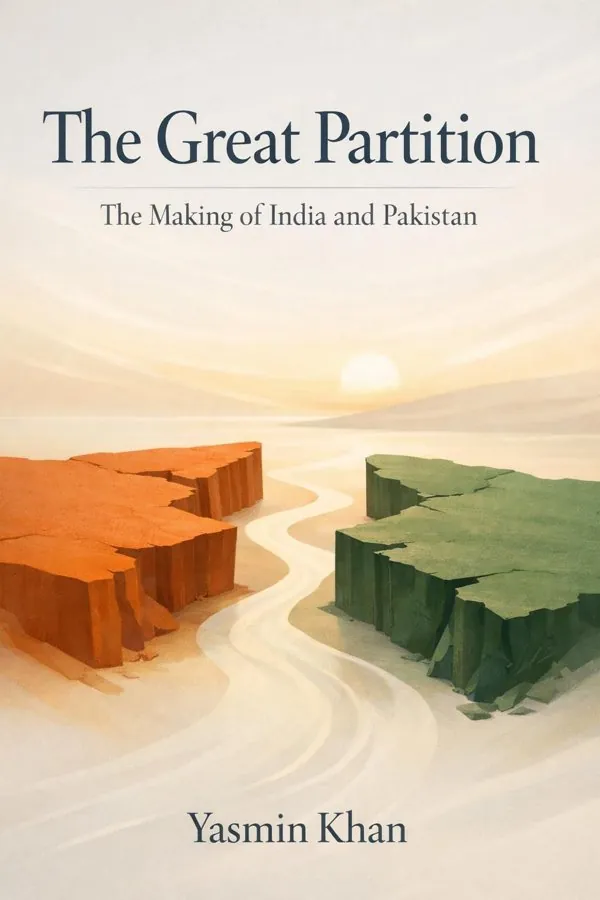
The Great Partition: The Making of India and Pakistan: Summary & Key Insights
by Yasmin Khan
 10 min10 chaptersAudio available
Key Takeaways from The Great Partition: The Making of India and Pakistan
One of Khan’s most powerful insights is that Partition was not simply the birth of two nations; it was also the disorderly ending of an exhausted empire.
A nation is often imagined as a shared dream, but Khan reminds us that in the 1940s India contained competing dreams of sovereignty.
History often blames local rivals for violence, but Khan insists that imperial decision-making played a direct role in deepening the crisis.
By the time borders were drawn, much of the trust needed to live with them had already collapsed.
Few episodes in modern history better show the violence hidden inside cartography than the drawing of the Partition borders.
What Is The Great Partition: The Making of India and Pakistan About?
The Great Partition: The Making of India and Pakistan by Yasmin Khan is a world_history book spanning 10 pages. Some historical events are so vast that they seem impossible to grasp until a careful historian shows how national decisions entered ordinary homes, villages, trains, and bodies. Yasmin Khan’s The Great Partition: The Making of India and Pakistan does exactly that. The book examines the 1947 division of British India into the independent states of India and Pakistan, tracing how imperial retreat, political rivalry, administrative haste, and communal fear combined to produce one of the largest and bloodiest forced migrations in modern history. Rather than treating Partition as an inevitable constitutional outcome, Khan reveals it as a messy, contingent, and deeply human catastrophe. What makes this book especially important is its balance. Khan moves from high politics—Mountbatten, Jinnah, Nehru, Congress, the Muslim League—to the everyday experiences of refugees, women, civil servants, soldiers, and families suddenly trapped on the wrong side of a border that barely existed before it was enforced. The result is not just a political history, but a social and moral one. As a historian of empire and decolonization, Khan writes with authority, clarity, and empathy, making this book essential for anyone who wants to understand how states are made, how societies break, and why Partition still shapes South Asia today.
This FizzRead summary covers all 10 key chapters of The Great Partition: The Making of India and Pakistan in approximately 10 minutes, distilling the most important ideas, arguments, and takeaways from Yasmin Khan's work. Also available as an audio summary and Key Quotes Podcast.
The Great Partition: The Making of India and Pakistan
Some historical events are so vast that they seem impossible to grasp until a careful historian shows how national decisions entered ordinary homes, villages, trains, and bodies. Yasmin Khan’s The Great Partition: The Making of India and Pakistan does exactly that. The book examines the 1947 division of British India into the independent states of India and Pakistan, tracing how imperial retreat, political rivalry, administrative haste, and communal fear combined to produce one of the largest and bloodiest forced migrations in modern history. Rather than treating Partition as an inevitable constitutional outcome, Khan reveals it as a messy, contingent, and deeply human catastrophe.
What makes this book especially important is its balance. Khan moves from high politics—Mountbatten, Jinnah, Nehru, Congress, the Muslim League—to the everyday experiences of refugees, women, civil servants, soldiers, and families suddenly trapped on the wrong side of a border that barely existed before it was enforced. The result is not just a political history, but a social and moral one. As a historian of empire and decolonization, Khan writes with authority, clarity, and empathy, making this book essential for anyone who wants to understand how states are made, how societies break, and why Partition still shapes South Asia today.
Who Should Read The Great Partition: The Making of India and Pakistan?
This book is perfect for anyone interested in world_history and looking to gain actionable insights in a short read. Whether you're a student, professional, or lifelong learner, the key ideas from The Great Partition: The Making of India and Pakistan by Yasmin Khan will help you think differently.
- ✓Readers who enjoy world_history and want practical takeaways
- ✓Professionals looking to apply new ideas to their work and life
- ✓Anyone who wants the core insights of The Great Partition: The Making of India and Pakistan in just 10 minutes
Want the full summary?
Get instant access to this book summary and 100K+ more with Fizz Moment.
Get Free SummaryAvailable on App Store • Free to download
Key Chapters
One of Khan’s most powerful insights is that Partition was not simply the birth of two nations; it was also the disorderly ending of an exhausted empire. Britain emerged from the Second World War financially strained, politically weakened, and increasingly unable to justify or sustain imperial rule in India. Wartime inflation, famine, military mobilization, and mass political unrest had transformed colonial society. The old machinery of British authority still existed on paper, but its legitimacy had decayed.
Khan shows that this late-colonial context matters because it shaped the speed and carelessness of withdrawal. British officials were no longer planning a gradual, well-administered transition. They were trying to leave quickly, while preserving prestige and limiting liability. That compressed timetable made already difficult negotiations far more dangerous. Instead of building strong institutions for transfer, boundary enforcement, minority protection, and refugee relief, the imperial state increasingly operated through improvisation.
A practical way to understand this is to compare political independence with organizational handover. When a large institution exits without preparing systems, communication channels, and emergency plans, those left behind bear the cost. In 1947, millions of civilians became the human buffer for administrative failure.
Khan’s account also challenges nostalgic versions of empire that portray British rule as orderly to the end. The final act of empire was not dignified control but fraying authority. For readers today, this offers a broader lesson: political exits—whether from wars, occupations, or large governing arrangements—can be as consequential as political rule itself.
Actionable takeaway: When assessing major historical transitions, ask not only why a regime ended, but how the withdrawal was managed and who paid the price for haste.
A nation is often imagined as a shared dream, but Khan reminds us that in the 1940s India contained competing dreams of sovereignty. The Indian National Congress and the All-India Muslim League both claimed to speak for India’s future, yet they imagined that future in fundamentally different ways. Congress largely promoted a strong, secular, territorially unified India. The Muslim League, under Muhammad Ali Jinnah, increasingly argued that Muslims were a distinct political community whose interests could not safely be left to a Hindu-majority center.
Khan avoids caricature. She does not reduce Congress to simple idealism or the League to simple communalism. Instead, she shows how mistrust grew from institutional failures, electoral competition, regional anxieties, and hardening political language. Muslim minorities in some provinces feared permanent marginalization in a majoritarian system, while Congress leaders often underestimated the depth of those fears. At the same time, not all Muslims supported Pakistan, and not all Congress supporters agreed on centralization, minority safeguards, or federal compromise.
This complexity is crucial because it helps explain why Partition was not inevitable in a mechanical sense, yet became increasingly plausible as negotiations narrowed. Political actors were not merely debating maps; they were debating security, representation, and the meaning of democracy in a socially diverse subcontinent.
The modern application is striking. In plural societies, constitutional structures must be trusted by minorities, not just endorsed by majorities. If one group sees national unity as inclusion while another experiences it as vulnerability, political rhetoric can quickly harden into separation.
Actionable takeaway: When evaluating nationalist movements, look beyond slogans and ask what concrete protections different communities believed they would gain or lose under each political arrangement.
History often blames local rivals for violence, but Khan insists that imperial decision-making played a direct role in deepening the crisis. British policy in the final years of empire was inconsistent, reactive, and often detached from realities on the ground. Successive plans for constitutional transfer failed to create durable agreement, and the arrival of Lord Mountbatten accelerated the pace even further. The decision to bring forward the date of British withdrawal left little time to manage the consequences.
Khan is especially sharp in showing how power can be exercised through timing. A rushed deadline was not neutral. It limited consultation, increased panic, and gave local actors incentives to secure territory before formal transfer. Officials worked under impossible conditions, and administrative systems meant to handle census data, district authority, policing, and military division were stretched beyond reason.
The same applies to information. In 1947, uncertainty itself became dangerous. Ordinary people did not know which state their town would belong to, whether local police would protect them, or whether minorities would be safe after independence. Rumor filled the vacuum. In such circumstances, fear becomes political fuel.
A practical analogy can be found in any poorly managed reorganization: unclear authority, shifting deadlines, and weak communication amplify conflict. But in Partition, the stakes were existential. Entire populations had to make life-or-death decisions based on incomplete information.
Khan’s larger contribution here is moral as well as analytical. Decolonization was not only a liberation story; it was also shaped by the imperial state’s refusal or inability to ensure an orderly and humane exit.
Actionable takeaway: In moments of transition, pay close attention to deadlines, communication, and institutional capacity, because procedural failures can become humanitarian disasters.
By the time borders were drawn, much of the trust needed to live with them had already collapsed. Khan shows that Partition emerged from a long sequence of failed negotiations in which leaders debated federation, provincial autonomy, minority safeguards, power-sharing, and the distribution of authority at the center. These were not abstract constitutional details. They were the mechanisms by which diverse communities hoped to secure their future.
The breakdown of talks mattered because every failed compromise strengthened the belief that coexistence under one state would mean domination by another group. Congress leaders feared excessive fragmentation and political paralysis; Muslim League leaders feared permanent subordination in a centralized system. As proposals failed, each side increasingly interpreted concessions as weakness and ambiguity as danger.
Khan’s account is useful because it reveals that catastrophic political outcomes often arise not from one dramatic rupture but from the cumulative exhaustion of bargaining. When parties stop believing that institutions can protect them, identity hardens into a territorial claim. This is how constitutional dispute becomes a border dispute.
Readers can apply this lesson to current conflicts involving federalism, autonomy, or multiethnic states. Durable settlements require more than elite signatures. They require broad confidence that the rules will be fairly implemented after the deal is announced. Without that confidence, even elegant plans collapse.
Khan also reminds us that leaders negotiate under pressure from supporters, rivals, and unfolding events. Public rhetoric narrows room for compromise. Once mass expectations are mobilized, elite flexibility declines.
Actionable takeaway: When studying failed settlements, ask what institutional trust was missing, and whether the parties believed a signed agreement would actually protect them once political conditions changed.
Few episodes in modern history better show the violence hidden inside cartography than the drawing of the Partition borders. Khan examines the work of the Boundary Commissions and the role of Cyril Radcliffe, who was tasked with dividing Punjab and Bengal despite limited local knowledge, inadequate time, and impossible political pressure. Lines were drawn using maps, census figures, district data, and legal formulas, yet the people affected often had no idea where those lines would finally fall.
Khan’s key insight is that borders are never merely geographical. They reorder livelihoods, loyalties, transport routes, irrigation systems, military positions, family networks, and sacred landscapes. In Punjab and Bengal, communities were intermingled, not neatly separated. Villages, markets, and kinship ties crossed the very lines the commissions were supposed to make clear. The result was not a tidy territorial solution but a destabilizing abstraction imposed on a socially entangled world.
This matters today because maps still create the illusion of precision. A border may appear decisive in an atlas while remaining chaotic in lived reality. Partition demonstrates the gap between territorial logic and social complexity. Once the line was announced—late and under enormous tension—people scrambled to interpret what it meant. For many, the answer came through militia attacks, administrative confusion, and sudden flight.
The practical lesson extends beyond history. Whenever policymakers discuss redistricting, partition, secession, or border settlement, they must ask how infrastructure, minorities, mobility, and local economies will function after the line is drawn. Legal clarity without social planning is a recipe for disorder.
Actionable takeaway: Treat political maps as starting points, not solutions, and always ask how borders will affect the daily life of communities living across them.
Partition became one of the largest forced migrations in history not because all movement was planned, but because fear spread faster than authority. Khan vividly shows how violence, rumor, revenge, and collapsing trust pushed millions of Hindus, Muslims, and Sikhs to abandon homes they had occupied for generations. Trains, roads, refugee columns, and makeshift camps became the geography of Partition. Independence, in many places, arrived not as celebration but as flight.
A crucial point in Khan’s account is that migration was both reactive and self-reinforcing. One attack prompted rumors of larger massacres; one departing convoy convinced neighbors that staying behind was now impossible. As communities moved, militias and local opportunists exploited the vacuum. Property was looted, homes seized, and old social arrangements shattered. Violence was not random, but often organized around territory, honor, retaliation, and the desire to create demographically purified zones.
Khan also emphasizes scale. The statistics are staggering, but numbers alone cannot capture the lived experience of dislocation: families separated, children lost, possessions reduced to what could be carried, and refugees forced to rebuild identity in new states that were themselves barely functioning.
This has contemporary relevance. Refugee crises are often discussed as logistical problems, but Partition shows they are produced by political collapse, social panic, and the breakdown of trust. Once fear normalizes movement, institutions struggle to catch up.
For readers, this chapter is a reminder that communal peace depends not only on formal laws but on everyday confidence that neighbors, police, and local authorities will act predictably under stress.
Actionable takeaway: To understand mass displacement, look for the interaction between rumor, security failure, and organized violence rather than treating migration as a spontaneous population shift.
One of the book’s most important interventions is its insistence that Partition must be understood through gender as well as politics. Khan documents how women were abducted, raped, forcibly converted, trafficked, mutilated, and killed during the upheaval. In many cases, women’s bodies became symbolic battlegrounds for community honor, revenge, and ethnic domination. Violence against women was not incidental to Partition; it was central to how communal aggression was enacted and remembered.
Khan also goes further by examining what happened afterward. States in India and Pakistan launched recovery operations to locate and repatriate abducted women, but these efforts often treated women as property of community and nation rather than as autonomous individuals. Some women did not wish to return to former families; others had children or new attachments formed under coercive or ambiguous circumstances. Official recovery therefore created new moral and political dilemmas.
This perspective changes how we read national history. Partition is often narrated through male leaders, armies, and borders, yet women experienced the crisis through the intimate collapse of home, kinship, bodily safety, and social standing. Their stories reveal how state formation can penetrate the most private domains.
The wider application is clear. In many conflicts, gendered violence is dismissed as a side effect when it is actually a deliberate means of terror, signaling, and social destruction. Any serious analysis of political violence must therefore ask who becomes vulnerable in specifically gendered ways.
Khan’s treatment also encourages more ethical historical reading: victims are not symbols, and recovery is not always justice.
Actionable takeaway: When studying war, migration, or communal conflict, include gender at the center of analysis rather than treating women’s experiences as an afterthought.
A newly independent state is often imagined as a moment of empowerment, but Khan shows that in 1947 the state was being assembled while society was already breaking apart. Administrative division between India and Pakistan involved splitting armies, civil services, finances, records, transport systems, and police forces at the exact moment when violence was escalating. Institutions that might have stabilized the crisis were themselves in transition.
This administrative collapse had immediate humanitarian consequences. Refugee camps were overcrowded, food and medical care were inadequate, trains were unsafe, and local officials were often overwhelmed or partisan. Relief efforts existed, but they were frequently too late, too small, or too poorly coordinated to match the scale of displacement. Khan highlights the tragic mismatch between bureaucratic procedure and emergency reality.
An important lesson here is that state capacity cannot be improvised overnight. Flags, speeches, and declarations may create legal sovereignty, but effective governance depends on staffed offices, functioning communications, transport systems, disciplined security forces, and trusted local administration. Without these, even well-intentioned governments struggle to protect civilians.
This insight is highly relevant to modern nation-building and post-conflict transitions. International observers often focus on constitutional milestones while underestimating the mundane infrastructure that makes citizenship meaningful. Partition demonstrates that paperwork, rationing, policing, and camp management are not secondary details; they are the frontline of human survival.
Khan does not deny the efforts of individuals who worked heroically under impossible conditions. But her argument remains clear: the machinery of protection was too fragile for the scale of the crisis.
Actionable takeaway: When assessing new states or political transitions, measure not only legitimacy and leadership, but also administrative capacity to deliver security, relief, and basic order.
What a nation remembers is often inseparable from what it chooses to soften, simplify, or silence. Khan explores how India and Pakistan incorporated Partition into their national stories in uneven ways. Official narratives tended to emphasize state legitimacy, sacrifice, and survival, while the messier truths of mutual violence, local complicity, and personal ambiguity were harder to absorb. Memory became political terrain.
In Pakistan, Partition could be framed as the necessary fulfillment of Muslim nationhood. In India, it could be portrayed as a tragic but transitional cost on the way to secular democracy and sovereignty. Yet for survivors, memory was rarely so neat. It lived in lost homes, interrupted family histories, inherited trauma, changed surnames, and silences around abduction, betrayal, or shame. Oral testimony often preserved complexities that national mythmaking could not easily contain.
Khan’s treatment of memory is especially valuable because it connects history to ongoing identity formation. Partition did not end in 1947; it continued through textbooks, commemorations, border politics, and family stories. This explains why the event remains emotionally charged across generations.
There is also a practical lesson for readers beyond South Asia. States often narrate founding violence in ways that consolidate legitimacy. Citizens and scholars therefore need to compare official memory with local testimony, archival records, and marginalized voices. Doing so does not weaken national understanding; it deepens it.
Khan encourages a mature historical consciousness—one that accepts that multiple communities can carry real wounds without collapsing into competitive victimhood.
Actionable takeaway: When learning about national history, seek out memoirs, oral histories, and local accounts to test how official narratives include or exclude lived experience.
The most enduring message of Khan’s book is that Partition was not a single event but a continuing structure of politics, memory, and conflict. The creation of India and Pakistan reshaped citizenship, minority relations, military priorities, regional diplomacy, and conceptions of national identity. Its afterlives can be seen in refugee rehabilitation, disputes over property, recurring communal tensions, the Kashmir conflict, and the militarization of the Indo-Pak relationship.
Khan helps readers see that founding violence often hardens state behavior. When nations are born through insecurity, they tend to remain preoccupied with territorial defense, loyalty, and suspicion of internal dissent. Partition also altered demographics in ways that affected electoral politics, urban development, and social hierarchies for decades. Refugee communities became politically important; memories of loss informed attitudes toward borders, belonging, and patriotism.
The book’s relevance extends well beyond South Asia. It offers a case study in how decolonization can produce both liberation and enduring fracture, especially when sovereignty is tied to religious identity and implemented through rushed territorial division. It also warns against simplistic ideas that once borders are drawn, history settles. In reality, borders can institutionalize unresolved fears.
For contemporary readers, Khan’s work sharpens debates about nationalism, minority protection, post-imperial responsibility, and the management of mass displacement. It is not only a history of what happened; it is an explanation of why certain political wounds remain open.
Actionable takeaway: Treat major political ruptures as long-term processes, and look for their institutional, social, and emotional aftereffects rather than assuming the crisis ended when independence was declared.
All Chapters in The Great Partition: The Making of India and Pakistan
About the Author
Yasmin Khan is a British historian whose work focuses on the history of the British Empire, South Asia, decolonization, and the social effects of war. She has taught at the University of Oxford and is widely recognized for making complex historical subjects accessible without sacrificing scholarly depth. Her research often combines political history with attention to everyday lives, allowing readers to see how large state decisions reshape communities and individuals. In The Great Partition, this approach is especially evident in her treatment of refugees, women, local administrators, and survivors alongside major political leaders. Khan has also written on India during the Second World War, further strengthening her authority on the late-colonial period. She is respected for clear analysis, balanced judgment, and a strong commitment to humane historical writing.
Get This Summary in Your Preferred Format
Read or listen to the The Great Partition: The Making of India and Pakistan summary by Yasmin Khan anytime, anywhere. FizzRead offers multiple formats so you can learn on your terms — all free.
Available formats: App · Audio · PDF · EPUB — All included free with FizzRead
Download The Great Partition: The Making of India and Pakistan PDF and EPUB Summary
Key Quotes from The Great Partition: The Making of India and Pakistan
“One of Khan’s most powerful insights is that Partition was not simply the birth of two nations; it was also the disorderly ending of an exhausted empire.”
“A nation is often imagined as a shared dream, but Khan reminds us that in the 1940s India contained competing dreams of sovereignty.”
“History often blames local rivals for violence, but Khan insists that imperial decision-making played a direct role in deepening the crisis.”
“By the time borders were drawn, much of the trust needed to live with them had already collapsed.”
“Few episodes in modern history better show the violence hidden inside cartography than the drawing of the Partition borders.”
Frequently Asked Questions about The Great Partition: The Making of India and Pakistan
The Great Partition: The Making of India and Pakistan by Yasmin Khan is a world_history book that explores key ideas across 10 chapters. Some historical events are so vast that they seem impossible to grasp until a careful historian shows how national decisions entered ordinary homes, villages, trains, and bodies. Yasmin Khan’s The Great Partition: The Making of India and Pakistan does exactly that. The book examines the 1947 division of British India into the independent states of India and Pakistan, tracing how imperial retreat, political rivalry, administrative haste, and communal fear combined to produce one of the largest and bloodiest forced migrations in modern history. Rather than treating Partition as an inevitable constitutional outcome, Khan reveals it as a messy, contingent, and deeply human catastrophe. What makes this book especially important is its balance. Khan moves from high politics—Mountbatten, Jinnah, Nehru, Congress, the Muslim League—to the everyday experiences of refugees, women, civil servants, soldiers, and families suddenly trapped on the wrong side of a border that barely existed before it was enforced. The result is not just a political history, but a social and moral one. As a historian of empire and decolonization, Khan writes with authority, clarity, and empathy, making this book essential for anyone who wants to understand how states are made, how societies break, and why Partition still shapes South Asia today.
You Might Also Like
The Age of Capital
Eric Hobsbawm
10 min
The Gulag Archipelago
Aleksandr Solzhenitsyn
10 min
Jerusalem: The Biography
Simon Sebag Montefiore
10 min
The Anglo-Saxons
James Campbell
10 min
The Boer War
Thomas Pakenham
10 min
The Industrial Revolutionaries: The Making of the Modern World 1776–1914
Gavin Weightman
10 minBrowse by Category
Ready to read The Great Partition: The Making of India and Pakistan?
Get the full summary and 100K+ more books with Fizz Moment.