
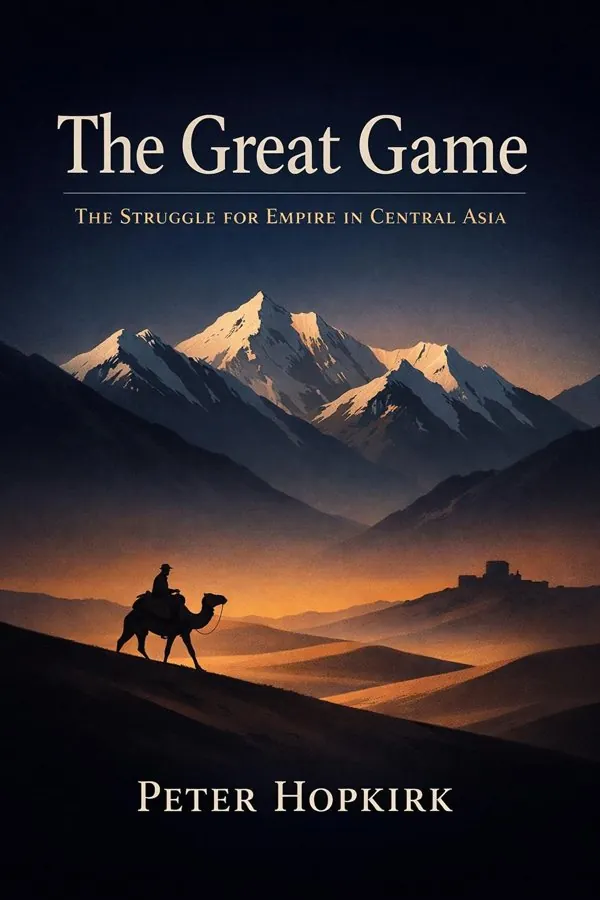
The Great Game: The Struggle for Empire in Central Asia: Summary & Key Insights
 10 min5 chaptersAudio available
What Is The Great Game: The Struggle for Empire in Central Asia About?
The Great Game: The Struggle for Empire in Central Asia by Peter Hopkirk is a world_history book spanning 5 pages. This historical narrative recounts the 19th-century rivalry between Victorian Britain and Tsarist Russia for dominance in Central Asia, known as the Great Game. Hopkirk vividly portrays the adventures of explorers, spies, and soldiers who risked their lives across the vast deserts and mountain passes from the Caucasus to China, shaping the geopolitical landscape of the region.
This FizzRead summary covers all 5 key chapters of The Great Game: The Struggle for Empire in Central Asia in approximately 10 minutes, distilling the most important ideas, arguments, and takeaways from Peter Hopkirk's work. Also available as an audio summary and Key Quotes Podcast.
The Great Game: The Struggle for Empire in Central Asia
This historical narrative recounts the 19th-century rivalry between Victorian Britain and Tsarist Russia for dominance in Central Asia, known as the Great Game. Hopkirk vividly portrays the adventures of explorers, spies, and soldiers who risked their lives across the vast deserts and mountain passes from the Caucasus to China, shaping the geopolitical landscape of the region.
Who Should Read The Great Game: The Struggle for Empire in Central Asia?
This book is perfect for anyone interested in world_history and looking to gain actionable insights in a short read. Whether you're a student, professional, or lifelong learner, the key ideas from The Great Game: The Struggle for Empire in Central Asia by Peter Hopkirk will help you think differently.
- ✓Readers who enjoy world_history and want practical takeaways
- ✓Professionals looking to apply new ideas to their work and life
- ✓Anyone who wants the core insights of The Great Game: The Struggle for Empire in Central Asia in just 10 minutes
Want the full summary?
Get instant access to this book summary and 100K+ more with Fizz Moment.
Get Free SummaryAvailable on App Store • Free to download
Key Chapters
The rivalry that we now call the Great Game did not begin with a formal declaration or treaty but with creeping suspicion. By the early nineteenth century, Russia had conquered the Caucasus and was pressing southward into Central Asia, subduing khanates like Khiva, Bokhara, and Kokand. Britain watched nervously from the Indian frontier. Every shift of Russian troops, every diplomatic mission into Persia or Afghanistan, seemed to echo like a distant drumbeat of invasion.
For the British strategists in Calcutta and London, the security of India was paramount. Napoleon’s failed ambitions had taught them that the Mughal territories could attract foreign predators, but the Russian advance seemed more methodical and enduring. Thus was born the theory of the buffer states—Afghanistan, Persia, and Tibet—whose integrity was to shield India from Russian approach. Yet defining a buffer meant entering it: exploration, treaty, and occupation followed. This fatal logic became the foundation of Britain’s Central Asian policy.
As I dug through historical records, the tone of British correspondence from the 1830s reveals an unmistakable anxiety bordering on paranoia. Reports from army officers and travelers returning from Persia were filtered through an imperial lens that saw every Russian maneuver as a potential threat. In truth, many Russian expeditions sought trade and prestige more than conquest, but fear magnified intent. The Great Game took on its name precisely because both sides were playing with incomplete maps and uncertain intelligence. Each move prompted another in reply—a contest not of direct war but of positioning, persuasion, and secrecy.
It was these shadows and misunderstandings that gave birth to the era of the explorer-agents, the men who would chart Central Asia on behalf of imperial safety, often under false identities and in constant danger.
Among the many figures who populate this narrative, none symbolize the audacity of Britain’s presence in Central Asia more fully than Captain Arthur Conolly, Charles Stoddart, and William Moorcroft. These men were not mere cartographers; they were spies in the age before espionage had a name. Their task was to travel disguised, to collect information about passes, rivers, and fortresses, and to assess the intentions of rulers who themselves were targets of Russian diplomacy.
William Moorcroft’s journeys to Bukhara and beyond in the early nineteenth century were driven as much by curiosity as by strategic necessity. He ventured through uncharted terrain, seeking new trade routes, while unwittingly laying the groundwork for intelligence networks. Conolly and Stoddart followed his footsteps years later with more explicit aims—to negotiate alliances and counter Russian influence. Their fate, captured and executed by the emir of Bukhara, became one of the defining tragedies of the Great Game. I wrote their story not merely to highlight their courage but to illustrate the perilous duality of imperial service—how duty to empire often demanded personal sacrifice of unimaginable magnitude.
These men worked in lands that had never seen European maps. They relied on rumor, instinct, and fragile local friendships. Their deaths shocked London and lingered as warnings of the limits of ambition. Yet by their efforts, British geographic knowledge of Central Asia expanded dramatically. The cartographic outlines produced through these missions would later inform military planning and colonial administration. To explore was to secure; to record a river’s course was to predict invasion routes. In the minds of strategists, geography was destiny, and those who mapped it were soldiers of empire no less than those who wielded muskets.
+ 3 more chapters — available in the FizzRead app
All Chapters in The Great Game: The Struggle for Empire in Central Asia
About the Author
Peter Hopkirk (1930–2014) was a British journalist, historian, and author renowned for his works on Central Asian history and the British Empire. His books, including 'The Great Game' and 'Foreign Devils on the Silk Road', are celebrated for their detailed research and engaging storytelling.
Get This Summary in Your Preferred Format
Read or listen to the The Great Game: The Struggle for Empire in Central Asia summary by Peter Hopkirk anytime, anywhere. FizzRead offers multiple formats so you can learn on your terms — all free.
Available formats: App · Audio · PDF · EPUB — All included free with FizzRead
Download The Great Game: The Struggle for Empire in Central Asia PDF and EPUB Summary
Key Quotes from The Great Game: The Struggle for Empire in Central Asia
“The rivalry that we now call the Great Game did not begin with a formal declaration or treaty but with creeping suspicion.”
“Among the many figures who populate this narrative, none symbolize the audacity of Britain’s presence in Central Asia more fully than Captain Arthur Conolly, Charles Stoddart, and William Moorcroft.”
Frequently Asked Questions about The Great Game: The Struggle for Empire in Central Asia
The Great Game: The Struggle for Empire in Central Asia by Peter Hopkirk is a world_history book that explores key ideas across 5 chapters. This historical narrative recounts the 19th-century rivalry between Victorian Britain and Tsarist Russia for dominance in Central Asia, known as the Great Game. Hopkirk vividly portrays the adventures of explorers, spies, and soldiers who risked their lives across the vast deserts and mountain passes from the Caucasus to China, shaping the geopolitical landscape of the region.
More by Peter Hopkirk
You Might Also Like
The Age of Capital
Eric Hobsbawm
10 min
The Gulag Archipelago
Aleksandr Solzhenitsyn
10 min
Jerusalem: The Biography
Simon Sebag Montefiore
10 min
The Anglo-Saxons
James Campbell
10 min
The Boer War
Thomas Pakenham
10 min
The Industrial Revolutionaries: The Making of the Modern World 1776–1914
Gavin Weightman
10 minBrowse by Category
Ready to read The Great Game: The Struggle for Empire in Central Asia?
Get the full summary and 100K+ more books with Fizz Moment.