
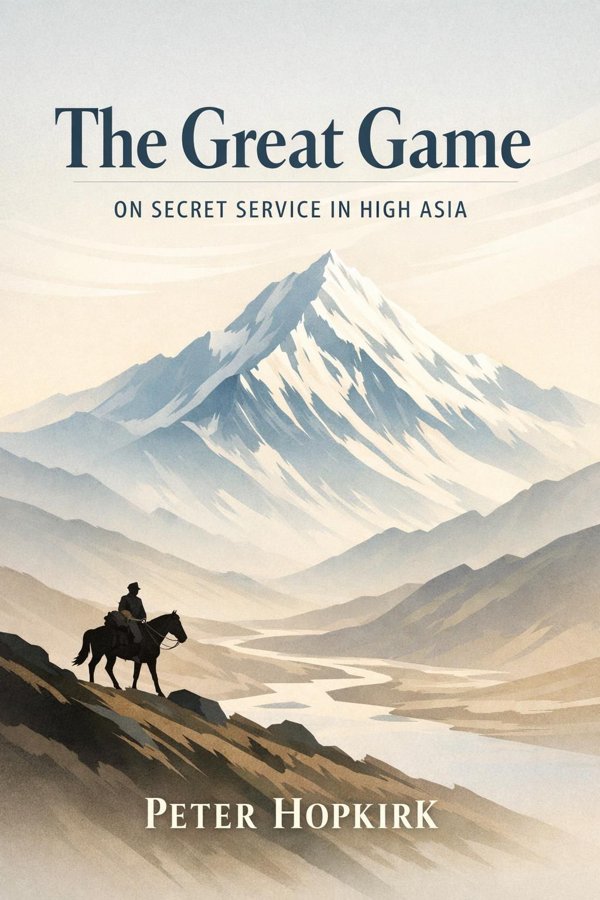
The Great Game: On Secret Service in High Asia: Summary & Key Insights
 10 min5 chaptersAudio available
What Is The Great Game: On Secret Service in High Asia About?
The Great Game: On Secret Service in High Asia by Peter Hopkirk is a world_history book spanning 5 pages. An account of the 19th-century geopolitical struggle between the British Empire and Tsarist Russia for dominance in Central Asia, known as the Great Game. Hopkirk narrates the daring exploits of explorers, spies, and soldiers who risked their lives in the remote regions of Afghanistan, Tibet, and the Pamirs, revealing the intrigue and adventure that shaped imperial history.
This FizzRead summary covers all 5 key chapters of The Great Game: On Secret Service in High Asia in approximately 10 minutes, distilling the most important ideas, arguments, and takeaways from Peter Hopkirk's work. Also available as an audio summary and Key Quotes Podcast.
The Great Game: On Secret Service in High Asia
An account of the 19th-century geopolitical struggle between the British Empire and Tsarist Russia for dominance in Central Asia, known as the Great Game. Hopkirk narrates the daring exploits of explorers, spies, and soldiers who risked their lives in the remote regions of Afghanistan, Tibet, and the Pamirs, revealing the intrigue and adventure that shaped imperial history.
Who Should Read The Great Game: On Secret Service in High Asia?
This book is perfect for anyone interested in world_history and looking to gain actionable insights in a short read. Whether you're a student, professional, or lifelong learner, the key ideas from The Great Game: On Secret Service in High Asia by Peter Hopkirk will help you think differently.
- ✓Readers who enjoy world_history and want practical takeaways
- ✓Professionals looking to apply new ideas to their work and life
- ✓Anyone who wants the core insights of The Great Game: On Secret Service in High Asia in just 10 minutes
Want the full summary?
Get instant access to this book summary and 100K+ more with Fizz Moment.
Get Free SummaryAvailable on App Store • Free to download
Key Chapters
Central Asia in the nineteenth century was more than empty wilderness—it was the pivot of world power. The vastness of the region, stretching from the Caspian Sea to the Himalayas, served both as barrier and bridge between civilizations. To the British, locked into the jewel of their empire—India—these northern mountains and deserts represented vulnerability. To the Russians, expanding relentlessly southward, they were a frontier begging to be conquered. Geography itself became a weapon, a silent manipulator of politics.
In my narrative, I sought to show how both empires misunderstood and glorified this terrain. To British strategists in Calcutta and London, the snowbound passes of Afghanistan looked like the potential avenue for a Russian invasion. To Russian generals and explorers, it was the gateway to influence over the East and ultimately toward India’s riches. Trade routes like the Silk Road and caravan tracks through Bukhara and Samarkand had, for millennia, carried goods and ideas. They would now carry spies and soldiers.
It is here that you begin to grasp the psychological geography of the Great Game—the way distant landscapes became symbols of peril. The British constructed a protective ring of watchfulness around India’s northern frontiers, sending surveyors and agents to map every inch of what was once terra incognita. The Russians, meanwhile, viewed the same lands as a stage upon which their own imperial narrative could expand. The collision was not immediate, but inevitable, driven by fear and wonder in equal measure.
Central Asia’s importance was not only strategic but spiritual. It drew men who were intoxicated by the unknown. Every valley promised forbidden cities; every mountain concealed tribal kingdoms resistant to conquest. Behind the diplomatic reports and military maps lay another layer—a pursuit of adventure, of human endurance. That is why, in telling this story, the land itself becomes a protagonist. It tests the ambitions of empires, defeats their pretensions, and survives their interference. The geography of Central Asia does not merely host this rivalry; it defines it.
The Great Game was born not through war but through curiosity—though soon curiosity gave way to calculation. I introduce figures like William Moorcroft, a veterinary surgeon turned explorer, who crossed Himalayan passes in search of horses but found himself instead in the service of empire. His journey into the forbidden realms of western Tibet and Central Asia marked Britain’s first hesitant steps into the secret frontier. Every map he sketched, every rumor he gathered, became part of a growing intelligence mosaic.
Across the steppes, the Russians had their own heroes of exploration. Nikolai Przhevalsky embodied both the scientific spirit and imperial ambition of the czar’s service. His expeditions into Mongolia and Tibet were ostensibly about zoology and geography, yet beneath that veneer lurked the strategic purpose of surveillance and penetration. Each of these men was a spy by circumstance, an explorer by passion, and a political instrument by design.
I wanted readers to feel the loneliness and grandeur of their missions. There were no radios, no diplomatic lifelines. Moorcroft’s march through unknown territories brought him face to face with suspicion and disease; Przhevalsky commanded caravans across wastelands where survival depended on sheer will. They both carried with them an invisible cargo: the anxieties of their governments and the weight of their civilizations.
Through their experiences, the Game acquired its first contours—a contest of knowledge. Whoever knew the ground first would control it later. The explorers’ journals were as valuable as any treaty. Their discoveries fed ministers’ ambitions, convincing both empires that mastery of Central Asia lay not only in conquest but understanding.
+ 3 more chapters — available in the FizzRead app
All Chapters in The Great Game: On Secret Service in High Asia
About the Author
Peter Hopkirk (1930–2014) was a British journalist, historian, and author known for his works on Central Asia and the history of espionage. He worked for The Times and wrote several acclaimed books on the Great Game and related subjects.
Get This Summary in Your Preferred Format
Read or listen to the The Great Game: On Secret Service in High Asia summary by Peter Hopkirk anytime, anywhere. FizzRead offers multiple formats so you can learn on your terms — all free.
Available formats: App · Audio · PDF · EPUB — All included free with FizzRead
Download The Great Game: On Secret Service in High Asia PDF and EPUB Summary
Key Quotes from The Great Game: On Secret Service in High Asia
“Central Asia in the nineteenth century was more than empty wilderness—it was the pivot of world power.”
“The Great Game was born not through war but through curiosity—though soon curiosity gave way to calculation.”
Frequently Asked Questions about The Great Game: On Secret Service in High Asia
The Great Game: On Secret Service in High Asia by Peter Hopkirk is a world_history book that explores key ideas across 5 chapters. An account of the 19th-century geopolitical struggle between the British Empire and Tsarist Russia for dominance in Central Asia, known as the Great Game. Hopkirk narrates the daring exploits of explorers, spies, and soldiers who risked their lives in the remote regions of Afghanistan, Tibet, and the Pamirs, revealing the intrigue and adventure that shaped imperial history.
More by Peter Hopkirk
You Might Also Like
The Age of Capital
Eric Hobsbawm
10 min
The Gulag Archipelago
Aleksandr Solzhenitsyn
10 min
Jerusalem: The Biography
Simon Sebag Montefiore
10 min
The Anglo-Saxons
James Campbell
10 min
The Boer War
Thomas Pakenham
10 min
The Industrial Revolutionaries: The Making of the Modern World 1776–1914
Gavin Weightman
10 minBrowse by Category
Ready to read The Great Game: On Secret Service in High Asia?
Get the full summary and 100K+ more books with Fizz Moment.