
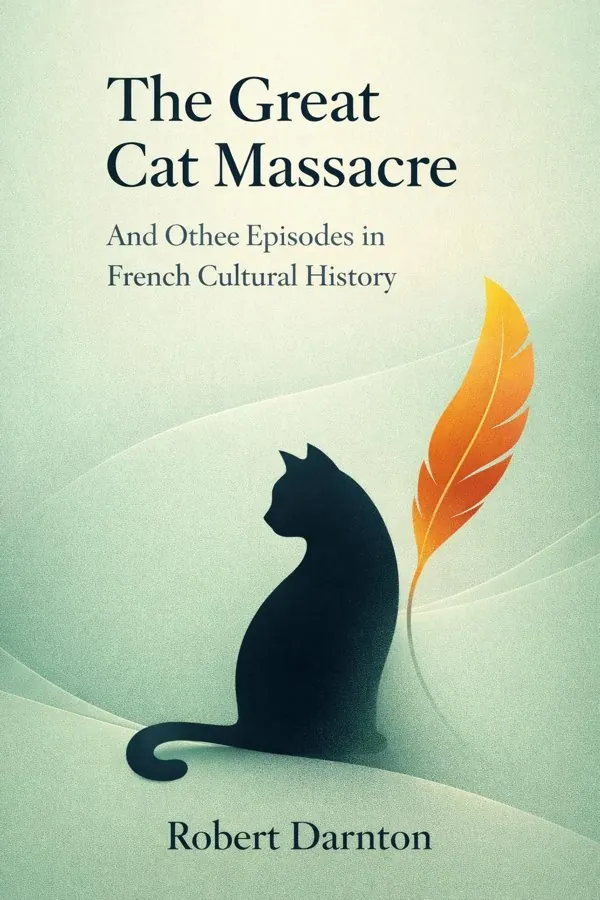
The Great Cat Massacre: And Other Episodes in French Cultural History: Summary & Key Insights
 10 min9 chaptersAudio available
Key Takeaways from The Great Cat Massacre: And Other Episodes in French Cultural History
The strangest events often reveal the deepest truths.
History becomes most valuable when it teaches us how not to mistake our own assumptions for universal truth.
Fairy tales are rarely as innocent as later generations imagine.
The stories a society tells do more than entertain; they quietly train people in how to see the world.
Revolutions begin in categories before they appear in streets.
What Is The Great Cat Massacre: And Other Episodes in French Cultural History About?
The Great Cat Massacre: And Other Episodes in French Cultural History by Robert Darnton is a civilization book spanning 8 pages. What can a cruel prank in a Paris print shop, a peasant folktale, or a police file reveal about an entire civilization? In The Great Cat Massacre, Robert Darnton argues that seemingly odd, trivial, or grotesque episodes can open a direct path into the mental world of eighteenth-century France. Rather than retelling familiar political events on the road to the French Revolution, he reconstructs how ordinary people, writers, workers, and officials made sense of authority, humor, injustice, and knowledge. The book matters because it shows that history is not only about institutions and wars; it is also about symbols, jokes, stories, and habits of thought. Darnton combines archival research with anthropology, literary criticism, and social history to interpret behaviors that modern readers might otherwise dismiss as irrational. His famous account of apprentices killing cats becomes a lesson in reading culture from the inside, not through modern assumptions. Darnton is uniquely qualified for this task. As one of the leading historians of eighteenth-century France and the history of books, he brings deep scholarly authority together with narrative energy. The result is a classic of cultural history that changes how we understand the past.
This FizzRead summary covers all 9 key chapters of The Great Cat Massacre: And Other Episodes in French Cultural History in approximately 10 minutes, distilling the most important ideas, arguments, and takeaways from Robert Darnton's work. Also available as an audio summary and Key Quotes Podcast.
The Great Cat Massacre: And Other Episodes in French Cultural History
What can a cruel prank in a Paris print shop, a peasant folktale, or a police file reveal about an entire civilization? In The Great Cat Massacre, Robert Darnton argues that seemingly odd, trivial, or grotesque episodes can open a direct path into the mental world of eighteenth-century France. Rather than retelling familiar political events on the road to the French Revolution, he reconstructs how ordinary people, writers, workers, and officials made sense of authority, humor, injustice, and knowledge.
The book matters because it shows that history is not only about institutions and wars; it is also about symbols, jokes, stories, and habits of thought. Darnton combines archival research with anthropology, literary criticism, and social history to interpret behaviors that modern readers might otherwise dismiss as irrational. His famous account of apprentices killing cats becomes a lesson in reading culture from the inside, not through modern assumptions.
Darnton is uniquely qualified for this task. As one of the leading historians of eighteenth-century France and the history of books, he brings deep scholarly authority together with narrative energy. The result is a classic of cultural history that changes how we understand the past.
Who Should Read The Great Cat Massacre: And Other Episodes in French Cultural History?
This book is perfect for anyone interested in civilization and looking to gain actionable insights in a short read. Whether you're a student, professional, or lifelong learner, the key ideas from The Great Cat Massacre: And Other Episodes in French Cultural History by Robert Darnton will help you think differently.
- ✓Readers who enjoy civilization and want practical takeaways
- ✓Professionals looking to apply new ideas to their work and life
- ✓Anyone who wants the core insights of The Great Cat Massacre: And Other Episodes in French Cultural History in just 10 minutes
Want the full summary?
Get instant access to this book summary and 100K+ more with Fizz Moment.
Get Free SummaryAvailable on App Store • Free to download
Key Chapters
History becomes most valuable when it teaches us how not to mistake our own assumptions for universal truth. Darnton uses the cat massacre to model a broader interpretive method: cultural practices that look senseless from the outside may become intelligible once placed within their symbolic environment. His approach draws from anthropology, especially the idea that rituals, jokes, and stories encode social meanings.
The apprentices’ performance resembled carnival, where the world briefly turns upside down and inferiors parody superiors. Their mock trial gave the event a theatrical quality, transforming private frustration into a collective drama. Cats themselves carried rich associations in early modern Europe, including sexuality, witchcraft, domestic intimacy, and feminine attachment. Once these meanings are restored, the massacre appears less as random brutality and more as a symbolic attack on household authority, especially the mistress’s preferences and the injustices of workshop life.
Darnton’s method asks readers to slow down. Instead of translating the past too quickly into familiar categories like class conflict or psychological frustration, he encourages “thick description,” or close attention to language, ritual, and context. This method has practical use beyond historical scholarship. In organizations, politics, or cross-cultural communication, people often misread actions because they ignore local codes. A joke in one setting may be an insult in another; a ceremonial gesture may carry layers of meaning invisible to outsiders.
The deeper point is humility. Understanding another culture, whether historical or contemporary, requires patience and interpretation, not instant certainty. Darnton reminds us that the past is a foreign country, but one we can approach with disciplined imagination. Actionable takeaway: when something seems irrational, map its symbols, social setting, and audience response before deciding what it means.
Fairy tales are rarely as innocent as later generations imagine. In one of the book’s most influential chapters, Darnton studies French peasant folktales and compares them with the polished literary versions that became familiar through writers like Charles Perrault or, later, the Brothers Grimm. What emerges is a world far more brutal, earthy, and socially revealing than modern bedtime stories suggest.
These tales were shaped by hunger, insecurity, and peasant survival. Children were often abandoned, stepmothers were dangerous, trickery was admired, and happy endings were uncertain. Instead of comforting moral lessons, many stories taught listeners how to navigate scarcity, hierarchy, and family conflict. A peasant audience did not hear these tales as fantasy detached from life. They heard echoes of their own conditions: thin resources, weak protection, and the need for cunning in the face of power.
Darnton’s insight is that storytelling preserves mental worlds. Folktales show not only what people feared, but what they considered normal. If a story treats abandonment casually, it suggests an environment where such possibilities were imaginable. If cleverness triumphs over virtue, it reflects a moral economy in which survival often mattered more than innocence. Today, popular narratives still perform this function. Crime dramas, superhero films, and internet myths reveal contemporary anxieties about justice, technology, and belonging.
The practical lesson is to treat stories as social documents. They may be fictional, but they are never culturally empty. Whether you are analyzing historical tales or modern media, ask what forms of life they normalize and what emotions they repeatedly rehearse. Actionable takeaway: when reading a story, look beyond plot and identify the fears, assumptions, and survival strategies of the world that produced it.
The stories a society tells do more than entertain; they quietly train people in how to see the world. Darnton shows that eighteenth-century tales circulated through oral culture as carriers of social knowledge. They transmitted expectations about family, work, sexuality, danger, and class. At the same time, they sometimes offered listeners a symbolic escape from ordinary power relations by celebrating reversals, tricks, and improbable victories.
This double function is crucial. On one side, stories reinforced social order by teaching what was possible, what was dangerous, and who could be trusted. A tale about a cunning servant or a foolish nobleman still relied on the audience’s familiarity with hierarchy. On the other side, storytelling gave expression to hidden wishes. The weak outsmarting the strong, the hungry outmaneuvering the wealthy, or the abandoned child surviving through wit allowed audiences to imagine justice in a world that rarely delivered it.
Darnton’s analysis helps explain why cultural forms can never be classified as either purely conservative or purely rebellious. The same story can stabilize values and subtly undermine them. We see this today in workplace humor, viral satire, and popular fiction. A comedy may mock elites while still reaffirming the structure it critiques. A children’s story may teach obedience while quietly honoring independence.
For readers, this chapter offers a tool for cultural interpretation: look at who tells stories, who listens, and what emotional work the stories perform. They often reveal unresolved tensions that formal institutions conceal. Darnton invites us to see narrative as a social practice rather than a decorative extra. Actionable takeaway: whenever you encounter a popular story, ask two questions—what order does it sustain, and what fantasy of reversal does it permit?
Revolutions begin in categories before they appear in streets. Darnton’s discussion of the Encyclopedists, especially the creators of the Encyclopédie, shows how the Enlightenment was not just a collection of abstract ideas but a concrete effort to reorganize knowledge. Denis Diderot, Jean le Rond d’Alembert, and their collaborators sought to gather, classify, and circulate human understanding on a new basis—one less dependent on inherited authority and more grounded in reason, craft, and critical inquiry.
This was a radical undertaking. The Encyclopédie did not merely summarize information; it challenged who had the right to define truth. It elevated practical arts alongside learned disciplines, creating a map of knowledge that subtly undermined traditional hierarchies of church, monarchy, and scholastic tradition. Cross-references between entries encouraged readers to think relationally and skeptically. Even when overt censorship constrained content, the structure of the work itself could suggest new ways of seeing the world.
Darnton emphasizes that ideas gain power through media and organization. The Enlightenment was not only philosophy in salons. It was also publishing, editing, circulation, and the material labor of producing books. In modern terms, changing the architecture of information can transform society. Search engines, educational platforms, and digital encyclopedias shape public thought not just by what they contain, but by how they organize access.
The chapter reminds us that intellectual change depends on infrastructure. If you want to understand how a culture thinks, examine how it stores, classifies, and distributes knowledge. Actionable takeaway: pay attention not only to ideas themselves, but to the systems that arrange and spread them, because those systems quietly shape what people can imagine.
Official culture is only half the story; the other half circulates in shadows. Darnton explores the “literary underground” of eighteenth-century France: the network of banned books, libels, pamphlets, and illicit texts that moved across borders and through informal distribution channels. This hidden world mattered because it connected readers to a body of writing that was irreverent, scandalous, political, and often commercially driven.
Much of this literature was not high philosophy. It included gossip about court life, attacks on public figures, pornography, satire, and sensational exposés. Yet Darnton argues that such works played a powerful role in eroding respect for established authority. By mixing entertainment with subversion, underground literature made monarchy and elite culture appear ridiculous, corrupt, and morally compromised. It did not single-handedly cause revolution, but it helped create a climate in which reverence weakened.
One of Darnton’s key contributions is to show that public opinion forms through messy channels. Readers do not consume only serious arguments; they absorb moods, suspicions, and narratives from whatever media capture attention. The lesson is strikingly contemporary. Today, memes, anonymous posts, rumor networks, and scandal-driven content often shape political feeling more effectively than formal essays. Information ecosystems are made not just of truth and falsehood, but of tone, repetition, and emotional charge.
Darnton also highlights the material side of subversion: smugglers, printers, sellers, and reading communities. Ideas travel because systems move them. Actionable takeaway: when assessing cultural change, look beyond official institutions and ask what unofficial, entertaining, or disreputable media are reshaping trust, authority, and public mood.
States observe their citizens, but in doing so they accidentally preserve fragments of ordinary life. Darnton mines police archives to show how surveillance records can become windows into popular culture. Eighteenth-century French police monitored writers, booksellers, rumor, and public speech, not simply to maintain order but to track the movement of ideas. Their reports, interrogations, and dossiers now allow historians to glimpse how people spoke, read, and circulated information.
What makes these sources so valuable is their unintended richness. A police report may have been created for control, yet it captures conversations, anxieties, networks, and habits that would otherwise vanish. Through these archives, Darnton reconstructs the relationship between authority and the public sphere. He reveals a society in which information moved through cafés, salons, workshops, streets, and clandestine print markets, while officials tried to monitor and contain it.
At the same time, Darnton is careful about source criticism. Police records reflect the priorities and prejudices of those who produced them. They are not transparent mirrors of reality. Historians must read them against the grain, asking what the authorities feared, what they ignored, and how those choices distort the picture. This is a useful lesson for modern readers navigating corporate data, media reports, or digital analytics. Records always reveal and conceal at once.
The broader takeaway is that bureaucratic documents can hold unexpected cultural depth if interpreted carefully. They show not only what institutions did, but what they considered threatening or significant. Actionable takeaway: when using official records of any kind, ask both what they document and what their creators’ motives reveal about the society that produced them.
Ideas do not change history by existing; they change history by finding audiences. Darnton challenges simplistic pictures of the Enlightenment by showing that philosophers became influential only through complex interactions with printers, booksellers, salons, censors, and readers. The relationship between thinkers and the public was dynamic, negotiated, and often unpredictable.
Philosophers such as Voltaire, Rousseau, and Diderot did not speak into a vacuum. Their texts entered a crowded marketplace shaped by fashion, censorship, commercial pressures, and reader expectations. Some works spread because they resonated with educated elites, while others gained force through excerpting, commentary, rumor, or scandal. Darnton’s point is not merely that ideas circulated, but that circulation transformed them. Once texts reached readers, they became part of wider debates that authors could not fully control.
This perspective helps correct the myth of the solitary genius remaking society through pure reason. Intellectual influence depends on mediation. Reviews, editions, pirated copies, discussion circles, and word of mouth all determine which ideas become consequential. In today’s world, the same principle applies to podcasts, newsletters, social media threads, and video clips. Content creators may generate arguments, but networks and audiences decide what becomes public common sense.
Darnton’s analysis encourages a more democratic understanding of culture. Readers are not passive consumers; they help produce meaning by selecting, sharing, and interpreting. If we want to understand major shifts in thought, we must study not only authors but reading communities. Actionable takeaway: whenever you evaluate an influential idea, trace the channels and audiences that amplified it, because reception is part of the message.
The deepest message of Darnton’s book is methodological: the past can be understood, but never by assuming it thinks like we do. Across all the episodes he studies, from apprentices’ jokes to peasant tales and Enlightenment texts, he argues for a form of cultural history that is both imaginative and disciplined. Historians must enter foreign mental worlds without flattening them into modern categories.
This requires interpretive humility. Darnton does not claim that symbols yield one final meaning, nor that archives speak for themselves. Instead, he models inquiry: gather evidence, compare patterns, reconstruct context, and test explanations against what people of the time likely found plausible. His work is famous not just because of its subjects, but because it demonstrates how to read culture as a web of meanings rather than a collection of isolated facts.
The practical value of this approach extends far beyond eighteenth-century France. It applies to business cultures, political subcultures, online communities, and international relations. People constantly misinterpret others because they assume shared meanings where none exist. Darnton teaches that understanding any group requires attention to its rituals, metaphors, humor, fears, and media.
For students, this means reading sources slowly. For leaders, it means listening before diagnosing. For general readers, it means resisting the temptation to label the unfamiliar as irrational. Cultural explanation is harder than moral reaction, but it is usually more illuminating. Actionable takeaway: cultivate the habit of asking, “What world of meaning makes this behavior sensible to its participants?” before offering judgment or analysis.
All Chapters in The Great Cat Massacre: And Other Episodes in French Cultural History
About the Author
Robert Darnton is an American historian and one of the most influential scholars of eighteenth-century French cultural and intellectual life. He is especially known for pioneering work in the history of books, reading, publishing, and the Enlightenment. Darnton taught at Princeton University and later at Harvard University, where he also served as director of the Harvard University Library. His research combines archival depth with methods drawn from anthropology and literary criticism, allowing him to reconstruct how ordinary people as well as intellectual elites made sense of their world. Through books such as The Great Cat Massacre, he helped expand the scope of historical inquiry beyond politics and institutions to include symbols, stories, media, and everyday mentalities.
Get This Summary in Your Preferred Format
Read or listen to the The Great Cat Massacre: And Other Episodes in French Cultural History summary by Robert Darnton anytime, anywhere. FizzRead offers multiple formats so you can learn on your terms — all free.
Available formats: App · Audio · PDF · EPUB — All included free with FizzRead
Download The Great Cat Massacre: And Other Episodes in French Cultural History PDF and EPUB Summary
Key Quotes from The Great Cat Massacre: And Other Episodes in French Cultural History
“The strangest events often reveal the deepest truths.”
“History becomes most valuable when it teaches us how not to mistake our own assumptions for universal truth.”
“Fairy tales are rarely as innocent as later generations imagine.”
“The stories a society tells do more than entertain; they quietly train people in how to see the world.”
“Revolutions begin in categories before they appear in streets.”
Frequently Asked Questions about The Great Cat Massacre: And Other Episodes in French Cultural History
The Great Cat Massacre: And Other Episodes in French Cultural History by Robert Darnton is a civilization book that explores key ideas across 9 chapters. What can a cruel prank in a Paris print shop, a peasant folktale, or a police file reveal about an entire civilization? In The Great Cat Massacre, Robert Darnton argues that seemingly odd, trivial, or grotesque episodes can open a direct path into the mental world of eighteenth-century France. Rather than retelling familiar political events on the road to the French Revolution, he reconstructs how ordinary people, writers, workers, and officials made sense of authority, humor, injustice, and knowledge. The book matters because it shows that history is not only about institutions and wars; it is also about symbols, jokes, stories, and habits of thought. Darnton combines archival research with anthropology, literary criticism, and social history to interpret behaviors that modern readers might otherwise dismiss as irrational. His famous account of apprentices killing cats becomes a lesson in reading culture from the inside, not through modern assumptions. Darnton is uniquely qualified for this task. As one of the leading historians of eighteenth-century France and the history of books, he brings deep scholarly authority together with narrative energy. The result is a classic of cultural history that changes how we understand the past.
You Might Also Like

The Structure of Scientific Revolutions
Thomas S. Kuhn
10 min
Genius
Harold Bloom
10 min
A Cultural History of the Medieval Age
Various Editors
10 min
A History of God: The 4,000-Year Quest of Judaism, Christianity and Islam
Karen Armstrong
10 min
A History of the World in 10½ Chapters
Julian Barnes
10 min
A Short History of Progress
Ronald Wright
10 minBrowse by Category
Ready to read The Great Cat Massacre: And Other Episodes in French Cultural History?
Get the full summary and 100K+ more books with Fizz Moment.