
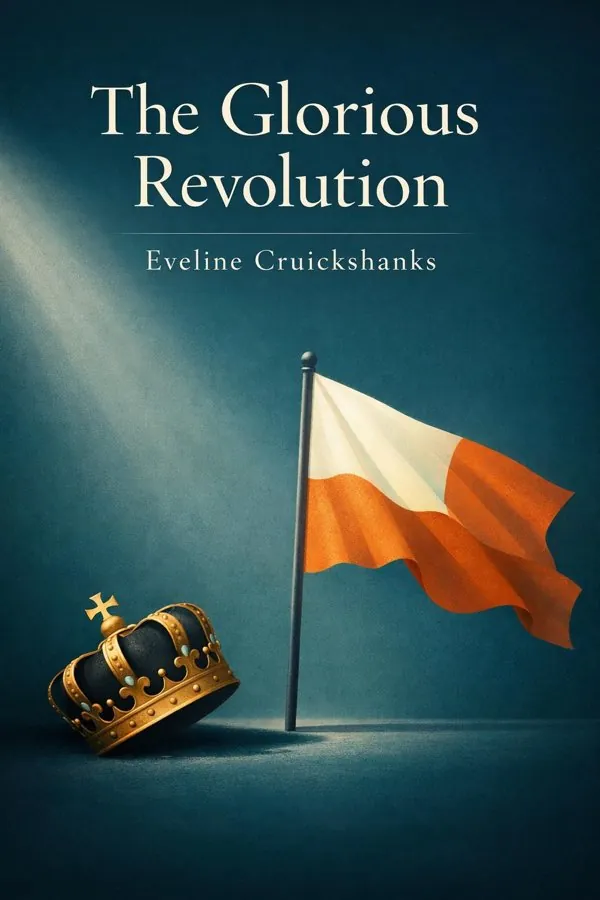
The Glorious Revolution: Summary & Key Insights
 10 min10 chaptersAudio available
Key Takeaways from The Glorious Revolution
Revolutions rarely begin with a single dramatic event; they grow out of tensions that have been accumulating for years.
Political arguments often sound constitutional on the surface, but religion can supply the passion that makes them explosive.
A ruler does not need to be a tyrant in intention to create a crisis of authority; it is enough to govern in ways large parts of society experience as threatening.
Resistance is rarely spontaneous; it is organized through relationships, shared language, and a growing sense that ordinary remedies have failed.
Inviting a foreign prince to intervene is not an act of pure patriotism; it is a gamble that domestic survival requires external force.
What Is The Glorious Revolution About?
The Glorious Revolution by Eveline Cruickshanks is a world_history book spanning 10 pages. Eveline Cruickshanks’s The Glorious Revolution revisits one of the most famous turning points in British history: the overthrow of James II in 1688 and the accession of William III and Mary II. Often presented as a calm, bloodless, and inevitable victory for liberty, the revolution is usually wrapped in patriotic myth. Cruickshanks challenges that comforting story. She shows that the events of 1688–1689 were driven by fear, faction, propaganda, dynastic calculation, religious conflict, and the hard realities of power. Rather than a simple constitutional triumph, the revolution emerges as a contested and deeply divisive political upheaval. What makes this book so valuable is its refusal to flatten history into a tidy morality play. Cruickshanks, a leading historian of late Stuart politics, Jacobitism, and party conflict, brings sharp archival insight to the era’s rival loyalties and competing interpretations. She helps readers see that constitutional change did not arise in a vacuum; it grew out of anxieties about monarchy, Parliament, Protestant identity, and European geopolitics. For anyone who wants to understand how modern Britain was shaped, this book offers a more rigorous and unsettling account than the traditional legend.
This FizzRead summary covers all 10 key chapters of The Glorious Revolution in approximately 10 minutes, distilling the most important ideas, arguments, and takeaways from Eveline Cruickshanks's work. Also available as an audio summary and Key Quotes Podcast.
The Glorious Revolution
Eveline Cruickshanks’s The Glorious Revolution revisits one of the most famous turning points in British history: the overthrow of James II in 1688 and the accession of William III and Mary II. Often presented as a calm, bloodless, and inevitable victory for liberty, the revolution is usually wrapped in patriotic myth. Cruickshanks challenges that comforting story. She shows that the events of 1688–1689 were driven by fear, faction, propaganda, dynastic calculation, religious conflict, and the hard realities of power. Rather than a simple constitutional triumph, the revolution emerges as a contested and deeply divisive political upheaval.
What makes this book so valuable is its refusal to flatten history into a tidy morality play. Cruickshanks, a leading historian of late Stuart politics, Jacobitism, and party conflict, brings sharp archival insight to the era’s rival loyalties and competing interpretations. She helps readers see that constitutional change did not arise in a vacuum; it grew out of anxieties about monarchy, Parliament, Protestant identity, and European geopolitics. For anyone who wants to understand how modern Britain was shaped, this book offers a more rigorous and unsettling account than the traditional legend.
Who Should Read The Glorious Revolution?
This book is perfect for anyone interested in world_history and looking to gain actionable insights in a short read. Whether you're a student, professional, or lifelong learner, the key ideas from The Glorious Revolution by Eveline Cruickshanks will help you think differently.
- ✓Readers who enjoy world_history and want practical takeaways
- ✓Professionals looking to apply new ideas to their work and life
- ✓Anyone who wants the core insights of The Glorious Revolution in just 10 minutes
Want the full summary?
Get instant access to this book summary and 100K+ more with Fizz Moment.
Get Free SummaryAvailable on App Store • Free to download
Key Chapters
Revolutions rarely begin with a single dramatic event; they grow out of tensions that have been accumulating for years. Cruickshanks begins by placing 1688 within the world of the restored Stuart monarchy after 1660. Charles II returned to the throne promising stability after civil war, regicide, and republican experiment. Yet the Restoration never fully healed the country’s divisions. Questions about the proper limits of royal power, the rights of Parliament, and the place of religion in public life remained unresolved.
The restored monarchy looked secure on the surface, but beneath it sat a brittle political order. Charles II had to manage competing factions, fears of arbitrary government, and recurring suspicion that the Crown might lean toward Catholicism or French-style absolutism. Parliament remained influential, but so did court patronage and personal networks. This meant politics did not operate through modern institutions alone; it depended on trust, personality, and rumor.
Cruickshanks shows that by the time James II inherited the throne in 1685, England was not entering a peaceful age but a system already strained by decades of ideological conflict. The Exclusion Crisis had already exposed deep fears about a Catholic successor. In other words, the Revolution of 1688 was not a sudden collapse but the breaking point of long-running instability.
A useful modern application is to remember that constitutional crises usually have long prehistories. Public institutions may look solid until old disputes, poorly resolved, return under pressure. When studying any political breakdown, examine the deeper structure before focusing on the headline event.
Actionable takeaway: To understand any major political change, start by identifying the unresolved conflicts that made the system vulnerable long before the crisis exploded.
Political arguments often sound constitutional on the surface, but religion can supply the passion that makes them explosive. In Cruickshanks’s account, the Catholic question was not a side issue in late seventeenth-century England; it was the emotional center of politics. Many Protestants believed Catholicism threatened not just doctrine, but liberty, property, and national independence. Anti-Catholic fear was therefore both theological and political.
James II’s open Catholicism transformed unease into alarm. His attempts to advance Catholic toleration were interpreted by many not as broad-minded reform but as a strategy to weaken the Church of England and remove safeguards against arbitrary rule. For his supporters, James was seeking justice for religious minorities and asserting lawful royal authority. For his enemies, he was dismantling the Protestant constitution.
Cruickshanks helps readers understand why compromise was so difficult. In a world where religion was tied to salvation, legitimacy, and loyalty, concessions looked dangerous. Even moderate reforms could be read as existential threats. This helps explain why the birth of James’s son in 1688 caused such panic: it suggested not merely a Catholic king, but a Catholic dynasty.
The broader lesson is that identities and beliefs can shape political behavior more deeply than institutional design alone. Modern observers often underestimate symbolic issues because they seem irrational or outdated. Yet political systems become unstable when groups believe their way of life is under siege.
Actionable takeaway: When evaluating political conflict, do not separate policy from identity; ask which beliefs people see as non-negotiable, because those are often the true engines of crisis.
A ruler does not need to be a tyrant in intention to create a crisis of authority; it is enough to govern in ways large parts of society experience as threatening. Cruickshanks presents James II as a monarch whose policies intensified existing fears. He expanded the standing army, promoted Catholics to positions of power, used dispensing authority to bypass legal barriers, and challenged institutions that had long anchored the Protestant political order.
From James’s perspective, these moves may have seemed lawful and necessary. He believed in strong monarchy and in his right to relieve Catholics and dissenters from restrictive laws. But politics is not governed by intention alone. His methods suggested to many that he was placing royal will above established law. The trial of the seven bishops, who resisted the reading of his Declaration of Indulgence, became a symbolic turning point because it dramatized the conflict between conscience, church, and Crown.
Cruickshanks’s treatment is useful because it avoids easy caricature. James was not simply mad or uniquely oppressive; he was politically inflexible and fatally tone-deaf to the fears of his kingdom. He mistook legal power for political consent. That distinction matters in every age. Leaders can possess formal authority yet lose legitimacy if they seem to attack the institutions people trust.
A contemporary parallel appears whenever governments push major changes through technically valid procedures while ignoring public perception. If key constituencies believe norms are being broken, backlash can quickly outgrow the original issue.
Actionable takeaway: In politics and leadership, never confuse the ability to act with the wisdom to do so; legitimacy depends as much on trust and restraint as on legal right.
Resistance is rarely spontaneous; it is organized through relationships, shared language, and a growing sense that ordinary remedies have failed. Cruickshanks shows how opposition to James II formed through a mix of aristocratic networks, church interests, local political influence, and international calculation. Those who came to resist the king did not all share the same motives. Some were committed Protestants, some constitutional traditionalists, some political opportunists, and some simply alarmed by the direction of royal policy.
What united them was the belief that existing mechanisms could no longer contain the danger. Petitioning, parliamentary resistance, and quiet negotiation seemed insufficient. The widening fear that James intended to create a durable Catholic and absolutist regime drove opponents toward more extraordinary measures. The birth of a male heir in June 1688 sharpened the urgency. What had looked like a temporary problem now threatened to become a permanent succession.
Cruickshanks emphasizes that political change depended not merely on ideas but on communication. Letters, private meetings, elite trust, and carefully coordinated messaging helped transform scattered discontent into actionable resistance. This is a reminder that major historical change is often built in rooms far smaller than later national myths suggest.
For modern readers, this chapter offers a practical lens on coalition-building. Movements succeed when they align people with different interests around a shared immediate objective, even if their long-term visions diverge. That coalition may later fracture, but it can still alter history.
Actionable takeaway: When analyzing or building opposition, look beyond public slogans and map the networks, incentives, and shared fears that make collective action possible.
Inviting a foreign prince to intervene is not an act of pure patriotism; it is a gamble that domestic survival requires external force. One of the most dramatic episodes in the story is the invitation sent to William of Orange by leading English figures. Cruickshanks treats this not as a romantic rescue mission but as a deeply risky political calculation. The invitation rested on the belief that only William could mobilize enough military and symbolic power to challenge James successfully.
William had his own reasons for accepting. He was not merely the husband of Mary, James’s Protestant daughter; he was also a European statesman focused on resisting Louis XIV of France. England’s alignment mattered enormously to continental power politics. Thus the Revolution was never only an English domestic event. It was linked to wider Protestant alliances, dynastic claims, and strategic warfare.
Cruickshanks’s interpretation reminds readers that interventions are always dual-sided. The English opposition sought deliverance, but William sought advantage as well. He entered not as a neutral referee but as a political actor with military ambition and international goals. That does not make the invitation insincere; it makes it realistic.
This idea has broad application. Political coalitions often seek outside support in moments of crisis, but such support always arrives with interests attached. Whether in international diplomacy, corporate restructuring, or institutional reform, rescuers are rarely disinterested.
Actionable takeaway: When evaluating alliances, ask not only why one side sought help, but what the helper stood to gain; durable judgment depends on seeing both motives at once.
Regimes often look strongest just before they disintegrate. Cruickshanks demonstrates that James II did not lose power simply because William landed with an army. He lost because support for his rule unraveled rapidly once elites, officers, and influential figures began defecting. Authority depends on obedience, and obedience depends on confidence. Once confidence faltered, the king’s position became untenable.
William’s invasion in November 1688 was certainly a military event, but its success depended heavily on political collapse from within. Key nobles shifted allegiance. Members of James’s own family defected. Many who had served the Crown now concluded that preserving Protestantism and political order required abandoning the king. James’s eventual flight became one of the most symbolically important moments in the Revolution because it allowed his opponents to frame the throne as effectively vacated.
Cruickshanks thereby complicates the familiar image of a bloodless transfer of power. England avoided large-scale battle at the center, but the change of regime was still coercive, unstable, and saturated with fear. Moreover, conflict continued in Ireland and Scotland, where the revolution’s costs were far from bloodless.
The practical lesson is that institutions can unravel quickly when elites perceive a leader as unable to win. Momentum matters. So does narrative. A government may possess legal continuity, armed force, and formal status, yet collapse if enough insiders conclude that its future has ended.
Actionable takeaway: In any power struggle, watch defections closely; they are often better indicators of imminent change than public speeches or official claims of strength.
Constitutional revolutions are not made only by removing rulers; they are made by deciding what replaces them. After James fled, the Convention Parliament had to solve a problem with enormous implications: had James abdicated, deserted, forfeited, or merely been unlawfully displaced? Cruickshanks shows how these arguments mattered because the answers defined the future balance between monarchy and Parliament.
The settlement of 1689 installed William and Mary on conditions that reflected both necessity and principle. The Declaration of Rights, later enacted as the Bill of Rights, condemned abuses associated with James’s reign and sought to limit future overreach. It affirmed parliamentary consent, regular law, and protections against certain forms of arbitrary power. Yet Cruickshanks is careful not to present this as the birth of full democracy. The new order still depended on monarchy, elite rule, and contested interpretations.
What changed most was the political logic of kingship. The Crown could no longer plausibly claim the same unchecked hereditary authority in practice. Monarchy survived, but under terms more visibly conditioned by law, Parliament, and Protestant succession. The settlement did not end conflict; it institutionalized a new framework within which conflict would continue.
Readers can apply this insight broadly: moments of transition are defined not just by who wins, but by how victory is codified. New rules often emerge through compromise, ambiguity, and expediency rather than philosophical purity.
Actionable takeaway: When judging a political settlement, study the legal language and institutional compromises, because that is where revolutionary energy becomes durable structure.
Victorious regimes often celebrate liberty while quietly narrowing who gets to define it. Cruickshanks highlights the constitutional and political consequences of the Revolution without accepting the classic Whig version at face value. Yes, 1688–1689 strengthened parliamentary government, curbed some royal pretensions, and reinforced the importance of law. But these gains were accompanied by exclusions, ongoing coercion, and partisan struggle.
The Revolution settlement privileged Protestant succession and tied political legitimacy more firmly to confessional identity. It also strengthened the political nation in ways that favored certain elites rather than the population as a whole. Parliament gained, but not every subject gained equally. Dissenters, Catholics, Jacobites, and those outside the governing class continued to face limits. This is crucial to Cruickshanks’s interpretation: constitutional progress should not be mistaken for universal inclusion.
Her account invites readers to think critically about how political victories are narrated. Later generations often describe settlements in the language of freedom, but freedom is usually distributed unevenly. Some rights expand while others contract. Some institutions become more accountable while others become more exclusionary.
This remains highly relevant today. Reforms advertised as democratizing can still entrench the power of specific groups. The key question is not simply whether a reform limits one form of power, but whose interests the new arrangement serves.
Actionable takeaway: Whenever you hear a political settlement praised as a triumph for liberty, ask a second question immediately: liberty for whom, and on what terms?
A truly settled revolution does not need to spend decades defending itself. Cruickshanks’s expertise in Jacobitism gives her special authority in showing that the Revolution of 1688 did not produce instant consensus. Support for James II and his heirs persisted in England, Scotland, and especially Ireland, where the revolution unleashed warfare of profound consequence. The Jacobite challenge revealed that dynastic legitimacy remained contested long after William and Mary took the throne.
This matters because it breaks the illusion that 1688 resolved Britain’s political identity in one stroke. For many subjects, the old hereditary principle still carried moral force. Others objected to foreign intervention, the treatment of James, or the religious direction of the new regime. Jacobitism was not merely nostalgia; it was a living alternative political vision rooted in loyalty, monarchy, and competing ideas of legitimacy.
Cruickshanks also helps us see how governments consolidate themselves through memory. The stronger the Jacobite threat, the more the post-revolution state needed to defend its origin story. Official narratives of providence, liberty, and national salvation were not just celebratory; they were tools of stabilization.
Modern readers can apply this insight whenever a regime insists too quickly that all debate is over. Persistent opposition, even if eventually defeated, indicates unresolved moral and constitutional questions beneath institutional closure.
Actionable takeaway: To understand whether a political transformation truly succeeded, look at the scale and longevity of the resistance it continued to provoke.
History does not merely record events; it turns them into stories that justify the present. One of Cruickshanks’s most important contributions is her challenge to the long-term mythologizing of the Glorious Revolution. Over time, 1688 came to symbolize a uniquely British path to liberty: moderate, Protestant, parliamentary, and superior to the violent revolutions that later shook France and elsewhere. This interpretation became central to British political culture.
Yet myths simplify. They turn conflict into inevitability and complexity into moral clarity. Cruickshanks insists that the Revolution was neither purely bloodless nor universally welcomed, neither wholly principled nor free from self-interest. It involved foreign intervention, elite maneuvering, and deep social division. The polished national legend hides the rough edges of the actual event.
Understanding this process matters far beyond seventeenth-century studies. Every nation constructs usable pasts. These stories help create identity, legitimacy, and civic confidence. But they can also obscure exclusion, violence, and contingency. To read Cruickshanks well is to learn how historical memory is built, defended, and repeated.
A practical application is in how we consume public history today. Textbooks, commemorations, museum exhibits, and political speeches often present foundational events as morally settled. Critical reading requires asking what has been omitted, who benefits from the story, and what alternative accounts survive at the margins.
Actionable takeaway: Treat celebrated national turning points not only as historical events, but as narratives shaped afterward to serve political and cultural needs.
All Chapters in The Glorious Revolution
About the Author
Eveline Cruickshanks is a distinguished British historian of seventeenth- and eighteenth-century political history, best known for her work on the late Stuart period, Tory politics, and Jacobitism. Her scholarship has played an important role in challenging older Whig interpretations that treated British constitutional development as a smooth and inevitable march toward liberty. Instead, she has emphasized division, dynastic loyalty, party struggle, and the enduring complexity of political legitimacy. Cruickshanks has contributed extensively to the study of parliamentary history and the ideological conflicts surrounding the Revolution of 1688. Her deep familiarity with archival sources and with the rival political cultures of the age gives her work unusual authority. In The Glorious Revolution, she brings that expertise to one of Britain’s most mythologized historical events.
Get This Summary in Your Preferred Format
Read or listen to the The Glorious Revolution summary by Eveline Cruickshanks anytime, anywhere. FizzRead offers multiple formats so you can learn on your terms — all free.
Available formats: App · Audio · PDF · EPUB — All included free with FizzRead
Download The Glorious Revolution PDF and EPUB Summary
Key Quotes from The Glorious Revolution
“Revolutions rarely begin with a single dramatic event; they grow out of tensions that have been accumulating for years.”
“Political arguments often sound constitutional on the surface, but religion can supply the passion that makes them explosive.”
“A ruler does not need to be a tyrant in intention to create a crisis of authority; it is enough to govern in ways large parts of society experience as threatening.”
“Resistance is rarely spontaneous; it is organized through relationships, shared language, and a growing sense that ordinary remedies have failed.”
“Inviting a foreign prince to intervene is not an act of pure patriotism; it is a gamble that domestic survival requires external force.”
Frequently Asked Questions about The Glorious Revolution
The Glorious Revolution by Eveline Cruickshanks is a world_history book that explores key ideas across 10 chapters. Eveline Cruickshanks’s The Glorious Revolution revisits one of the most famous turning points in British history: the overthrow of James II in 1688 and the accession of William III and Mary II. Often presented as a calm, bloodless, and inevitable victory for liberty, the revolution is usually wrapped in patriotic myth. Cruickshanks challenges that comforting story. She shows that the events of 1688–1689 were driven by fear, faction, propaganda, dynastic calculation, religious conflict, and the hard realities of power. Rather than a simple constitutional triumph, the revolution emerges as a contested and deeply divisive political upheaval. What makes this book so valuable is its refusal to flatten history into a tidy morality play. Cruickshanks, a leading historian of late Stuart politics, Jacobitism, and party conflict, brings sharp archival insight to the era’s rival loyalties and competing interpretations. She helps readers see that constitutional change did not arise in a vacuum; it grew out of anxieties about monarchy, Parliament, Protestant identity, and European geopolitics. For anyone who wants to understand how modern Britain was shaped, this book offers a more rigorous and unsettling account than the traditional legend.
You Might Also Like
The Age of Capital
Eric Hobsbawm
10 min
The Gulag Archipelago
Aleksandr Solzhenitsyn
10 min
Jerusalem: The Biography
Simon Sebag Montefiore
10 min
The Anglo-Saxons
James Campbell
10 min
The Boer War
Thomas Pakenham
10 min
The Industrial Revolutionaries: The Making of the Modern World 1776–1914
Gavin Weightman
10 minBrowse by Category
Ready to read The Glorious Revolution?
Get the full summary and 100K+ more books with Fizz Moment.