
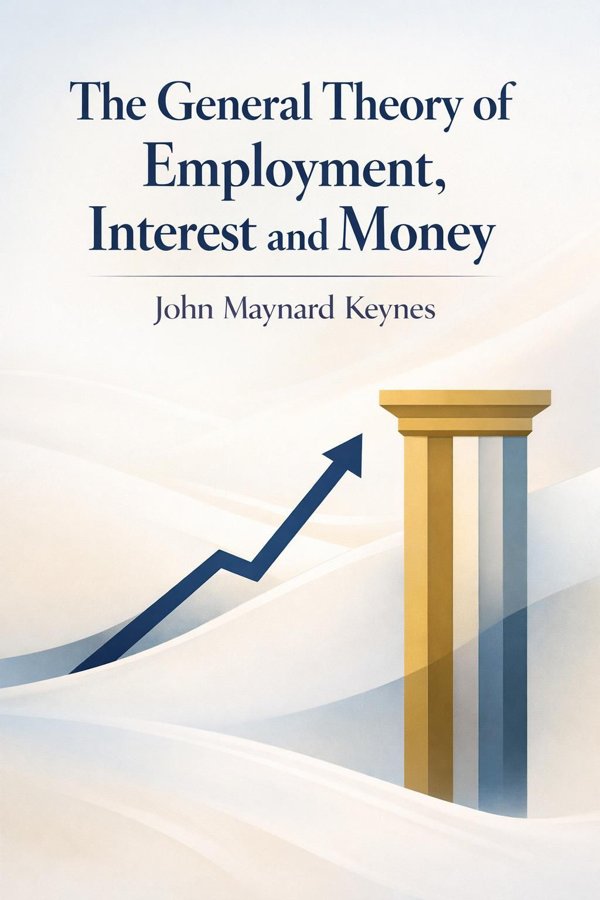
The General Theory of Employment, Interest and Money: Summary & Key Insights
 10 min9 chaptersAudio available
Key Takeaways from The General Theory of Employment, Interest and Money
An economy can be poor not because it lacks productive capacity, but because it lacks buyers.
People do not spend every extra dollar they earn, and that simple fact has enormous consequences for the whole economy.
The future is not calculated with certainty; it is imagined under uncertainty.
Interest rates are not just the price that balances saving and investment; they also reflect how strongly people want to hold cash.
Much of economic life is built not on risk that can be neatly measured, but on uncertainty that cannot.
What Is The General Theory of Employment, Interest and Money About?
The General Theory of Employment, Interest and Money by John Maynard Keynes is a economics book spanning 6 pages. Few books have changed the way governments understand recessions, unemployment, and economic stability as profoundly as The General Theory of Employment, Interest and Money. Published in 1936 in the shadow of the Great Depression, John Maynard Keynes’s landmark work challenged the long-standing belief that markets naturally return to full employment if left alone. Instead, Keynes argued that economies can settle into prolonged periods of weak demand, high unemployment, and wasted resources unless active policy steps are taken. At the heart of the book is a bold shift in perspective: output and employment are driven not simply by supply or wage flexibility, but by aggregate demand—how much households, firms, and governments are willing to spend. Keynes also rethought saving, investment, interest rates, uncertainty, and the role of expectations in shaping economic outcomes. His ideas laid the foundation for modern macroeconomics and transformed fiscal policy around the world. Dense but revolutionary, this is not just a book about economics; it is a new framework for understanding why capitalist economies can falter and what can be done when they do.
This FizzRead summary covers all 9 key chapters of The General Theory of Employment, Interest and Money in approximately 10 minutes, distilling the most important ideas, arguments, and takeaways from John Maynard Keynes's work. Also available as an audio summary and Key Quotes Podcast.
The General Theory of Employment, Interest and Money
Few books have changed the way governments understand recessions, unemployment, and economic stability as profoundly as The General Theory of Employment, Interest and Money. Published in 1936 in the shadow of the Great Depression, John Maynard Keynes’s landmark work challenged the long-standing belief that markets naturally return to full employment if left alone. Instead, Keynes argued that economies can settle into prolonged periods of weak demand, high unemployment, and wasted resources unless active policy steps are taken. At the heart of the book is a bold shift in perspective: output and employment are driven not simply by supply or wage flexibility, but by aggregate demand—how much households, firms, and governments are willing to spend. Keynes also rethought saving, investment, interest rates, uncertainty, and the role of expectations in shaping economic outcomes. His ideas laid the foundation for modern macroeconomics and transformed fiscal policy around the world. Dense but revolutionary, this is not just a book about economics; it is a new framework for understanding why capitalist economies can falter and what can be done when they do.
Who Should Read The General Theory of Employment, Interest and Money?
This book is perfect for anyone interested in economics and looking to gain actionable insights in a short read. Whether you're a student, professional, or lifelong learner, the key ideas from The General Theory of Employment, Interest and Money by John Maynard Keynes will help you think differently.
- ✓Readers who enjoy economics and want practical takeaways
- ✓Professionals looking to apply new ideas to their work and life
- ✓Anyone who wants the core insights of The General Theory of Employment, Interest and Money in just 10 minutes
Want the full summary?
Get instant access to this book summary and 100K+ more with Fizz Moment.
Get Free SummaryAvailable on App Store • Free to download
Key Chapters
An economy can be poor not because it lacks productive capacity, but because it lacks buyers. That is the central shock of Keynes’s principle of effective demand. Classical economists tended to assume that supply creates its own demand and that markets, if left flexible enough, will restore full employment. Keynes rejected this. Businesses do not hire workers simply because wages fall or because labor is available. They hire when they expect sales revenue to justify production. Employment therefore depends on the level of expected demand for goods and services.
Effective demand is the point at which entrepreneurs believe production will be profitable. If they expect weak sales, they cut output and employment. As incomes then fall, spending falls further, reinforcing the slump. In this way, an economy can become trapped below full employment without any automatic force strong enough to correct it quickly. The problem is not just production; it is the insufficiency of spending.
This insight helps explain recessions in practical terms. A factory may have machines, workers, and raw materials ready to go, yet still remain partly idle if customers are not buying enough. Likewise, a restaurant may reduce staff not because wages are too high, but because too few diners are coming in. On a national scale, the same logic applies: when households cut spending and firms postpone investment, total demand contracts and unemployment rises.
For policymakers, the principle of effective demand justifies intervention during downturns. If private demand collapses, public spending can help fill the gap and support employment. For business leaders, it is a reminder that hiring decisions depend on expected revenue, not abstract market equilibrium. Actionable takeaway: when diagnosing unemployment, look first at spending and demand expectations rather than assuming labor markets alone are to blame.
People do not spend every extra dollar they earn, and that simple fact has enormous consequences for the whole economy. Keynes’s idea of the propensity to consume explains how household behavior affects total demand. As income rises, consumption also rises, but usually by less than the increase in income. Some portion is spent, and some is saved. This means that higher output does not automatically guarantee enough spending to purchase all that could be produced.
Because consumers spend only part of any additional income, economies are vulnerable to shortfalls in demand. If people become cautious and increase saving sharply, firms may see sales weaken and cut back on production. Keynes argued that what makes sense for one household can become harmful when everyone does it at once. An individual who saves more may become financially safer, but if millions do so simultaneously during a slump, incomes and employment can fall. This is one version of the paradox of thrift.
Keynes linked this idea to the multiplier effect. If the government or a business injects new spending into the economy, that spending becomes someone else’s income. Part of that income is then spent again, generating further rounds of demand. For example, if a government funds road construction, workers and suppliers receive income, which they then spend at grocery stores, shops, and service businesses. The total increase in national income can therefore exceed the original expenditure.
This idea remains central in modern policy debates. Stimulus payments, infrastructure projects, and unemployment benefits are all defended partly on multiplier logic. The exact size of the multiplier may vary, but the principle remains powerful. Actionable takeaway: in weak economies, policies and business plans that raise spending among people likely to spend quickly can have outsized effects on growth and employment.
The future is not calculated with certainty; it is imagined under uncertainty. Keynes emphasized that investment decisions are not governed only by mechanical formulas or stable interest rates. They depend heavily on business expectations about future profits, which can shift suddenly and dramatically. He called the expected profitability of new investment the marginal efficiency of capital. If firms believe new factories, machines, offices, or technologies will generate strong returns, they invest. If they become pessimistic, investment can collapse even when resources are available.
This focus on expectations helps explain why economies can be unstable. Investment is one of the most volatile parts of demand because it reflects changing confidence about the future. A company may cancel expansion plans not because current sales are terrible, but because it fears lower future demand, political uncertainty, or financial stress. Once many firms do this together, the downturn becomes self-reinforcing.
The practical implications are wide-ranging. Consider housing markets. When developers expect strong future demand, they build apartments, hire contractors, and order materials. If confidence collapses, projects are delayed or scrapped, reducing employment across construction, finance, manufacturing, and retail. The same pattern appears in technology, transportation, and energy. In every case, present jobs depend on future expectations.
Keynes’s insight also explains why simply lowering costs may not revive investment. If expected profits are low, cheap credit alone may not be enough. Firms need reasons to believe future demand will justify the investment. That is why stable policy, credible institutions, and visible demand support matter.
Actionable takeaway: when evaluating economic weakness, ask not only whether money is available, but whether businesses have confidence that future sales will make investment worthwhile.
Interest rates are not just the price that balances saving and investment; they also reflect how strongly people want to hold cash. This was one of Keynes’s most important departures from classical economics. In his liquidity preference theory, the rate of interest is determined by the demand for money relative to its supply. People hold money for transactions, precaution, and speculation. When uncertainty rises, the desire for liquidity increases, and this can keep interest rates from falling enough to stimulate investment.
This means saving does not automatically flow into productive investment through a simple market-clearing mechanism. A person may choose not to spend, yet that does not guarantee a business will borrow and invest the exact same amount. If people prefer liquidity and hoard money, demand can weaken without any compensating rise in investment. The economy then contracts.
A practical example appears in financial crises. Even when central banks reduce rates, households and firms may still cling to cash because they fear losses or instability. Banks may also become cautious about lending. Under those conditions, low interest rates do not produce the expected surge in borrowing and spending. Keynes’s framework helps explain why monetary policy can become less effective in severe downturns.
This theory also shifts how we think about policy. If interest rates are shaped by liquidity preference, then restoring confidence and ensuring money actually circulates become crucial. Central banks may need unconventional policies, while governments may need to spend directly when private actors remain frozen.
For individuals and investors, the lesson is that cash demand itself can shape macroeconomic outcomes. For policymakers, it warns against assuming rate cuts alone will solve every recession. Actionable takeaway: treat interest rates as part of a broader system of confidence, liquidity, and expectations rather than as a simple balancing tool between saving and investment.
Much of economic life is built not on risk that can be neatly measured, but on uncertainty that cannot. Keynes drew a critical distinction between calculable probabilities and the deeper uncertainty surrounding the future. Businesspeople, investors, and consumers make decisions without knowing future profits, political developments, technological shifts, or financial conditions with precision. Because of this, economic behavior often rests on convention, habit, and what Keynes famously described as animal spirits.
This idea matters because it undermines overly mechanical views of markets. If the future were always clear, investment would respond smoothly to incentives and downturns might be brief. But under genuine uncertainty, moods can swing from optimism to fear, and those shifts can alter the entire economy. During a boom, confidence encourages borrowing, expansion, and hiring. During a crisis, the same actors suddenly delay spending, hold cash, and cancel plans. The result is not graceful adjustment but abrupt contraction.
You can see this in everyday business life. A retailer may postpone opening a new location not because financing is unavailable, but because the economic outlook feels too uncertain. Families may delay major purchases like homes or cars for the same reason. These choices are rational from the individual point of view, yet collectively they reduce demand and employment.
Keynes’s emphasis on uncertainty makes economics more realistic and more human. Decisions are not made by emotionless calculators; they are made by people trying to navigate an unknowable future. This also strengthens the case for stabilizing institutions, predictable policy, and automatic supports such as unemployment insurance, which reduce the damage caused by waves of fear.
Actionable takeaway: whenever economic conditions deteriorate, pay close attention to confidence and uncertainty, because shifts in psychology can move the economy as powerfully as changes in prices or interest rates.
Lower wages may reduce costs for one employer, but they do not necessarily restore full employment across an entire economy. Keynes challenged the classical view that unemployment mainly results from wages being too high. He argued that general wage cuts can actually worsen a slump because workers are also consumers. If wages fall broadly, household income falls, spending weakens, and firms may see even less reason to hire.
This is a crucial difference between individual logic and aggregate logic. One business might improve competitiveness by reducing wages if others do not follow. But if all wages decline together, total purchasing power shrinks. Businesses then face weaker demand for their products. The economy may become more depressed, not less. What appears sensible at the micro level can be destructive at the macro level.
Keynes also noted that lower money wages do not automatically produce lower real wages in a stable and beneficial way. Falling wages can affect prices, debt burdens, and expectations. If falling wages and prices lead consumers to postpone purchases in anticipation of better deals later, demand may weaken further. Debtors can also suffer because their incomes fall while their debts remain fixed in nominal terms.
Modern examples appear whenever economies pursue internal devaluation during crises. Sharp wage compression may improve certain cost ratios, yet it can also produce social strain, weak consumption, and prolonged stagnation. Keynes’s framework suggests that economies recover more reliably through stronger demand than through generalized wage suppression.
This does not mean wages never matter. It means aggregate employment cannot be understood by focusing on labor costs alone. Demand, expectations, and financial conditions are equally decisive. Actionable takeaway: be cautious of policies that treat lower wages as the main cure for unemployment; sustainable recovery usually requires restoring spending and confidence, not just reducing labor costs.
What is prudent for a household can become harmful for a nation. Keynes’s paradox of thrift captures one of the most counterintuitive ideas in economics: when everyone tries to save more at the same time, total income may fall so much that actual aggregate saving does not increase. In a recession, if households cut consumption sharply, businesses lose revenue, reduce production, and lay off workers. As incomes decline, the economy shrinks.
The paradox does not say saving is bad in general. Saving is essential for financial security and long-term planning. Keynes’s point is that the timing and context matter. During periods of weak demand, a collective surge in saving can deepen the downturn because one person’s spending is another person’s income. If businesses do not respond by increasing investment, higher intended saving simply means lower output.
This concept helps explain why recessions often feed on themselves. Consumers become cautious, firms react by cutting jobs, and the resulting income losses make consumers even more cautious. In such circumstances, public spending can offset the gap and prevent the economy from spiraling downward. That is why fiscal stimulus is often most strongly defended when private actors are trying to repair their balance sheets simultaneously.
A familiar example is the aftermath of a financial crash. Families focus on paying down debt, banks tighten lending, and companies postpone expansion. All these actions are understandable individually. Together, however, they can produce stagnation. Keynes’s insight shows why someone must be willing to spend when everyone else is retrenching.
Actionable takeaway: distinguish between healthy long-term saving and damaging short-term demand withdrawal; in downturns, support policies and business strategies that prevent collective caution from collapsing overall income.
When private demand fails, public action can keep the economy from sinking deeper. Keynes did not argue that government should replace markets in normal times. Rather, he argued that capitalist economies are prone to instability, especially when private investment collapses under uncertainty. In those moments, government spending can support employment, incomes, and confidence until private activity recovers.
This was a revolutionary claim because it redefined the state’s role. Instead of waiting passively for wages and prices to adjust, governments could act directly by funding infrastructure, public works, social support, and other expenditures that sustain demand. If unemployed workers build roads, schools, ports, or energy systems, their wages become spending in the wider economy. Businesses benefit from stronger sales, and the multiplier effect spreads the initial stimulus.
The practical value of this approach has appeared repeatedly, from New Deal-era programs to modern crisis responses. During severe recessions, tax revenues fall and private investment often retreats at the same time. If governments also cut spending aggressively, the downturn may intensify. Keynes’s framework suggests the opposite response: deficits may be necessary and even wise when they prevent larger losses in output and employment.
Of course, Keynes was not calling for careless spending under all conditions. The quality, timing, and scale of intervention matter. Productive public investment is more valuable than wasteful expenditure, and stimulus is most justified when idle resources and unemployment are high.
The broader lesson is that fiscal policy is not merely administrative bookkeeping; it is a tool for macroeconomic stabilization. Actionable takeaway: evaluate government budgets in context—during recessions, well-targeted public spending can be a stabilizing necessity rather than a policy failure.
A whole economy does not behave like a single household or firm. One of Keynes’s greatest achievements was to show that aggregate outcomes obey their own logic. Before Keynes, much economic thought focused heavily on individual markets and assumed that what was true for one actor would scale up neatly to society as a whole. The General Theory challenged that assumption and helped create macroeconomics as a distinct field.
This shift matters because many economic mistakes come from applying micro-level reasoning to aggregate problems. A company can become more competitive by cutting wages, but an entire economy may weaken if all wages fall and demand collapses. A family can improve its finances by saving more, but if every family does so during a recession, national income may contract. These are not contradictions. They are examples of how the whole differs from the parts.
Keynes’s framework connected national income, employment, consumption, investment, interest, and expectations into a unified system. It gave economists and policymakers new tools for understanding booms, recessions, and persistent unemployment. It also changed the language of public policy. Terms such as aggregate demand, multiplier, fiscal stimulus, and demand management all reflect Keynes’s influence.
Today, even economists who disagree with parts of Keynes still work within a world he helped define. Central banks watch spending and expectations. Governments monitor unemployment gaps and business confidence. Financial crises are analyzed partly through the lens of liquidity and demand shortfalls. In that sense, The General Theory is not just a historical text; it is the foundation of much contemporary economic thinking.
Actionable takeaway: when analyzing national economic problems, avoid assuming that what is rational for one individual is automatically beneficial for the economy as a whole; always think in aggregate terms.
All Chapters in The General Theory of Employment, Interest and Money
About the Author
John Maynard Keynes (1883–1946) was a British economist whose ideas reshaped both economic theory and public policy. Educated at Eton and King’s College, Cambridge, he became a leading intellectual figure through his work in economics, finance, and government service. Keynes served in the British Treasury during and after World War I, later gaining international prominence for criticizing the Treaty of Versailles and for developing a new approach to recession and unemployment. His 1936 book The General Theory of Employment, Interest and Money laid the foundation for modern macroeconomics by arguing that aggregate demand, uncertainty, and investment drive economic performance. Beyond academia, he influenced public institutions, wartime finance, and the postwar economic order. His legacy endures in debates over fiscal policy, financial crises, and the role of government in stabilizing capitalist economies.
Get This Summary in Your Preferred Format
Read or listen to the The General Theory of Employment, Interest and Money summary by John Maynard Keynes anytime, anywhere. FizzRead offers multiple formats so you can learn on your terms — all free.
Available formats: App · Audio · PDF · EPUB — All included free with FizzRead
Download The General Theory of Employment, Interest and Money PDF and EPUB Summary
Key Quotes from The General Theory of Employment, Interest and Money
“An economy can be poor not because it lacks productive capacity, but because it lacks buyers.”
“People do not spend every extra dollar they earn, and that simple fact has enormous consequences for the whole economy.”
“The future is not calculated with certainty; it is imagined under uncertainty.”
“Interest rates are not just the price that balances saving and investment; they also reflect how strongly people want to hold cash.”
“Much of economic life is built not on risk that can be neatly measured, but on uncertainty that cannot.”
Frequently Asked Questions about The General Theory of Employment, Interest and Money
The General Theory of Employment, Interest and Money by John Maynard Keynes is a economics book that explores key ideas across 9 chapters. Few books have changed the way governments understand recessions, unemployment, and economic stability as profoundly as The General Theory of Employment, Interest and Money. Published in 1936 in the shadow of the Great Depression, John Maynard Keynes’s landmark work challenged the long-standing belief that markets naturally return to full employment if left alone. Instead, Keynes argued that economies can settle into prolonged periods of weak demand, high unemployment, and wasted resources unless active policy steps are taken. At the heart of the book is a bold shift in perspective: output and employment are driven not simply by supply or wage flexibility, but by aggregate demand—how much households, firms, and governments are willing to spend. Keynes also rethought saving, investment, interest rates, uncertainty, and the role of expectations in shaping economic outcomes. His ideas laid the foundation for modern macroeconomics and transformed fiscal policy around the world. Dense but revolutionary, this is not just a book about economics; it is a new framework for understanding why capitalist economies can falter and what can be done when they do.
More by John Maynard Keynes

You Might Also Like

Business Adventures
John Brooks
10 min
Nudge
Richard H. Thaler, Cass R. Sunstein
10 min
The Hitchhiker"s Guide to the Galaxy
Douglas Adams
10 minThe Muqaddimah
Ibn Khaldun
10 minThe Outsiders
William N. Thorndike
10 min
A Little History of Economics
Niall Kishtainy
10 minBrowse by Category
Ready to read The General Theory of Employment, Interest and Money?
Get the full summary and 100K+ more books with Fizz Moment.