
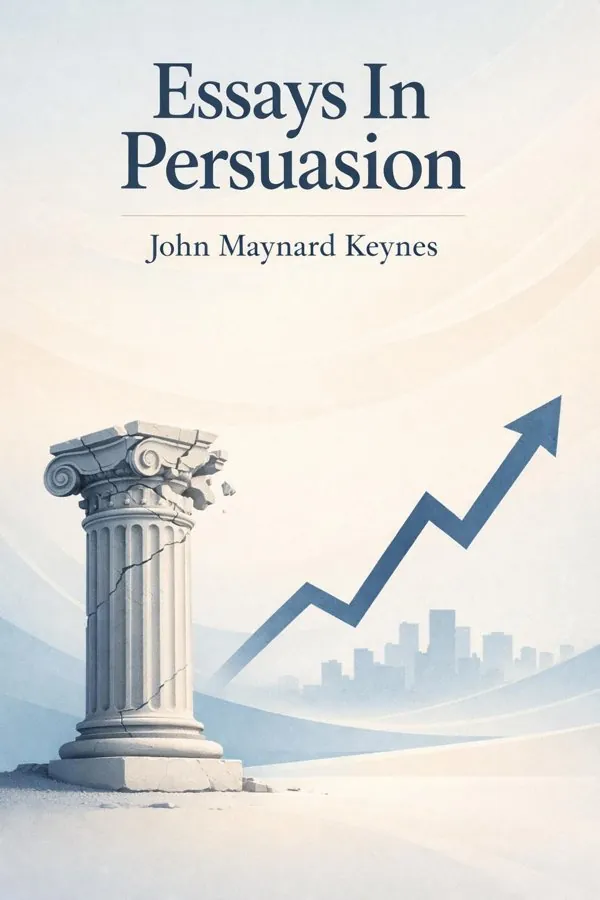
Essays In Persuasion: Summary & Key Insights
 10 min9 chaptersAudio available
What Is Essays In Persuasion About?
Essays In Persuasion by John Maynard Keynes is a economics book spanning 9 pages. Essays in Persuasion is a collection of essays written by the British economist John Maynard Keynes, first published in 1931. The book gathers Keynes’s writings from the 1910s and 1920s, addressing economic and political issues of his time, including the Treaty of Versailles, the Great Depression, and monetary reform. It showcases Keynes’s persuasive style and his efforts to influence public policy and opinion through clear economic reasoning and moral argument.
This FizzRead summary covers all 9 key chapters of Essays In Persuasion in approximately 10 minutes, distilling the most important ideas, arguments, and takeaways from John Maynard Keynes's work. Also available as an audio summary and Key Quotes Podcast.
Essays In Persuasion
Essays in Persuasion is a collection of essays written by the British economist John Maynard Keynes, first published in 1931. The book gathers Keynes’s writings from the 1910s and 1920s, addressing economic and political issues of his time, including the Treaty of Versailles, the Great Depression, and monetary reform. It showcases Keynes’s persuasive style and his efforts to influence public policy and opinion through clear economic reasoning and moral argument.
Who Should Read Essays In Persuasion?
This book is perfect for anyone interested in economics and looking to gain actionable insights in a short read. Whether you're a student, professional, or lifelong learner, the key ideas from Essays In Persuasion by John Maynard Keynes will help you think differently.
- ✓Readers who enjoy economics and want practical takeaways
- ✓Professionals looking to apply new ideas to their work and life
- ✓Anyone who wants the core insights of Essays In Persuasion in just 10 minutes
Want the full summary?
Get instant access to this book summary and 100K+ more with Fizz Moment.
Get Free SummaryAvailable on App Store • Free to download
Key Chapters
When the guns fell silent in 1918, Europe stood on the edge of an abyss. The victors, intoxicated by triumph, sought to extract from Germany a peace founded upon punishment rather than reconciliation. In my essay on the Treaty of Versailles, I argued that this approach did not build peace—it undermined it. The economic clauses of the treaty imposed reparations so vast that they defied both logic and morality. No economy, however industrious, could bear such burdens without collapse. By demanding hundreds of billions in payments, the Allies condemned themselves to future instability, for Europe is not a set of detached nations; it is a living system. When one organ is diseased, the whole body suffers.
I wrote with urgency because I saw what others refused to see: that these negotiations, cloaked in rhetoric about justice and retribution, lacked economic realism. The winning governments sought to appease domestic anger by ensuring that Germany would ‘pay for the war,’ but they failed to understand that impoverishing one nation impoverishes its trading partners. My purpose was not to defend Germany’s actions, but to defend Europe’s future. The war had destroyed capital, disrupted trade routes, and strained social fabrics; peace could have rebuilt them. Instead, the treaty extended the conflict by economic means.
I predicted that the reparations system would breed resentment and political extremism, and history tragically confirmed this. The rise of inflation, unemployment, and authoritarianism in Germany stemmed not merely from internal flaws but from external suffocation. Through these writings, I appealed to policymakers to recognize the interdependence of nations. A stable world order requires mutual prosperity, not imposed misery. By ignoring this, the Versailles settlement became the first step on the long road to another catastrophe.
My reflections on the treaty stand as a plea for intelligence in the making of peace—a reminder that moral indignation must be tempered by economic understanding. If vengeance guides policy, the victors become victims of their own shortsightedness.
Throughout the early 1920s, reparations were more than an economic matter; they were an obsession that distorted the entire international system. In my essays on this subject, I offered precise economic analysis to show that the reparations demanded from Germany were inconsistent with any reasonable capacity to pay. The calculations of those who advocated massive transfers were grounded in neither data nor compassion—they were born of political will.
Germany, struggling under inflation and the loss of productive territories, needed reconstruction, not ruin. Yet, year after year, the discussion focused on extracting payments instead of reconstructing trade. I stressed that the reparations policy turned creditors and debtors into antagonists when both had a stake in recovery. The French sought security, the British sought solvency, and the Germans sought survival. What I urged was a system based on cooperation—a restructuring that recognized industrial realities and the need to restore Europe’s common market.
My argument was not theoretical; it was fundamentally pragmatic. I warned that if reparations were not reduced or reorganized, Germany would experience financial breakdown, leading to hyperinflation and political turmoil. And so it happened. The collapse of the mark, the chaos of unemployment, the erosion of social trust—all were the predictable outcomes of a policy rooted in economic ignorance. The true tragedy was that these effects did not remain confined within Germany’s borders. Every fluctuation in the German economy affected exports, investments, and the entire network of European finance.
Writing from the perspective of 1931, I reflected on how those early warnings might have changed history had they been heeded. The lesson is clear: economic relationships among nations are symbiotic. To design policies that disregard this fact is to court disaster. Reparations ceased to be an instrument of justice; they became an engine of instability. I hoped that by exposing this flaw, I might persuade readers to consider cooperation not as charity but as necessity—the only path forward for a war-torn continent.
+ 7 more chapters — available in the FizzRead app
All Chapters in Essays In Persuasion
About the Author
John Maynard Keynes (1883–1946) was a British economist whose ideas fundamentally changed the theory and practice of macroeconomics and the economic policies of governments. He is best known for his advocacy of government intervention to mitigate the adverse effects of economic recessions and depressions, as articulated in his seminal work, The General Theory of Employment, Interest and Money (1936).
Get This Summary in Your Preferred Format
Read or listen to the Essays In Persuasion summary by John Maynard Keynes anytime, anywhere. FizzRead offers multiple formats so you can learn on your terms — all free.
Available formats: App · Audio · PDF · EPUB — All included free with FizzRead
Download Essays In Persuasion PDF and EPUB Summary
Key Quotes from Essays In Persuasion
“When the guns fell silent in 1918, Europe stood on the edge of an abyss.”
“Throughout the early 1920s, reparations were more than an economic matter; they were an obsession that distorted the entire international system.”
Frequently Asked Questions about Essays In Persuasion
Essays In Persuasion by John Maynard Keynes is a economics book that explores key ideas across 9 chapters. Essays in Persuasion is a collection of essays written by the British economist John Maynard Keynes, first published in 1931. The book gathers Keynes’s writings from the 1910s and 1920s, addressing economic and political issues of his time, including the Treaty of Versailles, the Great Depression, and monetary reform. It showcases Keynes’s persuasive style and his efforts to influence public policy and opinion through clear economic reasoning and moral argument.
More by John Maynard Keynes

You Might Also Like

Business Adventures
John Brooks
10 min
Nudge
Richard H. Thaler, Cass R. Sunstein
10 min
The Hitchhiker"s Guide to the Galaxy
Douglas Adams
10 minThe Muqaddimah
Ibn Khaldun
10 minThe Outsiders
William N. Thorndike
10 min
A Little History of Economics
Niall Kishtainy
10 minBrowse by Category
Ready to read Essays In Persuasion?
Get the full summary and 100K+ more books with Fizz Moment.