
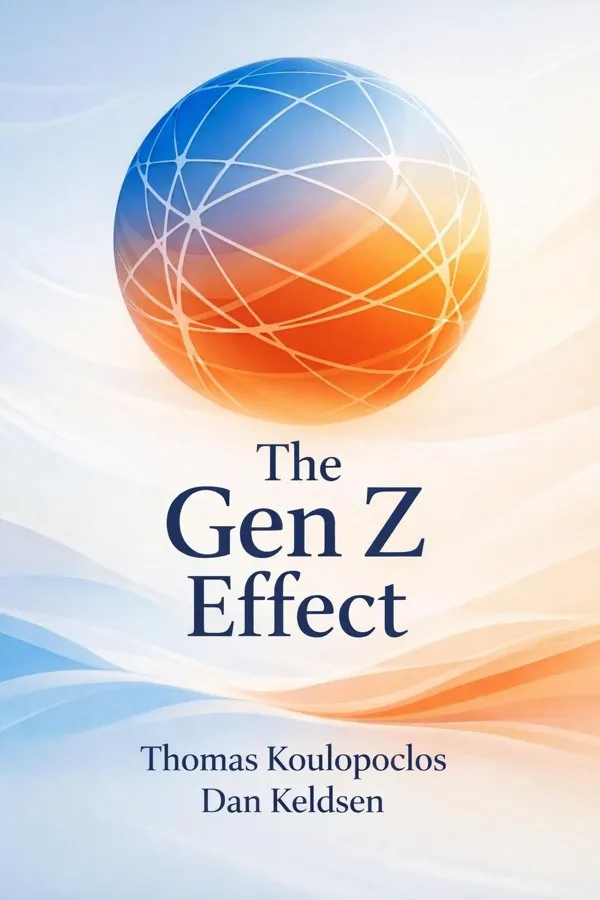
The Gen Z Effect: The Six Forces Shaping the Future of Business: Summary & Key Insights
by Thomas Koulopoulos, Dan Keldsen
 10 min9 chaptersAudio available
Key Takeaways from The Gen Z Effect: The Six Forces Shaping the Future of Business
What if the biggest generational shift is not that Gen Z is different, but that generations themselves matter less than they used to?
The modern world is no longer merely connected; it is continuously, instantly, and globally entangled.
Economic power is shifting from those with the biggest resources to those who can move the fastest with the least friction.
In the digital era, the ability to shape attention and trust can matter more than traditional wealth or status.
When knowledge becomes abundant, the real challenge is no longer access to information but the ability to learn continuously, filter wisely, and apply insight quickly.
What Is The Gen Z Effect: The Six Forces Shaping the Future of Business About?
The Gen Z Effect: The Six Forces Shaping the Future of Business by Thomas Koulopoulos, Dan Keldsen is a future_trends book spanning 8 pages. The Gen Z Effect argues that the youngest digital-native generation is not simply another age cohort moving through a familiar cycle. Instead, Thomas Koulopoulos and Dan Keldsen show that Gen Z is accelerating a deeper transformation in how business, education, leadership, innovation, and technology work. The book identifies six powerful forces reshaping the future: collapsing generational boundaries, global hyper-connectivity, a new slingshot economy, the rise of influence over affluence, the disruption of education, and the growing humanization of technology. Together, these forces explain why old assumptions about work, markets, and organizational design are rapidly losing relevance. What makes the book especially valuable is that it treats Gen Z less as a demographic category and more as a signal of systemic change. Koulopoulos, founder of the innovation-focused Delphi Group, and strategist Dan Keldsen bring strong credibility to the topic through decades of work in digital transformation and emerging business models. Their message is urgent but practical: organizations that understand these shifts can adapt and thrive, while those that cling to industrial-era habits risk becoming obsolete.
This FizzRead summary covers all 9 key chapters of The Gen Z Effect: The Six Forces Shaping the Future of Business in approximately 10 minutes, distilling the most important ideas, arguments, and takeaways from Thomas Koulopoulos, Dan Keldsen's work. Also available as an audio summary and Key Quotes Podcast.
The Gen Z Effect: The Six Forces Shaping the Future of Business
The Gen Z Effect argues that the youngest digital-native generation is not simply another age cohort moving through a familiar cycle. Instead, Thomas Koulopoulos and Dan Keldsen show that Gen Z is accelerating a deeper transformation in how business, education, leadership, innovation, and technology work. The book identifies six powerful forces reshaping the future: collapsing generational boundaries, global hyper-connectivity, a new slingshot economy, the rise of influence over affluence, the disruption of education, and the growing humanization of technology. Together, these forces explain why old assumptions about work, markets, and organizational design are rapidly losing relevance. What makes the book especially valuable is that it treats Gen Z less as a demographic category and more as a signal of systemic change. Koulopoulos, founder of the innovation-focused Delphi Group, and strategist Dan Keldsen bring strong credibility to the topic through decades of work in digital transformation and emerging business models. Their message is urgent but practical: organizations that understand these shifts can adapt and thrive, while those that cling to industrial-era habits risk becoming obsolete.
Who Should Read The Gen Z Effect: The Six Forces Shaping the Future of Business?
This book is perfect for anyone interested in future_trends and looking to gain actionable insights in a short read. Whether you're a student, professional, or lifelong learner, the key ideas from The Gen Z Effect: The Six Forces Shaping the Future of Business by Thomas Koulopoulos, Dan Keldsen will help you think differently.
- ✓Readers who enjoy future_trends and want practical takeaways
- ✓Professionals looking to apply new ideas to their work and life
- ✓Anyone who wants the core insights of The Gen Z Effect: The Six Forces Shaping the Future of Business in just 10 minutes
Want the full summary?
Get instant access to this book summary and 100K+ more with Fizz Moment.
Get Free SummaryAvailable on App Store • Free to download
Key Chapters
What if the biggest generational shift is not that Gen Z is different, but that generations themselves matter less than they used to? Koulopoulos and Keldsen argue that the traditional model of neatly separated generations is breaking down. In the past, culture, media, education, and work changed slowly enough that each age group developed distinct attitudes based on shared experiences. Today, technology compresses those differences. A teenager, a manager in mid-career, and a retiree can all use the same platforms, access the same information, and participate in the same cultural conversations in real time.
This collapse of generations matters because many business assumptions still depend on outdated segmentation. Companies continue to market, recruit, and design products as if age determines behavior. But digital fluency, adaptability, curiosity, and network participation often matter more than birth year. A 55-year-old entrepreneur who lives online may behave more like a Gen Z consumer than a 22-year-old with limited digital engagement.
In the workplace, this means organizations must stop relying on stereotypes such as “young people want flexibility” or “older workers resist change.” Instead, leaders should focus on mindset, not age. Cross-generational teams can become more effective when companies build around shared tools, transparent communication, and continuous learning rather than hierarchy.
A practical example is social commerce. Brands that assume only younger users care about creator-driven recommendations miss the growing number of older consumers who also discover products through TikTok, YouTube, or niche online communities. The same pattern applies to remote work, gaming, AI tools, and digital payments.
Actionable takeaway: replace age-based assumptions with behavior-based strategy. Segment customers and employees by habits, values, and digital engagement, not just by generation labels.
The modern world is no longer merely connected; it is continuously, instantly, and globally entangled. The authors present hyper-connectivity as the infrastructure behind the Gen Z effect. Billions of people now carry devices that link them to markets, media, knowledge, communities, and one another at all times. This is not just a communication shift. It changes how ideas spread, how trust forms, how products scale, and how crises unfold.
In a hyper-connected environment, distance matters less, speed matters more, and gatekeepers lose power. A student can learn from experts across the world, a small brand can reach a global audience without a physical store, and a customer complaint can become a public reputational issue within hours. The same networks that empower innovation also amplify volatility.
For business, this means strategy must account for constant feedback loops. Marketing is no longer a one-way broadcast. Product development is no longer confined to internal teams. Customer experience is no longer local. Hyper-connectivity rewards organizations that listen, respond, and iterate quickly.
Consider how a niche product can explode through online communities. A startup selling an eco-friendly accessory may gain traction not through expensive advertising but through a chain reaction of reviews, reposts, and influencer mentions across different countries. At the same time, one poor design decision can be widely documented and criticized just as fast.
This force also changes competition. Your rivals are no longer just firms in your region or industry. Any connected player who solves a problem better, faster, or more transparently can attract your customers.
Actionable takeaway: build your organization for real-time responsiveness. Monitor digital signals closely, shorten feedback cycles, and treat connectivity as a core operating condition, not a marketing channel.
Economic power is shifting from those with the biggest resources to those who can move the fastest with the least friction. The authors call this the slingshot economy: a world in which individuals and small organizations can launch themselves far beyond their apparent size using digital tools, networks, and low-cost platforms. Like a slingshot, small players can achieve disproportionate impact when tension, timing, and leverage align.
This challenges the old belief that scale is always the greatest advantage. Large companies still possess capital, brand recognition, and distribution, but they also carry bureaucracy, legacy systems, and slower decision-making. Meanwhile, startups, freelancers, creators, and small teams can test ideas, gather audiences, and monetize quickly. Cloud computing, e-commerce platforms, crowdfunding, AI tools, and remote collaboration make it easier than ever to compete without traditional infrastructure.
The slingshot economy also changes careers. People no longer need to follow a rigid path through institutions to create value. A teenager can launch a digital product, build an audience, or start a service business from a laptop. A professional can turn expertise into courses, consulting, or software. Economic opportunity becomes more distributed, though also less predictable.
For established organizations, the lesson is not to fear every startup but to understand the conditions that allow nimble competitors to flourish. Many industries are vulnerable because incumbents optimize for efficiency while newcomers optimize for experimentation. The companies that survive combine scale with startup-like speed.
A practical application is internal entrepreneurship. Instead of forcing every idea through slow approval chains, companies can create micro-teams with clear budgets, short testing windows, and direct access to customers.
Actionable takeaway: reduce the cost of experimentation. Whether you are an individual or an enterprise, create structures that allow small bets, fast learning, and rapid scaling when something works.
In the digital era, the ability to shape attention and trust can matter more than traditional wealth or status. One of the book’s most important insights is the shift from affluence to influence. In earlier business models, advantage often came from owning scarce assets: factories, shelf space, capital, or media access. Today, influence can unlock many of those outcomes without requiring massive resources upfront.
Gen Z understands this intuitively because they grew up in ecosystems where creators, reviewers, community leaders, and niche experts often hold more persuasive power than formal institutions. A recommendation from a trusted online personality can outperform a major advertising campaign. A loyal community can help a small brand outcompete a larger one. Reputation has become more fluid, more visible, and more participatory.
This does not mean money no longer matters. It means that capital by itself is less decisive if an organization cannot earn credibility, attention, and engagement. Influence is created through authenticity, relevance, responsiveness, and shared values. Brands that try to manufacture it through empty messaging often fail because connected audiences can quickly detect inconsistency.
For businesses, this changes how value is built. Marketing, customer support, product quality, leadership behavior, and social impact now feed into a single public narrative. Every employee and customer can contribute to or weaken a company’s influence.
A practical example is direct-to-consumer brands that grow through transparent storytelling, community feedback, and creator partnerships rather than massive media budgets. The same principle applies to employers: companies with strong influence attract talent because people trust their mission and culture.
Actionable takeaway: invest in trust-building, not just visibility. Measure influence through community engagement, advocacy, and credibility, and align your actions with the story you want others to tell about you.
When knowledge becomes abundant, the real challenge is no longer access to information but the ability to learn continuously, filter wisely, and apply insight quickly. The book argues that education is undergoing a profound disruption because the old model was built for scarcity. Schools and universities once served as primary gateways to knowledge, credentials, and career preparation. But digital networks have opened alternative routes to learning that are faster, cheaper, and often more aligned with real-world needs.
For Gen Z, education is less likely to be viewed as a one-time phase ending in early adulthood. It becomes an ongoing process of skill acquisition, experimentation, and adaptation. Online courses, peer communities, tutorials, bootcamps, creators, workplace learning platforms, and AI-driven tools all compete with traditional institutions. Credentials still matter, but demonstrable capability increasingly matters more.
This has major implications for business. Employers can no longer assume that a degree alone predicts performance. At the same time, they cannot rely on formal education systems to produce all the skills they need. Organizations must become active learning environments where employees reskill continuously. This is especially important in fields affected by automation, analytics, software, and changing customer expectations.
A practical example is hiring for portfolios, projects, and problem-solving ability rather than filtering candidates only by school pedigree. Another is replacing annual training programs with modular, on-demand learning tied directly to evolving business priorities.
The disruption of education also expands opportunity. Motivated learners can build careers without following traditional elite pathways, though they must take more responsibility for directing their own growth.
Actionable takeaway: treat learning as a permanent operating system. Whether leading a company or building a career, create habits and structures for continuous, skill-based development rather than relying solely on formal credentials.
The next great technological advantage will not come from making systems more machine-like, but from making them more human-centered. Koulopoulos and Keldsen describe a shift toward the humanization of technology: tools increasingly adapt to people rather than forcing people to adapt to tools. Interfaces become simpler, personalization grows more sophisticated, and technology blends into daily life in more natural ways.
This matters because earlier generations of technology often demanded technical literacy, patience, and conformity. Users had to learn the machine. Gen Z expects the opposite. They assume technology should be intuitive, immediate, and responsive. If an app is confusing, a service feels cold, or a system creates friction, they move on. This expectation is spreading across all age groups as digital experiences improve.
Humanized technology is not only about design elegance. It also includes empathy, accessibility, trust, and ethics. AI, automation, and data systems can create enormous value, but only if people understand them, feel respected by them, and believe they are being used responsibly. When technology becomes alienating or opaque, adoption suffers and backlash grows.
In practice, organizations should design around real user behavior. A bank might replace jargon-heavy interfaces with conversational guidance. A hospital might use digital tools that reduce stress for patients rather than merely optimizing internal workflows. A company implementing AI might focus on augmenting employees instead of making them feel disposable.
The deeper point is that technology now competes on emotional experience as much as on functionality. The companies that win are those that combine efficiency with empathy.
Actionable takeaway: evaluate every technology decision through a human lens. Ask not only whether a system works, but whether it is understandable, trustworthy, inclusive, and genuinely helpful.
The future does not punish size; it punishes rigidity. One of the book’s strongest practical messages is that organizations built for stability struggle in an environment defined by rapid shifts in technology, expectations, and competition. Traditional hierarchies often assume that leaders at the top gather information, make plans, and push decisions downward. But in a world shaped by Gen Z forces, knowledge is widely distributed, change happens quickly, and customers can redefine markets almost overnight.
This means organizational design must evolve. Companies need flatter communication, faster decision cycles, stronger cross-functional collaboration, and more openness to external ideas. Innovation can no longer sit in a separate department while the rest of the company preserves the status quo. Adaptability must become a core capability.
Culture is central here. Employees at every level need permission to question assumptions, share information, and test improvements. Leaders should reward learning and responsiveness, not just compliance. The old model of control through information scarcity breaks down when everyone can access data, expertise, and competitive signals in real time.
A practical example is product development. Instead of long, isolated planning cycles, adaptive organizations use shorter iterations with customer feedback built into each phase. Another is talent management: rather than defining rigid job roles, companies create fluid teams that can reconfigure around opportunities and problems.
The organizational implications extend beyond process. They affect office design, digital infrastructure, communication norms, and leadership style. If a company says it values agility but still requires endless approvals and punishes mistakes, it remains trapped in an outdated model.
Actionable takeaway: audit your organization for friction. Identify where decisions stall, information gets trapped, or experimentation is discouraged, and redesign those areas to support speed, transparency, and learning.
In a world of empowered networks, the leader’s role is no longer to command the future into existence but to create conditions in which people can discover it. The authors suggest that Gen Z-era leadership demands a major mindset shift. Industrial-age leadership prized authority, predictability, and top-down planning. But today’s environment is too fast-moving and too interconnected for any single leader to possess all the answers.
Effective leaders now act more like architects of possibility than supervisors of routine. They set direction, define principles, remove barriers, and help teams make sense of complexity. This is especially important when leading digitally native employees who expect transparency, autonomy, and purpose. They are less likely to respond well to status-based authority and more likely to engage when they understand why their work matters.
This leadership model also requires comfort with uncertainty. Instead of waiting for perfect information, leaders must make provisional decisions, learn publicly, and adapt quickly. They need the humility to listen across age groups and functions, and the discipline to avoid confusing confidence with certainty.
A practical example is strategy communication. Rather than presenting a rigid five-year blueprint, a strong leader may frame a clear mission, identify near-term priorities, and invite teams to surface signals from customers and markets that could reshape the plan. Another is talent development: enablement-focused leaders coach employees to build judgment, not just execute instructions.
The result is a more resilient organization because intelligence is distributed rather than centralized. People closest to the problem can respond faster and more creatively.
Actionable takeaway: lead by creating clarity, context, and capability. Spend less time trying to control every outcome and more time empowering people to act intelligently in changing conditions.
The easiest way to misunderstand this book is to treat Gen Z as just another consumer segment to target with new branding. The authors’ deeper point is that Gen Z represents a leading indicator of broader systemic change. Their behaviors reflect what happens when people grow up in a world of permanent connectivity, abundant information, fluid identities, and accessible digital tools. What appears youthful today often becomes mainstream tomorrow.
This is why the Gen Z effect reaches far beyond youth marketing. It affects hiring, product design, education, media, customer expectations, innovation cycles, and corporate legitimacy. Businesses that treat Gen Z as a temporary trend may miss the larger transformation unfolding across society. The real issue is not how to “appeal to young people,” but how to operate in a world where the norms Gen Z takes for granted increasingly shape everyone’s expectations.
For example, transparency is not a youth preference; it is becoming a general requirement in connected markets. Seamless digital experiences are not a niche demand; they are becoming baseline expectations across age groups. Lifelong learning, creator-led influence, remote collaboration, and personalized technology are all expanding beyond Gen Z itself.
Seen this way, Gen Z functions like an early warning system for business strategy. Studying their habits helps leaders anticipate future standards before they become universal. That makes the book valuable even for organizations whose current customers or employees skew older.
Actionable takeaway: use Gen Z as a lens for scenario planning. Ask which of their behaviors signal future mainstream expectations, and begin adapting your products, processes, and culture before the market forces you to.
All Chapters in The Gen Z Effect: The Six Forces Shaping the Future of Business
About the Authors
Thomas Koulopoulos is a business thinker, author, and founder of Delphi Group, a Boston-based innovation and strategy firm focused on the future of business, technology, and organizational change. He is widely known for helping leaders understand disruption and rethink how companies adapt in fast-moving markets. Dan Keldsen is a strategist, consultant, and writer specializing in digital transformation, emerging technologies, and the ways connected systems reshape work and customer behavior. Together, they bring decades of experience analyzing how innovation changes industries, institutions, and human expectations. In The Gen Z Effect, they combine technological insight with practical business strategy, offering a forward-looking view of how generational change signals broader shifts in leadership, education, value creation, and competitive advantage.
Get This Summary in Your Preferred Format
Read or listen to the The Gen Z Effect: The Six Forces Shaping the Future of Business summary by Thomas Koulopoulos, Dan Keldsen anytime, anywhere. FizzRead offers multiple formats so you can learn on your terms — all free.
Available formats: App · Audio · PDF · EPUB — All included free with FizzRead
Download The Gen Z Effect: The Six Forces Shaping the Future of Business PDF and EPUB Summary
Key Quotes from The Gen Z Effect: The Six Forces Shaping the Future of Business
“What if the biggest generational shift is not that Gen Z is different, but that generations themselves matter less than they used to?”
“The modern world is no longer merely connected; it is continuously, instantly, and globally entangled.”
“Economic power is shifting from those with the biggest resources to those who can move the fastest with the least friction.”
“In the digital era, the ability to shape attention and trust can matter more than traditional wealth or status.”
“When knowledge becomes abundant, the real challenge is no longer access to information but the ability to learn continuously, filter wisely, and apply insight quickly.”
Frequently Asked Questions about The Gen Z Effect: The Six Forces Shaping the Future of Business
The Gen Z Effect: The Six Forces Shaping the Future of Business by Thomas Koulopoulos, Dan Keldsen is a future_trends book that explores key ideas across 9 chapters. The Gen Z Effect argues that the youngest digital-native generation is not simply another age cohort moving through a familiar cycle. Instead, Thomas Koulopoulos and Dan Keldsen show that Gen Z is accelerating a deeper transformation in how business, education, leadership, innovation, and technology work. The book identifies six powerful forces reshaping the future: collapsing generational boundaries, global hyper-connectivity, a new slingshot economy, the rise of influence over affluence, the disruption of education, and the growing humanization of technology. Together, these forces explain why old assumptions about work, markets, and organizational design are rapidly losing relevance. What makes the book especially valuable is that it treats Gen Z less as a demographic category and more as a signal of systemic change. Koulopoulos, founder of the innovation-focused Delphi Group, and strategist Dan Keldsen bring strong credibility to the topic through decades of work in digital transformation and emerging business models. Their message is urgent but practical: organizations that understand these shifts can adapt and thrive, while those that cling to industrial-era habits risk becoming obsolete.
You Might Also Like
Futureproof: 9 Rules for Humans in the Age of Automation
Kevin Roose
10 min
The Third Wave
Alvin Toffler
10 min
2030: How Today's Biggest Trends Will Collide and Reshape the Future of Everything
Mauro F. Guillén
10 min
A Very Human Future: Enriching Humanity in a Digitized World
Rohit Talwar, Steve Wells, Alexandra Whittington
10 min
AI 2041: Ten Visions for Our Future
Kai-Fu Lee, Chen Qiufan
10 min
Abundance: The Future Is Better Than You Think
Peter H. Diamandis, Steven Kotler
10 minBrowse by Category
Ready to read The Gen Z Effect: The Six Forces Shaping the Future of Business?
Get the full summary and 100K+ more books with Fizz Moment.