
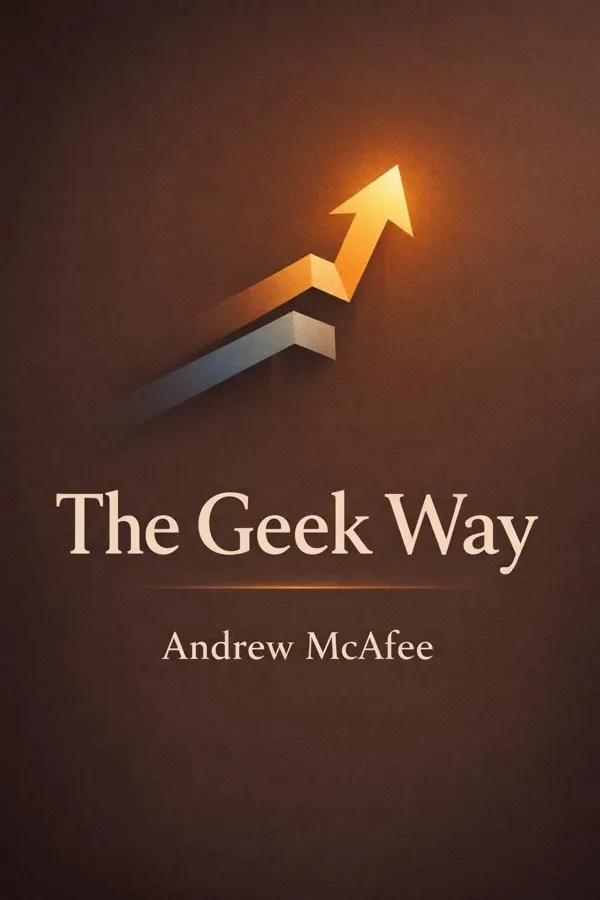
The Geek Way: The Radical Mindset That Drives Extraordinary Results: Summary & Key Insights
 10 min9 chaptersAudio available
Key Takeaways from The Geek Way: The Radical Mindset That Drives Extraordinary Results
One of the most radical shifts in modern management is simple: the highest-paid opinion should no longer automatically win.
When the future is unclear, certainty becomes a liability.
In fast-moving environments, delay can be more dangerous than error.
An organization cannot learn quickly if people are afraid to speak honestly.
Extraordinary performance rarely comes from one brilliant breakthrough.
What Is The Geek Way: The Radical Mindset That Drives Extraordinary Results About?
The Geek Way: The Radical Mindset That Drives Extraordinary Results by Andrew McAfee is a leadership book. In The Geek Way, Andrew McAfee argues that the most successful organizations of the modern era do not win because they are bigger, older, or more polished. They win because they think differently. McAfee uses the term “geek” not as an insult, but as a compliment: geeks are people and organizations that prize evidence over hierarchy, experimentation over certainty, speed over bureaucracy, and improvement over ego. In a world shaped by rapid technological change, unstable competition, and constant disruption, these habits are no longer optional. They are becoming the new operating system for high performance. Drawing on research, business history, and examples from companies such as Amazon, Google, Netflix, and SpaceX, McAfee shows how a geek mindset produces extraordinary results across industries. He also explains why many traditional institutions struggle to adopt these practices, even when the evidence is overwhelming. As a principal research scientist at MIT and a leading voice on technology and organizational change, McAfee brings both scholarly rigor and practical insight. The book matters because it offers leaders a clear framework for building organizations that learn faster, adapt better, and outperform rivals in uncertain times.
This FizzRead summary covers all 9 key chapters of The Geek Way: The Radical Mindset That Drives Extraordinary Results in approximately 10 minutes, distilling the most important ideas, arguments, and takeaways from Andrew McAfee's work. Also available as an audio summary and Key Quotes Podcast.
The Geek Way: The Radical Mindset That Drives Extraordinary Results
In The Geek Way, Andrew McAfee argues that the most successful organizations of the modern era do not win because they are bigger, older, or more polished. They win because they think differently. McAfee uses the term “geek” not as an insult, but as a compliment: geeks are people and organizations that prize evidence over hierarchy, experimentation over certainty, speed over bureaucracy, and improvement over ego. In a world shaped by rapid technological change, unstable competition, and constant disruption, these habits are no longer optional. They are becoming the new operating system for high performance.
Drawing on research, business history, and examples from companies such as Amazon, Google, Netflix, and SpaceX, McAfee shows how a geek mindset produces extraordinary results across industries. He also explains why many traditional institutions struggle to adopt these practices, even when the evidence is overwhelming. As a principal research scientist at MIT and a leading voice on technology and organizational change, McAfee brings both scholarly rigor and practical insight. The book matters because it offers leaders a clear framework for building organizations that learn faster, adapt better, and outperform rivals in uncertain times.
Who Should Read The Geek Way: The Radical Mindset That Drives Extraordinary Results?
This book is perfect for anyone interested in leadership and looking to gain actionable insights in a short read. Whether you're a student, professional, or lifelong learner, the key ideas from The Geek Way: The Radical Mindset That Drives Extraordinary Results by Andrew McAfee will help you think differently.
- ✓Readers who enjoy leadership and want practical takeaways
- ✓Professionals looking to apply new ideas to their work and life
- ✓Anyone who wants the core insights of The Geek Way: The Radical Mindset That Drives Extraordinary Results in just 10 minutes
Want the full summary?
Get instant access to this book summary and 100K+ more with Fizz Moment.
Get Free SummaryAvailable on App Store • Free to download
Key Chapters
One of the most radical shifts in modern management is simple: the highest-paid opinion should no longer automatically win. McAfee argues that geek organizations thrive because they move authority away from rank and toward evidence. In traditional institutions, seniority, titles, and political skill often determine which ideas survive. In geek cultures, ideas compete on their merits, and data becomes the referee.
This change matters because hierarchy is often a poor substitute for truth. Leaders may be experienced, but they are still vulnerable to bias, overconfidence, and blind spots. When markets move quickly, relying on instinct alone becomes dangerous. Geek organizations therefore build systems that force claims to be tested. They ask: What does the evidence say? What happened in the experiment? What can users tell us? Which version actually performed better?
McAfee points to technology firms that routinely use A/B testing, metrics dashboards, and postmortems to learn what works. But the principle applies far beyond software. A retailer can test store layouts before rolling them out widely. A hospital can compare care protocols and monitor outcomes. A school can evaluate teaching interventions using measurable results instead of tradition.
The challenge is cultural as much as technical. People often attach identity to their ideas. When evidence contradicts them, they feel personally threatened. Geek organizations normalize being wrong. They treat disconfirmation as progress, not humiliation. That creates intellectual honesty, which leads to better decisions over time.
The practical lesson is to redesign decision-making so evidence has a structural advantage. Ask teams to define success metrics in advance, run small tests before making big commitments, and review results openly. Actionable takeaway: in your next important decision, replace debate about opinions with a process that gathers and compares real evidence.
When the future is unclear, certainty becomes a liability. McAfee argues that the geek way is deeply scientific: it treats the world as something to be investigated, not assumed. Instead of pretending to know what customers want, what strategy will work, or what feature will succeed, geek organizations build hypotheses and test them quickly.
This mindset matters because uncertainty has become the norm. Markets shift unexpectedly, technologies evolve fast, and customer preferences change with little warning. In such environments, long planning cycles and rigid forecasts often create false confidence. Science offers a better model. It begins with a question, designs a test, collects evidence, and updates beliefs. It makes learning an operating discipline rather than an occasional event.
McAfee highlights how organizations like Amazon and Netflix use experimentation to discover better answers than executives could predict in conference rooms. They do not rely solely on broad strategic declarations. They run controlled tests on pricing, interface design, recommendations, logistics, and internal processes. The result is continuous adaptation.
This approach can help any leader. A nonprofit can test fundraising messages. A manufacturer can pilot workflow changes in one facility before wider expansion. A public agency can experiment with service delivery improvements in a single district. Scientific thinking is not confined to laboratories; it is a disciplined way of reducing costly guesswork.
The biggest barrier is often emotional. Leaders are rewarded for confidence, not curiosity. Yet the most capable organizations admit what they do not know and build mechanisms to find out. That humility becomes a strategic advantage.
Actionable takeaway: identify one important assumption your team is currently treating as fact, then convert it into a testable hypothesis with a clear experiment, timeline, and success metric.
In fast-moving environments, delay can be more dangerous than error. McAfee shows that geek organizations outperform not because they avoid mistakes, but because they learn and adjust faster than competitors. They understand that waiting for the perfect plan often means missing the moment entirely.
Traditional organizations often prize polish, approval chains, and exhaustive analysis. These habits can reduce visible mistakes, but they also slow reaction time. By the time a proposal is fully vetted, market conditions may have changed. Geek cultures instead favor rapid iteration. They launch, observe, refine, and relaunch. Their advantage comes from cycle time: how quickly they can move from idea to feedback to improvement.
This is visible in software development, where products can be updated continuously. But the principle extends more broadly. A consumer brand can launch limited releases to gauge response. A service business can test a new onboarding process with one customer segment. A city government can pilot a transit adjustment in one corridor before a full rollout. Speed does not mean recklessness; it means creating manageable experiments that generate learning quickly.
McAfee emphasizes that perfectionism often hides fear. Teams worry about criticism, reputational damage, or internal politics. Yet releasing nothing is also a choice, and often the worse one. Geek organizations build resilience by treating early versions as part of the learning process.
Leaders can support this by setting shorter planning horizons, reducing unnecessary approvals, and distinguishing between reversible and irreversible decisions. Reversible decisions should move fast. Irreversible ones deserve greater care.
Actionable takeaway: choose one initiative that has been stalled by over-analysis and ask, “What is the smallest useful version we can test this month?” Then execute it and learn from the results.
An organization cannot learn quickly if people are afraid to speak honestly. McAfee argues that one of the hidden foundations of the geek way is psychological safety: the shared belief that people can question, challenge, admit mistakes, and present uncomfortable facts without being punished or humiliated.
This is essential because truth is often inconvenient. Engineers may know a product is not ready. Frontline employees may see customer problems leadership is missing. Analysts may detect evidence that contradicts the CEO’s strategy. In fearful cultures, these signals stay buried. People protect themselves by staying quiet, softening criticism, or telling superiors what they want to hear. The organization then pays a high price for fake harmony.
Geek organizations create conditions where candor becomes normal. Postmortems focus on what happened, not on assigning blame. Questions are welcomed across rank. Strong arguments are valued even when they disrupt consensus. This does not mean everyone is endlessly nice; many geek cultures are intense and demanding. But they make room for intellectual honesty.
The practical impact is enormous. Teams with psychological safety catch problems sooner, share knowledge more freely, and recover faster from failure. In healthcare, this can mean nurses raising concerns before a preventable error occurs. In aviation, it can mean crew members challenging a dangerous assumption. In business, it can mean confronting weak product-market fit before a major launch wastes millions.
Leaders shape this climate through small signals. Do they react defensively when challenged? Do they punish bad news? Do they publicly admit their own mistakes? People watch these cues closely.
Actionable takeaway: in your next team meeting, explicitly ask for disconfirming evidence or concerns, thank those who raise them, and respond with curiosity rather than defensiveness.
Extraordinary performance rarely comes from one brilliant breakthrough. More often, it emerges from relentless, incremental improvement. McAfee shows that geek organizations excel because they are obsessed with getting a little better all the time. They do not assume success is permanent, and they do not treat established processes as sacred.
This constant-improvement mentality creates a compounding advantage. A tiny enhancement in product design, customer service, hiring, logistics, or pricing may seem insignificant in isolation. But when an organization makes hundreds or thousands of such improvements each year, the cumulative effect becomes enormous. Competitors who move occasionally cannot keep up with a system that improves continuously.
A key part of this mindset is measurement. You cannot improve what you never examine. Geek organizations instrument their work. They gather feedback, track key metrics, and notice deviations early. They also separate ego from process. If a better method appears, they are willing to replace the old one, even if it was once considered excellent.
This approach applies in every sector. A restaurant can refine table turnover, menu layout, and online ordering. A university can improve advising workflows and course completion rates. A manufacturing firm can reduce downtime by tracking process variation and learning from near misses. The principle is not glamorous, but it is powerful.
Many organizations say they value improvement while preserving habits that block it. They celebrate innovation rhetorically yet punish disruption operationally. McAfee’s point is that improvement must be built into daily routines, not reserved for special initiatives.
Actionable takeaway: establish one recurring improvement ritual, such as a weekly review of a key process or customer pain point, and require the team to implement at least one small upgrade each cycle.
Harmony can feel productive, but it often produces weak thinking. McAfee argues that geek organizations benefit from vigorous debate because disagreement surfaces flaws, sharpens reasoning, and prevents bad ideas from passing unchallenged. The goal is not conflict for its own sake. It is the pursuit of better decisions through intellectual friction.
In many organizations, disagreement is suppressed. Employees fear appearing difficult. Managers avoid tension to preserve morale. Executives interpret pushback as disloyalty. The result is artificial consensus, where questionable assumptions go untested and strategic mistakes become more likely. Geek cultures take a different view: strong ideas should survive scrutiny, and weak ones should not be protected by politeness.
This dynamic is visible in high-performing technical environments where design reviews, code reviews, and product critiques are rigorous. People are expected to defend their reasoning with facts, logic, and evidence. But the underlying principle extends beyond engineering. A marketing team can challenge campaign assumptions before launch. A board can force clearer thinking by interrogating strategic narratives. A startup can hold pre-mortems to imagine why a plan might fail.
Healthy debate requires rules. It should focus on ideas, not status or identity. Participants need shared facts, clear decision rights, and a norm that once a decision is made, the team aligns behind it. Without these guardrails, debate can turn into politics or paralysis.
Leaders play a crucial role by inviting dissent, rewarding well-founded objections, and refusing to equate agreement with loyalty. When people know they can challenge ideas safely, the organization becomes smarter.
Actionable takeaway: before finalizing your next major decision, assign someone to argue the strongest case against it and require the team to address that critique explicitly.
Technology alone does not create great organizations, but it can dramatically strengthen the geek way. McAfee shows that digital tools make it easier to test ideas, collect evidence, share information, coordinate work, and improve systems at scale. In other words, technology amplifies a mindset that is already committed to learning and adaptation.
Consider what digital systems make possible. A company can run thousands of product experiments simultaneously, measure customer behavior in real time, and update services continuously. Teams can collaborate across locations, access common dashboards, and spot emerging issues quickly. Machine learning can improve forecasting, recommendations, and anomaly detection. These capabilities reduce guesswork and shorten the distance between action and feedback.
But McAfee is careful not to romanticize technology by itself. Many organizations invest heavily in digital platforms while keeping old habits intact. They install dashboards but ignore the data. They deploy collaboration tools but preserve rigid silos. They collect customer feedback but do not change decisions. In these cases, technology becomes expensive decoration.
The real value appears when tools support geek norms: experimentation, transparency, speed, and evidence-based decision-making. A sales organization can use CRM data to test outreach approaches rather than relying on folklore. A logistics team can use sensor data to detect bottlenecks and improve routing. A school system can use learning platforms to identify where students struggle and adjust instruction.
Technology should serve inquiry, not vanity. The question is not whether your organization has the latest tools, but whether those tools help people learn and improve faster.
Actionable takeaway: audit one digital system your organization already uses and ask whether it genuinely improves experimentation, visibility, or decision quality; if not, redesign the workflow before buying another tool.
The strongest leaders are not the ones who appear infallible. McAfee argues that the geek way depends on leaders who model intellectual humility: the willingness to admit uncertainty, revise beliefs, and prioritize truth over ego. This is radical because many institutions still reward confidence theater more than honest learning.
Humility matters because culture often mirrors leadership behavior. If a leader acts as though they must always be right, subordinates will hide disagreement, filter bad news, and protect the leader’s narrative. But when leaders openly say, “I may be wrong,” “What am I missing?” or “Let’s test that,” they legitimize inquiry. They make it safe for others to surface information that improves outcomes.
This does not mean leaders should be indecisive or weak. Geek leadership combines conviction with revisability. A leader can make bold bets while remaining open to evidence that those bets need adjustment. That combination is powerful: clear direction without dogmatism.
In practice, humility can be visible in several ways. Leaders can publish decision rationales and revisit them later. They can conduct after-action reviews that include their own choices. They can ask junior employees to critique plans. They can reward people who identify errors early, even when those errors are inconvenient.
The opposite style may seem commanding in the short term, but it usually creates brittle organizations. When reality changes, arrogant systems adapt slowly because acknowledging error feels too costly. Humble systems learn faster.
Actionable takeaway: choose one recent decision you made, publicly review what you expected versus what happened, and name one lesson you would apply differently next time.
Perhaps the most important claim in McAfee’s book is that the geek way is not limited to Silicon Valley. It is not reserved for coders, startups, or elite technology companies. It is a general approach to organizing human effort in a complex world, and its principles can be adapted across industries, sectors, and institution types.
This broader relevance matters because many readers may admire companies like Amazon, Google, or SpaceX while assuming their own setting is too regulated, too traditional, or too human-centered for geek practices. McAfee rejects that excuse. While not every method transfers directly, the core mindset does: respect evidence, run experiments, encourage candor, improve relentlessly, and stay open to revision.
A government agency can test policy delivery rather than relying entirely on precedent. A hospital can use checklists, data review, and candid error analysis to improve patient outcomes. A law firm can measure turnaround time, client experience, and workflow bottlenecks instead of accepting established habits as fixed. Even highly regulated environments can create pilot programs, feedback loops, and learning systems.
The main obstacles are usually not external. They are internal: status hierarchies, fear of embarrassment, attachment to legacy methods, and a belief that professionalism means certainty. McAfee’s message is that extraordinary results become possible when organizations challenge those assumptions.
Adopting the geek way does not require copying tech culture’s quirks. It requires embracing its most productive disciplines. The question is not whether your organization looks like a tech company. It is whether it learns like one.
Actionable takeaway: identify one area of your organization where tradition dominates practice, then introduce a geek-style experiment, metric, or review process to begin shifting from assumption to evidence.
All Chapters in The Geek Way: The Radical Mindset That Drives Extraordinary Results
About the Author
Andrew McAfee is a principal research scientist at the MIT Sloan School of Management and a widely recognized expert on the effects of digital technology on business and society. His work focuses on how organizations adapt to rapid technological change, how management practices evolve, and why some institutions thrive while others fall behind. McAfee is the author and coauthor of several influential books, including The Second Machine Age and Machine, Platform, Crowd, which helped shape conversations about automation, platforms, and the digital economy. Known for combining rigorous research with accessible explanation, he writes for leaders who want practical insight grounded in evidence. In The Geek Way, McAfee applies that perspective to organizational culture, leadership, and the habits that drive exceptional performance.
Get This Summary in Your Preferred Format
Read or listen to the The Geek Way: The Radical Mindset That Drives Extraordinary Results summary by Andrew McAfee anytime, anywhere. FizzRead offers multiple formats so you can learn on your terms — all free.
Available formats: App · Audio · PDF · EPUB — All included free with FizzRead
Download The Geek Way: The Radical Mindset That Drives Extraordinary Results PDF and EPUB Summary
Key Quotes from The Geek Way: The Radical Mindset That Drives Extraordinary Results
“One of the most radical shifts in modern management is simple: the highest-paid opinion should no longer automatically win.”
“When the future is unclear, certainty becomes a liability.”
“In fast-moving environments, delay can be more dangerous than error.”
“An organization cannot learn quickly if people are afraid to speak honestly.”
“Extraordinary performance rarely comes from one brilliant breakthrough.”
Frequently Asked Questions about The Geek Way: The Radical Mindset That Drives Extraordinary Results
The Geek Way: The Radical Mindset That Drives Extraordinary Results by Andrew McAfee is a leadership book that explores key ideas across 9 chapters. In The Geek Way, Andrew McAfee argues that the most successful organizations of the modern era do not win because they are bigger, older, or more polished. They win because they think differently. McAfee uses the term “geek” not as an insult, but as a compliment: geeks are people and organizations that prize evidence over hierarchy, experimentation over certainty, speed over bureaucracy, and improvement over ego. In a world shaped by rapid technological change, unstable competition, and constant disruption, these habits are no longer optional. They are becoming the new operating system for high performance. Drawing on research, business history, and examples from companies such as Amazon, Google, Netflix, and SpaceX, McAfee shows how a geek mindset produces extraordinary results across industries. He also explains why many traditional institutions struggle to adopt these practices, even when the evidence is overwhelming. As a principal research scientist at MIT and a leading voice on technology and organizational change, McAfee brings both scholarly rigor and practical insight. The book matters because it offers leaders a clear framework for building organizations that learn faster, adapt better, and outperform rivals in uncertain times.
More by Andrew McAfee

Leading Digital: Turning Technology into Business Transformation
George Westerman, Didier Bonnet, Andrew McAfee
10 min
Machine, Platform, Crowd: Harnessing Our Digital Future
Andrew McAfee, Erik Brynjolfsson
10 min
The Second Machine Age: Work, Progress, and Prosperity in a Time of Brilliant Technologies
Erik Brynjolfsson, Andrew McAfee
10 minYou Might Also Like

Extreme Ownership
Jocko Willink
10 min
Dare to Lead
Brene Brown
10 min
Leaders Eat Last
Simon Sinek
10 min
The 21 Irrefutable Laws of Leadership
John Maxwell
10 min
Start With Why
Simon Sinek
10 min
How to Lead When You're Not in Charge
Clay Scroggins
10 minBrowse by Category
Ready to read The Geek Way: The Radical Mindset That Drives Extraordinary Results?
Get the full summary and 100K+ more books with Fizz Moment.