
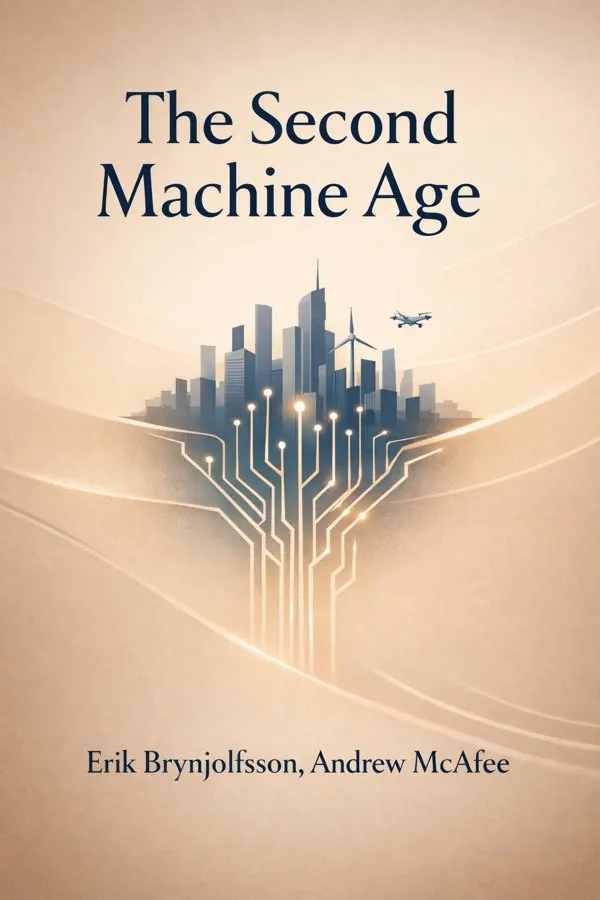
The Second Machine Age: Work, Progress, and Prosperity in a Time of Brilliant Technologies: Summary & Key Insights
by Erik Brynjolfsson, Andrew McAfee
 10 min5 chaptersAudio available
What Is The Second Machine Age: Work, Progress, and Prosperity in a Time of Brilliant Technologies About?
The Second Machine Age: Work, Progress, and Prosperity in a Time of Brilliant Technologies by Erik Brynjolfsson, Andrew McAfee is a economics book spanning 5 pages. In this influential work, MIT scholars Erik Brynjolfsson and Andrew McAfee explore how digital technologies are reshaping economies, societies, and the nature of work. They argue that we are entering a 'second machine age' driven by exponential advances in computing, automation, and artificial intelligence, which will bring both unprecedented prosperity and significant challenges for labor and inequality.
This FizzRead summary covers all 5 key chapters of The Second Machine Age: Work, Progress, and Prosperity in a Time of Brilliant Technologies in approximately 10 minutes, distilling the most important ideas, arguments, and takeaways from Erik Brynjolfsson, Andrew McAfee's work. Also available as an audio summary and Key Quotes Podcast.
The Second Machine Age: Work, Progress, and Prosperity in a Time of Brilliant Technologies
In this influential work, MIT scholars Erik Brynjolfsson and Andrew McAfee explore how digital technologies are reshaping economies, societies, and the nature of work. They argue that we are entering a 'second machine age' driven by exponential advances in computing, automation, and artificial intelligence, which will bring both unprecedented prosperity and significant challenges for labor and inequality.
Who Should Read The Second Machine Age: Work, Progress, and Prosperity in a Time of Brilliant Technologies?
This book is perfect for anyone interested in economics and looking to gain actionable insights in a short read. Whether you're a student, professional, or lifelong learner, the key ideas from The Second Machine Age: Work, Progress, and Prosperity in a Time of Brilliant Technologies by Erik Brynjolfsson, Andrew McAfee will help you think differently.
- ✓Readers who enjoy economics and want practical takeaways
- ✓Professionals looking to apply new ideas to their work and life
- ✓Anyone who wants the core insights of The Second Machine Age: Work, Progress, and Prosperity in a Time of Brilliant Technologies in just 10 minutes
Want the full summary?
Get instant access to this book summary and 100K+ more with Fizz Moment.
Get Free SummaryAvailable on App Store • Free to download
Key Chapters
When we speak of the second machine age, we are not speaking in metaphors. We truly are in a new epoch of technological progress, one driven not by the engines of steam but by the engines of computation. The hallmark of this transformation is exponential growth: a doubling pattern of improvement that compounds year after year. Moore’s Law—the observation that computing power roughly doubles every eighteen months—has held true for decades, and its implications are staggering. What begins slowly soon accelerates beyond human intuition.
During the first machine age, change unfolded at the pace of infrastructure—railways, factories, power grids. But digital technologies evolve on a different scale: bits replicate faster than atoms. This is why innovations that once seemed like science fiction—speech recognition, driverless cars, and machine translation—now move rapidly into our daily experience. Exponential growth explains the surprises we constantly encounter when old industries are abruptly redefined by a new algorithm or a smarter machine.
The significance of this shift lies in its universality. Digital technologies are general-purpose, meaning they affect nearly every sector and process. Once information can be digitized, its cost of distribution plummets and its potential multiplies. This is why productivity numbers, despite some measurement lag, began to surge in sectors that adopted digital tools. The second machine age is not confined to technology firms; it permeates retail, healthcare, education, and manufacturing.
Recognizing the exponential character of digital progress allows us to prepare for the unexpected. It also helps explain why traditional forecasts often fail—because they assume linear change. In truth, we have reached the inflection point of the curve where the progress of technology outpaces our capacity to adjust. The challenge now is not invention but adaptation, not creating more tools but learning how to live—and work—with them wisely.
At the core of today’s transformation are remarkable advances in artificial intelligence, robotics, and networked computing—technologies that extend not only what machines can do but what humans can achieve. When we observed IBM’s Watson defeating champions at Jeopardy! or Google’s autonomous vehicles navigating city streets, we were witnessing a milestone: the first time digital systems demonstrated genuine judgment in complex, unstructured environments.
These breakthroughs matter because they point toward a new partnership between humans and machines. Digital tools are no longer just instruments of automation; they are engines of augmentation. They amplify our cognitive capacities, allowing a designer, doctor, or researcher to reach insights that would have been unattainable alone. We have entered an age where expertise is increasingly symbiotic—where the best performances come not from human or machine in isolation, but from their collaboration.
This synergy has broad implications for productivity and creativity. A radiologist with AI support can detect disease earlier and more accurately. An entrepreneur can deploy global-scale algorithms without a corporate empire. Yet, the same technologies that empower can also disrupt. Tasks that required specialized human judgment—driving trucks, performing legal reviews, writing news briefs—are now being mastered by digital systems. The pattern is consistent: technologies that complement human strengths raise value; those that substitute for human labor reduce demand.
The digital network serves as the backbone for this revolution. Connectivity transforms isolated innovations into ecosystems of shared intelligence. The internet of things, cloud computing, and machine learning are interlocking parts of a single digital organism, and each advance feeds the next. Understanding this dynamic is crucial because it shapes how economies scale. The old boundaries of industry and geography dissolve as digital power spreads through code. This is why we call it a second machine age—it represents not just new tools but a new logic of collective capability.
+ 3 more chapters — available in the FizzRead app
All Chapters in The Second Machine Age: Work, Progress, and Prosperity in a Time of Brilliant Technologies
About the Authors
Erik Brynjolfsson is a professor at MIT Sloan School of Management and director of the MIT Initiative on the Digital Economy. Andrew McAfee is a principal research scientist at MIT and co-director of the same initiative. Both are leading voices in the study of technology’s impact on business and society.
Get This Summary in Your Preferred Format
Read or listen to the The Second Machine Age: Work, Progress, and Prosperity in a Time of Brilliant Technologies summary by Erik Brynjolfsson, Andrew McAfee anytime, anywhere. FizzRead offers multiple formats so you can learn on your terms — all free.
Available formats: App · Audio · PDF · EPUB — All included free with FizzRead
Download The Second Machine Age: Work, Progress, and Prosperity in a Time of Brilliant Technologies PDF and EPUB Summary
Key Quotes from The Second Machine Age: Work, Progress, and Prosperity in a Time of Brilliant Technologies
“When we speak of the second machine age, we are not speaking in metaphors.”
“When we observed IBM’s Watson defeating champions at Jeopardy!”
Frequently Asked Questions about The Second Machine Age: Work, Progress, and Prosperity in a Time of Brilliant Technologies
The Second Machine Age: Work, Progress, and Prosperity in a Time of Brilliant Technologies by Erik Brynjolfsson, Andrew McAfee is a economics book that explores key ideas across 5 chapters. In this influential work, MIT scholars Erik Brynjolfsson and Andrew McAfee explore how digital technologies are reshaping economies, societies, and the nature of work. They argue that we are entering a 'second machine age' driven by exponential advances in computing, automation, and artificial intelligence, which will bring both unprecedented prosperity and significant challenges for labor and inequality.
You Might Also Like

Business Adventures
John Brooks
10 min
Nudge
Richard H. Thaler, Cass R. Sunstein
10 min
The Hitchhiker"s Guide to the Galaxy
Douglas Adams
10 minThe Muqaddimah
Ibn Khaldun
10 minThe Outsiders
William N. Thorndike
10 min
A Little History of Economics
Niall Kishtainy
10 minBrowse by Category
Ready to read The Second Machine Age: Work, Progress, and Prosperity in a Time of Brilliant Technologies?
Get the full summary and 100K+ more books with Fizz Moment.