
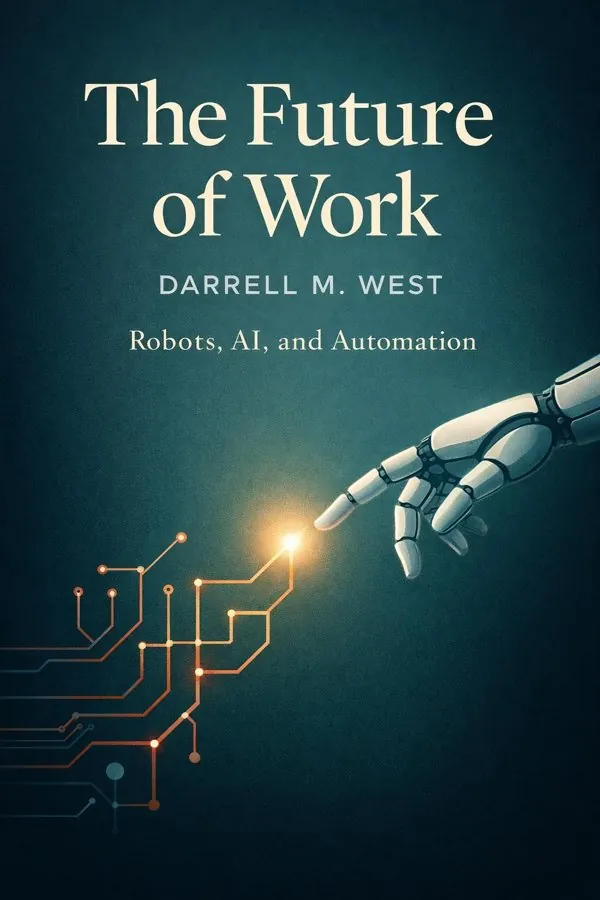
The Future of Work: Robots, AI, and Automation: Summary & Key Insights
 10 min8 chaptersAudio available
What Is The Future of Work: Robots, AI, and Automation About?
The Future of Work: Robots, AI, and Automation by Darrell M. West is a future_trends book spanning 8 pages. In this book, Darrell M. West explores how artificial intelligence, robotics, and automation are transforming employment, productivity, and social structures. He examines the implications for workers, businesses, and governments, offering policy recommendations to manage technological disruption and ensure equitable outcomes in the evolving labor market.
This FizzRead summary covers all 8 key chapters of The Future of Work: Robots, AI, and Automation in approximately 10 minutes, distilling the most important ideas, arguments, and takeaways from Darrell M. West's work. Also available as an audio summary and Key Quotes Podcast.
The Future of Work: Robots, AI, and Automation
In this book, Darrell M. West explores how artificial intelligence, robotics, and automation are transforming employment, productivity, and social structures. He examines the implications for workers, businesses, and governments, offering policy recommendations to manage technological disruption and ensure equitable outcomes in the evolving labor market.
Who Should Read The Future of Work: Robots, AI, and Automation?
This book is perfect for anyone interested in future_trends and looking to gain actionable insights in a short read. Whether you're a student, professional, or lifelong learner, the key ideas from The Future of Work: Robots, AI, and Automation by Darrell M. West will help you think differently.
- ✓Readers who enjoy future_trends and want practical takeaways
- ✓Professionals looking to apply new ideas to their work and life
- ✓Anyone who wants the core insights of The Future of Work: Robots, AI, and Automation in just 10 minutes
Want the full summary?
Get instant access to this book summary and 100K+ more with Fizz Moment.
Get Free SummaryAvailable on App Store • Free to download
Key Chapters
When we talk about automation, we must stand on the shoulders of history. The story of technological change is a human story—of disruption, adaptation, and ultimately reinvention. In earlier industrial revolutions, machines replaced labor but also created entire new industries. The steam engine displaced manual transport yet enabled modern logistics and manufacturing. Electricity automated production but also expanded the scope of human creativity and leisure. Information technologies reduced clerical tasks but opened vast opportunities in services and digital entrepreneurship.
From this perspective, it becomes clear that technological change does not destroy work—it transforms it. What matters is how we respond. In the nineteenth century, societies that embraced education and infrastructure prospered, while those that resisted fell behind. The same pattern is repeating now. Automation today moves faster and affects more sectors simultaneously than ever before. The pace of change strains traditional systems of education, labor policy, and welfare. Governments accustomed to regulating static industries must learn to govern fluid algorithms. Workers, too, must evolve—not simply by acquiring technical skills but by cultivating adaptability, emotional intelligence, and lifelong learning.
Historically, labor markets have been resilient when people were given pathways to new skills and a sense of inclusion. The challenge now is scale and speed. Digital platforms can upend entire sectors overnight; artificial intelligence can replace human judgment in minutes. These forces amplify inequality if we fail to update our social compact. Learning from history, therefore, means committing to continuous adaptation. The Industrial Revolution rewarded curiosity and innovation. The digital revolution will require the same virtues—magnified and institutionalized.
In the present landscape, artificial intelligence acts as the new electricity—quietly penetrating every industry, every workflow, every decision chain. Machine learning systems process vast datasets to detect patterns, anticipate behavior, and optimize performance. Robotics merges mechanical power with cognitive intelligence, turning machines into collaborators rather than mere instruments. In manufacturing, robots build and inspect with precision that minimizes waste. In healthcare, AI assists in diagnosis and personalized treatment. In retail and logistics, algorithms predict demand, manage inventory, and even determine the prices you see online.
Automation is not confined to blue-collar jobs; it increasingly affects white-collar professions. Lawyers rely on AI for document review, journalists use algorithms to filter data, and financial analysts depend on machine learning to forecast markets. The defining quality of this era is convergence—where data, connectivity, and learning systems unite to reshape both production and knowledge work.
These technologies promise efficiency but also raise disquieting questions about agency. Who controls the algorithms that now mediate our decisions? How transparent are they? A world where machines know us better than we know ourselves alters power dynamics between individuals, corporations, and governments. Understanding these trends requires both technical literacy and ethical awareness. The more embedded technology becomes in our lives, the more vital it is to anchor it in human-centered design. My argument throughout this chapter is clear: automation is inevitable, but inequality and alienation are not. Our capacity to choose the direction of innovation remains intact if we seize it.
+ 6 more chapters — available in the FizzRead app
All Chapters in The Future of Work: Robots, AI, and Automation
About the Author
Darrell M. West is a senior fellow at the Brookings Institution, where he studies technology policy, innovation, and governance. He has authored several books on the intersection of technology and society, focusing on how digital transformation affects politics, economics, and public life.
Get This Summary in Your Preferred Format
Read or listen to the The Future of Work: Robots, AI, and Automation summary by Darrell M. West anytime, anywhere. FizzRead offers multiple formats so you can learn on your terms — all free.
Available formats: App · Audio · PDF · EPUB — All included free with FizzRead
Download The Future of Work: Robots, AI, and Automation PDF and EPUB Summary
Key Quotes from The Future of Work: Robots, AI, and Automation
“When we talk about automation, we must stand on the shoulders of history.”
“In the present landscape, artificial intelligence acts as the new electricity—quietly penetrating every industry, every workflow, every decision chain.”
Frequently Asked Questions about The Future of Work: Robots, AI, and Automation
The Future of Work: Robots, AI, and Automation by Darrell M. West is a future_trends book that explores key ideas across 8 chapters. In this book, Darrell M. West explores how artificial intelligence, robotics, and automation are transforming employment, productivity, and social structures. He examines the implications for workers, businesses, and governments, offering policy recommendations to manage technological disruption and ensure equitable outcomes in the evolving labor market.
You Might Also Like
Futureproof: 9 Rules for Humans in the Age of Automation
Kevin Roose
10 min
The Third Wave
Alvin Toffler
10 min
2030: How Today's Biggest Trends Will Collide and Reshape the Future of Everything
Mauro F. Guillén
10 min
A Very Human Future: Enriching Humanity in a Digitized World
Rohit Talwar, Steve Wells, Alexandra Whittington
10 min
AI 2041: Ten Visions for Our Future
Kai-Fu Lee, Chen Qiufan
10 min
Abundance: The Future Is Better Than You Think
Peter H. Diamandis, Steven Kotler
10 minBrowse by Category
Ready to read The Future of Work: Robots, AI, and Automation?
Get the full summary and 100K+ more books with Fizz Moment.