
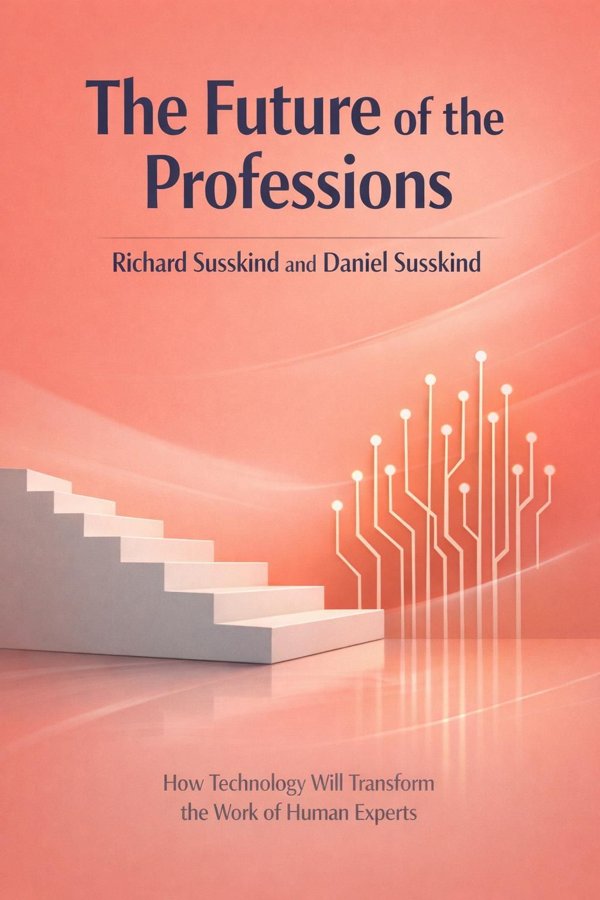
The Future of the Professions: How Technology Will Transform the Work of Human Experts: Summary & Key Insights
by Richard Susskind, Daniel Susskind
 10 min7 chaptersAudio available
What Is The Future of the Professions: How Technology Will Transform the Work of Human Experts About?
The Future of the Professions: How Technology Will Transform the Work of Human Experts by Richard Susskind and Daniel Susskind is a future_trends book spanning 7 pages. This book explores how technology, particularly artificial intelligence and automation, is transforming the traditional professions such as law, medicine, education, and accounting. The authors argue that the roles of human experts will be redefined as machines and systems increasingly perform tasks once reserved for professionals. They outline two possible futures: one where professionals use technology to work more efficiently, and another where technology replaces many professional roles entirely.
This FizzRead summary covers all 7 key chapters of The Future of the Professions: How Technology Will Transform the Work of Human Experts in approximately 10 minutes, distilling the most important ideas, arguments, and takeaways from Richard Susskind and Daniel Susskind's work. Also available as an audio summary and Key Quotes Podcast.
The Future of the Professions: How Technology Will Transform the Work of Human Experts
This book explores how technology, particularly artificial intelligence and automation, is transforming the traditional professions such as law, medicine, education, and accounting. The authors argue that the roles of human experts will be redefined as machines and systems increasingly perform tasks once reserved for professionals. They outline two possible futures: one where professionals use technology to work more efficiently, and another where technology replaces many professional roles entirely.
Who Should Read The Future of the Professions: How Technology Will Transform the Work of Human Experts?
This book is perfect for anyone interested in future_trends and looking to gain actionable insights in a short read. Whether you're a student, professional, or lifelong learner, the key ideas from The Future of the Professions: How Technology Will Transform the Work of Human Experts by Richard Susskind and Daniel Susskind will help you think differently.
- ✓Readers who enjoy future_trends and want practical takeaways
- ✓Professionals looking to apply new ideas to their work and life
- ✓Anyone who wants the core insights of The Future of the Professions: How Technology Will Transform the Work of Human Experts in just 10 minutes
Want the full summary?
Get instant access to this book summary and 100K+ more with Fizz Moment.
Get Free SummaryAvailable on App Store • Free to download
Key Chapters
To understand where we are heading, we must remember how we arrived here. The professions emerged as society’s mechanism for managing specialized knowledge. Long before the internet or globalized education, information was scarce, and expertise resided in the minds of a few. Professions developed to regulate access to that knowledge. They built institutions—guilds, colleges, licensing boards—that ensured trust, competence, and social legitimacy.
This historical model rested on two pillars: information asymmetry and moral assurance. The public, unable to assess complex matters of law or medicine, relied on professionals to act in their best interest. In exchange for exclusivity and respect, professionals were expected to uphold ethical standards. This system produced enormous social benefits: safer surgeries, fairer trials, more reliable financial systems. But it also created barriers—high costs, limited access, and monopolistic tendencies. For centuries, this was tolerated as necessary for quality assurance. Today, digital technologies eat away at these foundations by making information abundant and accessible.
Thus, the professions’ historical legitimacy—derived from scarcity of expertise—is undermined. The challenge before us is how to preserve the social goods of professionalism—competence, trust, accountability—when knowledge becomes democratized and machine-mediated.
The real catalyst of change is not discontent with professionals but the relentless evolution of technology. Richard Susskind’s earlier work on the future of law foreshadowed this: systems that once only supported professionals now start to replace them in specific tasks. The book identifies several technological forces—automation, artificial intelligence, online knowledge systems, crowdsourced expertise, and big data—all converging to transform how knowledge is produced and consumed.
Crucially, we distinguish between automation and innovation. Automation is about doing traditional tasks more efficiently with machines. Innovation, however, is about reimagining those tasks entirely. When hospitals introduce diagnostic algorithms, we are not simply speeding up tests—we are redefining what it means to diagnose. When online education platforms reach millions, they erode the notion of academic exclusivity. The result is a new division of labor: some parts of professional work remain deeply human, but a growing portion migrates to systems that operate faster, cheaper, and sometimes more reliably.
These technologies render obsolete the romantic idea of the solitary expert drawing on unique knowledge. Instead, expertise becomes embedded in systems—algorithms, databases, and communities that share insight globally. For every domain touched by technology, the consequences ripple outward, challenging institutions to rethink their identities and roles.
+ 5 more chapters — available in the FizzRead app
All Chapters in The Future of the Professions: How Technology Will Transform the Work of Human Experts
About the Authors
Richard Susskind is a British author, speaker, and independent adviser to major professional firms and governments, specializing in the future of professional services and the impact of technology. Daniel Susskind is a Fellow in Economics at Balliol College, Oxford, and a researcher focusing on technology, work, and inequality.
Get This Summary in Your Preferred Format
Read or listen to the The Future of the Professions: How Technology Will Transform the Work of Human Experts summary by Richard Susskind and Daniel Susskind anytime, anywhere. FizzRead offers multiple formats so you can learn on your terms — all free.
Available formats: App · Audio · PDF · EPUB — All included free with FizzRead
Download The Future of the Professions: How Technology Will Transform the Work of Human Experts PDF and EPUB Summary
Key Quotes from The Future of the Professions: How Technology Will Transform the Work of Human Experts
“To understand where we are heading, we must remember how we arrived here.”
“The real catalyst of change is not discontent with professionals but the relentless evolution of technology.”
Frequently Asked Questions about The Future of the Professions: How Technology Will Transform the Work of Human Experts
The Future of the Professions: How Technology Will Transform the Work of Human Experts by Richard Susskind and Daniel Susskind is a future_trends book that explores key ideas across 7 chapters. This book explores how technology, particularly artificial intelligence and automation, is transforming the traditional professions such as law, medicine, education, and accounting. The authors argue that the roles of human experts will be redefined as machines and systems increasingly perform tasks once reserved for professionals. They outline two possible futures: one where professionals use technology to work more efficiently, and another where technology replaces many professional roles entirely.
You Might Also Like
Futureproof: 9 Rules for Humans in the Age of Automation
Kevin Roose
10 min
The Third Wave
Alvin Toffler
10 min
2030: How Today's Biggest Trends Will Collide and Reshape the Future of Everything
Mauro F. Guillén
10 min
A Very Human Future: Enriching Humanity in a Digitized World
Rohit Talwar, Steve Wells, Alexandra Whittington
10 min
AI 2041: Ten Visions for Our Future
Kai-Fu Lee, Chen Qiufan
10 min
Abundance: The Future Is Better Than You Think
Peter H. Diamandis, Steven Kotler
10 minBrowse by Category
Ready to read The Future of the Professions: How Technology Will Transform the Work of Human Experts?
Get the full summary and 100K+ more books with Fizz Moment.