
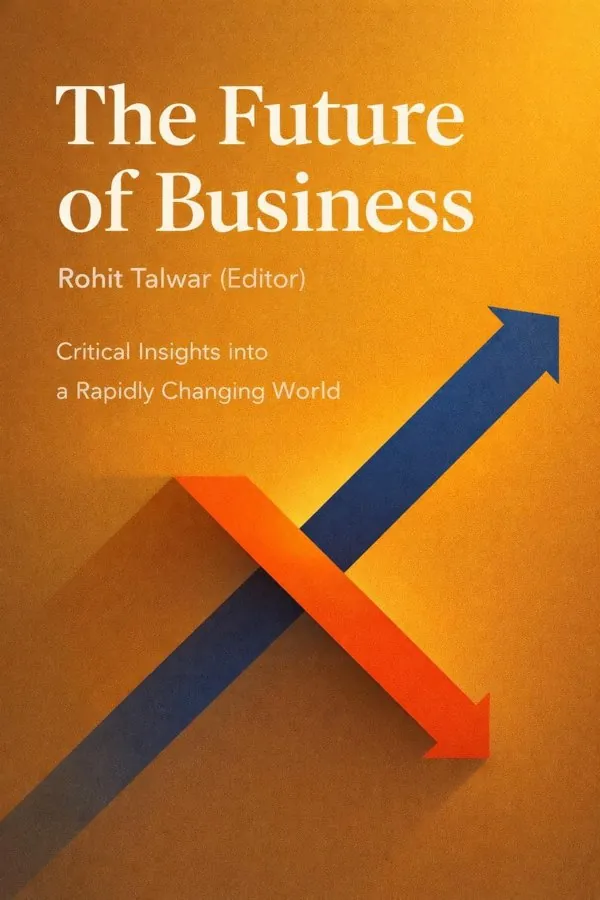
The Future of Business: Critical Insights into a Rapidly Changing World: Summary & Key Insights
 10 min8 chaptersAudio available
Key Takeaways from The Future of Business: Critical Insights into a Rapidly Changing World
The most dangerous assumption in business is that technology only changes tools, when in reality it changes power.
The result is a world where competitive threats and growth opportunities can emerge from unexpected places.
Markets change when people change, and one of the book’s most compelling arguments is that shifting social values are now a major driver of business transformation.
Sustainability is often discussed as a moral obligation, but this book makes a stronger claim: in the future, it will also be a test of business viability.
In a volatile world, leadership is less about having the right answers and more about asking the right questions early enough.
What Is The Future of Business: Critical Insights into a Rapidly Changing World About?
The Future of Business: Critical Insights into a Rapidly Changing World by Rohit Talwar (Editor) is a future_trends book spanning 5 pages. The Future of Business: Critical Insights into a Rapidly Changing World examines what happens when technological disruption, economic volatility, social change, and environmental pressure collide. Rather than treating the future as a distant abstraction, this book brings together perspectives from futurists, academics, and business leaders to show how change is already reshaping strategy, leadership, work, and competition. It explores the rise of artificial intelligence, automation, biotechnology, blockchain, and other transformative forces, while also addressing the human questions they raise: how organizations should adapt, what customers will expect, and what responsible leadership looks like in uncertain times. What makes the book especially valuable is its broad lens. It does not present the future as a single prediction, but as a set of plausible shifts that businesses must prepare for now. Rohit Talwar, a respected futurist and founder of Fast Future Publishing, is well known for helping leaders understand emerging trends and their practical implications. As editor, he assembles a diverse range of voices into a coherent guide for navigating complexity. The result is a thoughtful, provocative overview for anyone trying to build a resilient business in an age of rapid transformation.
This FizzRead summary covers all 8 key chapters of The Future of Business: Critical Insights into a Rapidly Changing World in approximately 10 minutes, distilling the most important ideas, arguments, and takeaways from Rohit Talwar (Editor)'s work. Also available as an audio summary and Key Quotes Podcast.
The Future of Business: Critical Insights into a Rapidly Changing World
The Future of Business: Critical Insights into a Rapidly Changing World examines what happens when technological disruption, economic volatility, social change, and environmental pressure collide. Rather than treating the future as a distant abstraction, this book brings together perspectives from futurists, academics, and business leaders to show how change is already reshaping strategy, leadership, work, and competition. It explores the rise of artificial intelligence, automation, biotechnology, blockchain, and other transformative forces, while also addressing the human questions they raise: how organizations should adapt, what customers will expect, and what responsible leadership looks like in uncertain times.
What makes the book especially valuable is its broad lens. It does not present the future as a single prediction, but as a set of plausible shifts that businesses must prepare for now. Rohit Talwar, a respected futurist and founder of Fast Future Publishing, is well known for helping leaders understand emerging trends and their practical implications. As editor, he assembles a diverse range of voices into a coherent guide for navigating complexity. The result is a thoughtful, provocative overview for anyone trying to build a resilient business in an age of rapid transformation.
Who Should Read The Future of Business: Critical Insights into a Rapidly Changing World?
This book is perfect for anyone interested in future_trends and looking to gain actionable insights in a short read. Whether you're a student, professional, or lifelong learner, the key ideas from The Future of Business: Critical Insights into a Rapidly Changing World by Rohit Talwar (Editor) will help you think differently.
- ✓Readers who enjoy future_trends and want practical takeaways
- ✓Professionals looking to apply new ideas to their work and life
- ✓Anyone who wants the core insights of The Future of Business: Critical Insights into a Rapidly Changing World in just 10 minutes
Want the full summary?
Get instant access to this book summary and 100K+ more with Fizz Moment.
Get Free SummaryAvailable on App Store • Free to download
Key Chapters
The most dangerous assumption in business is that technology only changes tools, when in reality it changes power. In this book, emerging technologies are presented not as isolated innovations but as interconnected forces that are redefining industries from the ground up. Artificial intelligence improves prediction and decision-making, robotics expands automation beyond factories, 3D printing shortens supply chains, blockchain reshapes trust and verification, and biotechnology opens new frontiers in health, food, and materials. Together, these advances alter cost structures, customer expectations, and the speed at which new entrants can challenge established players.
A central insight is that technology is no longer a support function. It is becoming the architecture of business itself. For example, AI can help retailers forecast demand more precisely, reducing waste and improving profitability. In finance, blockchain-based systems can streamline transactions and cut reliance on intermediaries. In manufacturing, 3D printing enables rapid prototyping and localized production, allowing firms to customize products faster and more cheaply. Even sectors once considered resistant to disruption, such as healthcare or professional services, are being reshaped by data-driven tools and intelligent systems.
The book also warns against passive observation. Organizations that wait for technologies to mature before paying attention often discover that faster competitors have already captured market share, talent, and customer trust. Leaders do not need to adopt every new technology immediately, but they do need a disciplined process for scanning, testing, and evaluating what matters.
Actionable takeaway: Build a technology radar for your organization and identify two or three emerging tools that could meaningfully improve efficiency, customer value, or business model innovation within the next three years.
The global economy no longer moves in neat cycles that businesses can predict with confidence; it behaves more like a living network shaped by shocks, interdependence, and shifting centers of influence. The book highlights how globalization, digital platforms, geopolitical tensions, new consumer markets, and rising entrepreneurial ecosystems are redistributing power across regions and industries. The result is a world where competitive threats and growth opportunities can emerge from unexpected places.
One important theme is that traditional assumptions about scale and market dominance are weakening. Digital businesses can grow globally with relatively low physical infrastructure, while smaller firms can reach niche audiences through platforms, data, and ecosystem partnerships. At the same time, large companies face heightened fragility because their operations depend on global supply chains, regulatory stability, and access to data. A disruption in one region can now ripple quickly through production, pricing, labor availability, and customer demand elsewhere.
The book encourages readers to think beyond familiar market categories. Growth may come from emerging economies, new middle-class populations, decentralized workforces, or entirely new forms of value exchange enabled by digital ecosystems. Consider how payment startups have transformed access to financial services in regions where legacy banking was weak, or how platform companies create global reach without owning traditional infrastructure. Economic leadership increasingly belongs to those who can adapt fastest to changing networks of value.
The deeper lesson is that businesses must monitor macroeconomic signals, policy changes, and ecosystem dynamics together rather than in isolation. Competitive advantage depends not only on internal excellence but also on understanding how the surrounding system is evolving.
Actionable takeaway: Review your business model through a global lens and identify one new region, platform, or partnership model that could reduce dependence on a single market or revenue source.
Markets change when people change, and one of the book’s most compelling arguments is that shifting social values are now a major driver of business transformation. Consumers, employees, investors, and communities increasingly expect organizations to demonstrate purpose, inclusivity, transparency, and social awareness. Profit still matters, but it is no longer enough on its own to secure loyalty or legitimacy. Businesses are being judged not just by what they sell, but by how they behave.
The book explores how demographic change, urbanization, digital connectivity, and rising social consciousness are redefining expectations. Younger generations, in particular, often care deeply about ethical sourcing, diversity, environmental responsibility, and brand authenticity. Employees want meaningful work, flexible arrangements, and leaders who communicate clearly about values. Customers can now amplify praise or criticism instantly through social media, making reputation both more valuable and more vulnerable.
Practical implications are everywhere. A company designing new products must think about accessibility and inclusion from the beginning, not as an afterthought. Employers competing for talent may need to offer hybrid work, continuous learning, and stronger well-being support. Brands that claim a social mission must back it up with measurable action, because empty messaging is quickly exposed. The book suggests that social change is not separate from strategy; it is increasingly central to market relevance.
This does not mean chasing every cultural trend. It means developing a real understanding of the communities you serve and recognizing that trust is built through consistency between words and actions. Businesses that ignore social expectations may still survive for a time, but they risk becoming increasingly out of touch.
Actionable takeaway: Audit whether your customer experience, hiring practices, and brand messaging genuinely reflect the values your stakeholders now care about most.
Sustainability is often discussed as a moral obligation, but this book makes a stronger claim: in the future, it will also be a test of business viability. Climate risk, resource scarcity, regulatory change, investor pressure, and consumer expectations are turning environmental and social responsibility into strategic necessities. Companies that treat sustainability as peripheral may find themselves facing higher costs, damaged reputations, and shrinking access to capital and talent.
The book emphasizes that sustainability is not simply about reducing harm. It can also drive innovation, efficiency, and long-term resilience. For instance, designing products for circular use can reduce material waste while creating new service models. Improving energy efficiency can lower operating costs. Transparent supply chains can strengthen trust with customers and regulators. Businesses that rethink packaging, logistics, sourcing, and product life cycles may discover opportunities that traditional cost-focused thinking overlooked.
There is also an ethical dimension. As technologies become more powerful and business influence expands, leaders must think carefully about consequences. Questions about data privacy, labor displacement, carbon impact, and responsible sourcing cannot be outsourced to public relations teams. Ethical responsibility must be built into strategy, governance, and product design. The book presents sustainability and ethics as intertwined: both require organizations to consider the wider systems they affect.
A practical example is a manufacturer shifting toward renewable energy, traceable inputs, and recyclable components. These changes reduce risk, improve brand positioning, and prepare the company for stricter future standards. Similar logic applies in finance, food, real estate, and consumer goods.
Actionable takeaway: Identify one environmental or ethical issue most material to your business and turn it into a measurable strategic objective rather than a vague statement of intent.
In a volatile world, leadership is less about having the right answers and more about asking the right questions early enough. The book argues that traditional command-and-control leadership models are increasingly inadequate in environments shaped by rapid change, ambiguity, and complex interdependence. Future-ready leaders need foresight, adaptability, emotional intelligence, and the ability to guide organizations through scenarios that may not resemble the past.
A key distinction is between efficiency leadership and adaptive leadership. The former focuses on optimizing current operations; the latter prepares organizations for disruption, experiments with alternatives, and creates cultures that can respond quickly when conditions shift. This means leaders must become better at horizon scanning, scenario planning, and interpreting weak signals before they become major trends. It also means embracing collaboration, because no single executive can fully understand every technological, social, and geopolitical change affecting the business.
The book highlights practical behaviors that matter: communicating honestly during uncertainty, encouraging experimentation, rewarding learning, and balancing short-term performance with long-term resilience. For example, a leader facing automation pressures should not simply cut costs. They should also consider workforce reskilling, culture change, and how automation aligns with customer value and organizational purpose. In crisis situations, credibility depends on transparency and calm judgment rather than false certainty.
Leadership in the future is therefore not only strategic but deeply human. Teams need trust, clarity, and psychological safety if they are to innovate under pressure. Organizations that cultivate these qualities are more likely to adapt successfully than those led by rigid hierarchies.
Actionable takeaway: Add structured future-focused discussion to leadership routines by dedicating regular time to emerging risks, opportunities, and alternative scenarios.
One of the book’s strongest implicit warnings is that innovation is no longer an occasional project; it must become an organizational habit. In a rapidly changing world, companies cannot rely on a single breakthrough, a dominant product, or a legacy brand advantage to protect them indefinitely. Markets evolve too quickly, technologies diffuse too fast, and customer expectations shift too often. The winners are those that build systems for ongoing experimentation and learning.
The book encourages readers to think of innovation broadly. It includes new products and services, but also new business models, partnerships, processes, channels, pricing structures, and organizational designs. A company may innovate not by inventing new technology itself, but by recombining existing technologies to solve a customer problem in a simpler or more scalable way. For instance, a traditional manufacturer might add predictive maintenance services using sensors and analytics, turning a product sale into a recurring revenue relationship.
Experimentation is essential because the future cannot be forecast with precision. Small pilots, customer testing, and rapid iteration reduce uncertainty more effectively than long internal debates. This approach also lowers the cost of failure. Instead of making one massive bet, businesses can explore multiple possibilities, learn quickly, and scale what works. To support this, leaders need to create a culture in which informed risk-taking is respected rather than punished.
Importantly, innovation should be tied to real strategic questions. Random novelty is not enough. The most valuable experiments are those that address key uncertainties: what customers may want next, how delivery models may change, or which technologies could alter economics.
Actionable takeaway: Launch one low-cost experiment each quarter focused on a major uncertainty in your market, and evaluate it using learning gained, not just immediate profit.
The future of business is also the future of work, and this book makes clear that the employment relationship is being fundamentally redesigned. Automation is changing task composition, digital tools are enabling distributed collaboration, and workers increasingly seek flexibility, autonomy, and continuous development. As a result, organizations must rethink not only how work gets done, but how talent is attracted, developed, and retained.
A major insight is that jobs are unlikely to disappear in a simple one-for-one fashion. Instead, many roles will be reconfigured. Routine tasks may be automated, while human work shifts toward creativity, judgment, empathy, relationship management, and oversight of intelligent systems. This creates both opportunity and tension. Businesses can become more productive, but only if they invest in reskilling and redesigning roles thoughtfully. Otherwise they risk capability gaps, employee resistance, and cultural fragmentation.
The book also points to the rise of hybrid structures: full-time staff working alongside freelancers, remote teams, platform workers, and specialized external partners. This can increase agility, but it also requires stronger coordination, clearer accountability, and new approaches to leadership. A global team spread across time zones, for example, may need different performance measures, communication norms, and collaboration tools than a co-located workforce.
Organizations that thrive will likely treat learning as a strategic capability, not a perk. They will help employees build digital literacy, adaptability, and interdisciplinary skills. They will also pay closer attention to well-being, because burnout and disengagement carry rising costs in knowledge-driven environments.
Actionable takeaway: Map the tasks most vulnerable to automation in your organization and pair that analysis with a concrete reskilling plan for the people affected.
The future cannot be predicted with certainty, but it can be explored systematically. A recurring strength of the book is its emphasis on foresight as a practical business discipline rather than a speculative exercise. Foresight involves scanning for trends, identifying weak signals, imagining plausible scenarios, and using those insights to make better decisions today. In unstable environments, this capability becomes a source of resilience.
Many businesses fail not because change was invisible, but because they lacked processes to interpret it. Signals were dismissed as niche, distant, or irrelevant until they became impossible to ignore. The book argues that organizations should regularly consider alternative futures: What if regulation shifts sharply? What if a core technology becomes dramatically cheaper? What if consumer trust collapses in a key industry? What if geopolitical fragmentation reshapes supply chains? These questions help leaders prepare strategic options before they are under pressure.
Scenario thinking is especially valuable because it reduces overconfidence. Rather than betting everything on one forecast, organizations can stress-test strategies against multiple possible conditions. A retailer, for example, might model futures shaped by inflation, AI-driven personalization, or sustainability regulation, then design more flexible supply, pricing, and customer engagement approaches. This does not eliminate uncertainty, but it improves readiness.
Foresight also supports innovation by revealing unmet needs and emerging spaces for value creation. When teams look beyond current assumptions, they can spot opportunities that competitors may still be ignoring. Over time, this creates a more alert and adaptive culture.
Actionable takeaway: Introduce a simple scenario planning exercise for your team each year, exploring three plausible futures and the strategic moves your organization would need in each.
All Chapters in The Future of Business: Critical Insights into a Rapidly Changing World
About the Author
Rohit Talwar is a British futurist, author, keynote speaker, and the founder of Fast Future Publishing. He is widely recognized for his work on future trends, disruptive technologies, innovation, and the long-term forces shaping business and society. Over the years, he has advised organizations across sectors on how to anticipate change, prepare for uncertainty, and develop more future-ready strategies. Talwar is especially known for translating complex developments such as artificial intelligence, automation, and shifts in work and leadership into practical insights for decision-makers. As an editor, he has curated several anthologies that bring together expert perspectives on the future of business, work, and emerging opportunities. His writing appeals to leaders who want strategic foresight grounded in real-world application.
Get This Summary in Your Preferred Format
Read or listen to the The Future of Business: Critical Insights into a Rapidly Changing World summary by Rohit Talwar (Editor) anytime, anywhere. FizzRead offers multiple formats so you can learn on your terms — all free.
Available formats: App · Audio · PDF · EPUB — All included free with FizzRead
Download The Future of Business: Critical Insights into a Rapidly Changing World PDF and EPUB Summary
Key Quotes from The Future of Business: Critical Insights into a Rapidly Changing World
“The most dangerous assumption in business is that technology only changes tools, when in reality it changes power.”
“The book highlights how globalization, digital platforms, geopolitical tensions, new consumer markets, and rising entrepreneurial ecosystems are redistributing power across regions and industries.”
“Markets change when people change, and one of the book’s most compelling arguments is that shifting social values are now a major driver of business transformation.”
“Sustainability is often discussed as a moral obligation, but this book makes a stronger claim: in the future, it will also be a test of business viability.”
“In a volatile world, leadership is less about having the right answers and more about asking the right questions early enough.”
Frequently Asked Questions about The Future of Business: Critical Insights into a Rapidly Changing World
The Future of Business: Critical Insights into a Rapidly Changing World by Rohit Talwar (Editor) is a future_trends book that explores key ideas across 8 chapters. The Future of Business: Critical Insights into a Rapidly Changing World examines what happens when technological disruption, economic volatility, social change, and environmental pressure collide. Rather than treating the future as a distant abstraction, this book brings together perspectives from futurists, academics, and business leaders to show how change is already reshaping strategy, leadership, work, and competition. It explores the rise of artificial intelligence, automation, biotechnology, blockchain, and other transformative forces, while also addressing the human questions they raise: how organizations should adapt, what customers will expect, and what responsible leadership looks like in uncertain times. What makes the book especially valuable is its broad lens. It does not present the future as a single prediction, but as a set of plausible shifts that businesses must prepare for now. Rohit Talwar, a respected futurist and founder of Fast Future Publishing, is well known for helping leaders understand emerging trends and their practical implications. As editor, he assembles a diverse range of voices into a coherent guide for navigating complexity. The result is a thoughtful, provocative overview for anyone trying to build a resilient business in an age of rapid transformation.
You Might Also Like
Futureproof: 9 Rules for Humans in the Age of Automation
Kevin Roose
10 min
The Third Wave
Alvin Toffler
10 min
2030: How Today's Biggest Trends Will Collide and Reshape the Future of Everything
Mauro F. Guillén
10 min
A Very Human Future: Enriching Humanity in a Digitized World
Rohit Talwar, Steve Wells, Alexandra Whittington
10 min
AI 2041: Ten Visions for Our Future
Kai-Fu Lee, Chen Qiufan
10 min
Abundance: The Future Is Better Than You Think
Peter H. Diamandis, Steven Kotler
10 minBrowse by Category
Ready to read The Future of Business: Critical Insights into a Rapidly Changing World?
Get the full summary and 100K+ more books with Fizz Moment.