
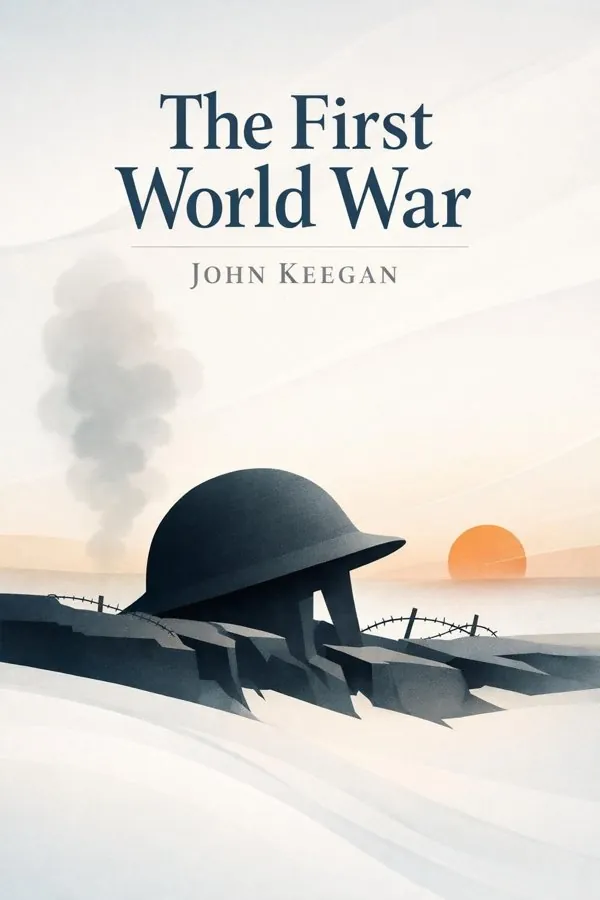
The First World War: Summary & Key Insights
by John Keegan
 10 min10 chaptersAudio available
Key Takeaways from The First World War
Peace can endure for decades and still be dangerously fragile.
History often turns on small moments, but only when larger forces are ready to move.
The opening months of the war shattered one of the deadliest assumptions in modern history: that the conflict would be brief, mobile, and decisive.
When movement failed, entrenchment became more than a temporary expedient; it became the defining condition of the Western Front.
One of the enduring distortions of First World War memory is the tendency to reduce it to the trenches of France and Belgium.
What Is The First World War About?
The First World War by John Keegan is a war_military book spanning 12 pages. John Keegan’s The First World War is a sweeping, deeply human history of the conflict that destroyed the old European order and set the terms for the modern age. Rather than treating World War I as a distant sequence of dates, treaties, and battle names, Keegan shows how a relatively prosperous and interconnected continent descended into industrialized slaughter on an unprecedented scale. He explains the political tensions, military doctrines, technological changes, and strategic misjudgments that turned a regional crisis into a global war involving empires, colonies, civilians, and entire national economies. What makes this book especially powerful is Keegan’s ability to unite high command decisions with the lived experience of soldiers in trenches, sailors at sea, and families on the home front. He writes not only as a historian of campaigns and commanders, but as a careful interpreter of how war reshapes societies and memory. The result is both an authoritative military history and a meditation on why this conflict still matters: because so many of the crises, ideologies, borders, and political wounds of the twentieth century were born in its fire.
This FizzRead summary covers all 10 key chapters of The First World War in approximately 10 minutes, distilling the most important ideas, arguments, and takeaways from John Keegan's work. Also available as an audio summary and Key Quotes Podcast.
The First World War
John Keegan’s The First World War is a sweeping, deeply human history of the conflict that destroyed the old European order and set the terms for the modern age. Rather than treating World War I as a distant sequence of dates, treaties, and battle names, Keegan shows how a relatively prosperous and interconnected continent descended into industrialized slaughter on an unprecedented scale. He explains the political tensions, military doctrines, technological changes, and strategic misjudgments that turned a regional crisis into a global war involving empires, colonies, civilians, and entire national economies. What makes this book especially powerful is Keegan’s ability to unite high command decisions with the lived experience of soldiers in trenches, sailors at sea, and families on the home front. He writes not only as a historian of campaigns and commanders, but as a careful interpreter of how war reshapes societies and memory. The result is both an authoritative military history and a meditation on why this conflict still matters: because so many of the crises, ideologies, borders, and political wounds of the twentieth century were born in its fire.
Who Should Read The First World War?
This book is perfect for anyone interested in war_military and looking to gain actionable insights in a short read. Whether you're a student, professional, or lifelong learner, the key ideas from The First World War by John Keegan will help you think differently.
- ✓Readers who enjoy war_military and want practical takeaways
- ✓Professionals looking to apply new ideas to their work and life
- ✓Anyone who wants the core insights of The First World War in just 10 minutes
Want the full summary?
Get instant access to this book summary and 100K+ more with Fizz Moment.
Get Free SummaryAvailable on App Store • Free to download
Key Chapters
Peace can endure for decades and still be dangerously fragile. Keegan begins by showing that pre-1914 Europe was not a calm and settled civilization so much as a tense system of rival powers held together by deterrence, diplomacy, imperial competition, and habit. Great Britain, France, Germany, Austria-Hungary, Russia, and the Ottoman Empire all operated within a balance-of-power framework that promised order while quietly rewarding suspicion. Alliances were intended to prevent war by signaling strength, yet they also created rigid commitments that reduced room for compromise once a crisis began.
Keegan helps readers see that the war did not emerge from a single villain or one sudden breakdown. Instead, it came from an environment in which nationalism intensified public feeling, military planning encouraged rapid mobilization, and governments feared weakness more than escalation. Germany worried about encirclement, Austria-Hungary feared internal disintegration, Russia sought influence in the Balkans, and France remained haunted by its earlier defeat. Each power viewed its own moves as defensive and the other’s as aggressive.
A practical way to understand this idea is to think about modern organizations or states that build systems for security but become trapped by them. Emergency plans, alliances, and competitive postures can create confidence, but they can also narrow choices when pressure rises. Keegan’s account reminds us that structures meant to preserve peace can become engines of war if leaders rely on automatic responses instead of political imagination.
Actionable takeaway: When assessing any conflict, look beyond the triggering event and examine the deeper system of fears, commitments, and assumptions that made escalation seem inevitable.
History often turns on small moments, but only when larger forces are ready to move. The assassination of Archduke Franz Ferdinand in Sarajevo in June 1914 appears, at first glance, to be the single cause of the First World War. Keegan shows why that interpretation is too simple. The killing mattered enormously, but it became catastrophic because Europe’s alliance system, military timetables, and diplomatic habits transformed a local outrage into a continental emergency.
Austria-Hungary saw the assassination as both an insult and a strategic threat, especially because nationalism in the Balkans endangered the empire’s already fragile multinational structure. Germany gave Austria-Hungary strong backing, hoping to preserve its ally and perhaps resolve tensions decisively. Russia, in turn, felt compelled to support Serbia. Once mobilization began, political control weakened. Military plans were designed for speed and total commitment, not pause and negotiation. France and Britain were then drawn in through alliance obligations, strategic realities, and concern over German power.
Keegan’s strength lies in his ability to connect diplomatic telegrams to the logic of military institutions. Plans such as Germany’s rapid western offensive were not neutral technical devices; they pressured leaders into acting before alternatives could be explored. In modern terms, this is a lesson in how organizations can become prisoners of their own procedures. A crisis becomes more dangerous when systems are built for irreversible action.
Actionable takeaway: In any high-stakes dispute, identify which routines, deadlines, or automatic commitments are shrinking the space for judgment, and question them before they force a bad decision.
The opening months of the war shattered one of the deadliest assumptions in modern history: that the conflict would be brief, mobile, and decisive. Keegan explains how Europe entered the war with confidence in offensive action, patriotic energy, and inherited military doctrines that were poorly suited to industrial firepower. Germany advanced through Belgium in accordance with its strategic design for defeating France quickly, while France launched attacks driven partly by the spirit of offensive elan. In the east, Russia moved more quickly than expected, forcing Germany to divide attention between fronts.
These campaigns produced dramatic movement and enormous losses, but not the expected decision. The German advance was checked at the Marne. On other fronts, armies discovered that railways could deliver men rapidly, but machine guns, artillery, and defensive positions made breakthrough far harder than prewar planners believed. The result was not victory but exhaustion, improvisation, and mounting casualties.
Keegan uses the opening campaigns to expose a recurring problem in military and political life: leaders often prepare for the war they imagine rather than the one they will actually fight. Doctrine, optimism, and institutional pride can make adaptation painfully slow. The practical relevance extends beyond battlefields. Businesses, governments, and institutions also launch major initiatives with assumptions about speed, resistance, and outcome that collapse on contact with reality.
The early campaigns teach that momentum is not the same as strategy, and confidence is not the same as understanding. Action without realistic appraisal can magnify disaster.
Actionable takeaway: Before committing to a major plan, test your assumptions against the strongest possible resistance, and prepare for a longer, costlier, more adaptive struggle than initial models suggest.
When movement failed, entrenchment became more than a temporary expedient; it became the defining condition of the Western Front. Keegan shows that trench warfare was not simply a symbol of futility but a rational, if terrible, response to the firepower of modern weapons. Once armies dug in from the North Sea to Switzerland, defense gained extraordinary strength. Barbed wire slowed attackers, machine guns swept open ground, artillery pulverized assembly areas, and communication failures made coordinated assaults fragile and often chaotic.
Keegan is especially good at restoring the physical reality behind the phrase trench warfare. Mud, rot, vermin, shellfire, exhaustion, and constant fear shaped the war as much as maps and command orders. Soldiers endured not only battle but prolonged exposure to danger, discomfort, and uncertainty. This endurance became one of the war’s central human facts. The trench was a military structure, but it was also a psychological environment that tested discipline, comradeship, and morale.
At the strategic level, trench warfare forced armies to search for ways to restore mobility. Massive bombardments, creeping barrages, mining operations, and later tanks were all attempts to break the deadlock. Yet Keegan makes clear that the problem was systemic, not merely technical. To attack successfully, forces needed timing, logistics, surprise, and communications that early war armies often lacked.
The broader lesson is sobering: when conditions favor defense, courage alone cannot overcome structural disadvantage. Persistence without adaptation simply increases loss.
Actionable takeaway: When facing repeated failure, stop treating the obstacle as a matter of effort alone and ask what underlying system must change before progress becomes possible.
One of the enduring distortions of First World War memory is the tendency to reduce it to the trenches of France and Belgium. Keegan broadens the picture by showing that the conflict sprawled across Eastern Europe, the Balkans, the Middle East, Africa, and the seas. On the Eastern Front, armies maneuvered over vast distances, producing dramatic advances and retreats unlike the static lines in the west. Russia’s weaknesses in logistics, command, and industrial support were exposed repeatedly, even as its manpower and geographic scale made it a formidable participant.
The collapse of older empires becomes clearer when these wider theaters are included. Austria-Hungary struggled under the strain of multi-front warfare and internal national divisions. The Ottoman Empire fought in the Caucasus, Mesopotamia, Gallipoli, and the Arab lands, revealing both resilience and fragility. Colonial troops, laborers, and resources from across empires also sustained the war effort, meaning the conflict was global in manpower and consequence, not merely European in origin.
Keegan’s treatment helps readers understand that strategic perspective matters. A battle may look decisive within one front while being only one pressure point in a much larger system. This has practical value in modern analysis, where focusing too narrowly on a single visible arena can obscure the forces actually determining outcomes elsewhere.
By widening the lens, Keegan also restores the diversity of wartime experiences. Mobility, occupation, famine, ethnic tension, imperial administration, and revolution all took different forms outside the western trench line.
Actionable takeaway: Whenever a major event seems to have one iconic setting, expand your frame and ask what other regions, actors, and hidden dependencies are shaping the real outcome.
Wars are not won only where armies collide; they are also won through supply, endurance, and control of movement. Keegan emphasizes that naval warfare and blockade were central to the First World War, even though they are often overshadowed by trench battles. Britain’s naval supremacy allowed the Allies to restrict Germany’s access to food, raw materials, and overseas trade. Over time, this economic pressure weakened German civilian life, strained industry, and narrowed strategic options.
Germany sought an answer through submarine warfare. U-boats offered a way to challenge British power indirectly by attacking merchant shipping. This strategy had real effect, but it also carried severe political risk. Unrestricted submarine warfare blurred the line between combat and commerce and contributed directly to bringing the United States into the war. Keegan shows that strategic innovation can generate tactical success while producing disastrous diplomatic consequences.
The naval dimension also illustrates how modern war links battlefield action to national economies. Industrial capacity, shipping routes, food distribution, and financial resilience become part of military power. This is why blockade mattered so much: it turned geography and naval organization into long-term instruments of attrition.
In contemporary terms, Keegan’s insight translates readily to any contest in which logistics and networks determine resilience. An organization may appear strong at the front line while quietly becoming vulnerable in its supply chain, finances, or external relationships.
Actionable takeaway: Do not judge strength by visible force alone; examine the less dramatic systems of supply, access, and sustainability that ultimately decide whether an effort can endure.
The First World War is often described as a war of new machines, but Keegan’s deeper point is that technology transformed combat faster than institutions learned how to use it well. Machine guns, heavy artillery, poison gas, aircraft, wireless communication, and tanks all altered the battlefield, yet none of them automatically produced effective strategy. Weapons created possibilities, but command systems, training methods, and mental habits often lagged behind.
This mismatch helps explain both the war’s grim attrition and its bursts of innovation. Artillery became the dominant killer, but coordinating bombardment with infantry movement was extraordinarily difficult. Aircraft began as reconnaissance tools and evolved into instruments of control and attack. Tanks promised mobility, but early mechanical limits and uneven doctrine prevented immediate decisive success. Gas created terror and confusion, yet it did not by itself break the deadlock. Keegan shows that victory comes less from owning new technology than from integrating it into a coherent method.
The same principle applies outside military history. New tools in business, politics, medicine, or education often disappoint not because they lack power, but because organizations keep old assumptions while adopting new instruments. Technology without cultural adaptation tends to produce waste, confusion, or shallow gains.
Keegan’s analysis encourages readers to respect experimentation, but also to recognize the human cost of learning under fire. Armies adapted because they had to, and often only after catastrophic losses exposed the failure of older methods.
Actionable takeaway: When adopting a new tool, change the process, training, and expectations around it as well, or you will likely preserve old failures in more advanced form.
Modern war does not stop at the battlefield, and Keegan makes clear that the First World War became a struggle of entire societies. States mobilized not only soldiers but factories, farms, railways, schools, newspapers, and households. Governments expanded control over industry, labor, prices, censorship, and information. Civilian morale became a strategic asset, while shortages, grief, inflation, and exhaustion became political dangers.
The home front was not a secondary theater. It determined whether armies could be supplied, whether populations would tolerate sacrifice, and whether regimes could survive prolonged strain. Women entered new forms of industrial and public work, often filling roles left vacant by mobilized men. At the same time, civilian suffering intensified under blockade, displacement, disease, and economic disruption. Keegan’s account reminds us that total war dissolves the neat separation between combatant and noncombatant.
This broad mobilization also helps explain why 1917 was so volatile. When war reaches deeply into daily life, frustration accumulates in every institution. The Russian Revolution, labor unrest, mutinies, and mounting social tension across Europe reflected not just battlefield events but the exhaustion of societies living under extreme pressure.
The practical lesson is relevant wherever large systems demand sacrifice from ordinary people. Leaders who focus only on front-line performance and ignore morale, legitimacy, and material strain eventually undermine their own cause. Endurance depends on fairness, communication, and realistic management of burden.
Actionable takeaway: In any long campaign, pay close attention to the people sustaining the effort behind the scenes, because morale and support systems often determine success more than the visible struggle does.
Some years intensify a conflict; 1917 transformed it. Keegan treats this year as a decisive turning point because it combined military exhaustion, political upheaval, and strategic realignment. Russia, long weakened by battlefield losses, poor administration, and social crisis, moved toward revolution and eventual collapse as a major combatant. This removed one of Germany’s principal enemies in the east, but it did not produce the simple advantage Berlin hoped for.
At the same time, Germany’s decision to resume unrestricted submarine warfare helped draw the United States into the conflict. American entry did not deliver instant battlefield dominance, but it changed the long-term equation by promising fresh manpower, industrial scale, and financial support for the Allies. In effect, one great power left the war as another entered it. Keegan shows how this altered both material capability and political imagination. The Allies could now think beyond survival toward eventual superiority, while Germany faced the prospect of a war it could not outlast.
1917 also revealed the internal limits of endurance. Mutinies, strikes, and public disillusionment spread because the promise of victory no longer justified the visible costs. Keegan’s point is that wars are not decided only by tactical success. They are also judged by whether states can still command belief, sacrifice, and organized effort.
For modern readers, 1917 offers a useful framework for spotting strategic inflection points: moments when new participants, collapsing institutions, or shifts in public legitimacy quietly redefine what is possible.
Actionable takeaway: Watch for turning points not just in visible outcomes, but in changing capacity, coalition strength, and public willingness to continue.
The end of combat in 1918 did not resolve the forces the war had unleashed. Keegan traces the final campaigns, the collapse of empires, and the peace settlement to show that military victory and political settlement are not the same achievement. Germany’s spring offensives failed to secure a decisive result before Allied strength, increasingly reinforced by American participation, shifted the balance. As the Central Powers weakened, Austria-Hungary, the Ottoman Empire, and imperial Germany itself unraveled under military pressure, hunger, nationalist demands, and loss of confidence.
Yet the peace that followed carried its own dangers. The Paris settlement attempted to punish aggression, redraw borders, satisfy national aspirations, and build a more stable international order. It succeeded in ending the war formally, but it left resentments, ambiguities, and unresolved tensions that would haunt Europe and the wider world. Keegan does not reduce the treaty to a single explanatory sin, but he does show that the settlement struggled to reconcile justice, security, and practicality.
The broader legacy is immense. The war accelerated the fall of dynastic empires, intensified ideological conflict, normalized state intervention on a vast scale, and shaped the conditions from which the Second World War emerged. Keegan’s ultimate message is that the First World War was not a tragic interruption in modern history; it was one of its central makers.
This insight has lasting value. Ending a struggle requires more than defeating an opponent. It requires building a settlement that can endure emotionally, economically, and politically.
Actionable takeaway: When evaluating any victory, ask not only who won, but whether the post-conflict order addresses the grievances and structural problems that caused the struggle in the first place.
All Chapters in The First World War
About the Author
John Keegan (1934–2012) was a distinguished British military historian, journalist, and author whose work transformed how modern readers understand warfare. Educated at Oxford, he spent many years teaching at the Royal Military Academy Sandhurst, where he developed his reputation for combining operational analysis with vivid attention to the soldier’s experience. He later served as defense editor for The Daily Telegraph and became one of the English-speaking world’s most influential interpreters of military history. Keegan wrote several major works, including The Face of Battle, The Mask of Command, A History of Warfare, and The First World War. His writing is known for clarity, narrative power, and intellectual range, bridging battlefield detail, strategic thinking, and broader historical meaning. He remains a central figure in twentieth-century military scholarship.
Get This Summary in Your Preferred Format
Read or listen to the The First World War summary by John Keegan anytime, anywhere. FizzRead offers multiple formats so you can learn on your terms — all free.
Available formats: App · Audio · PDF · EPUB — All included free with FizzRead
Download The First World War PDF and EPUB Summary
Key Quotes from The First World War
“Peace can endure for decades and still be dangerously fragile.”
“History often turns on small moments, but only when larger forces are ready to move.”
“The opening months of the war shattered one of the deadliest assumptions in modern history: that the conflict would be brief, mobile, and decisive.”
“When movement failed, entrenchment became more than a temporary expedient; it became the defining condition of the Western Front.”
“One of the enduring distortions of First World War memory is the tendency to reduce it to the trenches of France and Belgium.”
Frequently Asked Questions about The First World War
The First World War by John Keegan is a war_military book that explores key ideas across 10 chapters. John Keegan’s The First World War is a sweeping, deeply human history of the conflict that destroyed the old European order and set the terms for the modern age. Rather than treating World War I as a distant sequence of dates, treaties, and battle names, Keegan shows how a relatively prosperous and interconnected continent descended into industrialized slaughter on an unprecedented scale. He explains the political tensions, military doctrines, technological changes, and strategic misjudgments that turned a regional crisis into a global war involving empires, colonies, civilians, and entire national economies. What makes this book especially powerful is Keegan’s ability to unite high command decisions with the lived experience of soldiers in trenches, sailors at sea, and families on the home front. He writes not only as a historian of campaigns and commanders, but as a careful interpreter of how war reshapes societies and memory. The result is both an authoritative military history and a meditation on why this conflict still matters: because so many of the crises, ideologies, borders, and political wounds of the twentieth century were born in its fire.
More by John Keegan
You Might Also Like
Patriot
Andrew Britton
10 min
War
John Hersey
10 min
An Army at Dawn: The War in North Africa, 1942–1943
Rick Atkinson
10 min
Brave New War: The Next Stage of Terrorism and the End of Globalization
John Robb
10 min
Catch-22
Joseph Heller
10 min
Command and Control: Nuclear Weapons, the Damascus Accident, and the Illusion of Safety
Eric Schlosser
10 minBrowse by Category
Ready to read The First World War?
Get the full summary and 100K+ more books with Fizz Moment.