
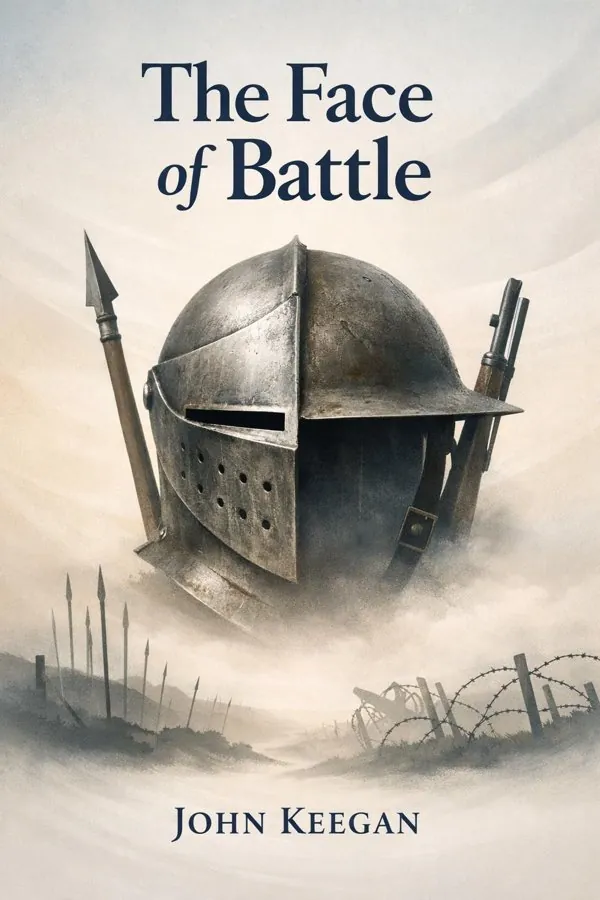
The Face of Battle: Summary & Key Insights
by John Keegan
 10 min9 chaptersAudio available
Key Takeaways from The Face of Battle
The most important fact about battle is also the one military history often hides: wars are fought by bodies and minds under extreme stress, not by arrows on a map.
Agincourt reminds us that medieval battle was not glorious pageantry but intimate, exhausting slaughter.
A battle is never fought in the abstract; it is fought somewhere, in some weather, by bodies that tire, hunger, panic, and break.
If Agincourt reveals the brutality of hand-to-hand battle, Waterloo shows how discipline allows armies to endure chaos without disintegrating.
One of the book’s most striking insights is that modernity did not simply make battle bigger; it made it less visible, less personal, and often more psychologically punishing.
What Is The Face of Battle About?
The Face of Battle by John Keegan is a war_military book spanning 11 pages. What does battle actually feel like for the people trapped inside it? That is the question John Keegan asks in The Face of Battle, and it is the reason this book changed military history. First published in 1976, the book rejects the usual focus on generals, tactics, and battlefield maps as the whole story of war. Instead, Keegan turns our attention to the ordinary soldier: the man standing in mud, smoke, fear, noise, confusion, and exhaustion, trying simply to survive. Through close studies of Agincourt, Waterloo, and the Somme, he shows how combat is experienced at ground level and how technology, discipline, terrain, leadership, and morale shape that experience. Keegan wrote with unusual authority. As a historian and longtime teacher at the Royal Military Academy Sandhurst, he knew both the traditions of military history and their limitations. His great achievement was to humanize battle without romanticizing it. The Face of Battle matters because it helps us see war not as an abstract contest of plans, but as a brutal, deeply human ordeal. It remains essential reading for anyone who wants to understand what warfare really is.
This FizzRead summary covers all 9 key chapters of The Face of Battle in approximately 10 minutes, distilling the most important ideas, arguments, and takeaways from John Keegan's work. Also available as an audio summary and Key Quotes Podcast.
The Face of Battle
What does battle actually feel like for the people trapped inside it? That is the question John Keegan asks in The Face of Battle, and it is the reason this book changed military history. First published in 1976, the book rejects the usual focus on generals, tactics, and battlefield maps as the whole story of war. Instead, Keegan turns our attention to the ordinary soldier: the man standing in mud, smoke, fear, noise, confusion, and exhaustion, trying simply to survive. Through close studies of Agincourt, Waterloo, and the Somme, he shows how combat is experienced at ground level and how technology, discipline, terrain, leadership, and morale shape that experience.
Keegan wrote with unusual authority. As a historian and longtime teacher at the Royal Military Academy Sandhurst, he knew both the traditions of military history and their limitations. His great achievement was to humanize battle without romanticizing it. The Face of Battle matters because it helps us see war not as an abstract contest of plans, but as a brutal, deeply human ordeal. It remains essential reading for anyone who wants to understand what warfare really is.
Who Should Read The Face of Battle?
This book is perfect for anyone interested in war_military and looking to gain actionable insights in a short read. Whether you're a student, professional, or lifelong learner, the key ideas from The Face of Battle by John Keegan will help you think differently.
- ✓Readers who enjoy war_military and want practical takeaways
- ✓Professionals looking to apply new ideas to their work and life
- ✓Anyone who wants the core insights of The Face of Battle in just 10 minutes
Want the full summary?
Get instant access to this book summary and 100K+ more with Fizz Moment.
Get Free SummaryAvailable on App Store • Free to download
Key Chapters
The most important fact about battle is also the one military history often hides: wars are fought by bodies and minds under extreme stress, not by arrows on a map. Keegan begins by challenging the conventional way battles are described. Traditional histories often emphasize commanders, plans, formations, and outcomes, but these can create the illusion that battle is orderly, rational, and fully controllable. In reality, combat is confusion, fatigue, terror, noise, injury, uncertainty, and imperfect information. Men rarely see the whole field. They struggle to hear commands, understand events, or even know whether they are winning.
This shift in perspective changes everything. Once we ask what battle looked and felt like to the ordinary participant, military history becomes not just a study of decisions from above but an inquiry into fear, discipline, endurance, cohesion, and survival. Why do men keep moving under fire? Why do some units hold while others collapse? Why is morale often more decisive than elegant strategy? Keegan argues that these questions are central, not secondary.
The idea applies beyond war. In any high-pressure environment, leaders may imagine systems work smoothly because charts and plans look clean from a distance. But people on the front line experience friction, overload, and ambiguity. Good leadership starts by understanding lived reality, not idealized procedure.
Actionable takeaway: Whenever you analyze a conflict, crisis, or organization, ask first what it looks like from the ground level of the people actually carrying the burden.
Agincourt reminds us that medieval battle was not glorious pageantry but intimate, exhausting slaughter. Keegan examines the famous 1415 victory of Henry V not as a patriotic legend but as a physical event involving men weakened by disease, hunger, armor, mud, and fear. The English army, though outnumbered, fought in defensive conditions that magnified its strengths. The muddy field constrained the French advance, and English archers disrupted heavily armored men-at-arms before the decisive crush of close combat.
What makes Keegan’s treatment powerful is his attention to bodily reality. Armor protected, but it also exhausted. Mud did not merely inconvenience; it trapped, slowed, and suffocated. Weapons were not symbols of heroism but tools used at arm’s length against vulnerable flesh. The famous English success becomes understandable not as destiny but as the interaction of terrain, fatigue, crowding, and discipline.
Keegan also shows how battlefield myths can oversimplify events. Agincourt is often remembered as a triumph of national genius, but his account highlights contingency. A different field, better coordination, or less disorder in the French ranks might have changed everything. This realism makes the battle more meaningful, not less.
The broader lesson is that conditions matter as much as intentions. Whether in warfare, business, or public policy, people often overcredit vision and undercredit environment. Outcomes are shaped by terrain, constraints, timing, and physical limits.
Actionable takeaway: When evaluating success, look beyond the heroic story and identify the concrete conditions that made victory or failure possible.
A battle is never fought in the abstract; it is fought somewhere, in some weather, by bodies that tire, hunger, panic, and break. One of Keegan’s enduring contributions is to restore physical conditions to the center of military understanding. In Agincourt, mud narrowed possibilities. At Waterloo, slopes, farm complexes, and visibility shaped timing and survival. At the Somme, shell holes, wire, rain, and shattered ground became active participants in the struggle.
This emphasis matters because strategy is always filtered through material reality. An order may be sensible on paper yet impossible in soaked terrain, among exhausted troops, or under artillery fire. A charge that appears bold in retrospect may have felt like a stumble through smoke and debris to the men carrying it out. Keegan helps the reader see that battle outcomes emerge from countless physical frictions. The ground slows movement. Weather ruins gunpowder or visibility. Hunger weakens judgment. Heavy equipment drains energy. Crowded formations create panic. Combat is a test not only of will but of endurance.
Modern readers can apply this insight widely. Plans fail not only because they are intellectually flawed but because they ignore implementation conditions. A workplace reorganization may look efficient from headquarters yet collapse when it meets limited staffing, poor tools, or unclear communication. A political reform may fail because it overlooks local realities.
Keegan’s realism teaches humility. Human beings do not act in empty space; they act inside constraints.
Actionable takeaway: Before judging any plan, ask what physical, logistical, and environmental conditions will shape how real people can actually carry it out.
If Agincourt reveals the brutality of hand-to-hand battle, Waterloo shows how discipline allows armies to endure chaos without disintegrating. Keegan’s analysis of the 1815 battle highlights the experience of infantrymen standing in formation under artillery bombardment, cavalry threat, smoke, and prolonged uncertainty. Waterloo is often narrated through the genius of Wellington or the return of Napoleon, but Keegan brings us into the ranks, where the central question was simpler and harsher: how did soldiers continue to stand at all?
Discipline in Keegan’s account is not mere obedience. It is a social and psychological system that enables men to remain in place when instinct tells them to run. Drill, unit identity, trust in officers, shared routines, and familiarity with formation all reduce panic. A square facing cavalry, for example, worked not because geometry is magical, but because soldiers believed enough in the formation and in one another to maintain it under terrifying pressure.
Waterloo also demonstrates how morale can fluctuate minute by minute. A unit may be brave one hour and near collapse the next. Small failures in communication, timing, or reinforcement can have oversized effects on confidence. Keegan reminds us that armies are emotional organisms as much as tactical instruments.
The lesson extends to all teams under pressure. People hold together when habits are practiced beforehand, roles are understood, and mutual trust is strong. In crisis, character matters, but preparation matters more.
Actionable takeaway: Build resilience before the moment of stress by creating shared drills, reliable routines, and trust strong enough to hold when fear and uncertainty rise.
One of the book’s most striking insights is that modernity did not simply make battle bigger; it made it less visible, less personal, and often more psychologically punishing. Between Waterloo and the Somme, industrialization transformed weapons, logistics, communication, and killing power. Firearms became faster, more accurate, and deadlier at greater distances. Artillery expanded from a supporting arm into a dominant force. Railways, mass conscription, and industrial supply systems enabled armies of unprecedented scale.
Keegan shows that these developments altered the soldier’s experience at a fundamental level. In earlier battles, combatants often saw their enemies and could interpret the fight through direct contact. In industrial war, death increasingly came from unseen shells, machine-gun fire, and dispersed positions. The battlefield widened and fragmented. Soldiers spent more time under threat without clear targets, which intensified helplessness and strain. The heroism celebrated in older military traditions became harder to recognize, not because courage disappeared, but because battlefield conditions changed what courage looked like.
This transition also complicates simplistic nostalgia. Technological progress did not civilize war. It often made killing more efficient while distancing decision-makers from bodily consequences. The same pattern appears in many modern systems: greater scale and technological sophistication can reduce visibility into human suffering.
Keegan’s point is not anti-technology but anti-abstraction. Tools reshape human experience and moral perception.
Actionable takeaway: Whenever technology expands power, ask how it changes what participants can see, feel, control, and morally understand about the consequences of their actions.
The Somme forces readers to confront a devastating truth: modern battle can become a system that consumes human beings faster than courage, planning, or leadership can save them. Keegan’s treatment of the 1916 offensive does not deny strategic context, but it emphasizes what the battle meant for the men who climbed out of trenches and crossed open ground into artillery and machine-gun fire. The Somme is not just a famous disaster; it is a case study in the collision between industrial firepower and inherited assumptions about attack, endurance, and sacrifice.
Keegan reveals how difficult it was for soldiers to move, orient themselves, communicate, and survive in a battlefield pulverized by shells. Trenches, wire, mud, and cratered ground destroyed cohesion. Units lost shape almost immediately. Officers could not reliably control events once men went over the top. Even carefully prepared attacks could dissolve in minutes. The result was a level of impersonality and helplessness unlike earlier warfare.
Yet Keegan does not portray the soldiers as passive victims. He shows their patience, courage, and grim competence. What failed was not bravery but the relationship between means and method. The battlefield had evolved faster than doctrine and expectation.
This has broad relevance. Institutions often continue using old mental models in radically changed environments. When that happens, effort and commitment may increase even as results worsen. The cost is paid by people closest to the point of failure.
Actionable takeaway: In any rapidly changing environment, question whether inherited methods still fit present conditions before asking people to sacrifice more in their name.
Battle is often imagined as a test of physical strength, but Keegan makes clear that psychological endurance is just as decisive. Across Agincourt, Waterloo, and the Somme, he shows that soldiers rarely fight as isolated individuals. They fight as members of small groups held together by habit, shared identity, leadership, and the fear of letting others down. Courage is therefore not simply an inner trait. It is social.
This is one of Keegan’s most valuable corrections to heroic mythology. Men do not usually continue under fire because they are fearless. They continue because they are trained, watched, supported, and bound to comrades. Fear remains constant, sometimes overwhelming. The question is how armies manage it. Effective structures reduce panic by giving soldiers predictable roles, trusted leaders, and immediate peer support. When cohesion breaks, even well-armed forces may collapse quickly.
The practical implications are significant. In every demanding organization, performance under stress depends less on speeches about bravery than on the quality of relationships and routines. Teams that have rehearsed together, communicated honestly, and built mutual reliance cope far better than groups assembled around abstract goals alone.
Keegan’s work also encourages empathy. If behavior under battle conditions is shaped by fear, exhaustion, and social bonds, then judgment should be cautious. What looks like cowardice from a distance may be the normal limit of human endurance.
Actionable takeaway: Strengthen group performance by investing in trust, small-unit cohesion, and realistic preparation, because people endure fear best when they do not face it alone.
One of Keegan’s boldest achievements is methodological: he argues that military history must stop treating battle as a stage for great men and start treating it as a lived human event. This does not mean strategy is unimportant. It means strategy alone is incomplete. Traditional battle narratives often create neat sequences of command, action, and result. They overstate control, minimize confusion, and elevate commanders at the expense of participants. In doing so, they risk turning suffering into spectacle.
Keegan challenges this by assembling evidence from memoirs, letters, drill manuals, battlefield conditions, and practical military knowledge. His goal is not to romanticize common soldiers, but to reconstruct what they could actually see, do, and endure. That method opened new possibilities for military history, influencing later scholars to ask about psychology, environment, logistics, trauma, and social experience alongside tactics and leadership.
The broader importance of this approach extends beyond war writing. History in general can become distorted when it privileges elites, official documents, and retrospective coherence. Real events are lived by ordinary people in uncertainty. To understand them well, we must recover that uncertainty rather than erase it.
For readers, this is a powerful intellectual habit. Whenever a story seems too smooth, too heroic, or too centered on leaders, it is worth asking whose experience has been omitted and what complexity has been flattened.
Actionable takeaway: When studying history or current events, look past top-level narratives and seek the perspective of the people who actually lived through the consequences.
Perhaps the deepest message of The Face of Battle is that combat exposes the limits of planning, leadership, and human control. Commanders can prepare, train, and inspire, but once battle begins, chance, friction, fear, terrain, weather, and misunderstanding all intervene. Keegan does not argue that leadership is meaningless. Rather, he shows that even the best leadership operates inside a world that resists tidy control. This is why battle is so often remembered through myths: myths restore order to events that felt chaotic and senseless to those inside them.
By comparing Agincourt, Waterloo, and the Somme, Keegan demonstrates that the form of battle changes across centuries, but uncertainty does not disappear. What changes are the tools, distances, scales, and rhythms of killing. What remains are vulnerability, incomplete knowledge, and the struggle to preserve cohesion amid danger. That continuity gives the book its moral force. War cannot be fully understood through abstractions because its reality is always borne by exposed human beings.
This insight can make readers wiser in many domains. Complex systems rarely behave exactly as designed. Leaders who overestimate control often create unnecessary risk. Better judgment comes from humility, feedback, preparation, and respect for front-line reality.
Keegan’s work endures because it replaces certainty with seriousness. It asks us to see battle honestly.
Actionable takeaway: In any complex undertaking, lead with humility, assume plans will meet friction, and stay close to the experience of those living the consequences.
All Chapters in The Face of Battle
About the Author
John Keegan (1934–2012) was one of the most influential military historians of the twentieth century. Educated at Oxford, he spent many years teaching at the Royal Military Academy Sandhurst, where he developed the perspective that would shape his most famous work: that war should be understood not only through strategy and commanders, but through the experience of the soldiers who fought it. He later became defense correspondent for The Daily Telegraph and wrote widely for general audiences as well as specialists. Keegan was known for combining scholarly depth with clear, vivid prose. His major works include The Face of Battle, The Mask of Command, The Second World War, and A History of Warfare. He helped transform military history into a more human, psychologically aware field.
Get This Summary in Your Preferred Format
Read or listen to the The Face of Battle summary by John Keegan anytime, anywhere. FizzRead offers multiple formats so you can learn on your terms — all free.
Available formats: App · Audio · PDF · EPUB — All included free with FizzRead
Download The Face of Battle PDF and EPUB Summary
Key Quotes from The Face of Battle
“The most important fact about battle is also the one military history often hides: wars are fought by bodies and minds under extreme stress, not by arrows on a map.”
“Agincourt reminds us that medieval battle was not glorious pageantry but intimate, exhausting slaughter.”
“A battle is never fought in the abstract; it is fought somewhere, in some weather, by bodies that tire, hunger, panic, and break.”
“If Agincourt reveals the brutality of hand-to-hand battle, Waterloo shows how discipline allows armies to endure chaos without disintegrating.”
“One of the book’s most striking insights is that modernity did not simply make battle bigger; it made it less visible, less personal, and often more psychologically punishing.”
Frequently Asked Questions about The Face of Battle
The Face of Battle by John Keegan is a war_military book that explores key ideas across 9 chapters. What does battle actually feel like for the people trapped inside it? That is the question John Keegan asks in The Face of Battle, and it is the reason this book changed military history. First published in 1976, the book rejects the usual focus on generals, tactics, and battlefield maps as the whole story of war. Instead, Keegan turns our attention to the ordinary soldier: the man standing in mud, smoke, fear, noise, confusion, and exhaustion, trying simply to survive. Through close studies of Agincourt, Waterloo, and the Somme, he shows how combat is experienced at ground level and how technology, discipline, terrain, leadership, and morale shape that experience. Keegan wrote with unusual authority. As a historian and longtime teacher at the Royal Military Academy Sandhurst, he knew both the traditions of military history and their limitations. His great achievement was to humanize battle without romanticizing it. The Face of Battle matters because it helps us see war not as an abstract contest of plans, but as a brutal, deeply human ordeal. It remains essential reading for anyone who wants to understand what warfare really is.
More by John Keegan
You Might Also Like
Patriot
Andrew Britton
10 min
War
John Hersey
10 min
An Army at Dawn: The War in North Africa, 1942–1943
Rick Atkinson
10 min
Brave New War: The Next Stage of Terrorism and the End of Globalization
John Robb
10 min
Catch-22
Joseph Heller
10 min
Command and Control: Nuclear Weapons, the Damascus Accident, and the Illusion of Safety
Eric Schlosser
10 minBrowse by Category
Ready to read The Face of Battle?
Get the full summary and 100K+ more books with Fizz Moment.