
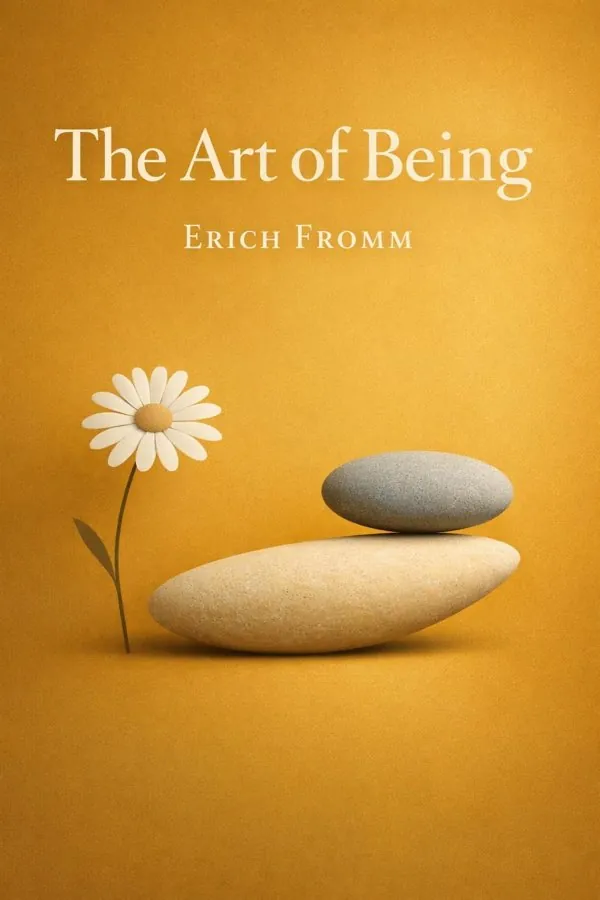
The Art of Being: Summary & Key Insights
by Erich Fromm
 10 min10 chaptersAudio available
Key Takeaways from The Art of Being
A person’s deepest crisis often begins not with suffering, but with a mistaken definition of what it means to exist.
A culture reveals its values by what it praises, and modern society overwhelmingly praises acquisition.
The way people speak often exposes the way they live.
Even the highest ideals can be reduced to possessions if approached in the wrong spirit.
One of the most painful features of modern life is that people can function efficiently while feeling inwardly absent.
What Is The Art of Being About?
The Art of Being by Erich Fromm is a western_phil book spanning 10 pages. What does it mean to truly live: to own more, achieve more, and accumulate more, or to become more awake, loving, and fully human? In The Art of Being, Erich Fromm confronts this question with unusual clarity and urgency. He argues that modern life pushes us toward a “having” orientation, in which identity is built on possession, status, and control. Yet this approach, however normal it may seem, leaves people inwardly impoverished, anxious, and alienated. Against it, Fromm proposes the richer mode of “being,” grounded in aliveness, presence, love, creativity, and genuine participation in life. This book matters because its diagnosis of modern society feels even more relevant today than when it was written. In an age of consumerism, branding, and self-optimization, Fromm asks whether we are mistaking acquisition for fulfillment. Drawing on psychoanalysis, philosophy, religion, and social criticism, he offers not just a critique of culture but a path toward inner and social renewal. As one of the twentieth century’s leading humanistic thinkers, Fromm writes with the authority of a psychologist and the moral seriousness of a philosopher concerned with the future of human freedom.
This FizzRead summary covers all 10 key chapters of The Art of Being in approximately 10 minutes, distilling the most important ideas, arguments, and takeaways from Erich Fromm's work. Also available as an audio summary and Key Quotes Podcast.
The Art of Being
What does it mean to truly live: to own more, achieve more, and accumulate more, or to become more awake, loving, and fully human? In The Art of Being, Erich Fromm confronts this question with unusual clarity and urgency. He argues that modern life pushes us toward a “having” orientation, in which identity is built on possession, status, and control. Yet this approach, however normal it may seem, leaves people inwardly impoverished, anxious, and alienated. Against it, Fromm proposes the richer mode of “being,” grounded in aliveness, presence, love, creativity, and genuine participation in life.
This book matters because its diagnosis of modern society feels even more relevant today than when it was written. In an age of consumerism, branding, and self-optimization, Fromm asks whether we are mistaking acquisition for fulfillment. Drawing on psychoanalysis, philosophy, religion, and social criticism, he offers not just a critique of culture but a path toward inner and social renewal. As one of the twentieth century’s leading humanistic thinkers, Fromm writes with the authority of a psychologist and the moral seriousness of a philosopher concerned with the future of human freedom.
Who Should Read The Art of Being?
This book is perfect for anyone interested in western_phil and looking to gain actionable insights in a short read. Whether you're a student, professional, or lifelong learner, the key ideas from The Art of Being by Erich Fromm will help you think differently.
- ✓Readers who enjoy western_phil and want practical takeaways
- ✓Professionals looking to apply new ideas to their work and life
- ✓Anyone who wants the core insights of The Art of Being in just 10 minutes
Want the full summary?
Get instant access to this book summary and 100K+ more with Fizz Moment.
Get Free SummaryAvailable on App Store • Free to download
Key Chapters
A person’s deepest crisis often begins not with suffering, but with a mistaken definition of what it means to exist. Fromm’s central insight is that human life can be organized according to two fundamentally different orientations: having and being. In the mode of having, a person secures identity through possession. This may include money, property, achievements, opinions, qualifications, or even relationships treated as personal assets. The underlying feeling is: I am what I own, control, and keep. In the mode of being, by contrast, life is defined by active presence. One exists through loving, sharing, creating, understanding, and participating fully in the moment.
Fromm does not deny that material needs matter. People require food, shelter, security, and practical forms of ownership. His argument is deeper: problems begin when possession becomes the center of identity. In that state, loss becomes terrifying, because losing something feels like losing oneself. The being orientation is more resilient because it rests on capacities, not stockpiles. You cannot possess love in a meaningful sense, but you can love. You cannot own wisdom like an object, but you can become wise through living inquiry.
This distinction helps explain why some people remain restless despite success. A professional may collect titles and still feel empty because achievement has replaced aliveness. A partner may say “my spouse” possessively while lacking genuine intimacy. In practical life, the shift from having to being can begin with simple questions: Am I trying to own this experience, or actually live it? Am I collecting knowledge, or being transformed by what I learn?
Actionable takeaway: For one week, notice how often you define yourself through what you have. Then consciously choose one daily activity—conversation, work, reading, or rest—to approach as a practice of presence rather than possession.
A culture reveals its values by what it praises, and modern society overwhelmingly praises acquisition. Fromm argues that capitalist consumer culture trains people to live in the having mode by equating worth with ownership, productivity, image, and market success. The result is not merely economic behavior but a whole psychological structure: people begin to consume not only goods, but also experiences, relationships, and even identities.
Advertising plays a major role in this process. It does not simply sell products; it manufactures dissatisfaction. People are taught to feel incomplete without the next purchase, upgrade, or symbol of status. Work, too, is often reduced to a race for advancement measured by income and recognition rather than meaning or contribution. Even leisure becomes another marketplace in which one collects entertainment, travel, and curated moments for display. The self becomes a project of branding.
Fromm’s critique is powerful because it connects social systems to inner life. A society centered on possession produces anxiety, envy, competitiveness, and fear of insignificance. If value depends on what one has, then others become rivals, and life becomes a struggle to maintain or improve one’s position. This orientation also weakens solidarity, because people increasingly relate to one another through exchange value rather than shared humanity.
The relevance today is striking. Social media intensifies the having mode by turning lives into visible inventories: followers, likes, purchases, credentials, and experiences. Yet more visibility rarely creates more depth. Fromm challenges readers to ask whether modern abundance has actually made people more fulfilled, or merely more distracted and dependent.
Actionable takeaway: Choose one area of life—shopping, social media, work ambition, or status comparison—and create a small limit around it. Use the saved time or attention for an activity that strengthens being, such as reflection, art, deep conversation, or service.
The way people speak often exposes the way they live. Fromm pays close attention to language because ordinary expressions reveal whether a person relates to life as something to possess or something to experience. In the having mode, people commonly describe thoughts, feelings, and relationships as objects they own: “I have an idea,” “I have faith,” “I have a beautiful partner,” “I have a problem.” This may seem harmless, but the grammatical habit reflects a deeper attitude of objectification.
Fromm contrasts this with the language of being, which emphasizes activity and process. Instead of treating life as a collection of possessions, the being orientation asks what one is doing, becoming, and expressing. For example, there is a difference between “I have knowledge” and “I understand,” between “I have religion” and “I believe,” between “I have a friend” and “I am befriending, loving, listening.” The first turns experience into a static possession; the second points to an active relationship.
This insight matters because language can harden inner habits. If a student sees learning as “having information,” education becomes memorization and storage. If love is understood as “having a partner,” the relationship can become controlling and insecure. But if learning means engaging reality and love means active care, then both become living practices.
In everyday life, small linguistic shifts can alter self-awareness. A person might replace “I have stress” with “I am feeling strained and need rest,” or “I have to impress them” with “I want to meet them openly.” Such changes do not magically solve problems, but they weaken the illusion that life is something to own and strengthen the sense that it is something to live.
Actionable takeaway: Listen to your own speech for a day. When you catch yourself using “have” for inner states or relationships, pause and rephrase the sentence in a more active, experiential way.
Even the highest ideals can be reduced to possessions if approached in the wrong spirit. Fromm shows that religion and philosophy contain both having and being tendencies. In the having mode, a person “has” faith, “has” the truth, “has” the correct doctrine. Belief then becomes a form of ownership, and spirituality becomes defensive, rigid, and often intolerant. The person clings to formulas instead of undergoing inner transformation.
In the being mode, religion and philosophy are not trophies of certainty but paths of awakening. Faith is lived as trust, openness, courage, and existential commitment. Truth is not a set of slogans stored in the mind, but something encountered through disciplined reflection, compassion, self-knowledge, and ethical action. Fromm draws on traditions such as Buddhism, biblical humanism, and mystical thought to show that some of the world’s deepest teachings emphasize detachment from ego, compassion for others, and the cultivation of presence.
This distinction helps explain why people can be deeply “religious” yet remain harsh, vain, or fearful. If religion is treated as property, it strengthens the ego instead of freeing it. The same applies to philosophy. One can collect intellectual systems and arguments while avoiding the harder task of inner change. Real wisdom is not the possession of ideas but the embodiment of insight.
A practical example appears in moral disagreement. In the having mode, one argues to defend one’s ideological property. In the being mode, one seeks truth through dialogue, humility, and openness to revision. Fromm’s point is not relativism, but maturity: truth should deepen humanity rather than inflate superiority.
Actionable takeaway: Examine one belief you strongly hold. Ask whether you are using it as an identity possession or living it as a discipline that makes you more honest, compassionate, and awake.
One of the most painful features of modern life is that people can function efficiently while feeling inwardly absent. Fromm describes alienation as a condition in which individuals become estranged from their own powers, their work, other people, and the natural world. They act, produce, consume, and perform, yet no longer feel fully connected to what they do or who they are. Life becomes mechanical.
Alienation grows when human activity is organized primarily for external rewards. A worker may spend years in a job that pays well but feels spiritually empty, experiencing labor as something sold rather than expressed. A person may adopt fashionable opinions not because they are deeply believed, but because they fit a social environment. Even emotions can become scripted, with people performing happiness, outrage, or intimacy according to expectation rather than authentic feeling.
Fromm links this alienation to the dominance of the having mode. When everything is viewed as an object—including one’s own abilities—human beings begin to market themselves. They ask not “What is true to my nature?” but “What will make me desirable?” This creates a divided self, outwardly adapted yet inwardly weakened. The consequences include boredom, anxiety, emptiness, and a chronic hunger for stimulation.
The antidote is not self-indulgence but reconnection with living activity. People feel less alienated when they participate in work they can care about, relationships in which they are genuinely seen, and practices that engage body, mind, and conscience. Gardening, craftsmanship, attentive conversation, and meaningful service can all counter the sense of unreality.
Actionable takeaway: Identify one recurring part of your week that feels lifeless or performative. Ask how you can make it more real—through greater honesty, creativity, skill, human contact, or alignment with your values.
Many people assume that “being” sounds passive, as if it meant withdrawal from effort or indifference to the world. Fromm insists on the opposite. The mode of being is intensely active, but its activity arises from inner vitality rather than greed or compulsion. It is the activity of loving, thinking, listening, creating, giving, and responding fully to reality. A person in the being mode is not inert but alive.
Fromm describes several traits of this orientation. First is presence: the capacity to attend deeply to what is before you instead of constantly reaching for more. Second is productive activity: using one’s powers in ways that express and develop them. Third is openness: relating to others and the world without immediately trying to dominate, classify, or exploit. Fourth is joy: not superficial pleasure, but the fulfillment that comes from exercising one’s highest capacities.
Examples make this concrete. A musician in the having mode may obsess over applause, prestige, and ownership of talent. In the being mode, music becomes an act of living expression. A parent in the having mode may treat a child as an extension of the self. In the being mode, parenting becomes attentive care for the child’s unfolding life. A reader in the having mode collects books and quotations; in the being mode, reading becomes a dialogue with ideas that changes perception.
This way of living does not eliminate pain, uncertainty, or limitation. But it changes one’s relationship to them. Instead of defending a brittle identity built on possessions, the person becomes more grounded in capacities that can deepen through practice.
Actionable takeaway: Pick one routine activity today—eating, walking, writing, listening, or working—and do it with complete attention, not as a means to an end but as an expression of being fully alive.
Education often fails not because people learn too little, but because they mistake information for understanding. Fromm applies the distinction between having and being to knowledge itself. In the having mode, learning means accumulating facts, concepts, and credentials. Knowledge becomes something one stores and displays. This may produce impressive performance, yet leave the person intellectually passive and existentially unchanged.
In the being mode, learning is an active encounter. To know something is to wrestle with it, test it, integrate it, and let it reshape perception. A student who memorizes a theory “has” knowledge in a superficial sense. A student who can think with it, question it, relate it to life, and use it responsibly is participating in the being mode of knowing. Understanding is dynamic.
This idea has practical implications for schools, professional life, and personal growth. A manager may collect leadership frameworks without becoming a better leader. A spiritual seeker may gather books and teachings while avoiding self-examination. A citizen may repeat political talking points without grasping social reality. Genuine learning requires curiosity, humility, and involvement. It asks not only “What do I know?” but “How am I changed by what I know?”
Fromm’s insight is especially important in an age of endless content. Information is abundant, but digestion is scarce. People often consume articles, videos, and podcasts at high speed, confusing exposure with comprehension. The mode of being invites slower, deeper study and conversation, where insight becomes part of character.
Actionable takeaway: The next time you read or study something important, stop after each section and ask three questions: What does this mean? Why does it matter? How should it change what I do?
Nothing reveals the difference between having and being more clearly than love. Fromm argues that modern people often confuse love with possession, dependency, excitement, or exclusivity. In the having mode, one says “I have a partner,” and the relationship becomes tied to control, jealousy, and fear of loss. The other person is unconsciously treated as a source of security, admiration, or emotional supply. What is called love may actually be attachment to possession.
In the mode of being, love is an active power. It is not primarily something one receives or owns, but something one does. To love means to care, respect, know, respond, and support the growth of another person while remaining fully alive oneself. This kind of love is not sentimental weakness. It requires discipline, patience, humility, and courage. It also includes self-love in the healthy sense: respect for one’s own dignity and development.
Fromm’s view applies not only to romance but to friendship, family, and community. A parent genuinely loves a child not by molding the child into a personal project, but by helping the child become fully themselves. A friend loves by listening honestly, not by keeping score. A citizen loves society by participating responsibly in the common good.
This perspective helps explain why relationships often deteriorate when initial excitement fades. If the bond was built on possession or projection, intimacy becomes suffocating. But if love is understood as ongoing activity, relationships can deepen through mutual growth and truthfulness.
Actionable takeaway: In one important relationship, ask yourself: Am I trying to secure this person, or to love them? Then perform one concrete act of non-possessive care—listening deeply, encouraging their freedom, or expressing appreciation without expectation.
Personal awakening alone cannot flourish in a dehumanizing social order. Fromm insists that the shift from having to being is not merely a private psychological adjustment; it also requires economic and institutional transformation. A society organized around profit, competition, and consumption continually reproduces the very traits it later diagnoses as personal problems: greed, anxiety, isolation, and emptiness. If people are shaped by the systems they inhabit, then human flourishing needs supportive social conditions.
Fromm therefore links ethics to politics. He envisions forms of social life that prioritize human development over sheer accumulation. Work should be meaningful rather than purely exploitative. Economic structures should serve life rather than sacrifice life to production. Democracy should be participatory, not merely formal, giving people real involvement in the conditions that shape them. Communities should cultivate solidarity rather than reducing everyone to isolated competitors.
This is not a rejection of practical economics, but a call to judge economic systems by human consequences. A wealthy society can still be spiritually impoverished if its members are lonely, overworked, fearful, and alienated. Conversely, policies that support education, mental health, dignified labor, public culture, and social trust may strengthen the mode of being far more than endless consumption can.
Readers need not adopt every political implication to grasp the core point: institutions reward certain character structures. If a culture constantly rewards manipulation and self-marketing, then moral appeals alone will be weak. Sustainable renewal requires environments that make depth, cooperation, and meaningful activity more possible.
Actionable takeaway: Consider one institution you participate in—workplace, school, community, or family. Identify a small change that would encourage cooperation, dignity, or participation over competition and passive consumption.
A new way of being is not achieved through a single insight but through repeated inner practice. Fromm ends on a note of disciplined hope: human beings can move toward the mode of being, but only if they cultivate habits that weaken narcissism, greed, and passivity. Spiritual renewal, in his humanistic sense, does not require dogma. It requires attention, self-knowledge, courage, and commitment to values larger than ego.
Fromm emphasizes practices such as concentration, mindful awareness, honest self-observation, and the willingness to endure uncertainty without rushing into distraction. The having mode depends on constant grasping: more noise, more possessions, more stimulation, more reassurance. The being mode grows in silence, reflection, creative work, loving contact, and active concern for others. This makes it both simple and demanding.
A practical example is the difference between distraction and presence. Many people feel restless when they are not consuming something—messages, entertainment, purchases, opinions. Fromm would see this as a symptom of an impoverished inner life. To become more fully human, one must rebuild the capacity to be present without immediately filling the space. Another example is service: helping others not to feel superior or useful, but to participate in shared humanity.
The deeper promise of this practice is freedom. A person rooted in being depends less on external validation and is therefore less easily manipulated by markets, ideologies, or status pressures. Such a person is not detached from society, but able to engage it more lucidly and lovingly.
Actionable takeaway: Create a short daily ritual—ten minutes of silent reflection, journaling, undistracted reading, or compassionate action—that strengthens presence and reminds you that your life is something to live, not merely to accumulate.
All Chapters in The Art of Being
About the Author
Erich Fromm (1900–1980) was a German-born social psychologist, psychoanalyst, sociologist, and humanistic philosopher whose work bridged psychology, ethics, and social criticism. Trained in both psychoanalysis and sociology, he became associated with the Frankfurt School before developing his own independent humanistic perspective. Fromm explored how modern society shapes character, desire, and freedom, often focusing on alienation, consumerism, authoritarianism, and the human need for love and meaning. After leaving Germany, he lived and worked in the United States and Mexico, writing influential books such as Escape from Freedom, The Art of Loving, To Have or To Be?, and The Sane Society. His enduring contribution lies in showing how personal well-being and social structures are inseparable, and in defending a vision of humanity grounded in love, reason, responsibility, and authentic being.
Get This Summary in Your Preferred Format
Read or listen to the The Art of Being summary by Erich Fromm anytime, anywhere. FizzRead offers multiple formats so you can learn on your terms — all free.
Available formats: App · Audio · PDF · EPUB — All included free with FizzRead
Download The Art of Being PDF and EPUB Summary
Key Quotes from The Art of Being
“A person’s deepest crisis often begins not with suffering, but with a mistaken definition of what it means to exist.”
“A culture reveals its values by what it praises, and modern society overwhelmingly praises acquisition.”
“The way people speak often exposes the way they live.”
“Even the highest ideals can be reduced to possessions if approached in the wrong spirit.”
“One of the most painful features of modern life is that people can function efficiently while feeling inwardly absent.”
Frequently Asked Questions about The Art of Being
The Art of Being by Erich Fromm is a western_phil book that explores key ideas across 10 chapters. What does it mean to truly live: to own more, achieve more, and accumulate more, or to become more awake, loving, and fully human? In The Art of Being, Erich Fromm confronts this question with unusual clarity and urgency. He argues that modern life pushes us toward a “having” orientation, in which identity is built on possession, status, and control. Yet this approach, however normal it may seem, leaves people inwardly impoverished, anxious, and alienated. Against it, Fromm proposes the richer mode of “being,” grounded in aliveness, presence, love, creativity, and genuine participation in life. This book matters because its diagnosis of modern society feels even more relevant today than when it was written. In an age of consumerism, branding, and self-optimization, Fromm asks whether we are mistaking acquisition for fulfillment. Drawing on psychoanalysis, philosophy, religion, and social criticism, he offers not just a critique of culture but a path toward inner and social renewal. As one of the twentieth century’s leading humanistic thinkers, Fromm writes with the authority of a psychologist and the moral seriousness of a philosopher concerned with the future of human freedom.
More by Erich Fromm
You Might Also Like
A Little History of Philosophy
Nigel Warburton
10 min
Areopagitica
John Milton
10 min
How To Think Like A Philosopher: Essential Principles For Clear Thinking
Peter Cave
10 min
Language, Truth and Logic
A. J. Ayer
10 min
The Age of Reason
Thomas Paine
10 min
The Essays
Michel De Montaigne
10 minBrowse by Category
Ready to read The Art of Being?
Get the full summary and 100K+ more books with Fizz Moment.