
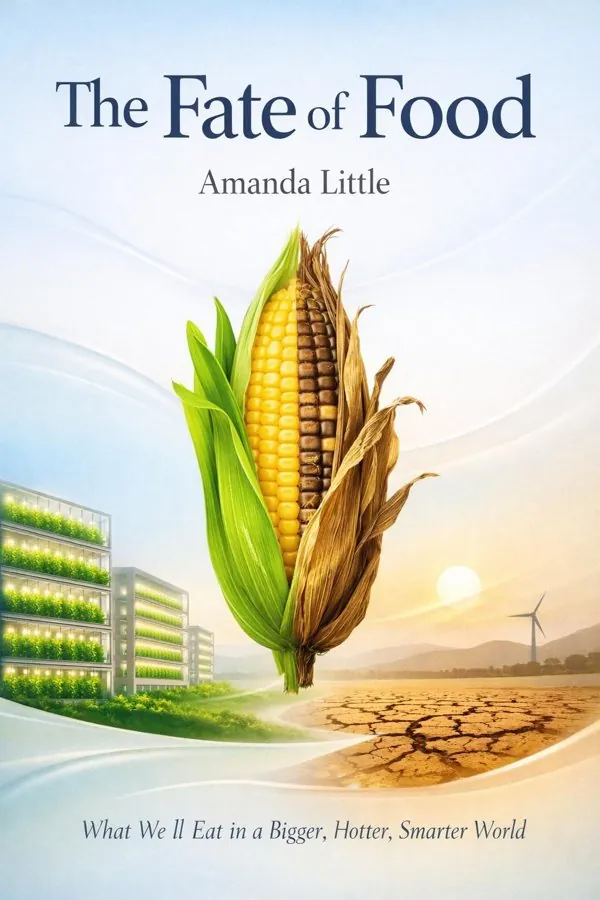
The Fate of Food: What We'll Eat in a Bigger, Hotter, Smarter World: Summary & Key Insights
 10 min9 chaptersAudio available
Key Takeaways from The Fate of Food: What We'll Eat in a Bigger, Hotter, Smarter World
The future of food will not emerge from nowhere; it will grow out of centuries of agricultural reinvention.
We often think food shortages begin in fields, but they frequently begin in rivers, aquifers, and skies.
A seed is a technology, and in a warming world, it may be one of the most important technologies we have.
The question is no longer whether our protein system must change, but how fast and how fairly that change can happen.
As farmland grows more vulnerable, one of the most unexpected places to grow food is the city itself.
What Is The Fate of Food: What We'll Eat in a Bigger, Hotter, Smarter World About?
The Fate of Food: What We'll Eat in a Bigger, Hotter, Smarter World by Amanda Little is a environment book spanning 9 pages. What happens to dinner when the planet gets hotter, water grows scarcer, soils degrade, and extreme weather reshapes the geography of farming? In The Fate of Food, journalist Amanda Little investigates that question with urgency, curiosity, and surprising optimism. Rather than offering a simple climate warning, she travels across farms, laboratories, oceans, deserts, and cities to examine how food is already being transformed by environmental stress and technological innovation. Along the way, she explores drought-resistant crops, gene editing, vertical farming, aquaculture, cultured meat, and smarter supply chains, showing how each might help feed a growing global population. The book matters because food sits at the intersection of survival, politics, economics, culture, and climate. If food systems fail, every society feels it. But Little argues that crisis can also accelerate reinvention. As an experienced environmental and energy reporter, she brings both investigative rigor and narrative warmth, grounding big scientific questions in real human lives. The result is a vivid, accessible exploration of how we may eat in the future—and what choices today will determine whether that future is just, resilient, and sustainable.
This FizzRead summary covers all 9 key chapters of The Fate of Food: What We'll Eat in a Bigger, Hotter, Smarter World in approximately 10 minutes, distilling the most important ideas, arguments, and takeaways from Amanda Little's work. Also available as an audio summary and Key Quotes Podcast.
The Fate of Food: What We'll Eat in a Bigger, Hotter, Smarter World
What happens to dinner when the planet gets hotter, water grows scarcer, soils degrade, and extreme weather reshapes the geography of farming? In The Fate of Food, journalist Amanda Little investigates that question with urgency, curiosity, and surprising optimism. Rather than offering a simple climate warning, she travels across farms, laboratories, oceans, deserts, and cities to examine how food is already being transformed by environmental stress and technological innovation. Along the way, she explores drought-resistant crops, gene editing, vertical farming, aquaculture, cultured meat, and smarter supply chains, showing how each might help feed a growing global population.
The book matters because food sits at the intersection of survival, politics, economics, culture, and climate. If food systems fail, every society feels it. But Little argues that crisis can also accelerate reinvention. As an experienced environmental and energy reporter, she brings both investigative rigor and narrative warmth, grounding big scientific questions in real human lives. The result is a vivid, accessible exploration of how we may eat in the future—and what choices today will determine whether that future is just, resilient, and sustainable.
Who Should Read The Fate of Food: What We'll Eat in a Bigger, Hotter, Smarter World?
This book is perfect for anyone interested in environment and looking to gain actionable insights in a short read. Whether you're a student, professional, or lifelong learner, the key ideas from The Fate of Food: What We'll Eat in a Bigger, Hotter, Smarter World by Amanda Little will help you think differently.
- ✓Readers who enjoy environment and want practical takeaways
- ✓Professionals looking to apply new ideas to their work and life
- ✓Anyone who wants the core insights of The Fate of Food: What We'll Eat in a Bigger, Hotter, Smarter World in just 10 minutes
Want the full summary?
Get instant access to this book summary and 100K+ more with Fizz Moment.
Get Free SummaryAvailable on App Store • Free to download
Key Chapters
The future of food will not emerge from nowhere; it will grow out of centuries of agricultural reinvention. Amanda Little begins with a crucial insight: farming has always been a technological system, not a timeless pastoral ideal. From early irrigation to mechanical harvesters to the Green Revolution’s fertilizers, pesticides, and high-yield seeds, every era has changed what and how humans eat. That history matters because it reminds us that today’s food crisis is not the first transformation agriculture has faced—though it may be the most globally destabilizing.
Little shows that previous revolutions solved immediate shortages while creating new long-term problems. Mechanization increased productivity but encouraged monocultures and fossil-fuel dependence. Synthetic fertilizers boosted yields but harmed waterways and soils. Industrial scaling made food cheaper for many people, yet often at ecological and social cost. The lesson is not that innovation is bad, but that innovation without systems thinking can simply move the problem downstream.
This historical perspective helps frame the book’s central argument: the next agricultural revolution must be smarter, cleaner, and more adaptive than the last. It must produce more food with fewer inputs, less land, and lower emissions while withstanding drought, heat, flood, and pests. Examples include precision agriculture, controlled-environment growing, and crop varieties designed for climate volatility rather than ideal conditions.
For readers, the practical takeaway is to stop imagining “traditional” and “modern” agriculture as opposites. The real question is which innovations build resilience without repeating past harms. Evaluate food solutions not only by yield, but by water use, biodiversity impact, energy demand, labor conditions, and long-term sustainability.
A seed is a technology, and in a warming world, it may be one of the most important technologies we have. Little explores how scientists are racing to develop crops that can survive heat, salinity, erratic rainfall, stronger pests, and degraded soils. This is not a futuristic side story—it is central to whether food systems can remain productive as climate patterns shift beyond historical norms.
The book examines several paths toward crop resilience. Conventional breeding still matters: selecting plants that naturally perform better under stress can create hardier varieties over time. But newer tools like gene editing accelerate the process by allowing scientists to target traits such as drought tolerance or disease resistance more precisely. Researchers are also reviving neglected crops and landraces that evolved under harsh local conditions and may offer traits industrial agriculture has overlooked.
Little does not present genetic innovation as a magic fix. Better seeds cannot compensate for depleted soil, poor water management, or unjust access to technology. Nor are public concerns about biotechnology irrelevant. Instead, she argues for a pragmatic approach: in a climate emergency, societies should judge agricultural technologies by evidence, transparency, and outcomes rather than ideology alone.
A practical example is the development of flood-tolerant rice or heat-resistant wheat that allows farmers to maintain yields despite weather extremes. Such innovations can protect livelihoods and reduce the risk of political instability caused by crop failures. But they work best when paired with extension services, local knowledge, and equitable distribution.
The actionable takeaway is to think beyond labels like “natural” or “engineered.” Support food systems that invest in resilient crops, open scientific research, and farmer access, because tomorrow’s food security may depend on seeds designed for a very different planet than the one agriculture was built for.
The question is no longer whether our protein system must change, but how fast and how fairly that change can happen. Little investigates one of the most visible frontiers in food innovation: alternatives to conventional meat. Industrial livestock production consumes vast amounts of land, water, feed, and energy while contributing heavily to greenhouse gas emissions, deforestation, and pollution. If billions more people seek meat-rich diets using current methods, the environmental math becomes increasingly untenable.
In response, entrepreneurs and researchers are building new protein pathways. Plant-based meat substitutes aim to mimic the texture and flavor of animal products while reducing ecological impact. Cultivated meat, grown from animal cells rather than whole animals, promises a future where meat can be produced with less land use and potentially lower emissions. Insects and microbial proteins also appear in the book as efficient, nutrient-dense possibilities, even if cultural acceptance remains uneven.
Little is careful not to oversell these innovations. Alternative proteins still face real barriers: high costs, energy demands, scaling challenges, regulation, and consumer skepticism. Some products are ultra-processed and not automatically healthier simply because they are meatless. Still, she argues that protein diversification is essential. The future will likely include a mix of conventional meat produced more responsibly, plant-based foods improved through food science, and novel proteins entering mainstream markets gradually.
For everyday readers, practical application starts with flexibility rather than purity. Replacing even some animal protein with legumes, plant-based options, or lower-impact seafood can reduce pressure on land and water systems. The actionable takeaway: treat protein choice as a climate and resource decision, and experiment with a wider range of sources instead of assuming meat must remain the unquestioned center of every plate.
As farmland grows more vulnerable, one of the most unexpected places to grow food is the city itself. Little explores the rise of urban agriculture and vertical farming, where crops are cultivated in stacked indoor systems under controlled light, temperature, humidity, and nutrient conditions. This approach seems almost science fiction at first, yet it responds directly to real pressures: shrinking arable land, transport emissions, volatile weather, and the need for fresher produce closer to consumers.
Vertical farms can grow leafy greens and herbs year-round with far less land than traditional agriculture and, in many cases, dramatically less water through recirculating hydroponic or aeroponic systems. Because they are enclosed, they are also protected from drought, flood, and many pests, reducing the need for pesticides. Urban greenhouses can supply nearby grocery stores and restaurants, shortening supply chains and improving freshness.
Still, Little emphasizes the tradeoffs. Indoor farms require substantial energy, especially for lighting and climate control. They are currently best suited to high-value, fast-growing crops rather than staples like wheat, rice, or corn. Their success therefore depends on cleaner electricity, smart business models, and realistic expectations about what they can and cannot replace.
The larger lesson is that food production need not remain tied exclusively to rural landscapes. Cities can become part of a distributed, resilient food network that includes rooftops, warehouses, community plots, and high-tech growing facilities. Schools, hospitals, and local governments can use these systems for education, freshness, and food access.
The actionable takeaway: support local and urban food initiatives where possible, but understand them as complements to traditional farming. Food resilience improves when production is diversified geographically and technologically.
The sea is often imagined as an endless pantry, but Little makes clear that it is anything but limitless. Wild fisheries have been strained by overfishing, warming waters, acidification, and habitat destruction. As climate change reshuffles marine ecosystems, seafood supplies become less predictable, and communities that depend on fishing face mounting uncertainty. Yet the ocean also offers one of the most promising frontiers for future nutrition—if managed with care.
A major focus is aquaculture, the farming of fish, shellfish, and seaweed. Done poorly, aquaculture can replicate the worst habits of industrial agriculture: overcrowding, pollution, disease, and heavy feed inputs. Done well, however, it can provide efficient protein with lower land use and potentially lower environmental impact than many terrestrial meats. Shellfish like mussels and oysters require no feed and can even improve water quality. Seaweed farming is especially compelling because it grows quickly, absorbs carbon and nutrients, and can be used for food, animal feed, fertilizer, and industrial materials.
Little’s reporting suggests that the future of marine food lies not in extracting more from wild ecosystems, but in cultivating intelligently within ecological limits. This means designing farms that work with local environments, improving feed efficiency, choosing species lower on the food chain, and protecting coastal habitats.
Consumers can apply this thinking by seeking sustainably sourced seafood, diversifying beyond a few popular species, and becoming more open to products like shellfish and seaweed. Policymakers, meanwhile, need strong regulation so ocean farming does not become another environmental shortcut with hidden costs.
The actionable takeaway: view the ocean not as an infinite backup plan, but as a delicate food system that can help nourish humanity only if stewardship comes before scale.
One of the fastest ways to improve food security is not to grow more food, but to stop losing so much of what we already produce. Little highlights food waste as a massive but often underappreciated failure in the global food system. Food is lost in fields, damaged in transport, spoiled in warehouses, discarded by retailers, and thrown away in homes. Each wasted item represents squandered land, water, labor, fertilizer, fuel, and money—not to mention unnecessary emissions.
The nature of waste varies by region. In lower-income countries, losses often happen earlier in the chain because of poor storage, refrigeration gaps, weak infrastructure, and market barriers. In wealthier countries, waste tends to occur at the retail and consumer level, where abundance, cosmetic standards, oversized portions, and confusion over date labels lead edible food to be discarded. Little shows that solving food waste therefore requires different tools in different contexts.
Practical interventions are surprisingly tangible. Better cold-chain logistics can preserve produce and dairy. Smarter packaging can extend shelf life. Software can help grocers predict demand more accurately. Restaurants can redesign menus and portions. Households can plan meals, freeze leftovers, and treat “best by” labels as guidance rather than rigid expiration dates. Upcycling companies can turn byproducts into new foods instead of trash.
Little’s larger point is that waste reduction is not a moral footnote; it is a central pillar of climate adaptation and food justice. Cutting waste reduces pressure to clear more land, pump more water, and overproduce vulnerable crops.
The actionable takeaway is immediate: audit your own food habits. Buy more deliberately, store food better, use leftovers creatively, and support businesses and policies that treat food waste as a solvable systems problem rather than an inevitable byproduct of abundance.
A food innovation is not truly successful if it feeds only the wealthy or leaves farmers behind. One of Little’s most important contributions is her insistence that the future of food is not just a technological question but a political and moral one. Climate shocks do not affect everyone equally, and neither do the benefits of adaptation. Smallholder farmers, low-income consumers, migrant laborers, and food-insecure communities often bear the greatest risks while having the least influence over policy and investment decisions.
Little explores how food systems are shaped by subsidies, trade rules, corporate concentration, land ownership, labor practices, and access to capital. New technologies—whether gene-edited seeds, robotic harvesters, or indoor farms—can increase resilience, but they can also deepen inequality if only large firms can afford them. Likewise, sustainable food often remains priced as a premium product, making it inaccessible to many people.
This is why governance matters. Public research, farmer training, rural infrastructure, fair labor standards, and inclusive financing can determine whether innovation becomes broadly useful or narrowly profitable. Cultural factors matter too: food is identity, tradition, and belonging, not just calories. Any attempt to redesign diets must respect local cuisines, values, and community knowledge rather than impose top-down solutions.
For readers, the practical implication is to evaluate food trends through an equity lens. Ask who benefits, who pays, who gets displaced, and who gains resilience. Support policies and companies that expand access instead of creating green luxury niches.
The actionable takeaway: when you encounter a new food solution, don’t ask only whether it is clever or efficient. Ask whether it is affordable, scalable, culturally adaptable, and fair—because a durable food future must work for more than the privileged few.
The most realistic future of food is unlikely to be a single breakthrough; it will be a mosaic of old wisdom and new tools. Little resists the fantasy that one invention—lab meat, vertical farms, gene editing, regenerative grazing, seaweed, or AI—will solve the food crisis by itself. Instead, she presents a more nuanced vision: tomorrow’s meal will likely come from a hybrid system blending biotechnology, ecology, local adaptation, digital tools, and behavioral change.
In this future, a city salad may come from a vertical farm, grains may be bred for heat tolerance, seafood may come from low-impact aquaculture, protein may be partly plant-based or cultivated, and supply chains may be optimized by data systems that reduce waste. At the same time, older practices such as crop rotation, soil stewardship, water conservation, and seed diversity will remain essential. Progress comes not from choosing between nature and technology, but from aligning them more intelligently.
Little’s reporting ultimately conveys cautious optimism. Climate change is already destabilizing agriculture, and there is no painless route ahead. But she finds ingenuity almost everywhere: in scientists breeding resilient crops, in farmers adapting to new realities, in entrepreneurs redesigning food production, and in communities rethinking what resilience means. The challenge is coordinating these efforts before environmental disruption outpaces reform.
For individuals, the practical application is to embrace experimentation and adaptability. Try more diverse foods, reduce dependence on the most resource-intensive staples, and stay open to innovations that once seemed strange. For institutions, it means investing in multiple solutions rather than betting on one.
The actionable takeaway: prepare for a food future defined less by certainty than by flexibility. Resilient eaters, businesses, and governments will be those willing to diversify, learn, and adapt.
All Chapters in The Fate of Food: What We'll Eat in a Bigger, Hotter, Smarter World
About the Author
Amanda Little is an American journalist, author, and professor whose work focuses on climate change, energy, technology, and sustainability. She has written for major outlets including The New York Times, Bloomberg, Vanity Fair, and Wired, earning recognition for reporting that connects environmental crises to politics, business, and everyday life. Little teaches investigative journalism at Vanderbilt University, where she helps train the next generation of long-form reporters. Her writing is known for combining rigorous research with immersive field reporting and clear storytelling. In The Fate of Food, she applies that approach to one of the century’s defining questions: how humanity will feed itself on a hotter, more crowded planet. Her work stands out for its balance of urgency, realism, and curiosity about practical solutions.
Get This Summary in Your Preferred Format
Read or listen to the The Fate of Food: What We'll Eat in a Bigger, Hotter, Smarter World summary by Amanda Little anytime, anywhere. FizzRead offers multiple formats so you can learn on your terms — all free.
Available formats: App · Audio · PDF · EPUB — All included free with FizzRead
Download The Fate of Food: What We'll Eat in a Bigger, Hotter, Smarter World PDF and EPUB Summary
Key Quotes from The Fate of Food: What We'll Eat in a Bigger, Hotter, Smarter World
“The future of food will not emerge from nowhere; it will grow out of centuries of agricultural reinvention.”
“We often think food shortages begin in fields, but they frequently begin in rivers, aquifers, and skies.”
“A seed is a technology, and in a warming world, it may be one of the most important technologies we have.”
“The question is no longer whether our protein system must change, but how fast and how fairly that change can happen.”
“As farmland grows more vulnerable, one of the most unexpected places to grow food is the city itself.”
Frequently Asked Questions about The Fate of Food: What We'll Eat in a Bigger, Hotter, Smarter World
The Fate of Food: What We'll Eat in a Bigger, Hotter, Smarter World by Amanda Little is a environment book that explores key ideas across 9 chapters. What happens to dinner when the planet gets hotter, water grows scarcer, soils degrade, and extreme weather reshapes the geography of farming? In The Fate of Food, journalist Amanda Little investigates that question with urgency, curiosity, and surprising optimism. Rather than offering a simple climate warning, she travels across farms, laboratories, oceans, deserts, and cities to examine how food is already being transformed by environmental stress and technological innovation. Along the way, she explores drought-resistant crops, gene editing, vertical farming, aquaculture, cultured meat, and smarter supply chains, showing how each might help feed a growing global population. The book matters because food sits at the intersection of survival, politics, economics, culture, and climate. If food systems fail, every society feels it. But Little argues that crisis can also accelerate reinvention. As an experienced environmental and energy reporter, she brings both investigative rigor and narrative warmth, grounding big scientific questions in real human lives. The result is a vivid, accessible exploration of how we may eat in the future—and what choices today will determine whether that future is just, resilient, and sustainable.
You Might Also Like
A Life on Our Planet: My Witness Statement and a Vision for the Future
David Attenborough
10 min
A Sky Full Of Birds
Matt Merritt
10 min
Carbon Zero: Imagining Cities That Can Save the Planet
Alex Steffen
10 min
Eaarth: Making a Life on a Tough New Planet
Bill McKibben
10 min
The Social Contract and Environmental Governance
Various Editors
10 min
The Wild Places
Robert Macfarlane
10 minBrowse by Category
Ready to read The Fate of Food: What We'll Eat in a Bigger, Hotter, Smarter World?
Get the full summary and 100K+ more books with Fizz Moment.